
There is something quietly significant about the 2023 Ford Mustang that you don’t fully appreciate until you step back and look at the bigger picture. This is the final year of the S550 generation, a platform that has carried the Mustang name since 2015, and Ford has chosen to send it off not with a bang but with a calm, confident nod. No dramatic redesign. No radical departures. Just a refined version of a formula that has already proven itself time and again.
And honestly, that feels right.
In an era where performance cars are increasingly complicated, electrified, and burdened with layers of technology that sometimes obscure the driving experience, this Mustang stands as something increasingly rare: an honest, unapologetic American performance coupe that still does exactly what it promises. It competes directly with the Chevrolet Camaro and Dodge Challenger, but it does so with a different personality. It is lighter on its feet than the Challenger, more livable than the Camaro, and arguably the most balanced of the trio when it comes to daily driving.
Underneath that familiar silhouette, the same core idea persists: rear-wheel drive, a choice between a manual or automatic transmission, and a decision that every buyer eventually faces between turbocharged efficiency and V8 theatrics. Ford keeps it simple, and that simplicity is precisely why the car still matters in 2023.
Our Honest Take on the 2023 Ford Mustang
The 2023 Ford Mustang works because it refuses to pretend to be something it’s not. The EcoBoost is surprisingly quick and genuinely usable every day, while the GT still delivers the kind of V8 character that most modern cars have quietly abandoned in favor of turbocharged silence and synthetic engine noises piped through speakers.
It’s not perfect, and it would be disingenuous to suggest otherwise. Interior materials at the base level feel dated, and the back seat is more of a theoretical concept than a practical space for human beings. But the driving experience, especially in GT form, still carries enough emotion to justify the badge on the grille.
If you want precision, there are better sports cars out there. If you want drama, there are louder ones. This Mustang sits somewhere in the middle, and that middle ground is exactly why it continues to sell in impressive numbers. It’s a car that doesn’t demand you be a professional driver to enjoy it, nor does it punish you for choosing the more sensible engine option. It simply is what it is, and in 2023, that authenticity is worth more than ever.
Pros
- Strong performance across both EcoBoost and V8 engine options
- Excellent straight-line speed with real-world daily usability
- Surprisingly comfortable ride compared to rivals
- Wide range of trims and configurations to suit different budgets
- Strong safety ratings from NHTSA
Cons
- Cheap interior plastics in lower trims
- Cramped rear seats that are barely usable for adults
- Handling feels heavier and less agile in GT models
- Fuel economy drops significantly with the V8
- Outgoing generation, with a redesigned model arriving for 2024
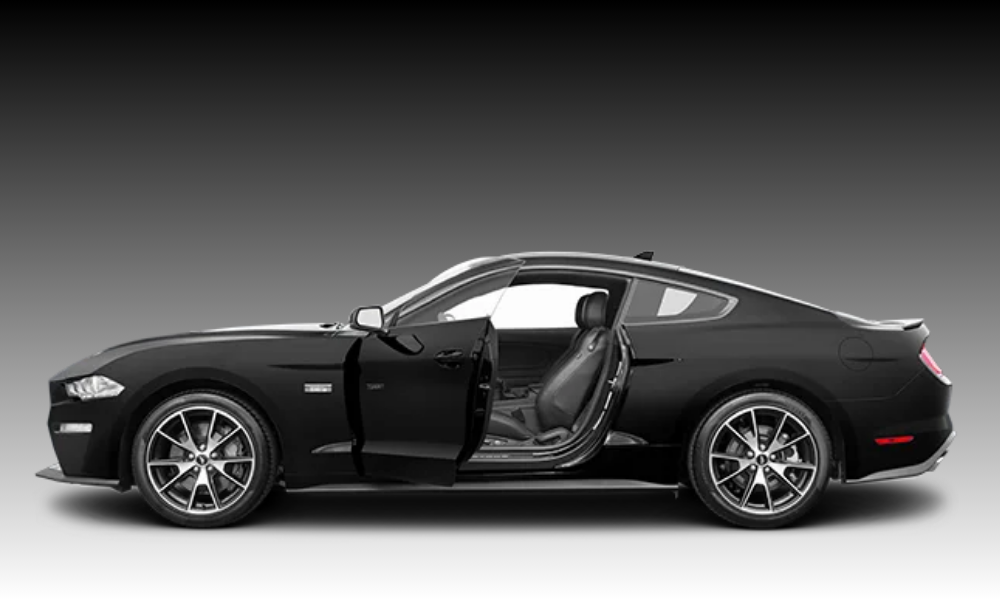
What Changed for the 2023 Ford Mustang?
There is no major redesign for the 2023 Ford Mustang, and that is entirely intentional. Ford knows that a new generation is already on the way for 2024, so the S550 platform is essentially being given a quiet send-off. The biggest changes this year are actually subtractions rather than additions.
The Shelby GT500 is gone for this model year, leaving a noticeable gap at the top of the range for those who crave the ultimate track-focused experience. Some exterior paint options have also been removed, including Cyber Orange Metallic Tri-Coat and Brittany Blue Metallic. Everything else carries over with the same engines, the same transmission choices, and the same general formula that has made the Mustang a continued success for nearly a decade.
In other words, this is a final refinement year rather than a reinvention. Ford isn’t trying to rewrite the rulebook. The company is simply making sure the current generation goes out on a high note.
2023 Ford Mustang Exterior: Still Turns Heads
The 2023 Ford Mustang still looks like a Mustang, and that matters more than any design critique you could level at it. The long hood, short rear deck, and wide stance remain largely untouched, and Ford hasn’t overcomplicated the formula with unnecessary design flourishes. It’s a car that knows exactly what it is and doesn’t feel the need to apologize for it.
Compared to its rivals, this coupe strikes a middle ground that works in its favor. The Camaro looks sharper but more aggressive than practical, with visibility that some owners find challenging. The Challenger looks retro but oversized, a throwback to a different era of automotive design. The Mustang sits between them. It is modern enough to feel current and classic enough to still evoke muscle car heritage.
The grille has been slightly revised, and there are new wheel designs available across the range, but the overall shape remains unmistakable. It’s not the most dramatic design in the segment, but it’s arguably the most balanced. You won’t mistake it for anything else on the road, and that identity is still worth something.
Ford Mustang Driving Experience: Two Personalities, One Body
The EcoBoost and the GT feel like two completely different cars wearing the same body. It’s a fascinating split personality that makes the Mustang range more versatile than you might expect.
The EcoBoost is lighter, more agile, and significantly easier to live with in daily traffic. The turbocharged 2.3-liter four-cylinder produces 310 horsepower and 350 lb-ft of torque, which is more than enough to make the car feel genuinely quick in most driving situations. It responds well at low and mid-range speeds, which makes it surprisingly fun in urban driving. This is the version that quietly makes the most sense for everyday use. It doesn’t punish you at the fuel pump or make you dread stop-and-go traffic.
The GT, on the other hand, is heavier, louder, and significantly more dramatic. The 5.0-liter Coyote V8 produces 450 horsepower and 410 lb-ft of torque, and it announces its presence with a soundtrack that no turbocharged four-cylinder can replicate. The steering feels more planted but less playful in tight corners, and the car’s weight becomes more apparent when you push it through a series of bends. It’s not as sharp as a modern European sports coupe, but it delivers a physical presence that the EcoBoost simply cannot match.
On highways, both versions settle into a comfortable rhythm, with stable cruising and minimal noise intrusion into the cabin. But push them hard, and the GT clearly shows its intent. It is built for straight-line confidence and emotional acceleration, not surgical corner carving.
Ford Mustang GT vs EcoBoost Performance: Numbers That Tell the Story
The performance figures for the 2023 Mustang lineup tell a clear story about what each version is designed to do.
The EcoBoost delivers 310 horsepower and 350 lb-ft of torque from its turbocharged 2.3-liter four-cylinder engine. It can sprint from 0 to 60 mph in approximately 5.0 to 5.5 seconds, which is genuinely impressive for a car that also manages to return up to 32 miles per gallon on the highway. For buyers who want the Mustang experience without the V8 fuel bills, this is a compelling option.
The GT steps things up significantly with a 5.0-liter Coyote V8 producing 450 horsepower and 410 lb-ft of torque. The 0 to 60 mph time drops to approximately 4.2 to 4.6 seconds depending on the transmission and configuration. Fuel economy predictably takes a hit. Expect around 15 miles per gallon in the city and 24 on the highway. For many buyers, the V8 is worth every penny at the pump.
The Mach 1 sits at the top of the range with a tuned version of the 5.0-liter V8 producing 470 horsepower and 410 lb-ft of torque. It benefits from parts borrowed from the GT350 and GT500, including enhanced cooling and suspension upgrades that make it the most track-focused variant in the lineup. The 0 to 60 mph time falls in the low 4-second range, and the handling improvements are immediately noticeable on a circuit.
2023 Mustang Ride Comfort: An Underrated Strength
Comfort is one of the Mustang’s most underrated strengths, and it is something that doesn’t always come through in the spec sheets or the marketing materials. On regular roads, the car absorbs imperfections better than you would expect from a performance coupe. The suspension is firm enough to communicate what the car is doing but compliant enough to avoid punishing you on your daily commute.
There is, however, a split personality here as well. Lower trims feel slightly budget-oriented inside, with harder plastics and a simpler layout that reminds you this is a car designed to hit a price point. Higher trims correct much of that with better materials and more equipment, but the gap between the base car and the fully loaded version is noticeable.
Road noise is well controlled, especially at cruising speeds, which makes this Mustang more livable than many expect from a rear-wheel-drive coupe. The EcoBoost is notably quieter than the GT thanks to the absence of the V8’s mechanical drama, but both versions offer a cabin that remains composed at highway speeds.
Mustang Interior: Function First, Emotion Second
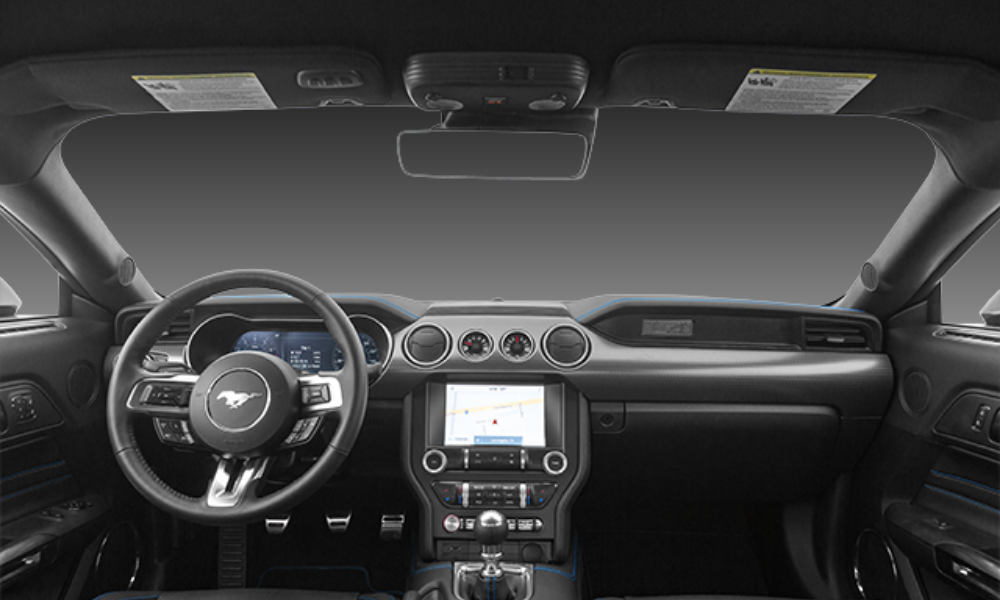
The interior design of the Mustang is functional first and emotional second. The layout is driver-focused, with controls placed where you expect them and a classic twin-gauge cluster aesthetic depending on the configuration you choose.
Higher trims significantly improve the experience with digital instrument clusters, better seats, and upgraded trim materials. The available 12.4-inch digital instrument cluster and 13.2-inch SYNC 4 infotainment screen bring the car into the modern era. The system supports wireless Apple CarPlay and Android Auto, and the interface is responsive and intuitive.
Lower trims feel more basic and less refined, which is one of the few areas where the Mustang clearly shows its age. The plastics are hard, the seats are less supportive, and the overall ambiance leans more toward rental car than sports car. It’s not a luxury interior, but it is a driver’s cockpit, and that is clearly the intent.
Mustang Technology: Functional Not Fancy
Base models of the Mustang still use a smaller screen setup, while higher trims offer Ford’s SYNC 4 system with better graphics and improved usability. The available 13.2-inch touchscreen is a significant upgrade, offering crisp visuals and quick response times.
Apple CarPlay and Android Auto are standard across the range, and optional upgrades include a larger digital gauge cluster and premium audio systems. The system is functional rather than cutting-edge, but it gets the job done without unnecessary complexity or distracting animations.
One area where this coupe falls behind some rivals is in the availability of advanced driver-assistance features. While adaptive cruise control and lane-keeping assist are available, they are not as comprehensive as what you might find in some European competitors. For a car that is fundamentally about driving pleasure, however, this is unlikely to be a dealbreaker for most buyers.
2023 Mustang Fuel Economy: The Price of Performance
Fuel economy varies dramatically depending on which engine you choose, and this is perhaps the most significant practical consideration for potential buyers.
The EcoBoost returns up to 21 miles per gallon in the city and 32 on the highway, making it genuinely efficient for a car with this level of performance. The combined figure of around 24 to 25 miles per gallon is impressive for a 310-horsepower rear-wheel-drive coupe.
The GT is a different story entirely. Expect around 15 miles per gallon in the city and 24 on the highway. The combined figure is approximately 18 to 19 miles per gallon, which is the price you pay for the privilege of a naturally aspirated V8 in an era of downsizing and turbocharging.
The Mach 1 sits somewhere in between, with figures that depend on the transmission choice. The manual transmission tends to be slightly less efficient than the automatic, but both versions will struggle to match the EcoBoost’s economy.
Mustang Practicality: The 2+2 Reality
The Mustang remains a 2+2 coupe in name more than in reality. The rear seats are tight and best suited for short trips, extra storage, or small children who don’t yet understand the concept of legroom. Adults will find the back seat cramped, and headroom is particularly limited due to the sloping roofline.
Cargo space is usable for a weekend trip, with 13.5 cubic feet of trunk capacity. That is enough for a couple of suitcases or a set of golf clubs, but this is not a practical family car. It’s a personal performance machine first and foremost, and the practicality compromises are part of the package.
Biggest Strength of the 2023 Ford Mustang: Balance Across the Range
The Mustang’s biggest strength is its balance. It manages to offer real performance in multiple forms without forcing you into an extreme personality. You can choose efficiency, refinement, or raw V8 emotion, and all three feel authentic. The car doesn’t try to be something it’s not, and that honesty is increasingly rare in the automotive world.
The car also benefits from a wide range of configurations that allow buyers to tailor it to their specific needs and budgets. Whether you want a daily driver with reasonable fuel economy or a weekend toy that announces its presence with every throttle application, there is a Mustang for you.
Biggest Weakness of the Ford Mustang: It Shows Its Age
The Mustang’s biggest weakness is its age. The S550 platform has been around since 2015, and you feel it in the interior materials and some handling characteristics compared to newer rivals. The Camaro, for all its visibility issues, offers sharper handling on a more modern platform. The Challenger, for all its size, offers more interior space and a more comfortable ride.
The car is not outdated, but it is clearly at the end of its lifecycle. The new S650 generation is already on the horizon, and the 2023 model feels like a car that is gracefully bowing out rather than pushing boundaries.
2023 Ford Mustang Competitors Worth Considering
The Mustang competes in a shrinking segment, but there are still worthy alternatives to consider.
The Chevrolet Camaro offers sharper handling and a more aggressive driving experience but compromises on daily comfort and visibility. The Camaro is the better track car while the Mustang is the better everyday car.
The Dodge Challenger offers more interior space, a more comfortable ride, and a retro design that appeals to a different kind of buyer. But it is significantly larger and less agile than the Mustang and feels more like a grand tourer than a sports coupe.
The Nissan Z offers more modern engine technology and a smaller footprint but lacks a V8 option and the emotional connection that comes with it. The Z is the more rational choice while the Mustang is the more emotional one.
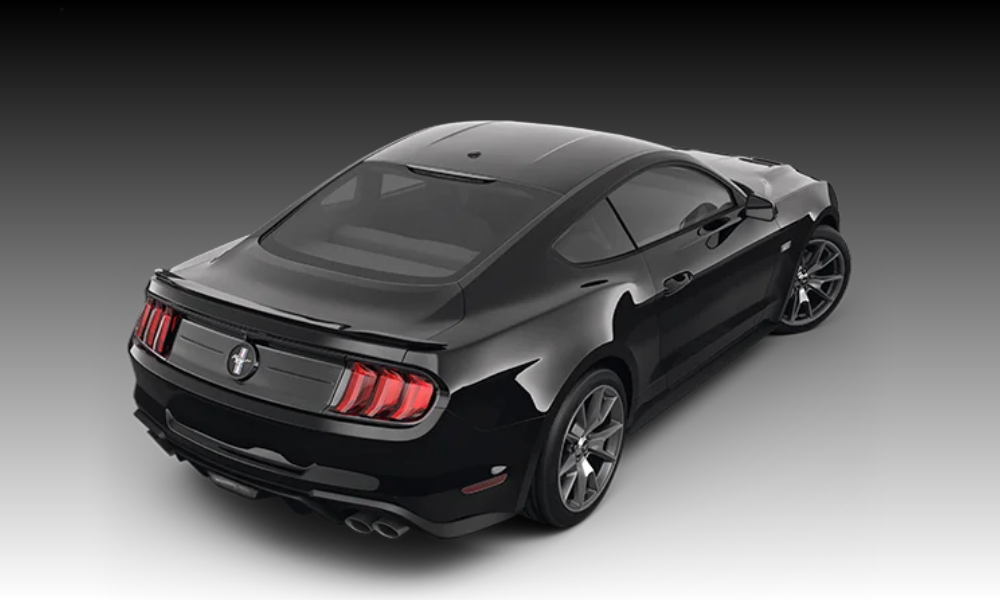
2023 Ford Mustang Trim Comparison
The 2023 Ford Mustang is available in several trims, each offering a different balance of performance and equipment.
EcoBoost is the entry point, offering the turbocharged four-cylinder engine and a focus on daily usability. It’s the rational choice for buyers who want the Mustang experience without V8 running costs.
EcoBoost Premium adds more equipment and better interior materials, making it a more comfortable daily driver.
GT is the core V8 experience, offering the 5.0-liter Coyote engine and the emotional connection that comes with it. This is the version that most buyers end up choosing, and for good reason.
GT Premium adds the same equipment upgrades as the EcoBoost Premium but paired with the V8 engine.
Mach 1 is the track-focused variant, offering enhanced cooling, suspension upgrades, and a tuned version of the V8. It’s the enthusiast’s choice.
Which 2023 Ford Mustang Trim Is Right for You?
If you’re debating between the 2023 Ford Mustang GT vs EcoBoost, the decision often comes down to how much you value the visceral V8 experience. The EcoBoost is the rational choice, the one that makes the most sense on paper and at the fuel pump. The GT is the emotional one, the car that delivers the experience most people associate with the Mustang name. The Mach 1 is the enthusiast’s pick, the car that rewards those who take their driving seriously.
Most buyers end up in the GT, and it’s not difficult to understand why. The V8 is the heart of the Mustang experience, and for many, the extra running costs are a price worth paying.
Should You Buy the 2023 Ford Mustang?
Yes, if you want a traditional American performance coupe with real character and multiple personalities depending on the trim you choose. The 2023 Ford Mustang offers something that few other cars can match, which is an emotional connection that transcends the spec sheet.
No, if you want cutting-edge refinement, modern interior luxury, or practical rear-seat usability. The Mustang is not a luxury car, and it doesn’t pretend to be one.
2023 Ford Mustang Final Verdict
The 2023 Ford Mustang doesn’t try to win the future. It wraps up the past generation properly. It’s loud when it needs to be, calm when you want it to be, and still one of the most recognizable performance cars on the road today. It’s not the most advanced coupe in the segment, but it might still be the most honest one.
In a world of increasingly complicated performance cars, there is something refreshing about a car that simply does what it promises. This Mustang understands its purpose and executes it without apology. And in 2023, that counts for more than any spec sheet could convey.
FAQ
Is the EcoBoost Mustang a realistic daily driver?
Yes, surprisingly so. The turbo four-cylinder delivers 310 hp, returns 24–25 mpg combined, and rides smoothly enough for daily commutes. The main compromises are the tight rear seats, a narrow trunk opening, and limited cargo space. The GT, however, consumes fuel more aggressively, making it a less practical daily choice for high-mileage drivers.
Why do most buyers choose the GT over the EcoBoost?
It’s about emotion, not logic. The 5.0-liter V8’s naturally aspirated growl and mechanical feel create a sensory connection that no turbocharged four-cylinder can replicate. The EcoBoost is quicker than many expect, but the GT delivers the full Mustang experience, sound, vibration, and character, that enthusiasts crave.
Is the Mach 1 worth the extra cost over a loaded GT Premium?
Yes, if you track your car. The Mach 1 borrows cooling and suspension hardware from the GT350 and GT500, offering sharper steering, better body control, and stronger brakes. On public roads, the GT Premium is more comfortable and quieter, making it the better daily companion. The Mach 1’s benefits only become obvious at the limit.
Should I wait for the new 2024 S650 Mustang instead?
That depends on your priorities. The S550 platform is proven, reliable, and has a massive aftermarket. The new S650 will bring a redesigned interior and updated styling, but first-year models often have teething issues. Buying a 2023 GT with a manual transmission also secures one of the last naturally aspirated V8s in a shifting regulatory landscape.
How well does the 2023 Mustang hold its value?
The manual-transmission GT holds its value exceptionally well due to its rarity and desirability. EcoBoost models depreciate faster, while the Mach 1 retains strong value because of limited production numbers. Compared to the Camaro and Challenger, the Mustang generally performs better in resale, especially in GT spec.


I love this type of car
I love this type of car