Choosing the Right Floor Jack for Your Vehicle
A Practical Guide to Lift Capacity Clearance and Everyday Garage Use

You pull into the driveway on a Saturday morning with a plan to rotate the tires before the weather turns. The factory scissor jack from the trunk comes out first, and within two minutes you remember why nobody likes it. It wobbles on the pavement, takes forever to crank, and makes you wonder whether the car is really going to stay put while you wrestle with a stubborn lug nut. That is usually the moment a vehicle owner starts looking seriously at a floor jack.
A good floor jack changes how routine work feels. Oil changes, brake inspections, wheel swaps, and a quick look at the underside of the car all become calmer when you can raise the vehicle smoothly and set it down just as smoothly. But the shopping part is where many people go wrong. The ton rating on the box gets all the attention, and it is natural to assume that a bigger number means a better tool. In practice, a hydraulic floor jack is a set of tradeoffs, and the number printed on the side is only one of them.
The things that decide whether a jack suits your vehicle are less obvious. Minimum height determines whether it can slide under a low front bumper at all. Maximum lift height decides whether it can raise a truck far enough to get a wheel off the ground. Reach matters when the proper lifting point sits well back from the edge of the vehicle. Overall size and weight affect how easily you can move it around the garage or lift it into a trunk. Steel and aluminum behave differently in the hand, and the right choice depends on whether the jack lives in one corner of a garage or travels with you. Wheel layout and handle length shape how it feels to position under a car on a rough concrete floor.
The sections below walk through those factors first and then look at five specific jacks that cover very different needs.
Our Take
The ton rating is a good place to begin, but it should be read as a ceiling and not as a promise. A 3 ton floor jack is rated for 6,000 pounds, yet that figure describes what the jack itself is built to handle. It does not tell you what load it will see on your particular vehicle. When you raise one corner of a car, the jack carries only a portion of the total weight. When you raise the front or rear end from a central point, it carries a different and often larger share. The actual split depends on the vehicle’s weight, how that weight is distributed, the suspension design, and exactly where you place the saddle. That is why simple fractions passed around online should not be treated as laws. The practical approach is to look up your vehicle’s curb weight, find the manufacturer’s lifting points in the owner’s manual, and choose a jack with comfortable margin above what you expect it to handle. Margin matters because a jack working near its limit leaves you no room for a heavier load, a loaded cargo area, or a slightly different lifting point.
Minimum height is where many purchases quietly fail. A jack that cannot fit beneath the vehicle is useless no matter how strong it is. The important detail is that a jack’s minimum saddle height is not the same as your car’s ground clearance. The saddle has to slide under a specific lifting point, and that point is often higher or lower than the bumper line you see from the side. Front lips, side skirts, and aerodynamic panels can all block the approach even when the lifting point itself is reachable. A low profile floor jack with a minimum height around three or four inches gives you more room to work with on sedans, sports cars, and lowered vehicles. Taller vehicles rarely need that much clearance, which means a very low jack is not automatically the better choice for them.
Maximum lift height and reach pull in the opposite direction. SUVs and trucks sit higher, and suspension work often requires raising the vehicle enough to let components hang freely. A jack that tops out at thirteen or fourteen inches may handle a passenger car comfortably but leave a taller vehicle just short of what you need. Reach matters for a related reason. On some vehicles the correct lifting point is set well back from the bumper, and a jack with a short neck cannot get there without catching on body panels. A very low jack with limited reach can be as frustrating as a tall one that will not fit. The best match comes from checking both ends of the range against the vehicle you actually own.
Material is the next decision. Steel offers durability and mass, and that extra weight can feel reassuring in a fixed garage where the jack rarely moves far. Aluminum reduces weight, which makes the jack easier to roll, carry, and load into a vehicle. Neither material is automatically stronger or safer. A well-built steel jack and a well-built aluminum jack can both do the work they are rated for, and the choice comes down to how the jack will be used. If it stays in a garage, weight matters less. If it travels to the track, the campsite, or a friend’s driveway, every pound counts.
Maneuverability ties these points together. Swivel casters, wheel placement, and handle length decide how the jack behaves when you are lining it up under a lifting point. A heavy jack with good casters rolls easily on a smooth garage floor but becomes awkward when you have to lift it over a threshold or into a truck bed. A lighter jack is easier to carry but can feel less planted when you pump the handle. These are small details until you are the one repositioning the jack for the fourth time in a cramped workspace.
Safety deserves a clear statement because it affects every purchase. A floor jack is built to lift and position a vehicle. It is not built to hold one for the duration of a repair. Before any part of your body goes under the vehicle, it must be supported by properly rated jack stands set on a solid surface. Place the jack on firm, level ground such as concrete, not soft asphalt on a hot day or a sloped driveway. Follow the manufacturer’s lifting points for your vehicle, and verify the weight, clearance, and the jack maker’s specifications before you trust any combination of vehicle and equipment. A rating on a box is a starting point for that check and never a replacement for it.
Finally, think about the work you actually do. Someone changing oil and rotating tires on a family sedan has very different needs from someone swapping suspension parts on a truck or working on a lowered sports car. There is no universal winner here. The right floor jack is the one that matches your vehicle and the way you use it.
BIG RED T83006 3 Ton Hydraulic Trolley Service Floor Jack
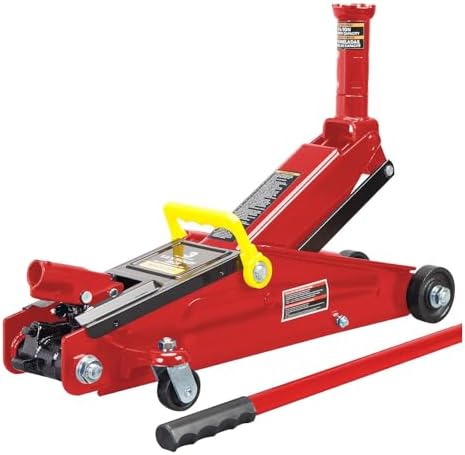
- Hydraulic trolley floor jack is providing long term durability with an industrial luster
- Features a 3 ton (6,000 lb) capacity with a minimum lifting height of 5-7/8″ and a maximum height of 20-7/8″; Features a…
- Equipped with (2) large steel casters and (2) 360-degree swivel casters for smooth maneuverability; Extra long saddle ne…
The BIG RED T83006 is a conventional heavy duty steel jack, and that plainness is part of its appeal. It is built for owners who care more about lifting range and reach than about carrying weight. With a minimum height of 5-7/8 inches and a maximum of 20-7/8 inches, it covers a wider span than most jacks in this group. That range is what makes it useful for SUVs, vans, and trucks, where a low-slung jack would run out of travel long before the wheels leave the ground.
The extra long saddle neck is the feature that matters most on higher vehicles. It lets the jack reach lifting points that sit farther under the chassis without forcing you to wedge the frame of the jack against a bumper or skid plate. For anyone who has tried to line up a short-necked jack under a truck and found the body in the way, that reach is a real practical gain. The single piston quick lift pump gets the saddle up to the vehicle without a long string of strokes, and the safety bypass system adds protection against overloading the hydraulics. The two large steel casters and two 360 degree swivel casters help it roll and turn in a garage, which matters because a jack this size is not something you want to drag.
That weight is the honest tradeoff. Heavy steel construction gives the jack a solid feel, but it also makes it a poor choice for anyone who needs to carry it regularly. The integrated carrying handle helps with short lifts, yet it does not turn this into a portable jack. If you plan to haul it to a track or load it in and out of a car trunk, it will wear on you quickly. It also makes less sense for very low sports cars, since a 5-7/8 inch minimum height will not slide under a front end that sits close to the ground.
A reader who wants a garage jack that stays in place and handles taller vehicles will likely appreciate it. A reader with a lowered car or a need for lighter weight should look at the jacks below.
Jack Boss 3 Ton Low Profile Aluminum and Steel Racing Floor Jack
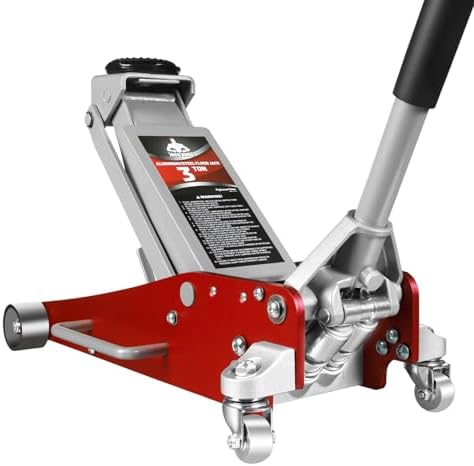
- 3-TON HEAVY-DUTY CAPACITY: This aluminum and steel car jack supports up to 3 tons (6,600 lbs), with a lifting range from…
- LOW-PROFILE DESIGN: With a minimum lifting height of just 3-15/16″, this low-profile floor jack easily slides underneath…
- DUAL-PUMP QUICK LIFT: The hydraulic jack equipped with a dual-piston pump, this heavy-duty floor jack reduces the number…
The Jack Boss tries to sit between worlds. It combines a low profile design with a 3 ton capacity, uses aluminum and welded steel in its construction, and adds a dual piston quick lift pump. That mix makes it interesting for owners who work on different kinds of vehicles and do not want to buy two jacks.
The minimum lifting height of about 3-15/16 inches gives it enough clearance for many lower cars, while the maximum of about 18-5/16 inches gives it more lift than a typical racing jack. That range broadens its usefulness. It can slide under a sedan or sports car without much fuss, and it still has the height to raise many SUVs and crossovers enough for wheel and brake work. The dual piston pump helps it reach the vehicle quickly, which is a small but welcome time saver when you are raising and lowering a car several times in an afternoon.
The mixed aluminum and steel construction is a compromise between strength and weight. At roughly 58.5 pounds according to the Amazon listing, it is lighter than a full steel jack of similar capacity, though it is hardly feather light. Most adults can lift it into a trunk or carry it across a driveway, but doing that often becomes tiring. It is manageable for occasional moves and heavy enough to notice when you are moving it every weekend. The large rubber saddle protects the contact point on the vehicle, and the two piece handle makes storage easier.
It is worth saying plainly that this is not a replacement for a professional workshop jack. It suits a home garage and an enthusiastic owner far better than a busy shop with daily heavy use. The listing notes that it meets ANSI/ASME PASE safety standards and carries a limited one year manufacturer warranty, which fits that role. Choose it if you want one jack to handle a low car and a taller vehicle. Look elsewhere if you need maximum reach for a truck or the lowest possible minimum height.
VEVOR 2.5 Ton Low Profile Heavy-Duty Steel Racing Floor Jack
- Jack it Up: With 2.5 tons/5500 lbs strong loading capacity, VEVOR’s floor jack can help you raise your car for whatever …
- For All Your Lifting Needs: Min. Height: 3.35″/85 mm. Max. Height: 14.96″/380 mm. The wide lifting range meets your lift…
- Rigid Steel Construction: Boasts heavy-strength steel construction, our low-profile jack is durable and sturdy to use. I…
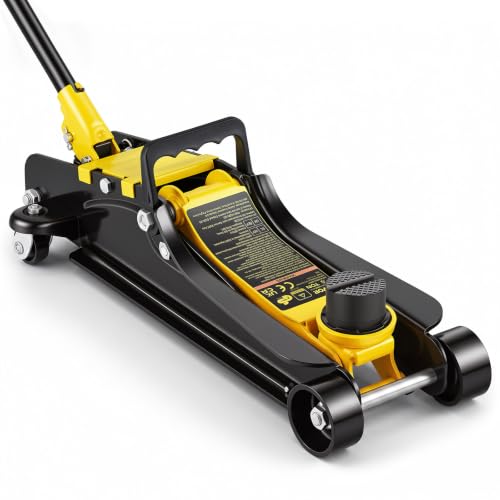
A 2.5 ton floor jack occupies a useful middle spot. It offers more capacity than a basic compact garage jack but stays smaller and simpler than a full 3 ton model. The VEVOR S385 fits that description, and its 5,500 pound rating gives plenty of margin for many family cars when used at the proper lifting points.
The number that stands out most is the 3.35 inch minimum height. That is low enough to slide under many sedans, coupes, and sporty cars with front lips that would block a taller saddle. For anyone who has struggled to get a jack under a low bumper, that extra clearance can decide whether the work is easy or frustrating. The maximum lift of 14.96 inches gives it a different role from the taller BIG RED. It works well for ordinary cars and some smaller crossovers, but it does not have the extra travel needed for many trucks and larger SUVs. That is a limitation to take seriously, because a 2.5 ton rating does not automatically suit every SUV or truck. Both capacity and lift range need to match the vehicle.
Construction is heavy duty steel, so this is not an ultra light travel jack. The steel wheels, swivel rear wheels, and 31.5 inch handle give it decent control in the garage, and the two piece removable handle makes storage easier. The 360 degree rotatable saddle with a rubber surface helps you line up the contact point without repositioning the whole jack, and the foam handle bumper is a small touch that protects paint and trim. The listing mentions a safety load system and compliance with CE, UKCA, and ASME standards.
It makes the most sense for an owner of a family car or a lower vehicle who wants good clearance without paying for capacity they will never use. It is a weaker fit for someone who regularly lifts a heavy truck or needs extra reach under a high chassis. In that case the BIG RED or Jack Boss offers more room to work.
JEGS Professional Low-Profile 3 Ton Aluminum Floor Jack
![3-Ton Aluminum Floor Jack [6,000 lbs. Capacity]](https://m.media-amazon.com/images/I/41TkhbCk3LL._AC_.jpg)
- LIGHTWEIGHT ALUMINUM CONSTRUCTION allows you to roll jack around with ease
- LOW PROFILE DESIGN lifts from 3 in. to 19 in. inches
- 360 DEGREE ROTATING SADDLE allows for easier movement
The JEGS 555-80077 is where aluminum construction becomes the main story. It is easy to read aluminum as a lighter version of a steel jack, but the real effect is on how the jack fits into your routine. A lighter body is simpler to roll around a garage, easier to lift into a vehicle, and less of a chore to put away at the end of the day. For someone who moves a jack often, that difference adds up over many sessions.
Pair that with a low profile and a 3 ton rating and the jack covers a lot of ground. The minimum saddle height of about 3-1/2 inches lets it fit beneath many lower vehicles, while the maximum lift of about 19-1/4 inches gives it unusual height for a low profile design. The hydraulic lift range is about 15-3/4 inches. That combination is what broadens its usefulness. A lowered car and a taller crossover can both be handled without switching jacks, which is the kind of flexibility home garage owners appreciate.
The details support that role. The saddle rotates 360 degrees and carries a rubber lift pad. Protective seals surround the hydraulic system, and integrated overload and bypass valves add protection. Dual side handles make the jack easier to move, and the two piece handle with a sleeve helps with storage. The chassis measures about 13 inches wide and 25-1/2 inches long, which keeps it compact enough for a tight garage. The Amazon listing says it meets ASME PASE standards.
The tradeoff is that aluminum alone does not make every part of the jack better than a steel one. Steel can offer a heavier, more planted feel, and some owners prefer that mass on a rough floor. This jack is not the lightest on the market, and it is not the strongest in this group. It is a good fit for someone who values easier handling and wants low clearance with generous lift. If your priority is raw reach for a tall truck, the BIG RED may still serve you better.
DNA Motoring TOOLS-00234 2 Ton Low Profile Hydraulic Trolley Service Floor Jack

- SPEEDY LIFT GARAGE JACK – This Hydraulic Trolley Jack features a 2 ton (4,000 lb) capacity with a min lifting height of …
- OVERLOAD PROTECTION & EASY JACK POSITIONING – Built-in dependable safety release valve triggers in the event of an overl…
- LIGHTWEIGHT DESIGN & HEAVY DUTY PERFORMANCE – Heavy duty steel construction provides rigidity and stability. Designed wi…
Not every buyer needs a 3 ton floor jack, and the DNA Motoring TOOLS-00234 is a good reminder. It is a 2 ton jack with a 4,000 pound capacity, built mainly for conventional passenger cars. For an owner who changes oil and rotates tires on a sedan or hatchback, that capacity can be perfectly adequate when it matches the vehicle and the lifting point.
Its heavy duty steel construction gives it a solid feel, and the swivel casters and large saddle make positioning straightforward. The built-in safety release valve protects against overload. The minimum height of 5.1 inches suits many regular cars, though it will not slip under very low vehicles the way a true low profile racing jack would. The maximum lift of 13 inches is the shortest in this group, and that is the main thing to understand before buying. It raises an ordinary car enough for wheel and brake work but falls short for taller vehicles.
The Amazon listing specifically does not recommend it for pickups, trucks, or very large SUVs, and that guidance deserves respect. This is a jack for cars. It is also meant for lifting only and must not be used as a substitute for jack stands, a point that applies to every jack here but is stated clearly for this one.
What this jack really reinforces is the central point of the whole guide. Buying a larger jack is not automatically smarter. If your vehicle is a normal passenger car and your work is routine, a smaller jack that fits the range you need can be a sensible choice. If you ever expect to work on an SUV or truck, one of the larger models will give you more room.
Choosing the Jack That Fits Your Garage and Your Vehicle
Picture the owner of an ordinary sedan who spends a few weekends a year on oil changes and tire rotations. That person does not need the tallest or strongest jack available. A smaller model like the DNA Motoring covers the job, and it is easier to store. If that same owner also wants to change oil filters at home and likes a little extra margin, the VEVOR 2.5 ton gives more clearance and capacity without growing too large for a shelf in the garage.
An SUV owner faces a different problem. Higher ground clearance means the jack needs to reach farther and lift higher, and the saddle needs to find the proper lifting point under a bigger chassis. The BIG RED makes the most sense there, with its long neck and tall lift range. The Jack Boss and JEGS can also work for many SUVs thanks to their generous maximum heights, though it is worth checking the numbers against your own vehicle first.
If you drive a lowered car, minimum height becomes the deciding factor. The VEVOR, JEGS, and Jack Boss all offer low entry heights, and the right choice depends on how much clearance you need and whether you also want extra lift for another vehicle. Before you buy, measure the distance from the floor to your lifting point and compare it to the jack’s minimum saddle height.
A garage owner who wants a heavy steel jack that stays put will likely lean toward the BIG RED or the VEVOR. Weight is an advantage when the jack never leaves the floor. A driver who needs something easier to move or carry will lean toward the JEGS, with the Jack Boss as a middle option. The difference between lifting 58 pounds and something heavier shows up quickly when you are loading a trunk or crossing a driveway.
Everyday realities matter too. A concrete floor gives a jack stable footing, while a sloped or soft surface does not. Storage space decides whether a long chassis is a nuisance or a convenience. Moving the jack around the vehicle, repositioning it for each wheel, and carrying it to the place you need it all play a part. If you plan to do brake work, a good set of brake pads is only half the equation, and a jack you trust to position the vehicle is the other half.
Whichever jack you choose, keep properly rated jack stands nearby and use them every time. The right floor jack is the one whose capacity, minimum height, maximum lift, reach, weight, and construction match your vehicle and the work you do. Check your vehicle’s weight, lifting points, and ground clearance, read the manufacturer’s specifications, and choose the jack that fits those facts. That decision will serve you far better than picking the biggest number on the box.