Tire Chains for Snow and Ice Choosing the Right Set
A practical guide to choosing tire chains, cables, and snow socks for safer winter driving.

The snow gets heavier somewhere past the last exit with services. The car that handled the first inch without fuss starts to hunt for grip on the climb, and a sign ahead says chains are required. Tire chains look simple on paper. The choice behind them depends on the tire, the space around it, the road ahead and the person who has to fit them while plows throw slush across the lane.
That last detail matters more than most buyers expect. Visibility is already poor when trucks pass, and even good windshield wiper blades can only do so much once the glass is coated in salty spray. Nobody wants to solve a fitting puzzle in those conditions. A traction device that looks sensible on a spec sheet can become a poor choice when the temperature drops and the light fades.
The market splits into three families. Traditional chains use steel links and offer the most mechanical bite. Cable chains, often called tire cables, trade bulk for a lower profile. Textile snow socks drop metal altogether and rely on fabric. Behind all three sit two questions that decide almost everything. How much clearance does the vehicle have around the tire, and what do the rules on the route require? The five sets below answer those questions in different ways.
Our Take
No single traction device suits every vehicle. A full-size pickup with generous wheel wells and a compact crossover with barely a finger of space behind the tire are solving different problems, even if both are heading up the same pass. Traditional chains put the most steel against the surface and tend to be the most durable. They also need the most room. Cables lower that profile so a tight vehicle can accept them, but they give up some bite and some lifespan. Textile devices go further in the other direction. They weigh little, fit in a small bag and install quickly, but they are a different class of product and not a softer version of a chain.
Installation sits between all of that and the buyer. Roadside fitting happens on cold ground with numb hands and sometimes with traffic close by. A chain that earns respect for strength but defeats its owner at the shoulder helps nobody. Self-tensioning designs cut the number of stops and adjustments. Cable and textile designs reduce the amount of hardware to handle. Each approach buys convenience with something different.
Start with clearance because it can remove options before preference enters the discussion. Then match the tire size, since a chain is cut for a range of dimensions and the wrong one is either dangerously loose or impossible to fit. After that, weigh how often snow will actually arrive and how willing the driver is to practice. Brand recognition counts for little against vehicle compatibility. A respected chain that does not clear the suspension is a worse purchase than a modest one that does.
Specifications below come from manufacturer material and should be read as manufacturer claims. Cardrav has not tested these products.
1. SCC Peerless Auto-Trac 0232105

- Worry-Free Self-Tightening Ratchets Provide Automatic Tightening And Centering
- Easy Installation And Removal In Minutes
- Do Not Exceed 30 Mph With These Chains On
A driver who wants conventional chain construction without the old routine of untangling links and chasing slack will find the Auto-Trac a sensible starting point. It is a link-style chain with a diamond pattern of cross chains. Ratcheting tensioners pull the chain tight and center it as the vehicle moves. Peerless says it meets SAE Class S clearance requirements and can be installed without moving or jacking up the vehicle.
Self-tensioning matters on snow for a practical reason. A chain that starts slightly loose can slap against the fender or inner wheel well and drift off the center of the tread. Peerless says its ratcheting system keeps the chain tight while driving and advises against adding separate tensioners. The company also describes the diamond pattern as giving a smoother ride than a plain ladder layout while still gripping snow and ice.
Picture pulling over on a mountain road with snow already building. A driver who has fitted chains many times may not mind a manual set. A first-time user will probably value a design that asks for fewer decisions with cold hands.
Strength comes with bulk. Link chains are heavier and more awkward to store than cables or fabric, and someone who sees snow twice a winter may resent the trunk space. Class S is also not a promise that a particular vehicle will clear. Peerless points to the vehicle manufacturer for wheel clearance guidance and sets a 30 mph limit while the chains are on. The 0232105 number is one size within a range, so confirm the exact tire size against the Peerless chart and the owner’s manual before ordering.
2. KÖNIG XG-12 PRO

- 31×11.50-15, 265/70-16, 235/85-16, 265/65-17, 275/60-17, 265/60-18, 255/60-18, 255/55-19, 265/50-19, 285/45-19, 255/50-2…
- The quick fitting snow chain for SUVs, providing superior driving comfort and top performaces.
- 12 mm inside and on-the-tread clearance.
Where the Auto-Trac aims at straightforward ease, König builds the XG-12 PRO around refinement. The company lists automatic tensioning through its ATC device, a Micro-Adjust feature for fine tension and a Wheel-Shield system meant to protect alloy wheels from scuffing. König says the ATC works transversely to the wheel so it can tension, center and balance the chain while driving. The fitting method uses a flexible cable that slides on the ground behind the wheel, which lets the parts connect without moving the vehicle.
This is the chain for a driver who expects hard winters and wants more than basic tensioning. Micro-Adjust speaks to the problem of tire sizes and wheel combinations that sit between standard fits. Wheel-Shield speaks to the driver whose expensive alloy wheels sit close to the steel. Those are real concerns on modern SUVs and vans, which is the audience König names, specifically vehicles with minor wheelhouse limitations.
König lists 12 mm of internal clearance. That figure is only useful when compared with the actual gap on the vehicle, and the vehicle maker may restrict chains regardless of what the chain maker claims. König also notes certification to European winter equipment standards. Those speak to European requirements and do not settle questions about American road rules.
The tradeoff is a system with more features to understand. A buyer who has never touched a chain may need to rehearse the adjustment step at home. The reward is a tighter and more precise fit on the tire. Confirm the size against König’s chart for the exact tire dimensions before ordering.
3. SCC SZ143 Super Z6 Cable Tire Chain

- Country of origin : China
- Designed for cars, pickups, and SUVs with very limited operating clearance around the drive tires
- Fast easy installation with no need to move the vehicle
Modern vehicles often leave very little room behind the tire. Larger wheels, lower-profile tires and tightly packed suspension parts, brake lines and sensors mean some cars cannot safely accept every conventional chain. A chain that touches a strut or brake line while rotating can cause serious damage long before the road gets dangerous. For those vehicles a cable is the correct technical answer. It is not simply a cheaper chain.
Peerless says the Super Z6 operates in less than half the space needed by most cable chains and tire chains, and describes it as meeting or exceeding Class S clearance on vehicles with limited space. It is made in sizes for passenger cars, pickups and SUVs, and SZ143 is one size within that series. The tire size chart decides which one belongs on a given vehicle.
The cable construction changes the compromise. A thinner cable cross-section fits where a link chain cannot, and it is lighter to carry and easier to handle. It also gives up some of the aggressive bite and long-term wear resistance of heavier steel. Cables suit drivers who need to comply with chain requirements and travel limited distances on snow. They are less suited to someone who expects to run on packed ice for long stretches.
Check the vehicle manual first. Some makers permit cable devices only in specific sizes or on specific axles. Follow the speed limit printed in the instructions that come with the set.
4. AutoSock HP697
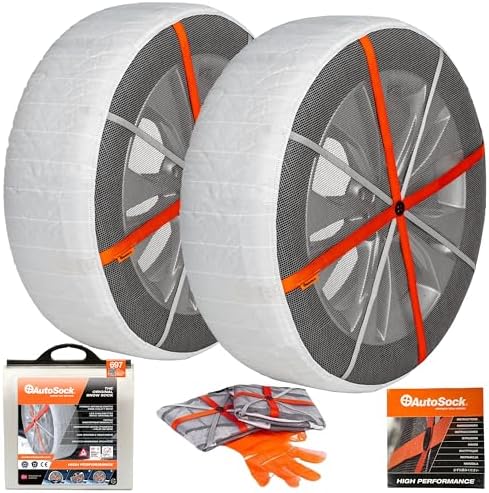
- WINTER TRACTION DEVICE FOR SNOW & ICE – AutoSock tire snow socks improve tire traction on winter roads when extra grip i…
- CHECK YOUR TIRE SIZE BEFORE ORDERING – Verify your tire size on tire sidewall to select the correct AutoSock model. Prop…
- SMOOTH, SELF-CENTERING TRACTION DEVICE – Textile auto snow socks webbing and straps help reduce snow buildup between tir…
AutoSock is not a metal chain, and the sooner a buyer accepts that the better the purchase will go. It is a textile cover that pulls over the tire tread. AutoSock describes itself as a Norwegian traction aid, and its published guidance says to fit it to the drive wheels, use it only on snow and ice and remove it when the road clears. It centers itself as the vehicle begins to move, and AutoSock’s guidance sets a top speed of 30 mph.
The practical appeal is easy to see. It folds into a small bag and weighs far less than steel. Fitting does not involve links, tensioners or a tangle of metal. It also suits situations where clearance is very limited, which is why some owners of vehicles with tight wheel wells look at textile devices first. For someone who sees snow only a few days a year, a sock that stays in the trunk without complaint can be a better fit than a heavy chain that never leaves its box.
The limits are straightforward. Fabric generally does not engage hard ice or deep snow the way steel does, and it wears quickly on bare pavement. It is intended for roads that are actually covered. Treat it as a tire chain alternative that works in its own way and not as a chain in different packaging.
Before relying on it for compliance, confirm that the specific model satisfies the rules on the route. Colorado, for example, requires alternative traction devices to appear on an approved product list. Confirm the HP697 size against the tire dimensions, and follow the manufacturer’s instructions on speed and use.
5. KÖNIG CG-9

- 215/70-16, 215/60-17, 225/55-17, 205/60-18, 215/55-18, 275/35-18, 235/40-19, 245/40-19, 255/35-19, 265/30-19, 255/30-20
- 9 mm inside and on-the-tread clearance
- Symmetrical diamond pattern chain
The CG-9 exists for drivers caught between two worlds. A conventional chain may not fit and a cable may feel too light for the conditions. König lists 9 mm of inside and on-the-tread clearance, which is tighter than the XG-12 PRO, and the company says the cross-sections use short-pitch low-profile links up to 9 mm thick. It uses the same ATC automatic tensioning, Micro-Adjust fitting and Wheel-Shield protection described for König’s other chains, along with a symmetrical diamond pattern.
König positions the CG-9 for passenger cars. That separates it from the XG-12 PRO, which targets SUVs and vans. Think of a sedan or hatchback with modest wheel-well space and a driver who wants metal links against the snow without the bulk of a larger system. König describes the cross-sections as simple straight links chosen to balance performance and ride comfort, so the emphasis leans toward smoothness over maximum aggression.
The fitting method follows König’s usual approach. A flexible cable slides on the ground behind the wheel so the parts connect without moving the vehicle, and the chain does not need an additional stop for retensioning. That suits someone who has never fitted chains and does not want to fuss at the roadside.
Low-profile links mean a trade. The chain can sit in tighter spaces, but it is not the heaviest-duty option for deep snow or steep ice. Sizes are numbered and matched to specific tire dimensions, so verify the exact fit before ordering.
How to Choose the Right Tire Chains
Tire size
The tire size printed on the sidewall is the starting point. A set is cut for a range of dimensions, and a chain that is too large will slap and slide while one that is too small may not go on at all. Use the maker’s size chart and not a general guess based on wheel diameter.
Vehicle clearance
Measure or confirm the space between the tire and the suspension, body panels, brake components and wheel well. The gap on the inside of the tire usually matters most because that is where the chain sits against hardware. Class S and similar ratings help but never replace the vehicle manufacturer’s own guidance.
Drive wheels
Chains go on the drive axle in most cases, but the correct axle depends on the vehicle manufacturer’s guidance and local requirements. All-wheel-drive vehicles in particular vary. Read the owner’s manual before assuming.
Snow and ice conditions
Deep snow rewards aggressive chain patterns. Packed snow and ice reward consistent contact and steady tension. Occasional light snow may not justify the weight of a heavy set, while a long mountain pass probably does.
Installation
A device that takes ten minutes of struggle at the shoulder will tempt people to skip it. Decide honestly how much patience and practice the owner has.
Storage
Chains live in the vehicle all winter. Weight, bulk and the ability to keep them within reach matter more than they seem in a showroom.
Driver confidence
A technically excellent chain that its owner cannot install correctly is a worse choice than a simpler one that goes on every time.
Chains vs Cables vs Snow Socks
The usual summary says chains are strong, cables are light and socks are easy. That is true but incomplete. Traditional chains grip because steel digs into snow and bites into ice, and the heavier cross members also survive far more distance on mixed surfaces. They require the most clearance and the most storage space. Because they are rigid and heavy they also tend to be harder on the vehicle if fitted badly.
Cable tire chains take the same basic idea and shrink it. The smaller cross-section clears tight wheel wells and can be installed quickly, and the lighter weight makes carrying a set all winter easy. In exchange the cable wears faster on bare pavement and offers less aggressive grip on thick ice. That makes them a good fit for drivers who need to comply with a requirement or reach a destination in the snow but do not expect to live in it.
Snow socks are a separate category. The textile surface increases friction on snow and ice and does so quietly and without the metal contact that can scratch wheels. It is also the lightest option and the simplest to store. The limits are speed, durability on bare road and performance in the roughest conditions. Treat chains vs snow socks as a decision about conditions and not as a ranking, because socks should not be assumed interchangeable with metal chains. Some jurisdictions accept them and some specify approved products.
For occasional use the compact option usually wins. For frequent use on difficult roads the heavier chain earns its place.
Tire Chain Fit, Clearance, and Installation
Confirm the exact tire size, the vehicle year, make and model, the wheel size and the tire dimensions. Then check the vehicle manufacturer’s chain recommendations and the clearance the chain requires. Some vehicles allow only low-profile devices, and some restrict chains on certain wheel sizes. Do not assume that two vehicles sharing a tire size share a chain. Wheel offset, suspension design and body shape change what actually fits.
Installing at home before a trip is one of the smartest preparations a driver can make. Lay the set out and read the instructions. Fit it once in a dry driveway with a kneeling pad and a pair of gloves so the process is familiar when conditions turn. Doing the job before snow and ice cover the tire removes most of the frustration.
After fitting, drive a short distance and stop to check the chain. If the manufacturer’s instructions call for retensioning, do it. Stop immediately if there is unusual contact or noise. Keep product-specific steps limited to what the maker publishes, because shortcuts around tensioners and fasteners are where mistakes happen.
When Tire Chains Are Required or Restricted
No single national rule covers tire chains in the United States. Requirements vary by state, road, pass, weather condition and level of restriction, and they can change quickly during a storm.
California uses posted chain control levels. At the highest level chains or traction devices are required on all vehicles with no exceptions, and lower levels depend on drive type and tires. Colorado separates a traction law from a chain law and lets the transportation department activate either on state highways. Alternative traction devices must meet its rules, which include an approved product list.
Those examples show how much detail can matter. Check the state transportation department for the specific route before travelling, and follow posted signs and officer instructions. A retailer listing is not a legal source.
Which Tire Traction Setup Makes Sense for You?
A compact sedan with little wheel-well space points toward a cable or low-profile chain such as the Super Z6 or CG-9. A driver with a pickup or SUV heading into deeper mountain snow has more room and more reason to choose a traditional chain such as the Auto-Trac or the XG-12 PRO. Someone who sees snow rarely and wants minimal storage burden may prefer a textile device like the AutoSock.
Traction does not replace the rest of winter preparation. Grip on the way forward matters, but stopping depends on the brakes doing their share. Worn brake pads are worth addressing before the season, because a set of chains cannot compensate for friction material that is already thin.
Final Thoughts
Strong traction comes from traditional chains for drivers who expect serious snow and have the clearance to accept them. Premium chains suit drivers who want stronger construction and easier tensioning without constant adjustments. Cables fit vehicles with limited clearance where a heavier chain simply will not go. Textile traction devices reward drivers who value portability and quick fitting and who will stay within the conditions they were built for. Low-profile metal chains sit between those worlds for drivers who want chain-like construction without the bulk of larger systems.
None of those categories matters if the set does not match the car. The right tire chains are the ones that fit the exact tire and vehicle, work within the available clearance and go on correctly before the road turns dangerous. That requires a little homework in autumn, a trial fitting in a dry driveway and a check of the rules for the route. The driver who has done those things will spend the first heavy snowfall behind the wheel and not kneeling in slush trying to work out what went wrong.