2022 Dodge Charger Review: Still the Only V8 Sedan Worth Buying
2022 Dodge Charger: From Glam To Speed To Thrash

Most new cars want you to forget you’re driving. The 2022 Dodge Charger is not most new cars.
Dodge spent the last decade watching the competition disappear. Toyota pulled the Avalon. Ford retired the Taurus. And instead of following them out the door, Dodge doubled down on everything the market said buyers didn’t want anymore: a big V8, rear-wheel drive, and a sedan that makes noise when you ask it to.
The platform hasn’t changed since 2011 and the interior shows it. That’s the honest version. The plastics feel cheap in places, the thick roof pillars create blind spots you’ll notice every single day, and on larger wheels the ride reminds you this car was designed when Obama was still in his first term. None of that is a secret. Dodge isn’t hiding it.
What Dodge is selling instead is something harder to find. No other sedan at this price gives you a naturally aspirated V8 and rear-wheel drive. No other four-door will cover 0-60 in 4.6 seconds for under $47,000. And nothing else in a showroom today sounds like a Scat Pack at wide-open throttle, or hits like a Hellcat when you put your foot down on an empty on-ramp.
For a certain kind of buyer, those facts make everything else negotiable. The dated interior, the fuel bills, the visibility issues. They knew about all of it before they walked in. The V8 is why they came. And in 2022, with the sedan segment basically empty around it, the Charger doesn’t have to apologize to anyone.
Our Take
The 2022 Dodge Charger is a muscle car that happens to have four doors. It’s big and heavy and drinks fuel like it’s settling a bet, but it delivers an experience that nothing else in this segment can touch. The Scat Pack’s 485-horsepower V8 hits hard. The Hellcat’s 717 horsepower hits harder. And the Redeye’s 797 horsepower is simply a different category of fast.
The Uconnect infotainment system punches well above the car’s price point. Customization options are unusually deep for a non-luxury brand. And the sheer visual presence of a Widebody Charger in a parking lot is difficult to argue with.
That said, the flaws are real. Interior quality doesn’t hold up at higher trim prices. The steering is vague. The rear suspension doesn’t love rough corners. And if you’re buying the Hellcat for daily commuting, expect to budget seriously for fuel.
For buyers chasing performance and character over polish and efficiency, the Charger is still one of the most compelling deals in the American market. It rewards feeling over thinking, and in 2022, that’s a rare thing to find in a new car.
Pros
- Powerful V8 engines, including 717- and 797-hp Hellcat variants
- Extensive trim levels and personalization options
- User-friendly Uconnect infotainment system with large touchscreen
- Spacious interior with room for five adults
- Distinctive muscle car styling with four-door practicality
Cons
- V8 engines are fuel-thirsty when driven enthusiastically
- Sloping roofline impedes visibility and rear seat access
- Interior materials feel cheap for the price point
- Vague steering feel and mid-corner bumps affect handling
- Aging platform shows in fit and finish
What’s New for 2022
The 2022 Charger receives only minor updates, which isn’t a surprise given where the generation stands in its lifecycle. The most notable addition is the Jailbreak package for the SRT Hellcat Redeye Widebody, a $995 option that unlocks exclusive color combinations, interior trim choices, unique badging, and a 10-horsepower increase. It also adds seatbelt and floor mat personalization that wasn’t previously available on this model. The Driver Convenience Group now includes a deluxe security alarm, which also comes standard on Scat Pack models. Beyond that, the lineup carries over unchanged.
Exterior Design: Muscle Car Swagger with Four Doors
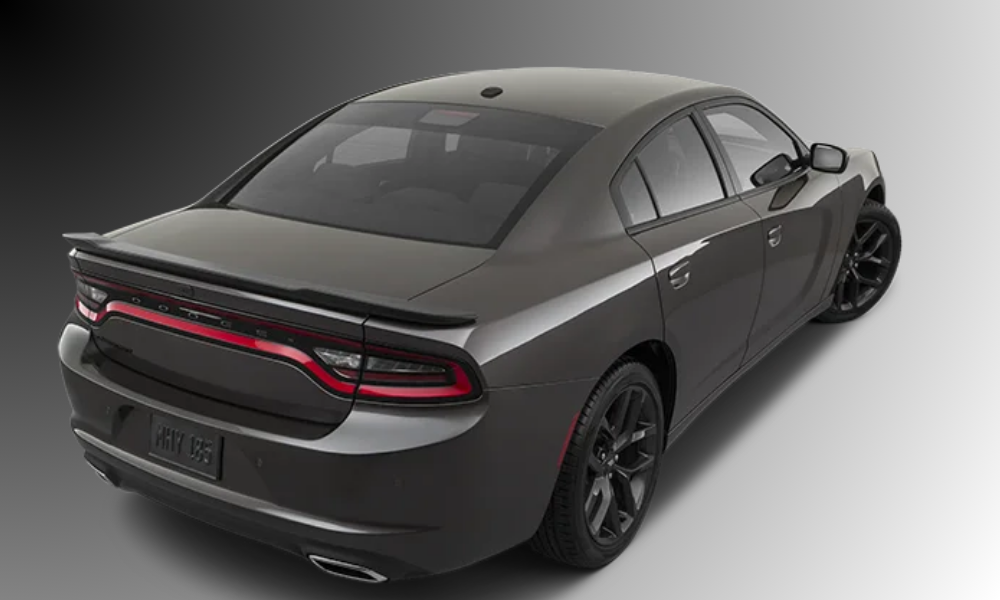
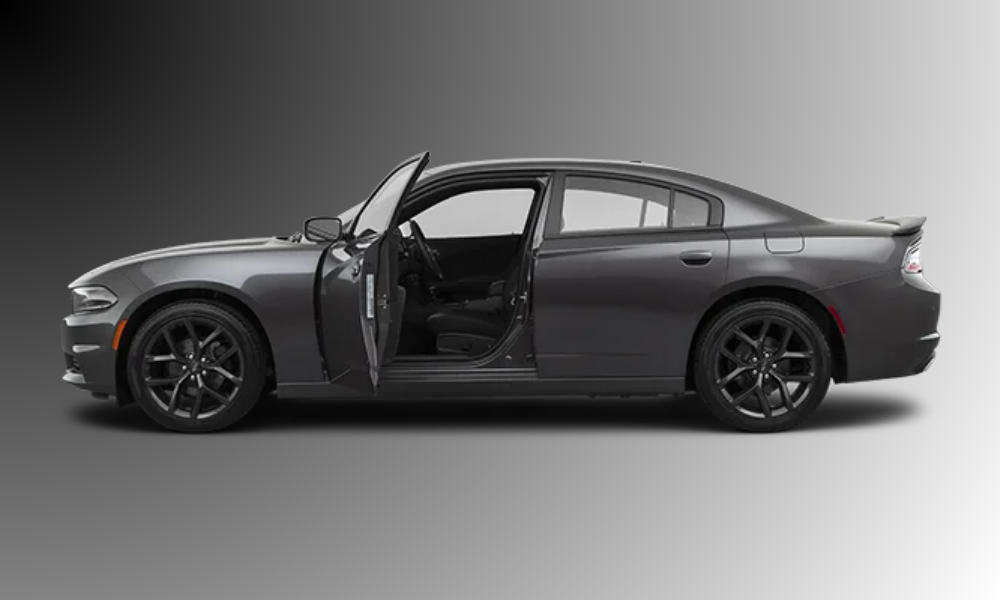
The Charger looks like it means business from every angle. The long hood, the wide stance, the sculpted body panels. It sits differently than anything else in a parking lot, and the Widebody package pushes that further with flared fenders, wider rubber, and a planted, low-to-the-ground stance that reads as genuinely aggressive rather than just styled to look that way.
The roofline slopes sharply toward the rear, which gives the Charger its coupe-like silhouette but creates real tradeoffs. Getting into the back seat requires a deliberate duck, and the thick pillars create blind spots that take some getting used to. These are not dealbreakers, but they’re genuine ergonomic compromises you’ll encounter every single day.
Driving Experience: A Big Car That Moves
The Charger is a large, heavy car that moves with a seriousness that smaller sports cars don’t prepare you for. The Scat Pack reaches 60 mph in around 4.6 seconds. The Hellcat does it in 3.6. Both times feel shorter than they look on paper.
Through fast corners, the car stays flatter than you’d expect given its size, helped by its wide track and firm suspension tuning. But it’s not a precision instrument. The steering gives you inputs without much feedback, and mid-corner bumps can produce noticeable movement from the rear axle. The throttle is also very sensitive, particularly on V8 models. Light inputs produce strong reactions, which keeps you alert in traffic and rewards deliberate driving on open roads.
This is not a car that disappears around you. It has presence, weight, and character. Some buyers will love that. Others will find it exhausting.
2022 Dodge Charger Performance: Power for Every Budget
The powertrain lineup in the 2022 Dodge Charger covers more ground than almost any other sedan on sale today, and the range between the base V6 and the top Hellcat Redeye is so wide that they barely feel like the same car.
At the entry point, the 3.6-liter Pentastar V6 produces 292 to 300 horsepower depending on trim, paired with an eight-speed automatic and optional all-wheel drive on the SXT and GT. It gets to 60 mph in around 6.4 seconds, which is perfectly adequate, and returns up to 30 mpg on the highway. It’s the sensible Charger, and it’s surprisingly capable as a daily driver.
The 5.7-liter Hemi V8 in the R/T is where the personality starts to come through. 370 horsepower and 395 lb-ft of torque, rear-wheel drive only, and a dual-mode exhaust that sounds noticeably different with the windows down. Fuel economy drops to 16 city and 25 highway, which is the expected tradeoff. This engine is the entry point into what the Charger is actually about.
The 6.4-liter Hemi in the Scat Pack is the one most enthusiasts actually want. 485 horsepower, 475 lb-ft of torque, a 4.3 to 4.6 second 0-60 time, and Brembo brakes that give you confidence to actually use what the engine offers. Fuel economy sits at 15 city and 24 highway, and you’ll see the lower end of that regularly. It’s the best balance in the lineup between performance and price.
Then there’s the supercharged 6.2-liter Hellcat. The standard version produces 717 horsepower and 650 lb-ft of torque. The Redeye takes that to 797 horsepower and 707 lb-ft, with a 3.6-second 0-60 time that requires a moment to process. The Hellcat gets 13 city and 22 highway, and that’s with some restraint. These engines are fast in a way that runs out of road before they run out of power, and driving them at anything approaching their limits requires space, attention, and a fair amount of respect for what’s happening underneath you.
Ride Comfort: Firm but Tolerable
Ride quality in the Charger is directly tied to which wheels you order. Base trims with smaller wheels ride with reasonable softness. Step up to the 20-inch wheels on higher trims and the ride becomes noticeably busier, particularly on patchy pavement or expansion joints at highway speed. The Scat Pack’s sport suspension is firm but manageable. It won’t rattle your teeth loose, but it’s not what you’d call comfortable over rough surfaces.
Front seat support is genuinely good. The bolstering keeps you in place during spirited driving, and the lumbar support holds up on longer trips. The rear seats are well-shaped with adequate padding. Road noise is present at highway speeds, which is worth knowing if you’re cross-shopping against quieter sedans.
Interior: Spacious but Uninspiring
The cabin gives you real space, especially up front. Rear passengers get enough headroom, hip room, and shoulder room for two adults comfortably, plus a third if needed. That’s a significant advantage over two-door competitors.
The materials are the weak point. Plastics throughout the cabin feel more rental car than performance sedan, particularly on trims where the sticker price starts approaching $47,000. Fit and finish quality is inconsistent. Getting in and out of the back seat requires some coordination given the roofline. These aren’t catastrophic flaws, but they stand out when you compare the cabin to what Kia or Hyundai are doing at lower price points.
Technology: One of the Best Infotainment Systems
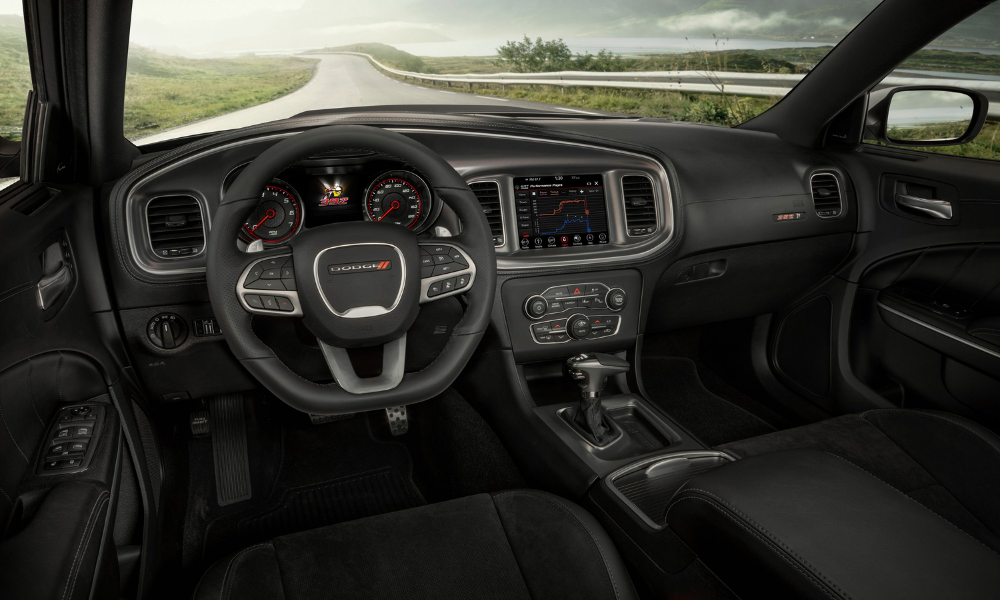
Uconnect remains one of the better infotainment systems available in this price range. It responds quickly, organizes music libraries without lag, and presents everything on a large, readable screen. The standard 7-inch display works fine. The optional 8.4-inch upgrade is worth the money.
Apple CarPlay, Android Auto, and Bluetooth are standard across the lineup. Higher trims add navigation, a premium audio system, and a 7-inch digital instrument cluster. Voice recognition is reliable. The overall experience is intuitive enough that you don’t need to think about it while driving, which is exactly what you want.
The optional Technology Group adds adaptive cruise control, forward collision mitigation, and lane-keeping assist. The adaptive cruise maintains a conservative following distance, but the systems work competently and don’t interfere unnecessarily.
Storage: Average Trunk, Limited Cabin Space
Trunk capacity sits around 16.5 cubic feet, which is decent on paper, but the high liftover height and the way the space narrows toward the rear make it less practical than the number suggests. Door pockets and center console storage are on the smaller side. The cupholders handle standard cans and not much else.
Car seat installation is more complicated than it needs to be. The anchor points are difficult to locate in all three positions, and loading a child seat in the back requires patience given the low roofline.
Biggest Strength and Weakness
No other sedan in this price range offers V8 power. That sentence sounds simple, but it’s the entire argument for the Charger. The R/T starts under $41,000. The Scat Pack gives you 485 horsepower for around $47,000. Comparable performance from European brands costs significantly more and comes with a completely different character. If V8 rear-wheel drive in a four-door is what you want, the Charger is not just the best option. It’s the only option.
The problem is that Dodge knows this, and it shows. The platform is from 2011, and that’s not a minor caveat buried in the specs. It surfaces in the interior quality, the handling precision, the visibility, and the overall fit and finish every time you sit inside. The Charger gets away with it because the competition in this specific segment is essentially gone, but put it next to a newer sedan from almost any other brand and the gap becomes obvious fast. You’re trading modernity for muscle, and for the right buyer that’s a perfectly reasonable trade. Just go in knowing exactly what you’re accepting.
Competitors Worth Considering
The Charger operates in a mostly empty segment, but there are alternatives worth knowing about.
The Kia Stinger is more refined, handles with more precision, and offers practical hatchback space. It doesn’t have a V8 option, and it lacks the Charger’s muscle car presence, but for buyers who want performance with more daily livability, it’s a strong alternative.
The BMW 5 Series offers a significantly more premium interior, sharper handling, and a more complete driving experience. It’s also substantially more expensive than any Charger except the top Hellcat trims.
The Tesla Model 3 delivers quick acceleration and strong technology, particularly in Performance trim. It doesn’t sound like anything, and it doesn’t feel like a muscle car, but buyers focused on efficiency and speed will find it competitive.
The Chevrolet Camaro SS is sharper to drive and more engaging through corners, but it’s a two-door with limited visibility and a cramped rear seat. It’s a different kind of compromise.
Trim Comparison
SXT (from ~$32,645): 292-hp V6, 17-inch wheels, 7-inch Uconnect, Apple CarPlay, Android Auto, AWD available. The entry point for buyers who want the Charger’s looks without the fuel bills.
GT (from ~$35,345): 300-hp V6, 19-inch wheels, sport-tuned suspension with Bilstein dampers, 8.4-inch touchscreen, slightly more aggressive exterior detailing. A meaningful step up in both style and driving feel.
R/T (from ~$40,895): 370-hp 5.7-liter V8, 20-inch wheels, dual-mode exhaust, performance steering wheel. The first Charger that sounds like a Charger.
Scat Pack (from ~$46,620): 485-hp 6.4-liter V8, Brembo brakes, sport suspension, Widebody package available from ~$50,720. The performance value of the entire lineup.
SRT Hellcat Widebody (from ~$73,720): 717-hp supercharged V8, Widebody package standard, adaptive Bilstein suspension, ventilated front seats, blind-spot monitoring. For buyers who want the car to do things that feel slightly illegal.
SRT Hellcat Redeye Widebody (from ~$82,415): 797-hp supercharged V8, 220-mph speedometer, competition-level suspension. The most powerful sedan you can buy new in America.
Jailbreak Package (~$84,140 as standalone trim, or $995 added to Redeye Widebody): Unlocks exclusive color and interior combinations, pushes output to 807 hp. Worth it if standing out is part of the plan.
Which Trim Does Cardrav Recommend?
The Scat Pack with the Widebody package. It gets you 485 horsepower, Brembo brakes, adaptive suspension, and wider tires, at a price that doesn’t require the same commitment as the Hellcat. The R/T is a strong second choice for buyers who want V8 character at a lower entry point. Skip the SXT and GT unless fuel economy and all-wheel drive availability are your actual priorities.
Should You Buy the 2022 Dodge Charger?
Buy it if you want a powerful, four-door sedan with genuine V8 performance and a personality that most modern cars have engineered out of themselves. The Charger offers something specific and increasingly rare, and it does it at a price that makes sense given what you’re getting.
Don’t buy it if interior quality, handling precision, or fuel economy are near the top of your list. The cabin feels dated at higher price points, the steering won’t satisfy anyone coming from a European sport sedan, and V8 models burn through fuel quickly in real-world driving. The Kia Stinger and BMW 5 Series are both worth a test drive if those things matter to you.
Final Verdict
The 2022 Dodge Charger is not trying to be everything. It’s trying to be one thing extremely well, and that thing is a powerful, characterful American sedan with an engine that sounds and feels like it belongs in a different era. The platform is old. The interior is behind the competition. The fuel economy is not something you want to dwell on.
But no other sedan gives you a V8 with rear-wheel drive at this price. No other sedan sounds like this, or accelerates like this, or parks in a lot and makes people stop walking. That’s what the Charger has always traded on, and in 2022, with the segment essentially empty around it, that trade still makes sense for the right buyer.
FAQ
Is the 2022 Dodge Charger a good daily driver?
It depends almost entirely on which engine you choose. The V6 trims are genuinely practical for daily use: reasonable fuel economy at up to 19 city and 30 highway mpg, comfortable enough over most surfaces, and AWD available for buyers in colder climates. The V8 models are a different story. The R/T is manageable with some discipline at the pump, rated at 16 city and 25 highway. The Scat Pack drops to 15 city and 24 highway and starts to feel like a commitment. The Hellcat, at 12 city and 21 highway, is a daily driver in the same way a steak is a sensible breakfast. Technically possible, but you’ll be thinking about it constantly. The cabin is spacious enough for everyday use, though the sloping roofline and thick pillars take some adjustment when it comes to visibility.
What makes the 2022 Dodge Charger worth buying over the Kia Stinger?
They’re genuinely different cars aimed at different buyers. The Stinger is more refined, comes standard with a larger 10.25-inch touchscreen, weighs around 350 pounds less than the Charger, and handles with more precision as a result. If those things matter most, the Stinger wins on points. But the Charger offers something the Stinger simply doesn’t: a V8 engine, rear-wheel drive as the standard configuration, and the kind of straight-line acceleration that the Stinger’s turbocharged engines can’t match. The Charger also has a significantly more spacious rear seat and a larger cabin overall. If you want driving refinement and a more modern interior, the Stinger is the better-rounded car. If you want a V8-powered American sedan with muscle car character and genuine performance headroom, the Charger has no real competition at its price point.
How does the Scat Pack compare to the R/T in real-world driving?
The gap is larger than the numbers suggest. The Scat Pack’s 6.4-liter V8 produces 485 horsepower against the R/T’s 370, but the difference in character is more significant than the horsepower delta alone. The Scat Pack adds Brembo brakes, a limited-slip differential, launch control, configurable drive modes, and available Widebody bodywork. The R/T is the smooth, accessible V8 entry point. The Scat Pack is what happens when Dodge takes that formula seriously. For most performance buyers, the extra cost is justified.
What is the Jailbreak package on the 2022 Dodge Charger?
It’s a $995 option available exclusively on the SRT Hellcat Redeye Widebody that unlocks color and interior combinations Dodge previously kept off the table: exclusive paint colors, unique interior trim choices, custom seatbelts and floor mats, and distinctive badging. It also pushes output from 797 hp to 807 hp at the same 707 lb-ft of torque. For buyers already spending over $82,000 on a Charger, it’s a straightforward upgrade if standing out matters to you.
How does the Charger compare to the Kia Stinger?
The Stinger is more refined, quieter at highway speed, and handles better partly because it’s a significantly lighter car. Its interior is more modern, with better standard tech. The Charger counters with V8 engine options that the Stinger can’t match, a larger and more accessible rear cabin, and a muscle car presence the Stinger doesn’t attempt to replicate. The Stinger also requires premium fuel, while the Charger’s V6 runs on regular. Choose the Stinger for precision, refinement, and a more complete daily package. Choose the 2022 Dodge Charger for V8 power, rear-wheel drive character, and an experience that nothing else at this price delivers.