Shopping for a luxury compact SUV is an exercise in restraint as much as desire. Every brand in the class can build a version that feels special in the showroom, and every one of them can also tempt you into a price that has little to do with how you will use the vehicle on a Tuesday morning. The real question is which features will change your daily life and which are simply pleasant to look at on a window sticker. This 2027 Genesis GV70 review is built around that question.
The GV70 is a serious answer to it. It is a five-seat gasoline SUV from the first generation that debuted for the 2022 model year, so 2027 is a refinement year, not a clean-sheet redesign. Prices start at $49,350 and climb to $71,700, with two very different engines and six configurations spread across that range. That is wide enough to make choosing the wrong one easy.
The more specific editorial question is how well the GV70 balances luxury, comfort, technology, power, and value. CardRav has not conducted its own hands-on test of this vehicle. This assessment draws on Genesis’s published U.S. specifications, official safety information, and available review findings, and it distinguishes among them as it goes.
Our Take on the 2027 Genesis GV70
The GV70’s strongest argument is its cabin and its equipment for the money. Reviewers describe a well-finished interior, a smooth ride, and stable highway manners, and the trim ladder lets buyers add leather, ventilation, upgraded audio, and camera-based visibility aids without jumping brands or price classes. Add a warranty package that is unusually generous for the segment, and the GV70 makes a persuasive case for buyers who want to feel looked after.
The meaningful compromises are narrower than you might expect. Some controls take getting used to, small-item storage is modest, and the driving character leans toward comfort and quiet more than toward sharp, sporty behavior. The V6 trims also cost substantially more than the four-cylinder versions, and that jump buys power rather than a proportionally better daily experience.
In our view, the GV70 suits buyers who prize a calm, richly equipped cabin and distinctive styling over the last degree of driving sharpness. If that describes you, the 2.5T models deserve more attention than the headline V6 does. If you want the most athletic compact luxury SUV on the market, other vehicles in the class are a better fit.
Where the GV70 Excels and Where It Falls Short
Start with what the GV70 does better than most of its price class: it looks like itself. The long hood, the sculpted body, and the two-line lighting signature make it recognizable at a glance, and that matters more than it sounds. Luxury buyers are partly paying to own something that does not blend into a parking lot, and the GV70 delivers that without relying on a loud badge. The cabin extends the same idea. It is comfortable and well equipped, and the range of seat options, from leatherette to Nappa leather, means the experience scales with the budget instead of being reserved for the top of the lineup.
The ride and highway behavior are the second pillar. Reviewers describe composed manners over broken pavement and reassuring stability at speed, which is exactly what a commuter or a family doing long weekend drives actually feels every day. Both engines are strong, with 300 horsepower from the four-cylinder and 375 from the V6, so even the cheaper powertrain is not a compromise in everyday use. The cargo area is also genuinely useful for the class, enough for strollers and weekend luggage without pretending to be a larger SUV. And the warranty, with five years of comprehensive coverage and a long powertrain term for original owners, gives the equipment story some financial weight.
Now the other side. The most consequential drawback is financial and sits at the top of the range. The V6 trims cost thousands more than the four-cylinder versions, and the V6 carries lower published fuel-economy figures, so the added output arrives with both a higher purchase price and higher fuel consumption. For a buyer who rarely wants more than 300 horsepower, that is money spent on capability that stays mostly unused. This is the kind of limitation that should shape a purchase decision, because it is large, measurable, and avoidable.
A second financial reality is that comfort and luxury features are tiered. Ventilated seats, genuine leather, premium audio, and the surround-view camera arrive higher up the ladder, so the base price describes a car most comfort-focused buyers will outgrow. That is not unusual in the class, but it means the starting MSRP is a floor and not a realistic budget for many shoppers.
The remaining drawbacks are more personal. The large display sits relatively far from the driver, and the center-console dial can be mistaken for the gear-selector control, which is an adjustment period and not a lasting flaw for most owners. Storage for small items is limited, with modest door pockets and glovebox. Those are annoyances you notice in the first week and then largely work around. The driving character is the same kind of subjective trade-off. The GV70 prioritizes comfort over maximum sportiness, which is a feature for most buyers and a disappointment for a few. Whether it matters depends entirely on what you want from a Saturday-morning drive.
What’s New for 2027?
Because the GV70 is carrying over its first-generation structure, the 2027 changes are modest but worth understanding precisely.
Wireless smartphone charging is now standard on the base trim. It is a small convenience, but it removes one reason to climb the trim ladder.
The headline change is the 3.5T Prestige Graphite, a new trim designation for 2027. It gives the top of the lineup a darker, more performance-minded identity, and Genesis details it in its announcement of the Prestige Graphite trim. It is a presentation upgrade built on the existing V6 and not a platform for new technology, and other GV70 trims do not receive its equipment. Much of what makes the GV70 appealing, including the large OLED display, the twin-turbo V6 option, and the general cabin layout, predates 2027, so treat those as established strengths and not as new additions.
Exterior Design: A Luxury SUV With Its Own Identity
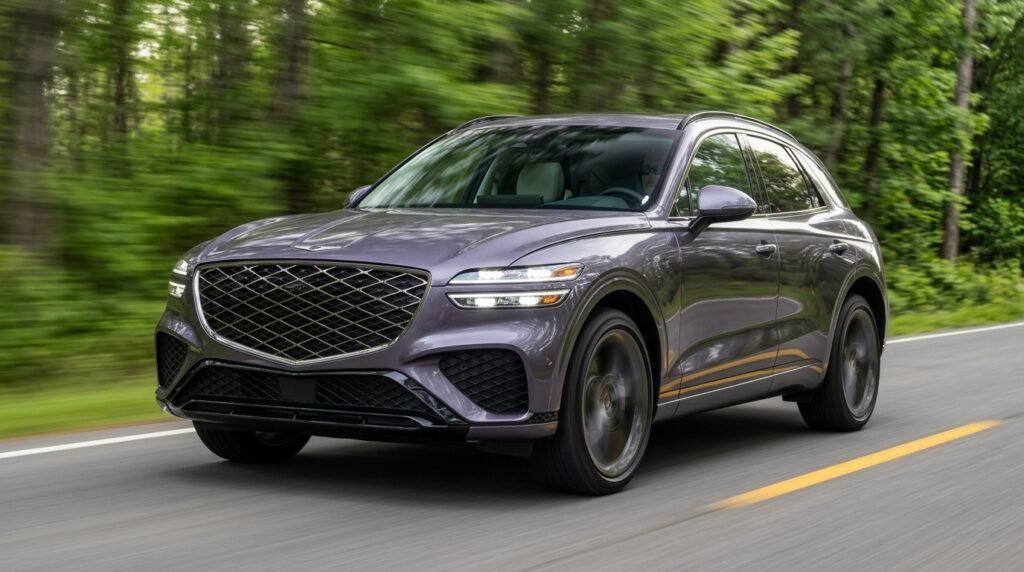
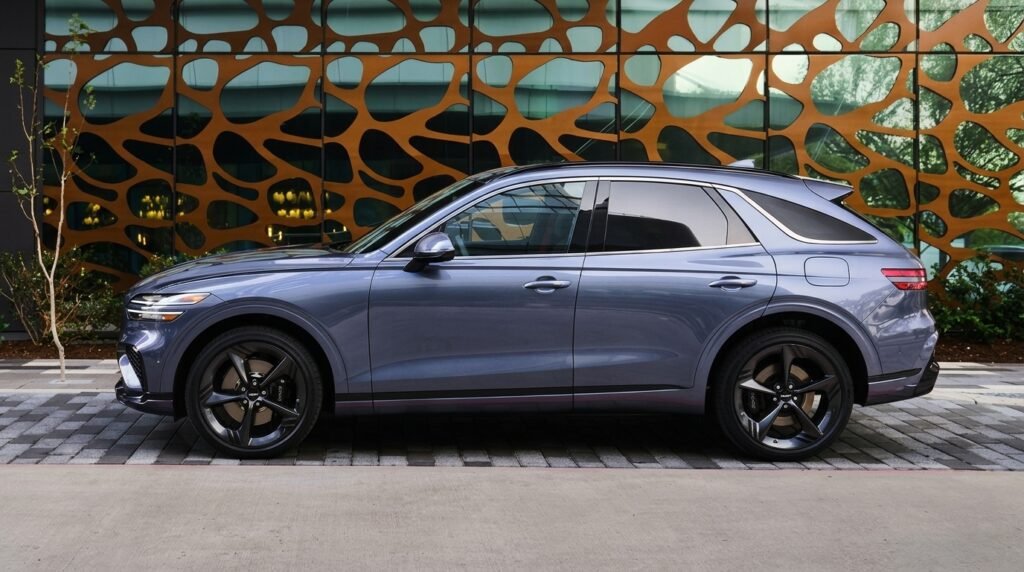
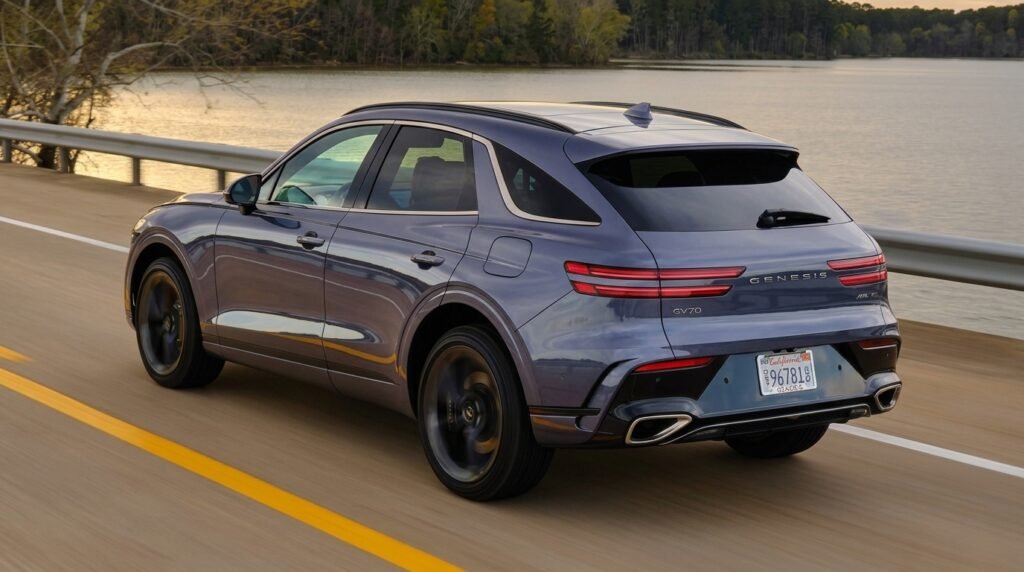
The GV70 avoids the boxy, upright proportions many buyers associate with compact luxury crossovers. A long hood and a roofline that tapers toward the rear give it a stance closer to a tall wagon than to a conventional SUV. At 185.6 inches long, 75.2 inches wide, and 64.2 inches tall on a 113.2-inch wheelbase, it is a compact vehicle, and the styling makes the most of those dimensions without pretending to be something larger.
The signature two-line lighting is the most recognizable part of the face, and it does real work. Genesis uses it as a brand identifier, so the GV70 is recognizable at night and from a distance, which cannot be said of every luxury SUV.
It is worth separating what differentiates the vehicle from what merely decorates it. The proportions, lighting signature, and sculpted body sides are the design. Wheel choices and trim finishes are the details that adjust the mood, and they are largely cosmetic. A 2.5T with 19-inch wheels and a Sport Prestige on 21-inch wheels share an underlying shape. They do not share the same visual intensity.
The Graphite is the clearest example of that adjustment. It adds dark exterior accents, gloss-black mirror caps, and red brake calipers, and it is offered in Ceres Blue Matte and Bering Blue among other colors. The result is a GV70 that looks more aggressive than the rest of the lineup. Genesis’s design language already leans athletic, and the Graphite simply turns the dial further. Those touches do not change how the vehicle performs. They change how it presents.
Genesis carries similar thinking into its electric models, which we explored in our review of the Genesis GV60. The GV60 is a different vehicle with a different mission, but it shows that the brand’s visual identity is consistent across very different products.
Interior Quality and Technology
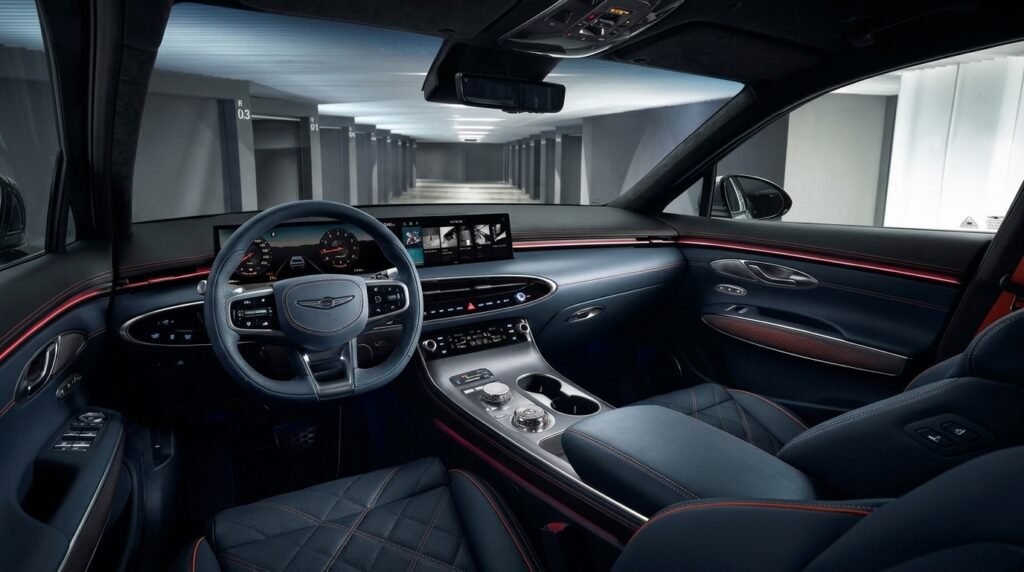
If one area defines the GV70 in reviews, it is the cabin. The design is contemporary, the surfaces are carefully finished, and the layout is heavily technology-driven. What matters is how the equipment changes daily use.
The seating story varies by trim. The base car has leatherette surfaces, while higher trims move to genuine leather and, on the V6 Sport Prestige and Graphite, Nappa leather. Ventilated front seats, heating, massage functionality, and extra driver-seat adjustment are available depending on configuration. Ventilation sounds like an indulgence until a hot summer commute, and extra adjustability makes a real difference on longer drives. These are comfort tools more than status symbols, and that is the lens we recommend for choosing among trims.
The centerpiece is a 27-inch OLED display that combines the instrument cluster and the infotainment and navigation experience. It transforms the dashboard visually, making the cabin feel more like a lounge than a traditional cockpit. Wireless Apple CarPlay and Android Auto are supported, and the base trim’s wireless charger means phone connectivity can be nearly cable-free from the lowest price point.
A big screen is not the same as an intuitive one, however. The display sits relatively far from the driver, which can make touch interaction a reach, and the center-console control dial can be confused with the gear-selector control, a classic case of two similar controls sharing space. Neither issue is disqualifying, but both can cause hesitation in the first weeks of ownership.
This is where physical buttons earn their keep. The GV70 retains physical controls for selected parking and camera functions, which means a driver can act without hunting through menus while reversing or maneuvering in a tight space. Voice control handles selected navigation, audio, climate, and phone functions rather than every possible vehicle command, so it works as a convenience and not a replacement for the buttons. The practical lesson for buyers is to spend time with the interface during a test drive and decide whether the learning curve suits your habits.
Comfort and Everyday Driving
The GV70’s ride is one of its strengths. Reviewers describe composure over broken pavement and reassuring stability at highway speeds, which fits the vehicle’s emphasis on quiet, comfortable travel. Wheel size matters here, because the larger 21-inch wheels on the sportier trims sharpen the look at some potential cost in ride softness.
Up front, the adjustability is a genuine asset. Trims with driver memory and Smart Posture Care add useful personalization for shared vehicles, and the heated steering wheel on the Select and above is a thoughtful addition for cold climates.
The rear seats are comfortable for a compact SUV, with useful reclining adjustment. Easy access to child-seat attachment points is a real practical advantage for families, because anyone who has fought with a car seat in a cramped back row knows how much that matters. Do not expect GV80 space, though. Adults on a long trip will feel the difference.
A few limitations are worth knowing. Door pockets and the glovebox are modest. The four-cylinder engine can become more noticeable under load, and some road noise may enter the cabin. These are proportionate criticisms that do not undermine the overall impression of comfort, but they suggest the GV70 is quiet and refined rather than hushed in every circumstance.
Cargo Space and Practicality
Genesis lists 28.9 cubic feet of cargo room behind the second row and 56.9 cubic feet with the rear seats folded. For a compact luxury SUV, that is a useful amount, though generous for the class is not the same as the largest in it. The loading area is wide, the rear seats fold flat, and a smart trunk function is available.
In everyday terms, the space is well suited to grocery runs, a folding stroller, and weekend luggage for a small family. The wide opening helps with bulky items, and the flat floor with the seats folded makes larger loads less awkward.
Styling and luxury packaging do not repeal the physics of a compact vehicle. A buyer who regularly hauls three children plus gear, or who needs more rear-seat room for adults, should consider stepping up. Our review of the larger Genesis GV80 is a good next stop for that kind of family. For the broader range of body styles in the brand’s larger lineup, see our coverage of the Genesis GV80 and GV80 Coupe.
The maximum towing rating is 3,500 pounds. That is light utility, suitable for a small trailer or a modest load, and not a signal that the GV70 is a dedicated tow vehicle. The maximum should not be assumed to apply identically to every configuration, and the trailer itself must be appropriate for the vehicle, so check the specific equipment on any model you are considering.
Engines, Performance, and Handling
Genesis offers two gasoline powertrains, and understanding the difference between them is the most important financial decision a GV70 shopper makes.
The 2.5T uses a 2.5-liter turbocharged four-cylinder with 300 horsepower and 311 lb-ft of torque. It is paired with an eight-speed automatic and all-wheel drive. That is a generous output for a compact SUV, and it gives the GV70 responsive everyday performance. For merging, passing, and commuting, 300 horsepower is more than adequate for most drivers, and buyers who want a lively vehicle without paying V6 prices will find the four-cylinder compelling.
The 3.5T uses a 3.5-liter twin-turbocharged V6 with 375 horsepower and 391 lb-ft of torque, also with an eight-speed automatic and all-wheel drive. The additional output offers stronger response and more reserve power, which matters most to drivers who want effortless acceleration and a more powerful character. It is the engine for buyers who prioritize performance over thrift.
The transmission is smooth in normal driving, with responsive downshifts when you ask for more acceleration. That is what most luxury buyers want from an automatic. All-wheel drive is standard across the lineup, which simplifies the decision.
On handling, reviews describe composed behavior and reassuring highway stability, while noting that the GV70 is not as overtly sporty as a Porsche Macan. Braking is smooth and reliable, although pedal feedback in sudden stops is not a clear standout. The overall character favors the blend of power, quiet comfort, and everyday usability over uncompromising sports-SUV behavior.
Reviews also indicate that the 3.5T models carry adaptive suspension hardware that the lower 2.5T trims do not share in the same way, so confirm exactly what a given trim includes when you configure one. Wheel and suspension setup shape the experience as much as the engine does.
Buyers curious about a very different powertrain should read our review of the all-electric Genesis Electrified GV70. It is a separate model variant with its own range, charging, and performance, none of which apply to the gasoline GV70 discussed here.
Fuel Economy and Ownership Costs
Genesis lists the 2.5T configurations at 20 mpg city and 26 mpg highway. The 3.5T configurations are listed at 18 mpg city and 25 mpg highway. Highway figures can vary with trim and wheel package, so check the window label for the exact configuration you are considering.
The comparison is straightforward. The V6 delivers more power and pays for it with lower fuel economy. Neither engine is a standout for efficiency in the class.
For a buyer who spends most of the time commuting, the 2.5T is the sensible choice. It offers better listed efficiency and a lower purchase price, and its 300 horsepower is plenty. Someone who values stronger acceleration may willingly accept the V6’s higher consumption. Real running costs depend on mileage, fuel prices, and driving conditions. The important point is that the difference in listed mileage is modest compared with the difference in sticker price.
2027 Genesis GV70 Trim Levels and Pricing
Genesis lists six configurations, each priced as a starting MSRP. These are manufacturer-listed starting prices, not what a buyer will necessarily pay after fees, incentives, or dealer pricing. The official Genesis GV70 page has the current configurator.
The 2.5T AWD starts at $49,350. It includes the 300-hp four-cylinder, all-wheel drive, the eight-speed automatic, the 27-inch OLED display, 19-inch alloy wheels, leatherette seats, and wireless smartphone charging. That is a meaningful starting point, since the signature display and powertrain are already there. What it lacks are the comfort and convenience features reserved for higher trims.
The 2.5T Select AWD costs $52,550. It adds a panoramic sunroof, driver memory with Smart Posture Care, and a heated steering wheel. For buyers in cold climates or those sharing the car, these are tangible upgrades, though not everyone will consider them worth the roughly $3,200 step.
The 2.5T Advanced AWD is $57,050. It brings genuine leather, ventilated front seats, a Bang & Olufsen premium audio system, and camera aids such as a surround-view monitor and blind-spot view monitor. For anyone who prioritizes comfort and cabin equipment over maximum power, this is the trim that deserves serious consideration, because it delivers much of the luxury experience without the V6 premium.
The 2.5T Sport Prestige AWD is $61,550. It adds 21-inch sport wheels, three-zone climate control, and a head-up display. The trade-off is a higher price and larger wheels that may firm up the ride in exchange for a sportier look. It makes sense for buyers who want the more athletic appearance and extra features while keeping the four-cylinder.
The 3.5T Sport Prestige AWD is $70,500. It pairs the 375-hp V6 with Nappa leather, heated second-row seats, 21-inch wheels, and further upper-trim equipment. The jump from the 2.5T Sport Prestige is roughly $8,950, which is substantial. Drivers who truly value the extra power will benefit most. Others may be better served by a well-equipped 2.5T.
The 3.5T Prestige Graphite AWD tops the range at $71,700. It uses the same V6 and adds the dark exterior trim, carbon-fiber interior detailing, and Nappa leather with suede inserts. It is $1,200 more than the standard V6 Sport Prestige, and what that buys is character, not speed. The Graphite appeals to buyers who want the look and feel, and it should not be confused with a faster car.
Safety and Driver-Assistance Features
Genesis lists a broad array of driver-assistance systems. These include forward collision-avoidance assistance, lane-keeping and lane-following assistance, blind-spot collision-avoidance assistance, adaptive cruise control with highway driving support, rear cross-traffic assistance, parking-related assistance, and camera systems. Availability varies by function and trim, so confirm the equipment on the specific trim you want. Driver-assistance technology can help, but it does not eliminate driving risk.
For independent assessment, the Insurance Institute for Highway Safety ratings page for the 2027 GV70 shows Good ratings in the small-overlap front test, the updated moderate-overlap front test, and the updated side test. Within the side test, driver torso and pelvis protection were rated Acceptable while the overall result was Good. The page also lists Good ratings for pedestrian front crash prevention with the standard forward collision-avoidance system, seat belt reminders, and child-seat anchor ease of use, along with an Acceptable headlight rating that applies to all trims. The page carries a Top Safety Pick designation, evaluated under the institute’s 2026 award criteria. It does not show the higher Top Safety Pick+ distinction.
Some of those results were carried forward from earlier test vehicles. The small-overlap rating comes from a 2022 GV70 and applies to 2022 through 2027 models. The side rating comes from a 2024 test vehicle and applies to 2024 through 2027 models. The moderate-overlap rating comes from a 2025 vehicle and applies to 2025 through 2027 models built after April 2024, when Genesis improved the rear seat belts and rear seat design. If you are shopping for a 2027 GV70, those details mean the ratings are tied to the vehicle’s shared structure and not to a crash test run on a 2027 car.
Warranty and Long-Term Value
Genesis lists a five-year/60,000-mile new-vehicle limited warranty. Its official warranty page also lists ten-year/100,000-mile powertrain coverage, which applies to original owners of new Genesis vehicles. A later owner should not assume the same powertrain term carries over. Every new Genesis also includes 36 months of complimentary scheduled maintenance, subject to the applicable time or mileage limit, and a five-year roadside assistance benefit that Genesis describes as a service and not a warranty.
In a luxury vehicle, warranty length shapes perceived value because it reduces uncertainty in the early years of ownership, and included maintenance lowers the cost of keeping the car on schedule. For an original owner who plans to keep the vehicle for many years, the powertrain term in particular offers real peace of mind. Genesis’s warranties also exclude normal wear items and damage from misuse or accidents, so the coverage is protection against defects and not against every expense.
Coverage length says nothing on its own about how reliable the GV70 will prove to be, how much it will cost to run, or how well it will hold its value. Think of the warranty as protection and reassurance, not a forecast.
How the GV70 Compares With Other Luxury SUVs
The GV70 competes with the BMW X3, Audi Q5, Mercedes-Benz GLC, Volvo XC60, and Porsche Macan. Rather than line up spec sheets, it is more useful to compare what each buyer is trading.
Reviews suggest the GV70 can offer a high level of equipment at a lower price than comparably equipped alternatives from established German luxury brands. That is a value-positioning argument, and it will not hold for every trim or every rival. The GV70’s pitch is that you get a distinctive design, a well-equipped cabin, a choice of two strong powertrains, and generous warranty coverage without paying the badge premium.
Those established rivals bring their own strengths: long histories, strong brand recognition, and in some cases a more overtly sporty driving feel. The Porsche Macan in particular is regarded as more sporty than the GV70. A driver who cares most about steering feel and handling sharpness may reach a different conclusion than a buyer focused on comfort, technology, and equipment. The Volvo XC60 and others offer their own takes on the comfort-focused formula, and a test drive of each is the only way to know which suits you.
The GV70 does not win every comparison, and it is not trying to. Its argument is that luxury, comfort, and equipment can be the priority, and that you can have them at a competitive price.
Who Should Buy the 2027 Genesis GV70?
The GV70 makes the most sense for buyers who want a luxurious, quiet, well-equipped compact SUV with a distinctive look, and who value a strong warranty. Commuters, couples, and small families will likely appreciate the cabin, the cargo space, and the easy child-seat access. If your priorities are comfort, technology, and value, it deserves a place on your list.
Several kinds of buyers might look elsewhere. Drivers who want the most athletic handling in the segment may prefer a rival with sharper dynamics. Families who need substantially more space should consider the larger GV80. Shoppers who do not need the extra power can skip the V6 and put their money into a well-equipped 2.5T, such as the Advanced, which delivers most of the luxury experience for far less.
Final Verdict
Return to the original dilemma: how to buy a luxury compact SUV that feels special without paying for things you will not use. The GV70’s best answer is that comfort and equipment matter more than raw performance for most owners. This 2027 Genesis GV70 review points toward a vehicle that gets the daily experience right: a quiet, well-finished cabin, a ride that handles rough pavement calmly, a distinctive design, and a warranty that offers peace of mind.
Its defining trade-off is a comfort-first character paired with a steep price step to the V6. A buyer who accepts that character gets a lot for the money, and a buyer who wants more edge will feel the gap against the sportiest rivals.
For most shoppers, the trim that deserves the closest consideration is the 2.5T Advanced. It combines a capable 300-hp engine with genuine leather, ventilated seats, premium audio, and camera aids at a price well below the V6 trims. Buyers who want more power will find the 3.5T rewarding, and those who love the look may be drawn to the Graphite, but both ask you to pay more for things that go beyond what everyday ownership strictly requires. As a luxury compact SUV, the GV70 makes its case on comfort and value, and it makes it well.