2026 Toyota Camry Balances Efficiency and Comfort
Explore the 2026 Camry’s hybrid performance, fuel economy, interior comfort, and trim options to see what makes it a practical choice for everyday driving.

This 2026 Toyota Camry review examines a simple question: can a midsize sedan still make sense when so many American buyers are gravitating toward crossovers? The Camry’s answer is to stop competing on drama. Every U.S. Camry is now a hybrid, so the car that once offered a four-cylinder, a V6, and a hybrid as separate choices now offers one powertrain tuned for the way most people actually drive: commuting, errands, school runs, and the occasional long highway day.
That changes what a buyer is weighing. A family sedan is judged on running costs, purchase price, ride comfort, cabin practicality, and whether it will still feel like a sensible decision in year five. Horsepower and styling matter, but they rarely decide whether someone is happy with a car after the novelty fades. The Camry has built its reputation on the basics, and the all-hybrid strategy pushes that approach further than any generation before it.
The central question is whether the Camry’s combination of efficiency, equipment, comfort, and everyday usability justifies a starting price of $29,600 and a top-trim price of $36,000, and which buyers benefit most. We have not driven this car for this review, so what follows rests on Toyota’s published specifications, published pricing, and our analysis of how the pieces fit together.
Our Take on the 2026 Toyota Camry
The most important thing about the 2026 Camry is a decision rather than a feature. By making the U.S. lineup hybrid-only, Toyota eliminated the old question of whether the efficient version was worth a premium. The efficient version is now the only version, and every price in the lineup already includes it.
For buyers who prioritize fuel economy, that is a clear win. The hybrid system is built to let electric assistance carry much of the load in the situations where most driving happens: pulling away from lights, crawling through traffic, cruising at moderate speeds. The intended experience is smooth and relaxed rather than urgent, and the Camry makes no pretense of being a sports sedan, even in its sportier trims.
The compromises are modest but real. There is no cheaper conventional gasoline option for buyers who would accept lower mileage in exchange for a lower sticker price. All-wheel drive adds cost and, on some trims, lowers efficiency. And the cosmetic upgrades that dominate the upper end of the range add visual drama without changing what the car does.
Our view is that the Camry’s strengths matter more in daily ownership than any headline figure. The standard safety suite, the efficient powertrain, and a practical cabin come with every trim. That makes the entry-level LE a more credible car than entry-level trims usually are, and it makes the choice among trims a question of comfort and appearance rather than basic capability. The cheapest Camry is not automatically the best purchase, but the most expensive one is rarely the best value either. We return to that question near the end.
What’s New for 2026?
The 2026 Camry is not a redesign. Toyota rebuilt the car for the 2025 model year, and the 2026 version carries over that generation’s platform, powertrain, and layout. A buyer who read about the 2025 car is looking at the same vehicle with a few changes. Readers who want context on how far the nameplate has come can look at our 2023 Toyota Camry review, which covers the previous generation and its optional V6.
The headline addition is the Nightshade Edition, a fifth trim that sits between the SE and the XLE. It adds satin-black 19-inch alloy wheels, black badging, and black exterior accents on the grille, door handles, side canards, mirror caps, rear diffuser, and spoiler. It is offered in Ice Cap white, Supersonic Red, or Midnight Black Metallic. Toyota also introduced a new paint called Dark Cosmos, a hazy blue available on the SE, XLE, and XSE.
How much do these changes matter? For ownership, very little. The Nightshade is an appearance package built on the SE’s foundation, and its interior and safety equipment match the SE’s. It appeals to buyers who care about how the car looks, and it asks for a modest premium to deliver that look. Anyone who cares mainly about efficiency, comfort, or value can ignore it without missing anything mechanical.
Trim Levels and Pricing
All five trims share the same hybrid powertrain, and all are available with front-wheel drive or all-wheel drive. Prices below are base MSRPs and do not include Toyota’s $1,195 destination charge, taxes, fees, or options. The price a buyer actually pays will differ from these figures. Toyota’s official trim comparison page lists current configurations.
The LE starts at $29,600. It is the efficiency leader, and the most affordable way into the lineup. It comes with an 8-inch touchscreen, a 7-inch digital gauge cluster, wireless Apple CarPlay and Android Auto, dual-zone climate control, and the full Toyota Safety Sense 3.0 suite. It is aimed at buyers who want low operating costs and see no need for upgrades. The trade-off is a plainer look and fewer comfort features.
The SE starts at $32,100. It adds a sport-tuned suspension, 18-inch black-finished alloy wheels, and sportier styling. A power tilt/slide moonroof is an available option rather than standard equipment, as are heated front seats. It suits buyers who want the Camry to look and feel a bit more engaging without paying for luxury equipment. It gives up some of the LE’s mileage advantage.
The Nightshade Edition starts at $33,100. It builds on the SE with the blacked-out 19-inch wheels and exterior trim described above, and it shares the SE’s sport-oriented suspension tuning. At $1,000 above the SE, it is a pure styling decision. It is a good fit for someone who has already chosen the SE and wants a more assertive look.
The XLE starts at $34,800. It shifts the emphasis to comfort and technology, with 18-inch wheels, upgraded LED exterior lighting, leather-and-microfiber seating, heated front seats, a 12.3-inch touchscreen, and a 12.3-inch digital instrument display. It is the first trim to bring the larger screens. It is aimed at people who spend a lot of time in the car and want the Camry’s comfort-first character fully expressed.
The XSE starts at $36,000. It combines the XLE’s upscale equipment with 19-inch wheels and a sport-tuned suspension. It is the most visually athletic Camry with the most equipment, and its trade-off is a firmer intended ride and, with all-wheel drive, the lowest fuel economy in the range. All-wheel drive is available on every trim for an additional charge of roughly $1,500.
Engine, Hybrid System, Transmission, and Performance
Every 2026 Camry uses a 2.5-liter four-cylinder gasoline engine paired with electric motors, in what Toyota describes as its fifth-generation hybrid system. Total system output is 225 horsepower with front-wheel drive and 232 horsepower with all-wheel drive. These are combined figures for the whole system, and they carry over unchanged from last year. All-wheel drive uses an electronic on-demand setup, which means the rear wheels are driven by a separate electric motor rather than a mechanical driveshaft.
The transmission is an eCVT. Instead of fixed gears, it blends engine and motor output continuously, which is part of why hybrids of this type feel smooth rather than shift-driven. The system runs on regular unleaded fuel.
What does this mean for driving? We have not tested the car, so we will not put numbers on acceleration. But the design intent is clear. Electric torque is available immediately, which tends to suit stop-and-go commuting and pulling away from intersections. Merging and highway passing draw on the engine and motors together, and 225 horsepower is a reasonable figure for a midsize sedan of this kind. Buyers who care about sharp performance should look to the sport-tuned trims, but they should remember that the tuning changes the suspension, not the powertrain. Every Camry has the same output.
Fuel Economy and Everyday Running Costs
The LE is the efficiency standout, rated by the EPA at 52 mpg city, 49 highway, and 51 combined with front-wheel drive. The SE, Nightshade, XLE, and XSE with front-wheel drive are all rated at 47 city, 45 highway, and 46 combined, a gap that reflects their larger wheels and different equipment. All-wheel drive costs little mileage on most trims. The LE drops to 50 mpg combined, and the SE, Nightshade, and XLE hold at 46 mpg combined. The XSE is the exception. With all-wheel drive it is rated at 43 mpg city, 43 highway, and 43 combined, the lowest in the range and three mpg below the front-wheel-drive XSE.
The practical lesson is that wheel size and drivetrain matter more than most buyers expect. Choosing the LE over a 19-inch trim costs less up front and delivers noticeably better mileage, and adding all-wheel drive raises the price at the dealership and, on the XSE in particular, lowers mileage at the pump. Buyers in snowy regions may find the trade worthwhile, since the mileage penalty is small on most trims and all-wheel drive is rare among hybrid sedans.
EPA numbers are standardized estimates. Real-world mileage depends on temperature, speed, load, tire pressure, trip length, and driving style, and hybrids tend to be sensitive to all of them. Short winter trips, for example, reduce efficiency because the engine runs more to warm up. We will not estimate annual savings, because the result depends on assumptions about mileage and fuel prices that vary widely from driver to driver. What the ratings do show is that the Camry sits near the top of the midsize class for efficiency, and the LE is the version to choose if that is the priority.
Exterior Design and Styling
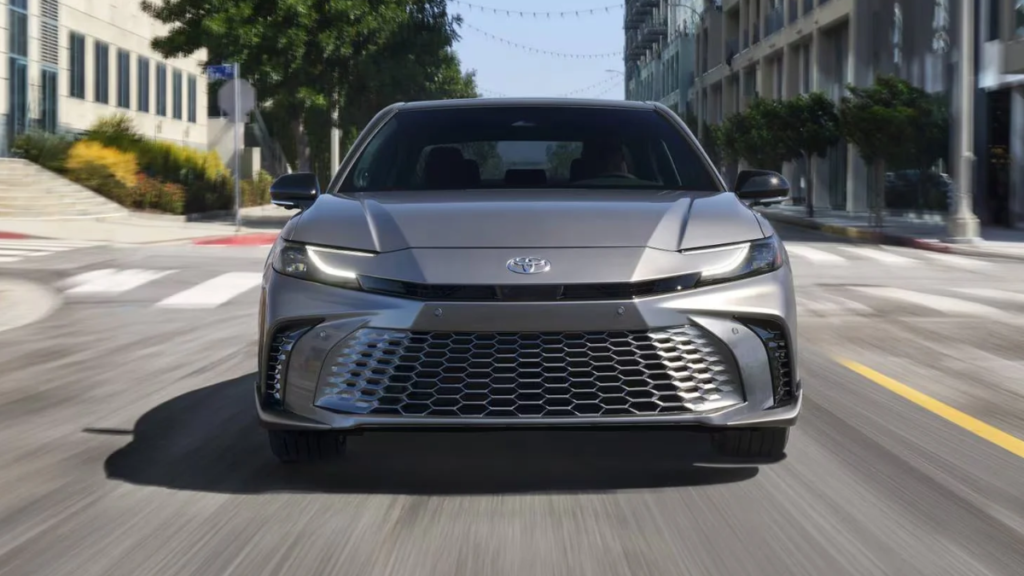
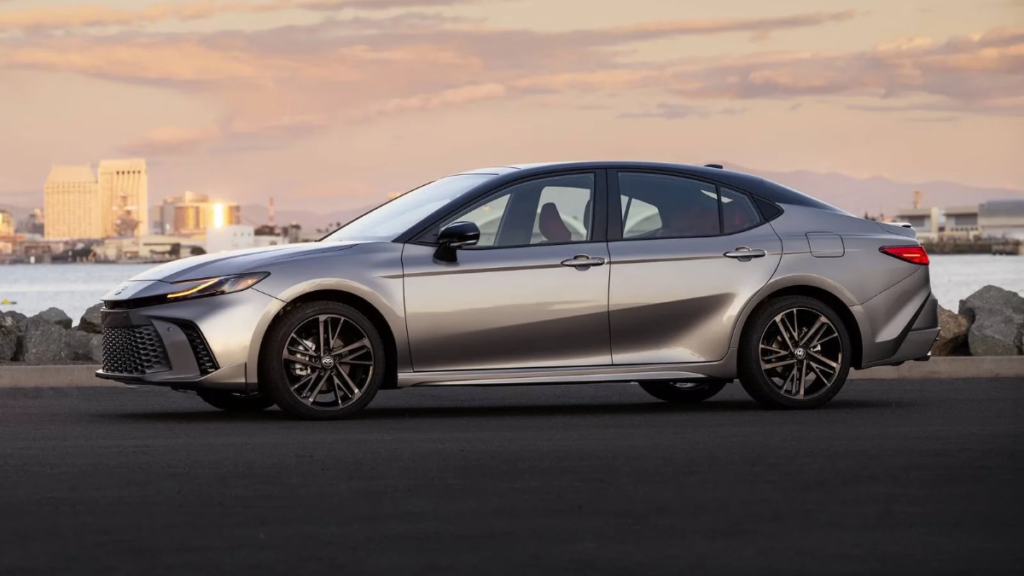
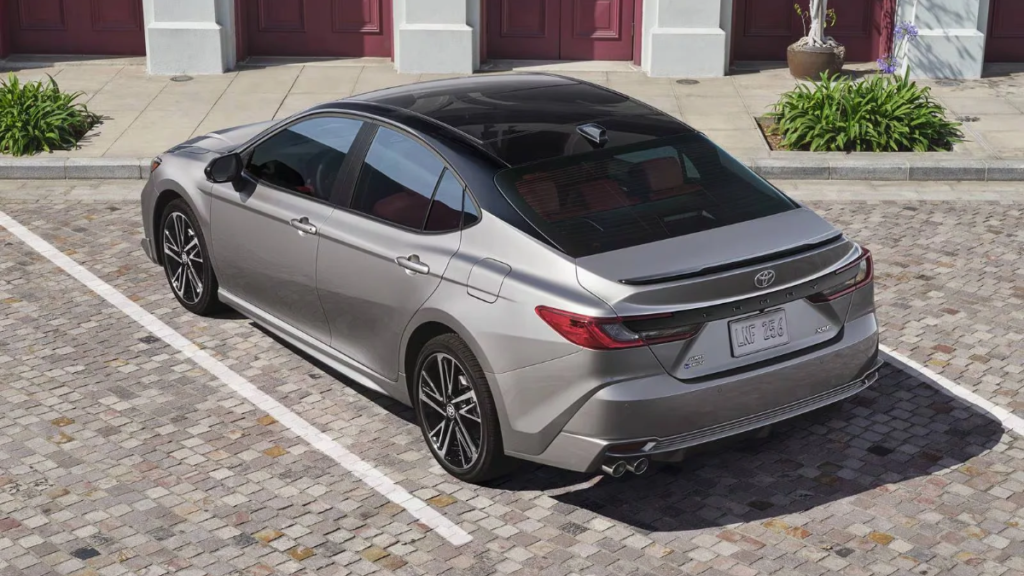
The Camry is a sleek, low-slung sedan, and the ninth-generation design leans into a sportier stance than older Camrys. The front end uses a sharply sculpted nose with slim headlights, and the roofline slopes toward a short rear deck. These are observations about styling rather than claims about performance, and they will matter most to buyers who have been put off by the Camry’s conservative reputation.
Trim differences are clear. The LE keeps a restrained look with the smallest wheels. The SE adds 18-inch black-finished alloys and sportier details. The XLE moves to 18-inch wheels with chrome window trim and upgraded LED lighting, giving it a more upscale feel. The XSE adds 19-inch wheels and sport styling. The Nightshade is the most dramatic, with satin-black 19-inch wheels and blacked-out grille, mirror caps, door handles, spoiler, and rear diffuser, available in white, red, or black. The black accents make the car look more aggressive and are most striking on white or red. The new Dark Cosmos blue offers a subtler choice on the SE, XLE, and XSE.
Interior Design, Seat Comfort, and Cabin Quality
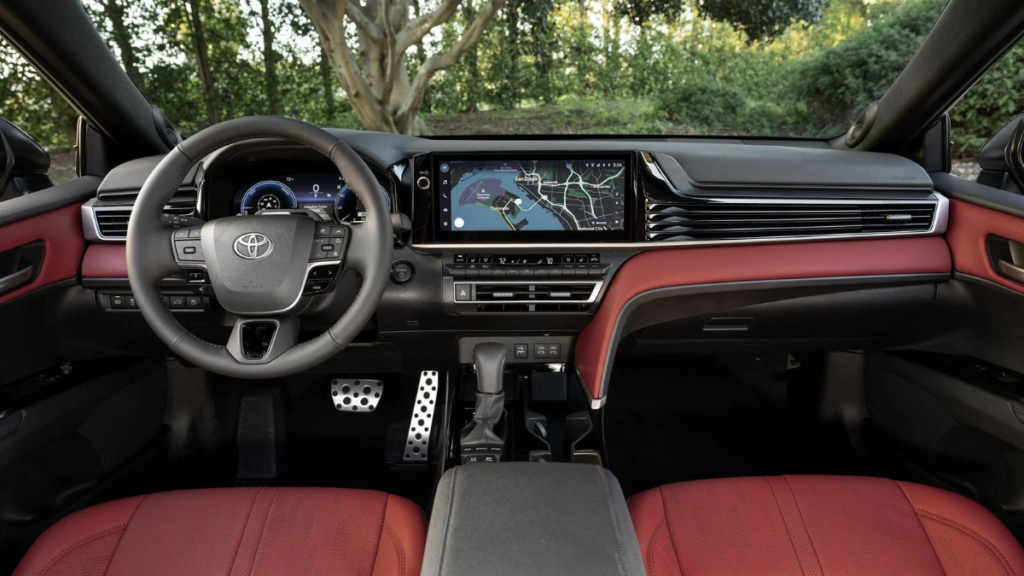
The Camry’s cabin is organized around a driver-focused dashboard with a digital instrument display and a central touchscreen. Dual-zone automatic climate control with rear-seat vents is standard on every trim, which is generous at this price. Front seat adjustability and rear-seat comfort are best judged in person, since seat shape and support vary from driver to driver, and we have not sat in these cars for this review.
Equipment differences between trims are more concrete. The LE uses fabric upholstery, and the SE and Nightshade use SofTex trim. The XLE moves to leather with Dinamica microfiber trim, and the XSE uses sport-perforated leather trim. Heated front seats are standard on the XLE and XSE and available as an option on the LE, SE, and Nightshade. The XLE and XSE also add eight-way power adjustment for both front seats and ambient lighting. Ventilated front seats are available only on the XLE and XSE, and they are part of the Premium Package, which also includes a panoramic glass roof. A heated steering wheel is available on multiple trims, but its availability varies by configuration. It can be added to the LE, SE, and Nightshade through the available Cold Weather Package, is optional on the XLE, and is included on the XSE.. A power tilt/slide moonroof is an available option on the LE, SE, and Nightshade, but it is not standard on them.
These features matter most in extreme climates and on long drives, where heated and ventilated seating makes a real difference to daily comfort. For buyers in moderate climates who mostly commute short distances, they are nice to have rather than essential.
Infotainment, Connectivity, and Driver Technology
Technology is where the trims separate most clearly. The LE, SE, and Nightshade use an 8-inch touchscreen and a 7-inch digital gauge cluster. The XLE and XSE step up to a 12.3-inch touchscreen and a fully digital 12.3-inch instrument display. Wireless Apple CarPlay and Android Auto are included on the LE, and Toyota’s Audio Multimedia system runs on all trims. A 10-inch color head-up display is available on the XLE and XSE.
In daily use, the larger screen offers a bigger map and easier-to-read controls, and the larger digital cluster puts navigation and drive information in front of the driver. But the 8-inch system covers the essentials and keeps the cabin simpler. Because wireless smartphone integration is standard, the biggest technology upgrade is mainly about screen size and display style. For most buyers, the XLE’s larger displays are a pleasant improvement rather than a necessity, and the LE’s setup is perfectly capable.
Passenger Space, Trunk Capacity, and Everyday Practicality
The 2026 Camry seats five and has a 15.1-cubic-foot trunk. That is enough for a week’s groceries, a set of golf clubs, or luggage for a family weekend trip, though a sedan’s trunk opening limits bulky items in a way a hatchback or SUV does not. Key-in-pocket trunk entry is available on equipped trims, a convenience that matters when your hands are full.
The Camry’s practicality is about ease rather than maximum capacity. Buyers who routinely haul bulky gear or travel with several children in car seats may find a crossover easier to load, and our 2026 Toyota RAV4 review and 2026 Honda CR-V review cover that alternative in detail. For couples, small families, and commuters, the sedan is easier to park, lower to step into, and more efficient than most SUVs.
Safety and Driver-Assistance Features
Every 2026 Camry comes with Toyota Safety Sense 3.0, a suite that includes a pre-collision system with pedestrian detection, dynamic radar cruise control, lane departure alert with steering assist, lane tracing assist, road sign assist, and automatic high beams. Toyota’s Proactive Driving Assist is also standard. Having this equipment on every trim means the LE does not require a safety compromise.
Blind Spot Monitor with Rear Cross-Traffic Alert and Safe Exit Alert are standard across all five trims, adding useful protection when changing lanes, reversing out of parking spaces, or opening a door near approaching traffic.
Higher trims, particularly the XLE and XSE, offer additional driver-assistance technology through available packages. Depending on configuration, these features can include Lane Change Assist, Traffic Jam Assist, Front Cross-Traffic Alert, a Panoramic View Monitor with a 360-degree overhead view, and Front and Rear Parking Assist with Automatic Braking. These upgrades are especially useful for drivers who frequently navigate crowded urban roads or tight parking spaces, but buyers should confirm package availability on the specific vehicle before purchasing.
Ride Comfort and the Daily Driving Experience
Ride quality depends on suspension tuning and wheel size, and here the trims differ in intent. The LE and XLE are tuned for comfort, with smaller wheels and a softer approach. The SE, Nightshade, and XSE use sport-tuned suspensions, and the 19-inch wheels on the Nightshade and XSE usually trade some ride softness for a more controlled feel. We cannot describe how each trim rides, since we have not driven them, but the pattern is consistent across the industry: larger wheels and firmer tuning bring sharper body control at the cost of some absorbency on rough pavement.
For daily driving, the practical advice is to match the trim to your roads. Commuters on smooth highways may enjoy the sportier setups. Drivers on broken city streets, or those who prioritize quiet comfort, will likely prefer the LE or XLE. A test drive on roads you know is worth more than any specification.
Ownership Considerations and Warranty
Toyota’s basic warranty covers three years or 36,000 miles. The hybrid battery is covered for ten years or 150,000 miles, whichever comes first, and other hybrid system components carry eight years or 100,000 miles of coverage. The powertrain warranty runs five years or 60,000 miles. The long battery coverage addresses the most common worry about hybrid ownership, and it is a genuine strength.
We will not make claims about repair costs, reliability rankings, or resale value, since those depend on data that varies by source and changes over time. The practical ownership points are simpler. The Camry is built in Georgetown, Kentucky, uses a hybrid system Toyota has refined across several generations, and runs on regular fuel. Buyers should also account for the $1,195 destination charge and any dealer additions when comparing prices.
Which 2026 Toyota Camry Trim Makes the Most Sense?
For most buyers, the XLE is the strongest overall value, with the LE as the better choice for anyone focused on cost and mileage. The XLE’s $5,200 premium over the LE buys the larger displays, leather-and-microfiber seating, standard heated front seats, power adjustment for both front seats, and upgraded lighting. Those are things you notice every day, and they transform the cabin without sacrificing the 46 mpg combined rating of the front-wheel-drive version. Ventilated seats, a heated steering wheel, and a panoramic roof cost extra on top of that, so buyers who want them should price a specific configuration rather than assume the XLE includes them.
The LE is the smart pick if your priority is the lowest price and the best fuel economy. It has the full safety suite, wireless smartphone integration, and dual-zone climate control, so it is not a stripped-down car.
The SE and Nightshade make sense mainly for buyers who prioritize looks and a sport-tuned suspension, and the Nightshade is purely an appearance upgrade. The XSE is for people who want the most equipment and sportiest look, and who accept that with all-wheel drive it carries the lowest mileage in the range. We would not automatically recommend the most expensive trim, since its additional cost buys styling and firmer tuning rather than additional capability.
Final Verdict
The 2026 Toyota Camry is a sound, sensible sedan whose hybrid-only lineup gives it a clearer identity than it has had in years. Its strengths are efficiency, standard safety equipment, a practical trunk, a long hybrid battery warranty, and a cabin that scales sensibly from the LE to the XLE. Its weaknesses are the lack of a cheaper gasoline option, the firmer intentions of the sport-tuned trims, and a price that climbs quickly once you add all-wheel drive and larger wheels.
It is best suited to commuters, couples, and small families who want low running costs and low drama. Buyers who want something more engaging may want to compare it with the 2026 Honda Accord, another hybrid-focused midsize sedan with its own character.
Our recommendation is the XLE for buyers who want comfort and technology, and the LE for buyers who want to spend as little as possible while still getting the Camry’s full safety suite and best mileage. The compromises worth weighing before you buy are the firmer ride on 19-inch trims, the mileage cost of all-wheel drive on the XSE, and the fact that the Nightshade’s appeal lies almost entirely in its appearance. A buyer who accepts those terms gets a competent, efficient sedan that does its job well.