2026 Honda CR-V Review: What Changed and Which Trim Is Best
A closer look at the new TrailSport Hybrid, trim levels, pricing, performance, fuel economy, and everyday practicality.

The 2026 Honda CR-V is a light refresh of a nameplate that has spent close to three decades as a dependable answer for buyers who want space, comfort, and a low stress ownership experience.
This is the fourth model year of the current sixth generation, which arrived in 2023 on the same platform that underpins the Civic. Rather than reworking the CR-V from the ground up, Honda used 2026 to close a handful of gaps that shoppers and reviewers had flagged since launch: a new TrailSport Hybrid trim, a larger touchscreen across every trim, and quicker reacting traction software for the all wheel drive system.This review covers every trim, powertrain, and tradeoff a shopper should weigh before signing paperwork on the 2026 CR-V.
Our Opinion
Cardrav sees the 2026 CR-V as a vehicle designed around how compact SUV owners actually use their cars, not around what photographs well in a showroom.It is not chasing horsepower figures or bold styling, and it never has been. It commits instead to predictable driving manners, an uncomplicated cabin, and enough room that a young family will not outgrow it within a couple of years.
That focus explains why the nameplate has stayed relevant across six generations, and it is also why this year’s changes read as sensible maintenance rather than a reinvention.The one place that focus falls short is crash safety, where a new industry test exposed a real weakness that buyers should not overlook simply because the rest of the package is strong.
Pros and Cons
Pros
The rear seat and overall cabin comfortably fit adults on long drives.
The hybrid powertrain returns some of the strongest EPA estimates in the segment.
Road and wind noise are well controlled at highway speed.
Every trim, including the base LX, includes the full Honda Sensing suite.
The new TrailSport Hybrid gives the lineup a genuinely distinct look and feel.
Physical climate controls keep everyday operation simple.
Cons
The updated IIHS moderate overlap front test result dropped to poor.
The turbocharged gas engine feels taxed under hard acceleration or on steep grades.
Blind spot monitoring and rear cross traffic alert are absent on the base LX.
The hybrid system is unavailable on the three lowest priced trims.
Towing capacity is modest across the board, and lower still on hybrid models.
What Is New For 2026
The sixth generation of the Honda CR-V debuted for the 2023 model year, and the 2026 CR-V continues that generation with the addition of the new CR-V TrailSport Hybrid.
Every trim now receives a standard 9 inch touchscreen, up from the smaller display that lower trims previously used, along with wireless Apple CarPlay, wireless Android Auto, and a wireless phone charging pad. Honda also widened front wheel drive availability to the Sport Hybrid and Sport L Hybrid trims, which previously leaned more heavily toward all wheel drive, opening a lower cost path into hybrid ownership for buyers in milder climates.
The Real Time AWD system also received a software update that reacts more quickly to wheel slip at low speed. Pricing moved up modestly across the lineup, in line with a normal model year increase rather than a repositioning of the vehicle.
2026 Honda CR-V Trim Lineup and Pricing
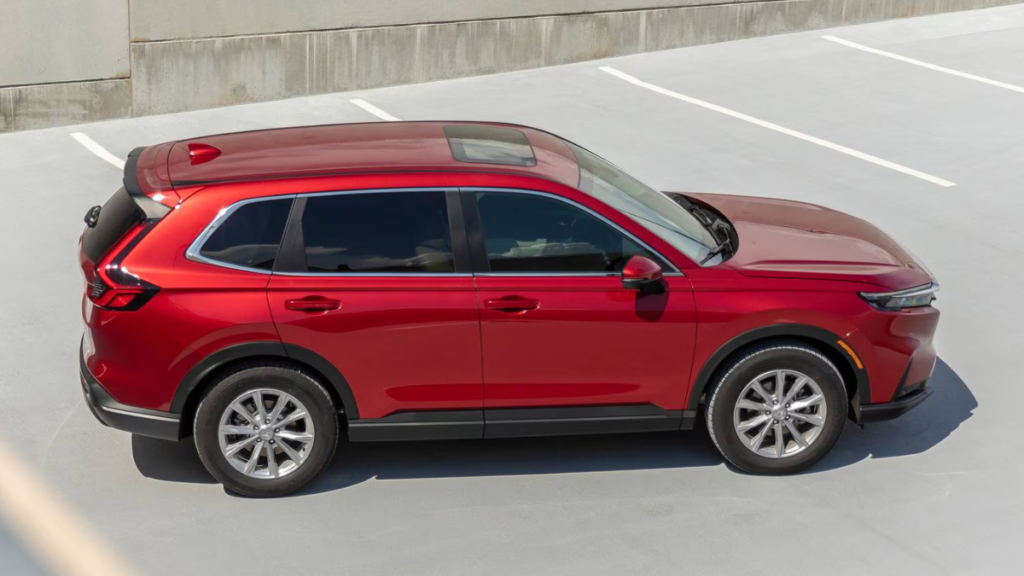
The 2026 Honda CR-V is offered in seven trims, and the pricing structure is worth understanding before assuming that spending more always buys a meaningfully different vehicle.Manufacturer suggested retail pricing before destination charges starts at $30,920 for the LX, $33,150 for the EX, and $35,400 for the EX L, all of which use the turbocharged gasoline engine.
The hybrid lineup begins with the Sport Hybrid at $35,630, a gap of only a few hundred dollars over the gasoline EX L, followed by the Sport L Hybrid at $38,725, the new TrailSport Hybrid at $38,800, and the range topping Sport Touring Hybrid at $42,550.
That narrow gap between the EX L and the Sport Hybrid is the most important pricing detail in the lineup.A buyer who assumes hybrids simply cost thousands more will be surprised to find that stepping from a well equipped gasoline trim into the base hybrid trim requires very little additional money, even though the ownership experience, in terms of fuel economy and daily refinement, changes substantially.
The gasoline LX, EX, and EX L differ mainly in comfort and convenience equipment, while the hybrid trims add power, refinement, and efficiency on top of a similar equipment progression.TrailSport Hybrid buyers should also note that despite sitting near the top of the price range, it trades leather seating for fabric, a deliberate choice tied to its outdoor oriented mission rather than a simple downgrade.
Exterior Design
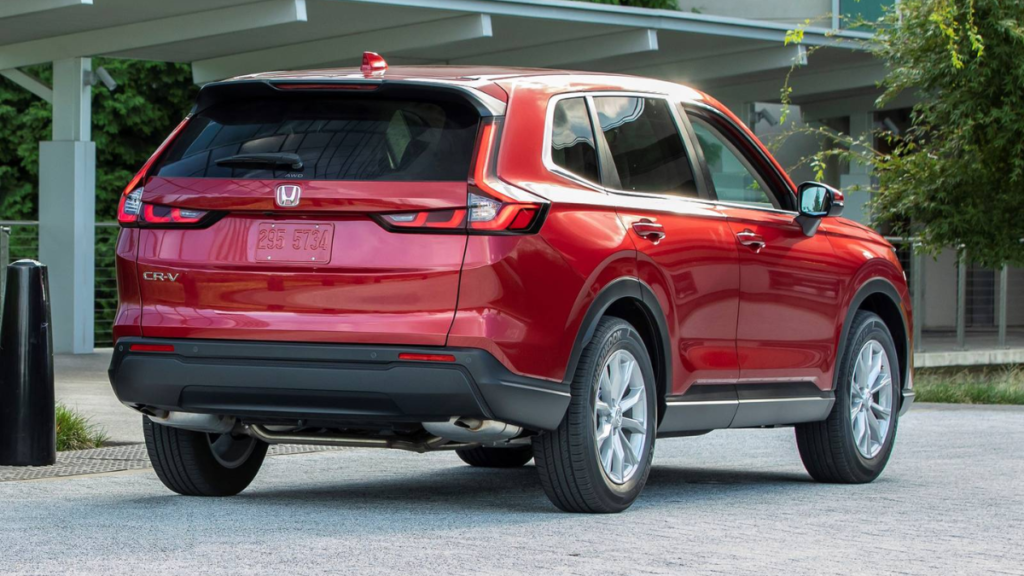
The sixth generation CR-V introduced a cleaner, more upright shape in 2023, trading some of the previous generation’s rounded surfaces for flatter panels and a stronger shoulder crease, and that basic silhouette carries over unchanged for 2026.It reads as mature rather than trend chasing, which should help it age gracefully.
The LX and EX keep things understated with body colored trim and standard alloy wheels, while the EX L adds chrome accents and a power liftgate for a slightly more upscale look.
The hybrid trims carry their own visual cues, including reshaped lower fascias and unique wheel designs that separate them at a glance from the gasoline lineup.Overall length lands at 184.8 inches on a 106.3 inch wheelbase, a footprint that balances a roomy cabin with easy parking in tight spaces.
The 2026 CR-V TrailSport Hybrid
The TrailSport Hybrid is the single biggest addition to the 2026 lineup and deserves a closer look on its own terms.It combines the 204 horsepower two motor hybrid system with standard all wheel drive, an exclusive Ash Green paint option, black window surrounds, a piano black spoiler, orange TrailSport badges, and 18 inch wheels wrapped in all terrain tires.What it does not add is extra ground clearance. Like every other CR-V, it rides at 8.2 inches, so this is not a vehicle built to compete with dedicated off road SUVs on rocky trails.
What the TrailSport Hybrid actually delivers is meaningful confidence on loose, wet, or unpaved surfaces, thanks to the combination of standard all wheel drive and tires with a more aggressive tread pattern than the rest of the lineup.
That is a genuine functional upgrade for anyone who regularly drives a gravel road, a muddy trailhead parking lot, or a snowy driveway, even if it will not turn the CR-V into something it fundamentally is not.Calling it a pure appearance package undersells the equipment underneath, and calling it a serious off roader overstates what a compact family crossover with unchanged ground clearance can realistically do.It sits accurately in between: a CR-V with real, usable traction upgrades and styling to match, still built around the same passenger focused mission as the rest of the lineup.
Driving Experience
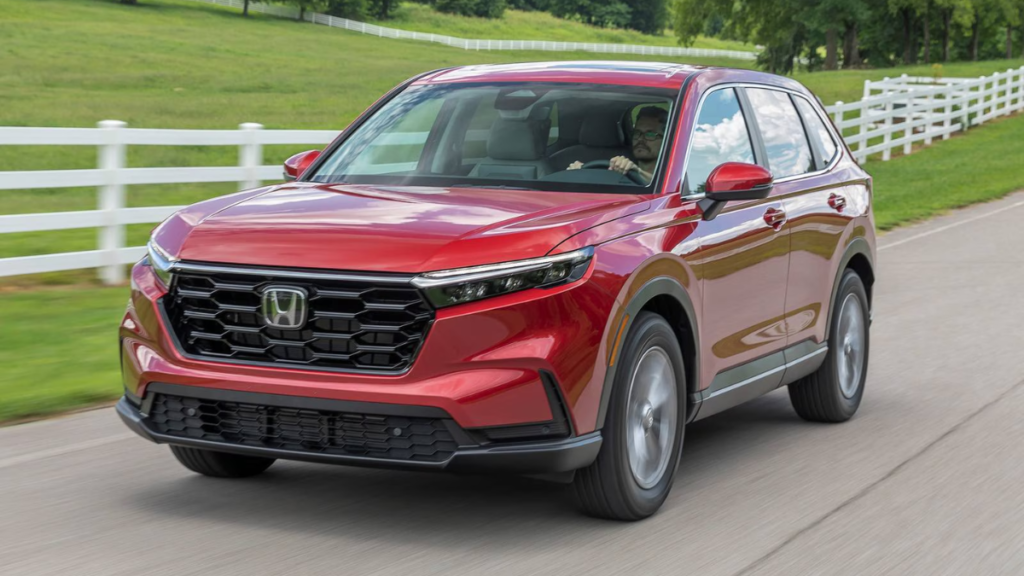
Behind the wheel, the CR-V continues to prioritize composure over excitement, which suits the family buyers who make up most of its audience.Steering is light but accurate, body roll stays well controlled for a tall crossover, and the suspension absorbs broken pavement without ever feeling floaty at highway speed.It is not a vehicle that rewards spirited driving, but it reduces fatigue on a long commute or a multi hour road trip, and that tradeoff is exactly what most CR-V owners are looking for.
Braking response is confident throughout the range, and a turning diameter of just over 37 feet keeps the CR-V easy to maneuver in parking lots and tight urban streets.
Performance and Acceleration
Honda continues to offer the CR-V with two distinct powertrains, and the choice between them meaningfully shapes daily driving.The LX, EX, and EX L use a 1.5 liter turbocharged four cylinder engine producing 190 horsepower, paired exclusively with a continuously variable transmission.It is smooth around town but can feel strained when passing on the highway or climbing a steep grade with a full cabin.
The Sport Hybrid, Sport L Hybrid, TrailSport Hybrid, and Sport Touring Hybrid instead use a 2.0 liter Atkinson cycle four cylinder engine paired with a two motor hybrid system, producing a combined 204 horsepower and 247 pound feet of torque.This setup delivers quicker, smoother acceleration from a stop than the gasoline engine, along with a quiet, electric feeling character at low speed.
Front wheel drive is standard on the LX through Sport L Hybrid trims, with all wheel drive available as an option on all of them, while the TrailSport Hybrid and Sport Touring Hybrid come with all wheel drive as standard equipment.
Ride Comfort and Cabin
Ride comfort has always been a CR-V strength, and the 2026 model continues that pattern.The suspension is tuned firm enough to stay composed through corners but forgiving enough to soak up potholes and expansion joints without transmitting harshness into the cabin.Road and wind noise are well suppressed for the class, which makes the CR-V a relaxing companion on longer highway stretches.
Higher trims add heated front seats starting on the EX and heated rear seats on select upper trims, while the Sport Touring Hybrid tops the range with ventilated front seats and a more premium leather interior.Even the base LX delivers seats that suit a wide range of body types.
Interior Design and Technology
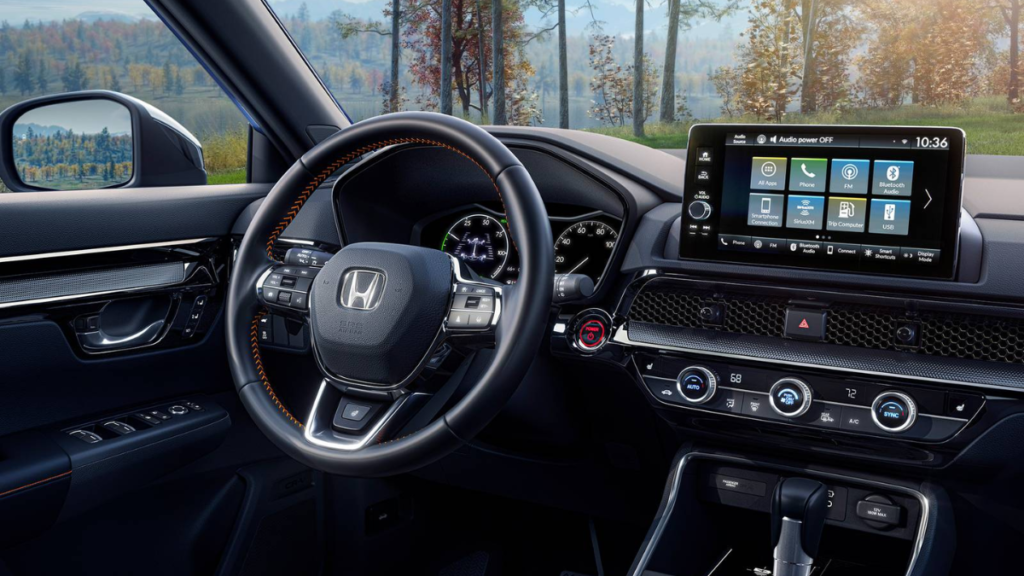
Step inside and the cabin philosophy becomes clear: everything is arranged for clarity rather than showy design flourishes.A horizontal dashboard layout keeps physical climate controls within easy reach, and Honda has resisted burying every function inside the touchscreen.
Material quality is a genuine strength, with soft touch surfaces on the upper dash and door panels even on midlevel trims.The LX and EX use cloth upholstery, while the EX L introduces leather seating, a power tailgate, front and rear parking sensors, and an upgraded eight speaker audio system.
Every trim now includes a standard 9 inch touchscreen with wireless Apple CarPlay and wireless Android Auto, a real step up from the smaller display that lower trims used to receive, plus a wireless phone charging pad and two front USB C ports as standard equipment across the board.
Rear seat USB C ports are reserved for the EX trim and above, so families relying on the base LX for backseat charging should plan around that gap.Instrument cluster technology splits the lineup: the LX, EX, and Sport Hybrid use a 7 inch digital cluster, while the EX L, Sport L Hybrid, TrailSport Hybrid, and Sport Touring Hybrid step up to a fully configurable 10.2 inch digital cluster.
Only the range topping Sport Touring Hybrid adds Google built in, bringing native Google Maps, Google Assistant, and Google Play Store access into the vehicle.Even with these gains, the CR-V’s 9 inch screen remains smaller than the 12.3 inch unit found on some rivals, so shoppers who prioritize sheer screen size may still look elsewhere.
2026 Honda CR-V Fuel Economy by Trim
Fuel economy remains one of the strongest reasons to consider the CR-V, and the figures vary meaningfully depending on powertrain and drivetrain.
The gasoline LX, EX, and EX L are EPA rated at 28 city and 33 highway miles per gallon with front wheel drive, dropping to 27 city and 31 highway with all wheel drive added.The Sport Hybrid and Sport L Hybrid, when equipped with the newly available front wheel drive, are EPA rated at 43 city and 36 highway miles per gallon, among the strongest figures in the compact SUV segment.
Those same two trims drop to 40 city and 34 highway when specified with all wheel drive, since Honda’s published ratings differ by drivetrain even within the same trim.The TrailSport Hybrid, which comes with standard all wheel drive, is rated at 38 city and 33 highway, a modest but expected dip tied to its heavier all terrain tires.The Sport Touring Hybrid, also standard all wheel drive, returns 40 city and 34 highway.
Buyers cross shopping trims should confirm which drivetrain a specific fuel economy figure applies to, since mixing front wheel drive and all wheel drive numbers for the same trim produces a misleading comparison.
Practicality: Cargo, Passenger Space, and Towing
Practicality has always been a CR-V calling card, and the 2026 model continues to deliver where it counts.
The base LX offers the most passenger volume in the lineup, while every other trim, including the EX L and all four hybrids, comes in slightly lower, a difference tied to equipment rather than a meaningful change in how roomy the cabin feels day to day.Front legroom measures 41.3 inches, and the rear seat is nearly as generous, which makes the back row genuinely comfortable for adults on longer trips.
Cargo capacity favors the gasoline trims slightly over the hybrids, since the hybrid battery pack claims a portion of the space behind the rear seats.In both cases the numbers remain competitive for the class, even if they trail the segment’s very best, and the 60 40 split rear seats fold flat to expand cargo room when needed.
The TrailSport Hybrid shares the same hybrid cargo layout as the rest of the electrified lineup, so its more rugged styling does not cost buyers any everyday usability.
Towing capacity is the CR-V’s clearest practical limitation.Gasoline trims are rated to tow up to 1,500 pounds when properly equipped, while every hybrid trim, including the TrailSport Hybrid and Sport Touring Hybrid, is rated at 1,000 pounds.Neither figure supports anything beyond a small utility trailer, a couple of kayaks, or a lightweight motorcycle trailer, and buyers who need to tow a camper or a boat regularly should look elsewhere.
2026 Honda CR-V Safety Ratings
Every 2026 Honda CR-V, including the base LX, comes standard with the Honda Sensing suite, which bundles forward collision warning, automatic emergency braking, lane departure warning with steering assist, adaptive cruise control with low speed follow, road departure mitigation, and automatic high beams.
Blind spot monitoring and rear cross traffic alert, by contrast, remain reserved for the EX trim and above, so shoppers who want that layer of awareness on a budget should plan on stepping up from the base trim.The safety picture carries an important caveat that every shopper should weigh.
The current CR-V generation, covering the 2023 through 2027 model years, has earned good results in several IIHS crash tests, including the small overlap front and side impact evaluations, along with a good headlight rating and acceptable marks in the front crash prevention tests for both vehicles and pedestrians.
Under the updated moderate overlap front test, which now includes a rear seat dummy, that same generation received a poor rating because of seat bracket deformation and seat belt movement that increased the risk of chest and abdominal injury to a rear passenger, and as a result it does not carry a Top Safety Pick award this year.Families who weigh crash test results heavily should treat the moderate overlap result as a genuine factor in cross shopping, not a footnote.
Reliability
The 2026 CR-V is still a new model year, which means it does not yet have a mature, multi year reliability record of its own.Early ownership complaint volume has been low, which is an encouraging early signal rather than proof of long term durability.
The CR-V nameplate carries a generally strong reputation for reliability across past generations, and expectations for 2026 are positive on that basis, but buyers should be cautious about treating a handful of months of ownership data as a verdict on how the vehicle will hold up over five or ten years.
Owners should also check the vehicle’s VIN for any applicable recalls before and after purchase.Earlier years of this generation, specifically 2023 through 2025, dealt with a steering related recall and a separate fuel feed hose recall affecting some hybrid models.
Those issues belong to the sixth generation’s broader history rather than to the 2026 model specifically, and a buyer considering a used 2023 or 2024 CR-V should simply confirm that any applicable recall work has already been completed on that particular vehicle.
Worthy Competitors
The compact SUV segment is crowded, and the CR-V faces serious competition from every direction.
The Toyota RAV4, fully redesigned for 2026 and sold exclusively as a hybrid, offers stronger horsepower and sharper new styling, which will appeal to buyers who want electrified power built into every trim rather than only the upper half of the lineup.
The Mazda CX 5 makes a strong case for buyers who value driving engagement and interior craftsmanship, backed by standard all wheel drive across its entire range, though it still lacks a hybrid option that many CR-V shoppers now expect.
The Hyundai Tucson is another strong alternative for shoppers who prioritize comfort, features, and a generous warranty.It also offers a larger available touchscreen and its own capable hybrid powertrain, though the CR-V still holds an edge in rear seat comfort and long term ownership reputation.
The Chevrolet Equinox rounds out the shortlist as a value oriented alternative, but it trails the CR-V in standard safety technology and interior refinement.No single one of these vehicles is automatically the right choice for every buyer, and the CR-V’s particular mix of comfort, efficiency, and everyday usability will suit some shoppers far better than others.
Cardrav Recommendation
The CR-V’s greatest strength is consistency across the entire lineup rather than excellence concentrated in one or two configurations.A buyer who chooses the base LX still gets the full Honda Sensing suite, a comfortable driving position, and a cabin that does not feel like an afterthought, while a buyer who stretches to the Sport Touring Hybrid gains real comfort and technology upgrades without giving up any of that underlying practicality.
Its weaknesses cluster around specific tradeoffs rather than a broad pattern of compromise: the moderate overlap front test result is a legitimate concern for families who weigh crash data closely, the gasoline engine strains under hard acceleration with a full load, and withholding blind spot monitoring from the base LX feels like an unnecessary omission on a vehicle that otherwise leads with safety equipment.
Buyers who want the simplest possible ownership experience, do not need hybrid efficiency, and mainly drive shorter distances should choose the EX or EX L, with the EX L standing out as the strongest value in the gasoline lineup thanks to its leather seating, power tailgate, and parking sensors.
Buyers who log significant highway miles or simply want to spend less time at the pump should choose a front wheel drive hybrid trim, since the Sport Hybrid and Sport L Hybrid deliver the best fuel economy in the entire lineup without any drivetrain compromise.All wheel drive is worth the added cost for buyers in regions with real winter weather or unpaved commutes, and it comes standard on the TrailSport Hybrid and Sport Touring Hybrid for exactly that reason.
The TrailSport Hybrid specifically suits buyers who spend weekends on gravel roads or hauling gear to a trailhead and want that added confidence without sacrificing hybrid efficiency.Buyers who want the most complete feature set, including the larger digital cluster, Google built in, and the strongest available audio system, should plan for the Sport Touring Hybrid.Families who prioritize crash test performance above everything else should compare the CR-V against rivals such as the Hyundai Tucson before committing.
Final Verdict on the 2026 Honda CR-V
Taken as a whole, the 2026 Honda CR-V is worth buying for most compact SUV shoppers, and the updated pricing and feature set give it a clear edge over a gently used example from earlier in this generation.It remains one of the easiest vehicles in its class to live with day to day, and the hybrid trims in particular deliver genuine efficiency gains without asking buyers to compromise on space or comfort.
The one group that should look elsewhere first is families who treat crash test scores as a top priority, since the CR-V’s moderate overlap result is a real mark against it this year.For nearly everyone else, the CR-V continues to earn its place as one of the more sensible vehicles a family can own.
FAQ
Is the 2026 Honda CR-V a good SUV for families?
Yes. It offers a spacious rear seat, a flexible cargo area, and the full Honda Sensing safety suite on every trim, which makes it a dependable choice for daily carpools and longer road trips alike, though families focused heavily on crash test scores should review the IIHS results first.
What changed on the CR-V for 2026?
The 2026 Honda CR-V adds a new TrailSport Hybrid trim, a standard 9 inch touchscreen across every trim, standard wireless smartphone charging, and expanded front wheel drive availability on the Sport Hybrid and Sport L Hybrid trims.
How much does the CR-V cost in 2026?
Pricing before destination charges starts at $30,920 for the base LX and climbs to $42,550 for the Sport Touring Hybrid, with the EX L and Sport Hybrid separated by only a few hundred dollars.
Does the hybrid CR-V get better fuel economy than the gas model?
Yes. The front wheel drive Sport Hybrid and Sport L Hybrid are EPA rated at 43 city and 36 highway miles per gallon, well ahead of the gasoline engine’s 28 city and 33 highway rating, though all wheel drive hybrid trims return somewhat lower figures.
Is the CR-V safe?
Every CR-V comes standard with the Honda Sensing suite and has a strong record in most individual crash tests, but it received a poor rating in the IIHS updated moderate overlap front test, so families who prioritize crash test scores should review the details closely before buying.