2026 Jeep Cherokee Hybrid Power MPG Space and Value
: A redesigned hybrid SUV that combines standard 4x4, everyday comfort, and practical efficiency.


The 2026 Jeep Cherokee Hybrid arrives at a moment when many compact SUV buyers want lower fuel bills but have no interest in installing a charger or planning trips around one. Jeep’s answer is a Cherokee that has been rebuilt from the ground up as a five-passenger crossover. Every example carries the same hybrid powertrain, and every example comes with a four-wheel-drive system. The official 2026 Jeep Cherokee overview presents it as a vehicle for daily life first and weekend adventures second, and that order of priorities explains most of what makes this SUV interesting.
Making the Cherokee hybrid-only is a bigger decision than it first appears. Efficiency is no longer an option box or a premium-trim feature. It is the baseline, and it shapes how the vehicle drives, what it costs to fuel, and who it is designed for. The same applies to standard 4×4, which gives the Cherokee a practical edge in rain, snow, and loose surfaces without asking buyers to climb the trim ladder.
The question this review sets out to answer is simple. Does the new Cherokee offer enough efficiency, space, and capability to justify its place in a market full of well-established hybrid SUVs? The answer depends on what a buyer expects from the Jeep badge, so it is worth looking closely at what the vehicle is and what it is not.
Our Take
The most useful way to understand the 2026 Cherokee is as a change of identity. For years, buyers associated the name with a small, trail-ready SUV. This generation is aimed at a different customer, someone who spends most of the year commuting, hauling groceries, and driving to school and weekend events. That customer wants good fuel economy, a roomy cabin, and confidence when the weather turns bad. The Cherokee’s standard hybrid powertrain and standard 4×4 are built for exactly that job, and on paper they cover it well.
What the vehicle does not attempt is traditional low-range off-road capability. Jeep’s own specifications describe an automatic four-wheel-drive system with a rear-axle disconnect, and they do not list low-range gearing or locking differentials. Buyers who see the Jeep badge and expect rock-crawling ability will be disappointed. Buyers who see a capable all-weather family SUV with a Jeep face will be pleased with the match.
The strengths are clear: standard electrification, standard 4×4, a 33.6-cubic-foot cargo area behind the rear seats, and a combined fuel-economy rating of 37 mpg. The compromises are just as clear. Published instrumented tests recorded 0-60 mph times in the mid-8-second range, which is adequate rather than lively. Published driving impressions also point to ergonomic quirks, including a thick, squared-off steering wheel and climate functions that live in touchscreen menus or a haptic panel. Finally, the price climbs meaningfully from the base model to the Overland.
These trade-offs matter because they point to different kinds of buyers. A shopper who values efficiency, space, and traction will likely find the Cherokee’s strengths outweigh its flaws. A shopper who wants quick acceleration, a premium-feeling cabin, or serious trail hardware will find the Cherokee asks them to compromise on the things they care about most. The vehicle is neither a bargain nor a stretch. It is a well-aimed, slightly conservative SUV whose value depends heavily on which trim you choose.
A Redesigned Cherokee With a Different Mission
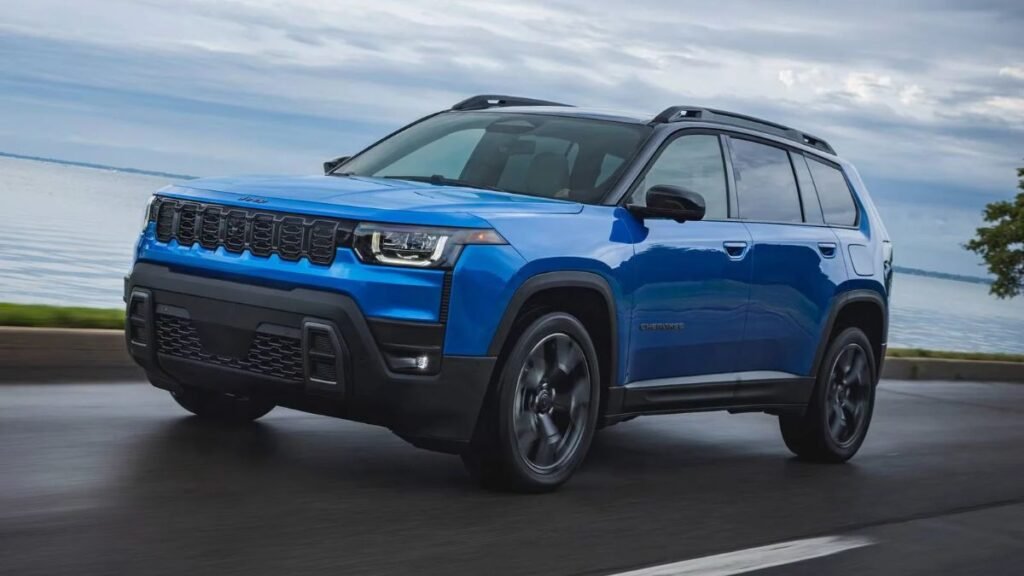
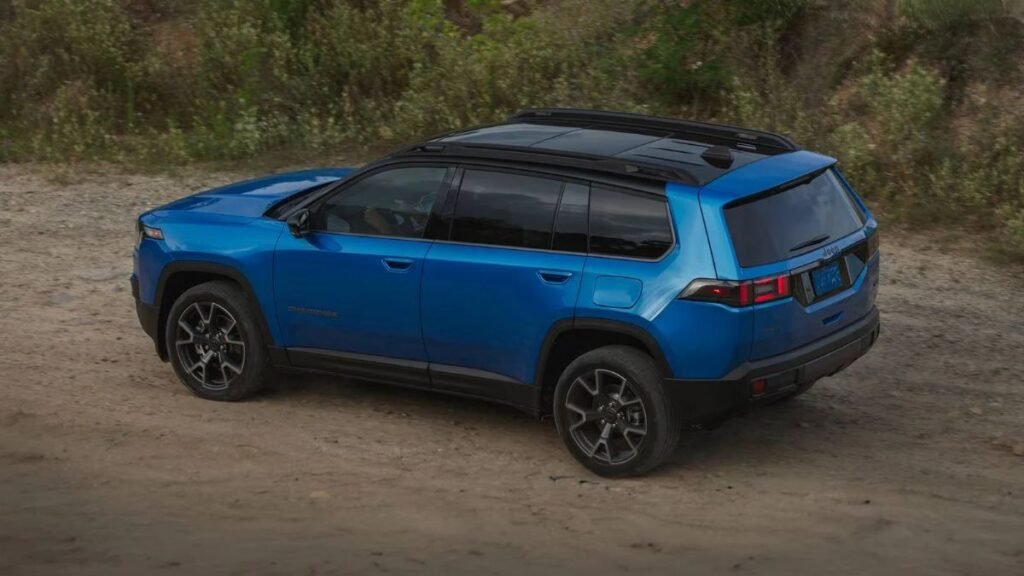
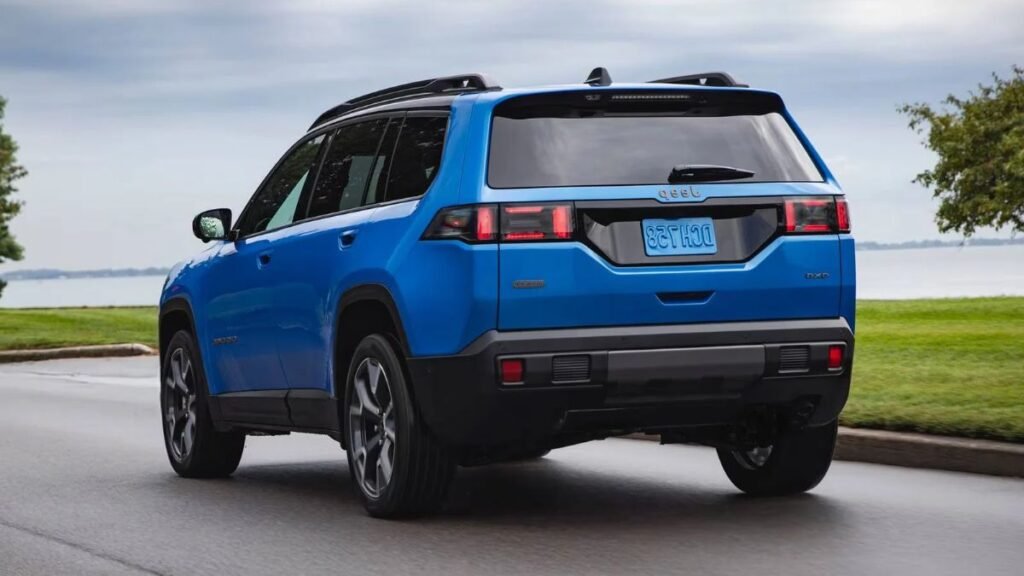
The 2026 model is a fully redesigned generation, and it is longer, taller, and wider than the Cherokee it succeeds. The shape is more upright and boxy than before. Square-cut LED headlights sit beside U-shaped daytime running lights, and the seven-slot grille remains the clearest link to Jeep’s heritage. Standard roof rails add to the practical, utilitarian stance. Jeep’s original 2026 Cherokee announcement frames the redesign around this return to the Cherokee name with a new body and a new powertrain.
The design is distinctive without being aggressive. Vertical surfaces and a flatter hood give the SUV a purposeful look, and the seven-slot grille keeps it recognizable at a glance. Yet nothing about the styling suggests a vehicle built primarily for technical trails. The proportions, the lighting, and the standard roof rails all point toward a modern family SUV that borrows Jeep’s visual vocabulary. That is not a criticism. It signals a deliberate shift toward everyday buyers, and it matches how the rest of the vehicle is engineered.
The 2026 Jeep Cherokee Hybrid Powertrain and What It Delivers
Every Cherokee uses the same powertrain: a turbocharged 1.6-liter four-cylinder gasoline engine paired with two electric motors and a continuously variable hybrid transmission. Jeep’s published Cherokee specifications list the gasoline engine at 177 horsepower and 221 lb-ft of torque. The complete hybrid system is rated at 210 horsepower and 230 lb-ft. The distinction matters. The larger figures describe what the engine and motors can deliver together, not the engine alone, and comparing the gasoline-only numbers with a rival’s combined output would be misleading.
In practice, the electric motors support the engine rather than replacing it. They provide torque during low-speed driving and help smooth the transition between power sources, which is where a hybrid’s character is most noticeable around town. The continuously variable transmission has no fixed gear steps. It adjusts engine speed continuously, which usually keeps the engine in an efficient range, but it can also produce a sustained rise in engine noise when a driver asks for strong acceleration.
The Cherokee is a conventional self-charging hybrid. Its battery receives energy through regenerative braking, which captures kinetic energy that would otherwise be lost as heat when the driver slows down and converts it into electricity for the hybrid system. There is no charging port and no need to plug in. For buyers who park on the street, live in an apartment, or simply prefer an ownership routine that looks like a regular gasoline car, that simplicity is a real advantage. Shoppers who want to drive on grid electricity should look at a plug-in alternative, such as the 2026 Nissan Rogue Plug-In Hybrid, which has a larger battery designed to be charged from an external power source. The Cherokee does not offer that capability.
Driving Performance and Everyday Behavior
Two independent instrumented tests recorded the Cherokee’s 0-60 mph time at 8.5 seconds and 8.7 seconds. These are published test results, not an official Jeep claim, and the small gap between them is a normal reminder that results vary with conditions and equipment. Neither figure suggests a quick SUV. Both suggest one that is competent for ordinary use, and that is consistent with a 210-horsepower system moving a family-size vehicle.
Published driving observations describe a vehicle that is at its best at lower speeds. Around town, the powertrain is described as smooth and quiet, with enough response for normal traffic. The weaker points appear during hard passing and highway merging, where acceleration is described as less convincing, and where the gasoline engine can become noticeably louder under a heavy throttle. That behavior fits the character of a CVT-equipped hybrid tuned for efficiency. It does not make the Cherokee unsafe or unpleasant, but it does mean a driver who regularly merges onto fast roads will want to plan passes with some margin.
Steering feedback and brake-pedal feel are not highlights. Handling is predictable, but nobody describes it as sporty. That is acceptable for a vehicle of this type, since the Cherokee is clearly not trying to win a handling contest. Ride comfort is where the published impressions are most positive, and it is arguably the most important quality for the kind of driving the Cherokee will do most often. A compliant, quiet ride is a benefit that owners notice every day, while quick acceleration is something they use occasionally.
Taken together, the Cherokee delivers adequate performance for everyday commuting and family use, but its acceleration leaves limited reserve for quick highway merges and passing maneuvers. Drivers who frequently encounter these situations may find themselves wishing for a stronger powertrain, particularly when carrying passengers or traveling on faster roads.
Fuel Economy and Driving Range
The EPA-related ratings for the 2026 Cherokee are 39 mpg in the city, 35 mpg on the highway, and 37 mpg combined. The city figure is higher than the highway figure, which is typical of hybrids. Electric assistance and regenerative braking do the most work in stop-and-go driving, where a conventional engine would waste energy. At steady highway speeds the engine does more of the work, and the advantage narrows.
Jeep advertises a total driving range of more than 500 miles on a full tank. That is a manufacturer figure, and it should be read as an estimate under favorable conditions rather than a guarantee. It nevertheless shows what the hybrid system is meant to deliver. A vehicle that can cover long distances between fill-ups is useful for commuters who want to refuel less often and for families planning road trips.
It is also important to distinguish estimated ratings from real-world consumption. EPA numbers come from standardized testing, and actual results depend on speed, temperature, load, terrain, tires, and driving style. Independently measured real-world fuel economy for the Cherokee is not something this review can quote, so buyers should treat the ratings as a comparison tool rather than a promise. The practical benefit is straightforward: the hybrid system gives the Cherokee a meaningful efficiency advantage without asking its owner to change any habits.
Standard 4×4 Capability and Off-Road Limitations
Every 2026 Cherokee comes with the Jeep Active Drive I four-wheel-drive system. It is an automatic setup that sends power to the wheels that need it and includes a rear-axle disconnect. When all-wheel traction is not needed, the disconnect lets the vehicle operate more efficiently. Selec-Terrain traction management adds Auto, Sport, Snow, and Sand/Mud modes, which adjust the vehicle’s responses to the surface. For most owners, that combination will handle rain, snow, gravel roads, and moderately uneven ground with confidence. Jeep’s official Cherokee information describes the system and its operation in more detail.
The geometry is respectable for a crossover. Jeep lists about 8 inches of ground clearance, a 19.6-degree approach angle, a 29.4-degree departure angle, and an 18.8-degree breakover angle. Those numbers give the Cherokee room to clear ruts, steep driveways, and moderate obstacles. They are not the figures of a purpose-built trail vehicle.
The limits are just as important. The Cherokee does not have low-range transfer-case gearing, and the described configuration does not include locking differentials. Those features matter when a vehicle must crawl slowly over rocks, climb steep loose grades, or maintain traction when wheels are lifted off the ground. Without them, the Cherokee is best suited to all-weather road use and moderate trails, not demanding off-road work.
That distinction is the key to understanding this model. The Cherokee is a capable, all-season family SUV with a Jeep face, and treating it as anything more demanding would be a mistake. Buyers who want serious off-road hardware should look elsewhere in Jeep’s lineup.
Towing and Practical Utility
Jeep rates the 2026 Cherokee to tow up to 3,500 pounds when properly equipped. That is a useful but modest figure. It is enough for small utility trailers, compact campers, a pair of jet skis, or trailers carrying motorcycles or bicycles. It is not meant for large boats, heavy travel trailers, or work-oriented hauling.
The rating should be read carefully. The maximum applies only when the vehicle is properly equipped, and buyers should confirm how a specific configuration affects the limit. Jeep’s specifications also list an 850-pound payload for the referenced base configuration. Payload, towing capacity, and passenger and cargo weight all work together, so a fully loaded family vehicle will have less margin than the headline numbers suggest. These ratings should not be assumed to be identical across every trim.
For buyers who tow occasionally and lightly, the Cherokee offers a sensible amount of capability. For those who tow regularly or carry heavy loads, a larger SUV or a truck would be a better fit.

Interior Design, Passenger Space, and Comfort
The Cherokee’s cabin is organized around family use. It seats five, and published impressions highlight generous rear-seat legroom and rear doors that make getting in and out easy. During normal city driving the cabin is described as comfortable and relatively quiet, which fits the vehicle’s focus on everyday comfort. Jeep’s Cherokee design and interior details list the available seating and comfort equipment, which includes heated and ventilated front seats, heated rear seats, leatherette upholstery, a power-adjustable driver’s seat, and a dual-pane panoramic sunroof. Availability depends on trim and equipment.
The cabin is not without flaws. Some materials may feel less premium than their price suggests, particularly on higher trims, and the Cherokee should not be considered a luxury-class interior. The steering wheel has a thick, squared-off shape that will appeal to some drivers and feel awkward to others, so it is worth testing before buying. Certain climate-control functions are handled through touchscreen menus or a haptic panel rather than conventional knobs and buttons. Those controls can be harder to operate by feel, especially on the move, and they require more attention than a physical switch.
The packaging is stronger than the polish. Its 188.1-inch length, 74.7-inch width, 67.5-inch height, and 113-inch wheelbase give it enough interior volume for a family without making it hard to park. The result is a cabin that works well for school runs, errands, and road trips, even if it does not impress with finish.
Infotainment and Technology
The 12.3-inch central touchscreen runs Uconnect 5, and a separate 10.25-inch digital cluster sits behind the steering wheel. These are two different displays: one handles navigation, media, and settings, and the other shows driving information. Both are standard, as are wireless Apple CarPlay, wireless Android Auto, Bluetooth, and a six-speaker audio system.
The large screen is useful in daily driving because it gives phone-based navigation and music a prominent place. Wireless smartphone connectivity removes the small but constant nuisance of plugging in a cable. A bigger screen also puts more functions behind menus, though, and that makes the climate-control issue mentioned above more significant. A driver who has to look at a touchscreen to adjust temperature or airflow will spend more time with their eyes off the road than one who can reach for a dial.
Standard Connect One services and over-the-air software updates keep the system current without a dealer visit. Buyers can also add a premium audio system, a wireless charging pad, a digital rearview mirror, a 360-degree surround-view camera, and a hands-free power liftgate. These upgrades vary by trim and equipment, so it is worth checking exactly what each configuration includes before assuming a feature is present.
Cargo Space and Everyday Practicality
Jeep lists 33.6 cubic feet of cargo space behind the second row and 68.3 cubic feet with the second row folded. Those are the official figures, and they are the numbers buyers should use for comparison.
With the seats up, the cargo area is large enough for typical weekly grocery runs, strollers, sports equipment, and luggage for a family weekend. Fold the second row, and the space grows to a level that accommodates bulky purchases, flat-packed furniture, bicycles, and long or tall items that would not fit otherwise. The folding rear seat makes the Cherokee flexible, and it turns the SUV from a family car into a small hauler when needed.
The relationship between passenger comfort and cargo volume is worth noting. Generous rear legroom means rear passengers do not have to give up comfort for luggage space, and the cargo area does not appear to come at their expense. That balance is a strong point for family buyers, who rarely want to choose between people and belongings.
Safety and Driver Assistance
Standard driver-assistance technology is extensive. Active Driving Assist and adaptive cruise control with Stop and Go help manage speed and following distance in traffic. Full-Speed Forward Collision Warning with Active Braking and Automatic Emergency Braking with pedestrian and cyclist identification can warn the driver and apply the brakes when a collision risk is detected. Blind Spot Monitoring and Rear Cross Path Detection watch for traffic that is difficult to see, particularly when changing lanes or backing out of a parking space. Active Lane Management and Drowsy Driver Detection help with lane position and driver attention, while Rear Park Assist with Rear Automatic Emergency Braking helps in tight spaces. A 360-degree surround-view camera is available.
These systems are meant to reduce risk and workload, not to replace the driver. They are driver-assistance features, not autonomous driving technology, and drivers must stay alert and ready to take control. Their effectiveness also depends on road conditions, weather, and system limits.
Trim Levels and Pricing
The 2026 Cherokee is offered in six configurations. The figures below are Jeep’s MSRPs, which do not include the $1,995 destination charge. The base Cherokee starts at $35,000, the Laredo at $38,000, the Limited at $40,000, the Limited Altitude at $40,595, the 85th Anniversary Edition at $40,905, and the Overland at $43,000. Once destination is added, those vehicles total $36,995, $39,995, $41,995, $42,590, $42,900, and $44,995 respectively.
The base Cherokee includes the hybrid powertrain, standard 4×4, the digital instrument display, the infotainment screen, and the major safety systems. In other words, it is not a stripped-down entry point. The Laredo adds upgraded cloth upholstery, fog lamps, 18-inch wheels, and a power-adjustable driver’s seat. The Limited moves toward comfort with leatherette upholstery, a heated steering wheel, a power liftgate, and additional convenience equipment. The Limited Altitude emphasizes a more distinctive appearance with trim-specific styling, and the 85th Anniversary Edition adds special anniversary styling and equipment. The Overland sits at the top with more upscale interior appointments and additional convenience features, some of which are standard or optional depending on configuration.
The general progression runs from practical to more indulgent. Because the base Cherokee already includes the powertrain, 4×4, and key safety equipment, the lower trims make a strong case for value-focused buyers. The higher trims bring comfort and style, but they also push the price into a range where the interior’s materials and ergonomic quirks become harder to overlook. For many shoppers, a mid-level trim will offer the best balance of equipment and cost.
Warranty and Long-Term Ownership Considerations
Jeep provides a basic limited warranty covering 3 years or 36,000 miles, along with powertrain coverage lasting 5 years or 60,000 miles. This gives buyers a defined period of protection for the vehicle’s major components, although the specific coverage terms should always be reviewed before purchase.
The Cherokee’s overall value depends on more than its starting price. Its 37 mpg combined fuel-economy rating, standard hybrid powertrain, standard 4×4 system, available equipment, and warranty coverage all contribute to the ownership proposition. The base model offers an appealing starting point for buyers who prioritize efficiency and essential features, while the higher trims add comfort and convenience at a noticeably greater cost. Choosing the right configuration is therefore important, particularly for buyers who want to avoid paying more for equipment they may rarely use.
How the Cherokee Fits the Compact SUV Market
The Cherokee competes in a crowded segment. Its most direct rivals are established hybrid SUVs that have built reputations for efficiency and practicality, and the 2026 Honda CR-V is a natural comparison for shoppers who want a hybrid that is easy to live with every day. The Cherokee’s pitch is that it adds standard 4×4 and a distinctive Jeep identity to that formula.
Buyers who want to look more widely can browse these compact SUV alternatives to see how other mainstream models approach the same priorities. The Cherokee’s strengths are its standard hybrid system, standard 4×4, and generous cargo area. Its weaknesses are its modest acceleration and some cabin ergonomics, and shoppers should weigh those against what rivals offer.
Final Verdict
The 2026 Jeep Cherokee Hybrid is best suited to buyers who want an efficient, spacious, all-weather family SUV and do not need serious off-road equipment. Its standard hybrid powertrain, standard 4×4, large cargo area, and comfortable ride give it a strong foundation for commuting, family travel, and winter driving. The 37 mpg combined rating and the 500-mile advertised range add real day-to-day value.
Drivers who prioritize quick acceleration, a premium cabin, or low-range off-road capability may prefer a different SUV. The Cherokee’s 0-60 mph times in the 8.5-to-8.7-second range, its occasionally loud engine under hard acceleration, and its touchscreen-heavy climate controls are real limitations. Higher trims also raise the price enough to make those limitations more noticeable. Before buying, test the steering wheel, try the climate controls, and decide whether a mid-level trim covers everything you need.
For the right buyer, the redesigned Cherokee is a compelling package. It is not the hardcore Jeep its badge might suggest, and it does not try to be. It is a practical, efficient, and capable family SUV that leaves the trail work to other Jeeps and handles the rest of life well. That honest sense of purpose is what makes it worth considering.