Any 2026 Honda Pilot review has to start with the problem every three-row SUV is asked to solve. A family wants a vehicle that swallows a weekend of luggage, seats a full crew without complaint, returns respectable mileage, accelerates with some confidence on an on-ramp, and still fits inside a monthly budget that makes sense. No single vehicle fully delivers all of that, and the real question is which compromises a buyer can live with for the next six or eight years. The Pilot has always been Honda’s answer to that equation, and it answers with a conventional recipe: a naturally aspirated V6, a long list of storage cubbies, physical buttons where most people expect them, and a body sized to be roomy without becoming unwieldy in a parking structure.
For 2026 the recipe gets a meaningful rework in the places families touch every day. A much larger central screen, a new instrument display, revised styling, a retuned steering system, and extra sound insulation all arrive on a platform that was already well established. The more interesting question is whether those updates change the argument for buying a Pilot, or whether they simply polish a vehicle whose strengths and weaknesses were already well understood. The answer depends on where the Pilot is strong, where it is merely adequate, and how its pricing sits against a segment that has become genuinely crowded.
This review is based on Honda’s published 2026 Pilot specifications, equipment information, pricing, fuel-economy ratings, safety technologies, and official owner documentation. It does not claim a personal driving or ownership experience, and manufacturer-published figures are identified as such.
Our Take
The 2026 Pilot is a sensible, well-organized family SUV that has become more pleasant to live with, though not more exciting to buy. Honda’s best work here is the kind that shows up on a Tuesday morning rather than in a brochure photograph. The cabin is arranged around real household habits, with plenty of places to put drinks, phones, and the small objects that otherwise migrate to the floor. The climate system still relies on physical controls, which is a quiet advantage in a market where many rivals bury basic functions inside menus. The standard power tailgate, the heated front seats on the entry trim, and the larger touchscreen with wireless smartphone projection make even the least expensive Pilot feel current.
The weaknesses are equally clear and have not been erased by the update. The V6 is smooth and familiar, but it is not particularly thrifty, and there is no hybrid version to soften the fuel bill for buyers who rack up miles. Pricing is another pressure point. A starting figure above $42,000 before destination puts the Pilot in territory where shoppers have many credible alternatives, and the warranty does not offer the long coverage that some competitors advertise. The third row deserves a nuanced verdict. Honda’s published 32.5 inches of third-row legroom is a respectable figure for the class, yet legroom alone does not decide how comfortable a tall adult will be on a long ride.
What keeps the Pilot relevant is balance. It avoids the kind of glaring flaw that ruins a family vehicle, and it does the everyday work of hauling people and belongings with little fuss. The 2026 changes sharpen the daily experience more than they alter the fundamental pitch, which is precisely what a mid-generation update should do. Buyers who value usability, a proven drivetrain layout, and straightforward controls will find a lot to like. Buyers who want the most efficient option will find a more compelling choice elsewhere.
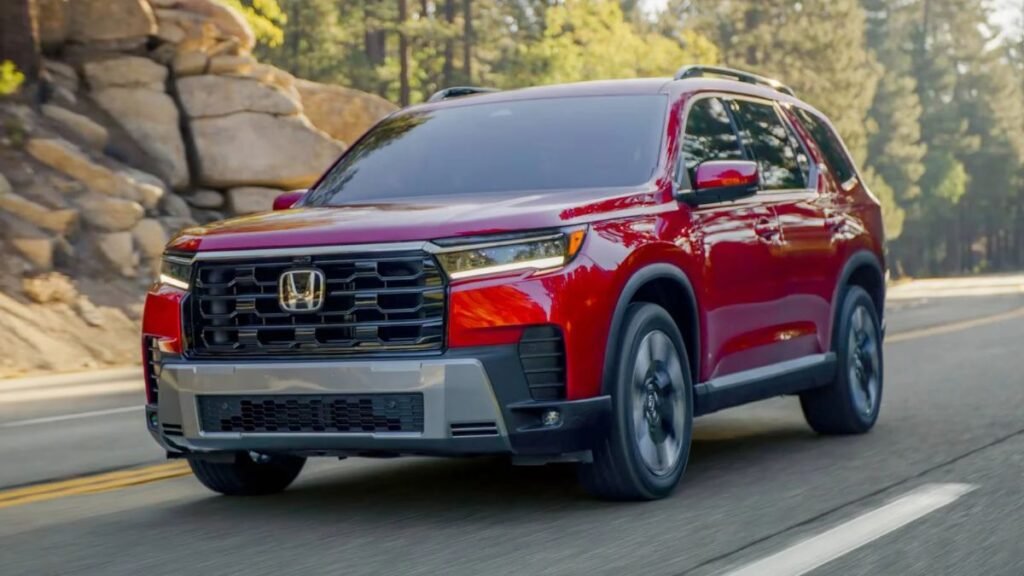
2026 Honda Pilot Review: A Family SUV With a More Modern Cabin
The Pilot in your driveway this year belongs to the fourth generation that arrived for the 2023 model year, which we covered in our original review of the fourth-generation Honda Pilot. The 2026 model is not a clean-sheet redesign. It is a mid-generation update, and treating it as anything else would overstate what Honda has done. Owners of a 2023 model will recognize the basic architecture, the proportions, and the overall character. What has changed is the layer of technology, styling detail, and refinement that sits on top of that foundation.
The most visible alteration is the cabin’s new centerpiece, a 12.3-inch touchscreen that is standard on every trim and roughly 37 percent larger than the screen it replaces. It is paired with a 10.2-inch digital instrument cluster, so the driver now looks at two modern displays instead of one. The software experience includes Google built-in, along with wireless Apple CarPlay and wireless Android Auto, which removes the cable ritual from short trips. A 5G Wi-Fi hotspot is available through applicable connectivity services and subscriptions, which is worth knowing for families who treat the second row as a mobile classroom or entertainment zone. The point is not that screens are inherently better, but that a larger display with native Google services tends to reduce the number of times a driver reaches for a phone. The retained physical climate controls mean the bigger screen does not take over every function. Shoppers who want to compare equipment side by side can use Honda’s official specifications and trim comparison page to confirm exactly what each version includes.
Outside, Honda revised the front end and fitted a larger grille, giving the Pilot a somewhat more assertive face without abandoning the squared-off, upright shape that makes the interior so usable. The dimensions explain why. Most 2026 Pilot trims measure approximately 200.1 inches long, while the TrailSport stretches to 200.4 inches. Width is 78.5 inches and the wheelbase is 113.8 inches, which makes the Pilot a substantial vehicle, yet its height of roughly 70.9 to 72 inches, depending on trim and equipment, keeps it from feeling like a truck. The long wheelbase is what allows generous room for the first two rows, and the boxy roofline is what keeps the cargo area useful. Standard ground clearance is approximately 7.3 inches, which is adequate for snowy streets and gravel driveways, while the TrailSport lifts that to about 8.3 inches.
Every 2026 Pilot uses the same 3.5-liter naturally aspirated V6, rated at 285 horsepower and 262 pound-feet of torque. It is not turbocharged, and there is no hybrid or plug-in option. A 10-speed automatic transmission handles shifting duties, and steering-wheel paddles are included for drivers who want to select gears manually, for example when descending a long grade with a loaded vehicle. Front-wheel drive is standard on Sport and EX-L, with all-wheel drive available as an option on those two trims. TrailSport, Touring, Touring Blackout, Elite, and Black Edition come with all-wheel drive as standard. The available i-VTM4 system can distribute torque between the front and rear axles and also between the rear wheels, which is meaningful in slippery conditions because it can send power to the wheel that can use it.
How the 2026 Honda Pilot Performs on the Road
The Pilot is engineered for comfortable family transport rather than for sporting ambition, and that intent is visible in how Honda describes its tuning priorities. The suspension is set up to keep the body composed over rough pavement and everyday road imperfections, which matters more to a household than a quick lap time ever will. Stability and predictable behavior come first. For 2026, Honda also modified the steering system with the aim of improving feel and feedback, a change that addresses one of the more common criticisms of large crossovers, which is that the wheel can seem disconnected from the road. It would be dishonest to claim a measured transformation, and the intent is best read as refinement rather than a conversion into a driver’s SUV.
The engine’s character is the traditional one for a big, naturally aspirated V6. With 285 horsepower and 262 pound-feet of torque, power builds progressively rather than arriving in a sudden surge, and the 10-speed automatic is tasked with keeping the engine in a useful range. The result is a powertrain that suits merging, passing, and highway cruising with a full cabin, though it is built for ease rather than excitement. Buyers who want a sporting driving experience will be looking at a different kind of vehicle, while those who want an unfussy, familiar gasoline V6 will find exactly that. No acceleration or braking figures are quoted here because this review relies on Honda’s published information rather than measurements of its own.
The practical difference between front-wheel drive and all-wheel drive deserves some thought. Honda’s published fuel-economy ratings favor the former, and front-wheel drive is also the cheaper route by $2,100 on both Sport and EX-L. For buyers in mild climates who rarely see snow, front-wheel drive is a defensible way to save money and fuel. For anyone facing winter roads, steep driveways, or unpaved access, the i-VTM4 system is the more reassuring choice, and it is a standard part of the more expensive trims.
Towing capacity follows the same split, and it needs more explanation than a single headline number. Front-wheel-drive Pilots are rated to pull up to 3,500 pounds, while all-wheel-drive models can tow up to 5,000 pounds when properly equipped. Those maximums are not fixed promises. According to the 2026 Honda Pilot owner’s manual towing limits, the permitted figure depends on how many people are aboard. With two occupants, the full 5,000 pounds for all-wheel drive and 3,500 pounds for front-wheel drive apply. With six occupants, the allowance falls to 4,000 pounds for all-wheel drive and 2,400 pounds for front-wheel drive. With seven occupants, it drops again to 2,500 pounds for all-wheel drive and 1,150 pounds for front-wheel drive, and with eight occupants Honda does not recommend towing at all. Additional cargo and accessories can reduce the permitted capacity further. The ratings are enough for a modest camper or a small boat, but a family that tows while carrying a full load of people should plan around the reduced numbers and verify the requirements for their specific trailer.
The TrailSport is the Pilot’s adventurous side, and it should be described with some restraint. It adds all-terrain tires, underbody protection, roughly an extra inch of ground clearance, off-road-oriented driving modes, and a multiview camera system with TrailWatch that improves visibility in tight situations on a trail. Hill Descent Control helps manage steep downhill sections. These are useful additions for camping trips, forest roads, and rough access routes, and they make the TrailSport a more capable family vehicle than a standard Pilot. They do not turn it into a rock crawler, and it is not a substitute for a dedicated body-on-frame off-roader. The TrailSport is also configured for seven occupants, and for 2026 it gains heated outboard second-row seats.
Size is the final piece of the driving picture. A vehicle roughly 200 inches long and 78.5 inches wide is easy to drive on the highway but requires attention in city garages and narrow lanes. From the Touring trim upward a surround-view camera system is available, which becomes more valuable the tighter one’s daily parking situation. Highway cruising, family road trips, and school-run duty are where this platform makes the most sense.
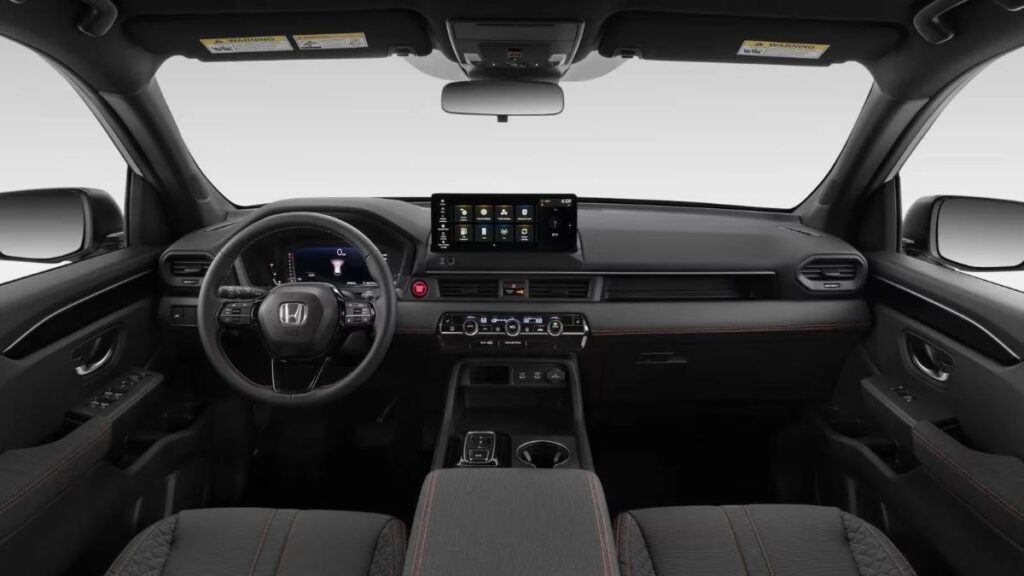
2026 Honda Pilot Interior, Comfort, and Cargo Space
Passenger comfort in the Pilot comes from space, seat support, and quietness rather than from a luxury atmosphere. Honda states that new sound-insulation improvements reduce wind and road noise by approximately 2 to 3 decibels in certain frequency ranges, which is a modest but real step toward a calmer cabin on long drives. Quieter surroundings matter on family trips because conversation, sleeping children, and navigation prompts all depend on it. The front row offers approximately 41 inches of legroom, and the second row follows closely at about 40.8 inches, so adults in either row have room to stretch out. That near parity is unusual and is one of the clearest benefits of the long wheelbase.
The third row is where honest evaluation matters. Honda’s published legroom figure is 32.5 inches, which is a reasonable number for a midsize three-row SUV, but a legroom measurement alone does not describe comfort. Passenger height, sitting posture, the footroom available beneath the second-row seat, and the length of the journey all shape the experience. Children and teenagers will generally manage well, and adults can ride back there comfortably on shorter trips, while longer adult journeys depend on who is sitting in the row and how they sit. The sensible way to judge it is to climb in and spend a few minutes in the seat you expect to use. Seating capacity reaches up to eight depending on trim and configuration, and the removable second-row center-seat arrangement on applicable configurations adds flexibility, as do the second-row layouts offered on selected EX-L versions. Heated outboard second-row seats are standard on the TrailSport, Elite, and Black Edition.
Storage is where the Pilot’s family-first thinking shows. The cabin has numerous cupholders, deep door pockets, and a variety of compartments in places where people reach for things without looking. It is a practical design rather than a showy one, and the physical climate buttons and knobs make everyday adjustments quick and uncomplicated. The Sport trim already includes the large touchscreen, the digital instrument display, heated front seats, Honda Sensing, and a power tailgate. Moving to EX-L brings leather-trimmed seating and wireless smartphone charging. Touring adds a panoramic moonroof and a 12-speaker Bose audio system. The Touring Blackout, a separate version that sits between Touring and Elite, pairs black 20-inch wheels and black Honda badges with the panoramic moonroof and Bose premium audio system. Elite layers on a head-up display and ventilated front seats in addition to its heated ones, and Black Edition finishes the range with 20-inch black wheels, black exterior accents, and premium leather with red stitching.
Cargo space is arguably the Pilot’s strongest everyday asset, though it deserves careful interpretation because Honda publishes both a standard figure and a higher maximum figure for each configuration. Behind the third row the standard volume is 18.6 cubic feet, with maximums ranging from 21.8 to 22.4 cubic feet depending on trim. That is enough for groceries, a few backpacks, or a folded stroller, but not a full vacation load for seven. Fold the third row, which splits 50/50, and the standard volume behind the second row is 48.5 cubic feet, with maximums of 59.5 to 60.1 cubic feet. This is where most families will spend their daily lives. Measured from behind the first row, the standard figure is 86.5 to 87 cubic feet, and the maximums climb to between 111.8 and 113.7 cubic feet depending on trim. That is plenty for sports gear, flat-packed furniture, or the long list of items that accompany a move to college. The important lesson is that large capacity with the seats folded does not equal generous luggage room when every seat is occupied. A family of six heading off for a week will still need to think about a roof carrier or pack carefully.
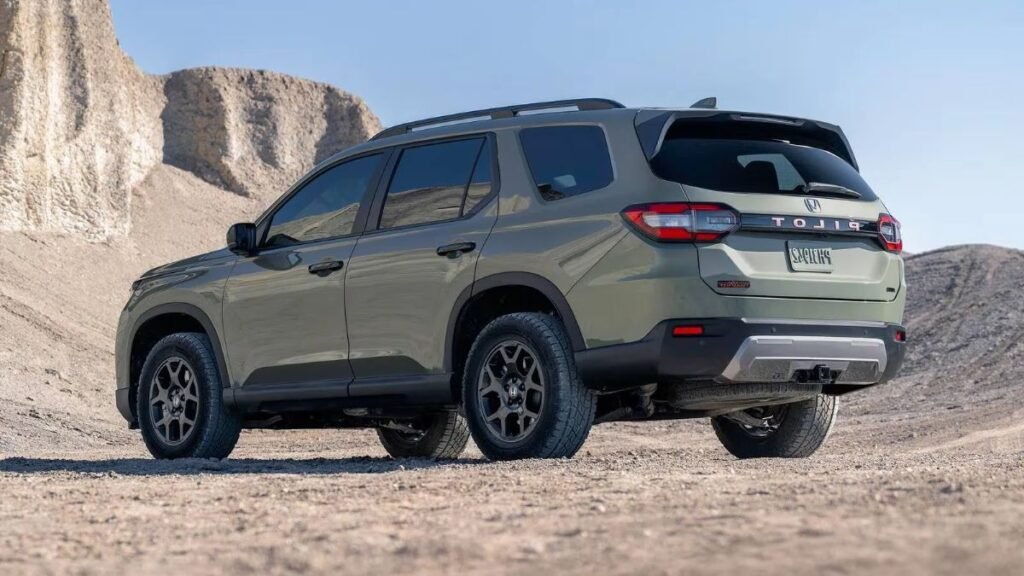
2026 Honda Pilot Safety, Fuel Economy, Trims, and Pricing
Honda’s factory safety equipment is built around the Honda Sensing safety technologies, which cover the driver-assistance features most shoppers now expect. The suite includes the Collision Mitigation Braking System and Forward Collision Warning, which work together to alert the driver and help reduce the severity of a frontal impact. Adaptive Cruise Control and Traffic Jam Assist ease the burden of highway and stop-and-go driving, while the Lane Keeping Assist System, Lane Departure Warning, and Road Departure Mitigation help the vehicle stay in its lane and away from road edges. Blind Spot Information and Cross Traffic Monitor address the visibility problems that come with a vehicle of this size, particularly when backing out of a parking space, and Traffic Sign Recognition keeps posted limits in front of the driver. New for 2026 is Post-Collision Braking, which is designed to help reduce the chance of additional impact after an initial collision. These are descriptions of equipment, not of independent crash-test outcomes, and exact availability and configuration can vary by equipment level, so buyers should confirm specifics for the trim they are considering.
Fuel economy is the section where the absence of a hybrid is felt most clearly. Honda’s published fuel-economy ratings for front-wheel-drive Sport and EX-L models are 19 mpg city, 27 highway, and 22 combined. With all-wheel drive, those same two trims rate 19 city, 25 highway, and 21 combined, and the Touring, Touring Blackout, Elite, and Black Edition share those all-wheel-drive figures. The TrailSport, with its all-terrain tires and added ground clearance, comes in at 18 city, 23 highway, and 20 combined. The fuel tank holds approximately 18.5 gallons of regular unleaded, and simple arithmetic puts the front-wheel-drive highway range near 500 miles at the published figure, which is respectable. Real-world consumption will vary with driving style, load, weather, and terrain, so these ratings are best used to compare trims rather than to predict a specific fuel bill. The V6 offers traditional gasoline-engine behavior and cannot match the efficiency of hybrid rivals, so high-mileage drivers should weigh that cost over time.
Pricing across the lineup runs from accessible to premium. Honda offers seven versions of the 2026 Pilot, and the Touring Blackout is listed as a separate version between Touring and Elite. All prices are manufacturer suggested retail before the $1,595 destination and handling charge, and they match the figures in Honda’s official September 2026 pricing announcement. Sport starts at $42,395 with front-wheel drive and $44,495 with all-wheel drive. EX-L begins at $44,695 in front-wheel-drive form and $46,795 with all-wheel drive. TrailSport AWD costs $50,595 and Touring AWD is $51,295. The Touring Blackout starts at $52,495, a premium of $1,200 over the standard Touring for its black wheels and badging. Elite AWD is $53,695, and Black Edition AWD tops the range at $55,195. MSRP is not what most buyers will actually pay. Taxes, registration, dealer fees, optional equipment, and local market conditions all shape the final figure, so the numbers above are a starting point for budgeting rather than a transaction price.
Warranty coverage is straightforward and not especially generous. Honda provides a basic limited warranty of 3 years or 36,000 miles and a powertrain limited warranty of 5 years or 60,000 miles, with coverage ending at whichever limit arrives first, and the full terms are laid out in Honda’s 2026 warranty booklet. That compares unfavorably on paper with Kia, which offers a 5-year or 60,000-mile basic warranty and a 10-year or 100,000-mile powertrain warranty for eligible original owners under its terms. Hyundai likewise offers a 10-year or 100,000-mile powertrain warranty for eligible original owners under specific conditions. Those longer terms are not automatically transferable in full to later owners, so the comparison depends on how long a buyer plans to keep the vehicle. Honda does not have the longest coverage in this group, and it would be inaccurate to suggest otherwise.

Is the 2026 Honda Pilot Worth Buying Compared With Its Rivals?
The Pilot’s competitive situation is more interesting than its raw numbers suggest. It sits in a segment where small differences matter, and each rival makes a different argument. The Pilot’s case rests on practicality, a familiar V6, and straightforward controls, while its weak points are fuel economy, the absence of a hybrid, and a warranty that is shorter than some competitors offer.
The Kia Telluride, now in its newer-generation 2027 form, leans on more modern technology and a broader choice of configurations, which gives it an edge for buyers who want the most current feature set. The Hyundai Palisade pursues a different strategy, appealing to shoppers who prefer a more premium cabin and a quieter, more upscale experience, and its 2026 lineup also includes a hybrid alternative that the Pilot cannot match. Both of those rivals also carry the longer powertrain warranties discussed earlier, subject to their eligibility terms.
Families who prioritize third-row practicality and cargo capacity will still want to look closely at the Toyota Grand Highlander, which also offers hybrid versions for buyers focused on fuel economy. Our own coverage, our full review of the Toyota Grand Highlander, explains why that vehicle resonates with larger households, though it examines an earlier model year and should be read for its general character rather than current specifications. The Nissan Pathfinder is the closest philosophical match, since it also relies on a conventional V6 rather than a hybrid system. At the other end of the temperament scale sits the Ford Explorer, which puts more emphasis on driving performance and available performance-oriented equipment. Readers weighing those two approaches can consult our detailed review of the 2026 Ford Explorer for a closer look. None of these competitors is universally better. Each simply optimizes a different priority, and the Pilot optimizes for usable, balanced, low-drama family transportation.
That framing leads to the verdict. The 2026 Honda Pilot is best suited to families who value cabin usability, a roomy first and second row, a third row with a respectable published legroom figure, a straightforward control layout, and a drivetrain without complicated technology. It is a particularly good fit for households that routinely carry passengers in the third row, tow modest loads with all-wheel drive, or want the added capability of the TrailSport without moving to a rugged truck-based vehicle. The updates for 2026 genuinely improve the experience, especially the larger infotainment system, the standard power tailgate, and the quieter cabin. It also helps that even the Sport trim arrives with a well-equipped interior.
It is a weaker match for shoppers who put fuel economy at the top of their list, because a hybrid rival will cost less to fuel over time. Families who plan to seat tall adults in the third row on long trips should sit back there before buying, because comfort in that row depends on posture and footroom in ways that no legroom figure reveals. Anyone who cares most about warranty length or premium cabin ambiance has competitors that make a stronger case. For everyone in between, which is a large portion of the three-row market, the Pilot remains a sound, sensible, and carefully refined choice. It does not win by being the best at one thing. It wins by being easy to live with every single day, and in a segment full of vehicles that chase headlines, that is a quietly persuasive position.