2022 Chevrolet Camaro Review: Still the Driver’s Choice
The sixth-generation Camaro delivers thrilling performance and driver-focused handling, but its lack of practicality makes it a car for enthusiasts.

2022 Chevrolet Camaro : The last great American two-door isn’t chasing trends, and that’s exactly the pointPull up next to a Mustang and a Challenger at a stoplight and you’ll notice something. The Camaro looks like it’s already moving. That low, tucked stance and narrow greenhouse give it a visual edge the other two don’t have, even sitting still. This 2022 Camaro review keeps coming back to that first impression, because Chevrolet built a car that photographs like a concept and drives like it means it.
This isn’t a nostalgia play dressed up in new sheet metal. The sixth-generation Camaro has always split opinion. Some drivers find the visibility cramped and the trunk useless. Others don’t care, because once you’re behind the wheel and the V8 wakes up, none of that matters as much as it did in the parking lot. That tension between form and function defines this car more than any spec sheet does.
By 2022, the Mustang had gone more upscale inside, and the Challenger kept leaning into raw straight-line power and back seat room. The Camaro stayed narrow, low, and focused. It’s the one of the three that feels most like a purpose-built sports coupe rather than a muscle car with two doors. That’s a compliment and a complaint at the same time, depending on who’s buying.
Since Chevrolet ended Camaro production after the 2024 model year, anyone working through a used Camaro buying guide today is almost certainly shopping the secondhand market rather than a new dealer lot. That changes the calculus. Depreciation has already taken its bite, inventory is scattered across the country, and the smart move is comparing trim level and mileage carefully rather than chasing the lowest sticker price on the first listing you find.
2022 Chevrolet Camaro Quick Facts
| Spec | Details |
|---|---|
| Engine Options | 2.0L Turbo I4 / 3.6L V6 / 6.2L V8 / Supercharged 6.2L V8 |
| Horsepower Range | 275 to 650 hp |
| Transmission Options | 6-speed manual, 8-speed automatic, 10-speed automatic |
| Drivetrain | Rear-Wheel Drive |
| Seating Capacity | 4 |
| Body Styles | Coupe, Convertible |
| Production Status | Discontinued after the 2024 model year |
Our Opinion
The 2022 Camaro is the sharpest handling car in its class and one of the best sounding, especially in SS and ZL1 form. Chevy’s engineers clearly prioritized the driving experience over practicality, and it shows in every corner you take with any confidence. Where it loses points is livability. Rear visibility is genuinely poor, the back seat is a joke, and the trunk opening makes loading anything larger than a duffel bag an exercise in patience.
If you’re cross-shopping purely on emotion, this is probably your car. If you need a daily driver that also hauls groceries and kids, look elsewhere in the lineup or consider the Mustang instead.
Pros and Cons
Pros
- Sharpest steering and chassis balance in the segment
- Wide range of engines, from efficient turbo four to supercharged V8
- Strong straight line performance across every trim
- Distinctive, low slung exterior design
- Standard wireless Apple CarPlay and Android Auto across the lineup
Cons
- Poor rear visibility and tight greenhouse
- Cramped back seat, essentially unusable for adults
- Small trunk opening limits cargo flexibility
- Infotainment screen feels small on lower trims
- Ride quality can be stiff on Performance Package equipped cars
What’s New for 2022
Chevrolet made only minor updates for the 2022 Camaro, keeping the formula largely unchanged. The lineup gained two new exterior colors, Vivid Orange and Rapid Blue, giving buyers more ways to personalize the car’s already aggressive design. Chevrolet also introduced the Shock and Steel Special Edition, which added unique visual touches without changing the Camaro’s mechanical setup.
For 2022, wireless Apple CarPlay and wireless Android Auto became standard across the lineup, making daily use more convenient by eliminating the need to connect a phone cable every time you get behind the wheel. Beyond these updates, the Camaro carried over mostly unchanged from the previous year, maintaining the same engine choices, performance character, and driver-focused personality that defined the sixth-generation model.
2022 Chevrolet Camaro Trim Levels Explained
Eight trims and two body styles make the Camaro lineup look complicated on paper, but each one really does target a different kind of buyer.
1LS is the value entry point, built around the turbocharged four-cylinder and a six-speed manual. It suits someone who wants Camaro looks and genuine fun without paying for cylinders they won’t use every day.
1LT adds the option of the V6 along with a power-adjustable passenger seat and satellite radio. It’s a sensible step for buyers who want a bit more presence without jumping straight to V8 territory.
2LT brings dual-zone automatic climate control and heated front seats, a good pick for anyone who wants daily comfort layered onto the sportier bones underneath.
3LT is the loaded four-cylinder or V6 trim, with the larger touchscreen, Bose audio, wireless charging, and a head-up display. This is the trim for someone who wants nearly every convenience feature without stepping up to V8 pricing or insurance costs.
LT1 is the sleeper of the lineup. It pairs the 455-horsepower V8 with the equipment level of the LT trims rather than the aggressive SS styling, appealing to buyers who want serious power without shouting about it.
1SS adds the visual and chassis upgrades that make the Camaro look and feel the part, functional hood vents, a sharper front splitter, and the SS driving character.
2SS layers in the bigger touchscreen, Bose sound, and available performance data recorder on top of the 1SS foundation, making it the best all-around V8 pick for most enthusiast buyers.
ZL1 sits at the top, built for drivers who want a genuine track weapon with a supercharged V8, Brembo brakes, and a firmer, more demanding character than anything else in the range.
2022 Chevrolet Camaro Review: Exterior Design and Styling
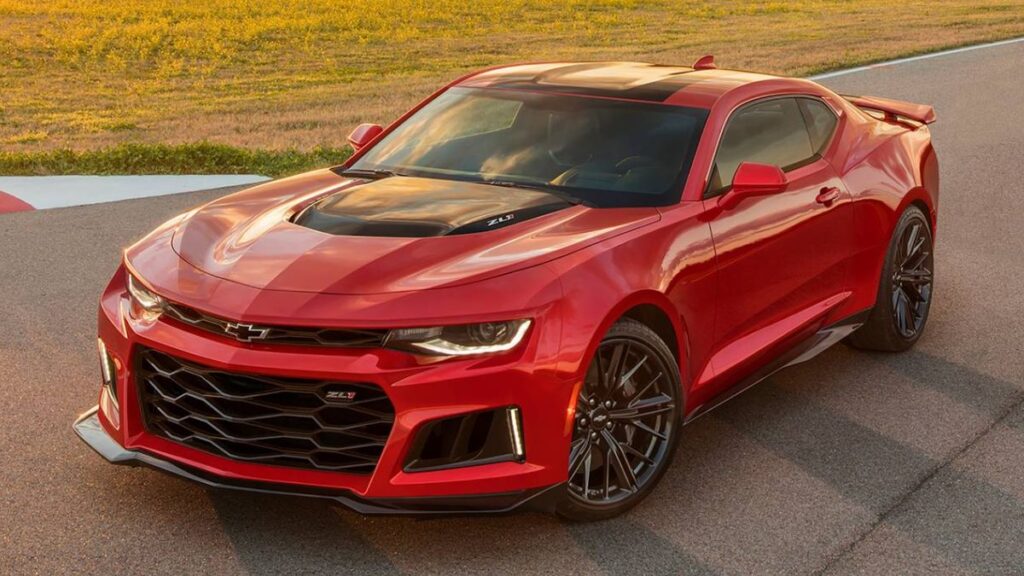
The Camaro’s silhouette hasn’t fundamentally changed in years, and it didn’t need to. The low nose, narrow slit-like headlights, and fastback roofline still look aggressive without trying too hard. Compared to the Mustang, which reads more classic and upright, the Camaro looks like it’s crouching before a sprint.
Higher trims add real visual differentiation rather than just badges. The 1SS and 2SS get functional hood vents and a more purposeful front splitter. The ZL1 goes further with a wider stance, unique wheels, and a rear spoiler that actually does something at speed rather than just looking the part. If you’re someone who cross-shops based on curb appeal alone, the Camaro consistently wins that argument against its two closest rivals.
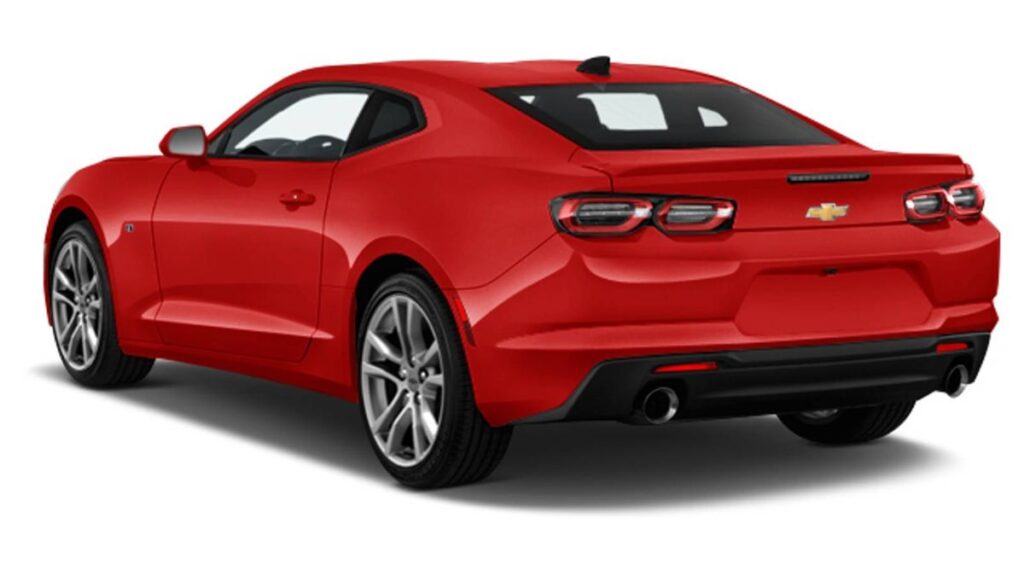
The one real drawback is practical rather than aesthetic. That dramatic roofline eats into headroom and rear visibility, a tradeoff you’ll notice every time you try to back out of a tight parking spot.
Driving Experience
The steering is quick without being nervous, and the chassis communicates exactly what the tires are doing in a way few affordable coupes manage. Turn into a corner and the car rotates with a precision that feels almost surgical for something wearing a bowtie badge.
Base four-cylinder cars are genuinely fun in their own right, lighter on the nose and eager to rev. Step into an SS with the available Magnetic Ride Control suspension and the whole character shifts. Body roll nearly disappears, and the brakes bite hard and stay consistent even after repeated hard stops. It’s the part of any Chevrolet Camaro SS review where the numbers stop mattering as much as the feeling in your hands.
The ZL1 takes things further into serious performance car territory. It rides firmer, demands more attention, and rewards a confident driver more than a casual one. It’s not a car you drive to unwind after a long day. It’s a car you drive because you want a challenge.
2022 Camaro Performance, Engine Options, and Acceleration
Chevrolet gave the 2022 Camaro four distinct engine personalities, and each one genuinely feels different rather than just offering more or less of the same thing.
The base engine is a turbocharged 2.0 liter four-cylinder producing 275 horsepower, paired with a six-speed manual transmission standard, with an eight-speed automatic available. It’s quick enough to reach 60 mph in about 5.5 seconds, which is more than adequate for most daily driving and genuinely surprising the first time you feel the turbo spool.
Step up to the 3.6 liter V6, which makes 335 horsepower. It’s the sensible middle ground of the lineup, offering a real jump in performance and a distinctly different exhaust note without pushing you into V8 fuel and insurance costs. But calling it the only smart choice would undersell what the V8 delivers. Enthusiasts will naturally gravitate toward the SS because it hands you the classic Camaro experience that a turbo four or V6 simply can’t replicate.
SS trims get a 6.2 liter V8 rated at 455 horsepower, capable of sprinting past highway speeds in around 4.0 seconds. It sounds the way a proper American V8 should, mechanical and a little unruly under hard throttle.
Topping the range is the ZL1, with a supercharged version of that same 6.2 liter V8 producing 650 horsepower and hitting 60 mph in roughly 3.5 seconds. That’s genuinely quick territory, competitive with cars costing far more.
2022 Chevrolet Camaro Review: Ride Comfort and Cabin Luxury
Comfort was never the Camaro’s mission statement, and you feel that the moment you settle in. Base and mid-level trims ride firmly but tolerably on most roads, absorbing bumps without beating you up too badly on a commute. Push into SS territory with the optional Magnetic Ride suspension, though, and things stiffen considerably. It’s a worthwhile tradeoff on a back road, less so on a pothole-riddled city street.
Seat comfort is a mixed bag. Lower trims use decent cloth buckets that hold you in place fine for daily use. Higher trims add leather and available heating, but even then the seats prioritize lateral support over long-haul comfort. If you’re planning road trips rather than weekend drives, this is worth test sitting before you commit.
Interior Design and Luxury
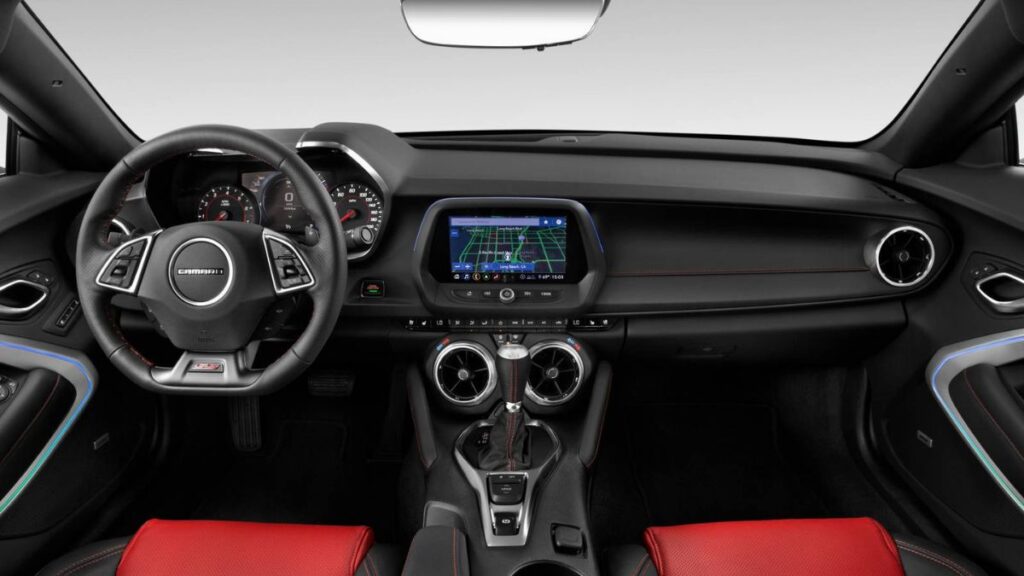
Inside, the Camaro leans sporty over plush, and that’s mostly a good thing. The dashboard wraps around the driver with a cockpit feel, and the physical buttons for climate control are a welcome throwback compared to touch-heavy rivals. It doesn’t feel cheap, but it also doesn’t try to compete with more luxury-oriented interiors from outside the segment.
Higher trims bring real upgrades, including dual-zone automatic climate control on the 2LT and a Bose branded sound system paired with an 8.0 inch HD touchscreen on the 3LT. Those additions genuinely change how the cabin feels day to day, moving from functional to something closer to premium.
Where the interior struggles is visibility and space. The high beltline and narrow windows create a closed-in feeling some drivers love and others find claustrophobic. There’s no middle ground here. Sit in one before you decide which camp you fall into.
Infotainment and Technology Features
Every 2022 Camaro comes with a 7-inch touchscreen infotainment system, voice recognition, a Wi-Fi hotspot, and wireless Android Auto and Apple CarPlay as standard equipment. That’s a genuinely strong baseline, and the wireless phone integration in particular removes one of the more annoying friction points in daily use.
Move up to the 3LT and you gain an 8.0 inch HD touchscreen, a Bose sound system, wireless charging, and a head-up display. The larger screen responds quickly and the menu structure is straightforward, though the graphics look a generation behind some rivals by 2022 standards. It works well, it just doesn’t dazzle.
A performance data and video recorder system is available on 2SS and ZL1 models, letting track day enthusiasts log lap data and record onboard footage. It’s a niche feature, but for the buyer who actually tracks their Camaro, it’s a genuinely useful one rather than a gimmick.
2022 Chevrolet Camaro Review: Fuel Economy and Real-World Efficiency
Efficiency was never going to be the Camaro’s headline feature, but the range does offer some real variance depending on which engine you choose. The turbocharged four-cylinder is the clear efficiency leader in the lineup, making it the sensible pick if fuel costs matter more to you than exhaust note.
Move up to the V6 and fuel economy drops noticeably in exchange for that extra power and sound. The V8 models, unsurprisingly, ask for the biggest sacrifice at the pump, and high performance trims like the ZL1 carry a gas guzzler tax of up to $2,100, a real cost consideration buyers sometimes overlook until it shows up on the window sticker.
If fuel economy is genuinely a priority, the four-cylinder Camaro delivers surprisingly reasonable numbers for a rear-wheel-drive sports car. Just don’t expect the same from anything wearing an SS or ZL1 badge.
Practicality and Storage
The Camaro sacrifices practicality intentionally to deliver a focused sports-car driving experience, and it’s worth being upfront about what that costs you day to day. The trunk opening is narrow and the space itself is shallower than you’d expect from the car’s overall length. Loading anything bulkier than a couple of duffel bags takes patience and sometimes a little creative angling.
The back seat exists more as a technicality than a usable space. Adults will find headroom and legroom nearly nonexistent, making it fine for short trips with kids but genuinely uncomfortable for grown passengers on anything longer than a quick errand. If rear seat usability matters to your daily routine, the Camaro simply isn’t built for that priority, and that’s a deliberate design choice rather than an oversight.
Front seat storage is reasonable, with a proper center console and door pockets that hold the essentials. But this is a two-person car with occasional room for two more in a pinch, not a genuine four-seater, and Chevy never really pretended otherwise.
2022 Chevrolet Camaro Review: Safety and Driver Assistance Features
Standard and available driver assistance features include forward collision warning, a rear camera mirror, rear parking sensors, blind-spot monitoring, and rear cross-traffic alert. Additional standard safety technology includes lane keep assist and OnStar connectivity, giving buyers a solid base of protection even on lower trims.
Independent crash testing on the Camaro has generally reflected well on the car’s structure and restraint systems, though buyers cross-shopping specific model years should check current ratings directly with NHTSA and IIHS, since testing protocols and published results can shift over time. What matters more day to day is that the driver assistance suite is genuinely useful here, helping offset one of the Camaro’s biggest real world weaknesses: that poor rear visibility mentioned earlier. The rear camera mirror in particular does real work compensating for what the greenhouse design takes away.
Worthy Competitors
Ford Mustang brings a more refined interior and significantly more usable trunk space, along with a V8 option in the GT trim that rivals the Camaro’s SS. It feels like the more livable daily choice of the two.
Dodge Challenger goes bigger in every dimension, more back seat room, more trunk space, and a genuinely massive range of V8 outputs at the top end. The tradeoff is size and weight working against it in corners where the Camaro shines.
Subaru BRZ takes a completely different approach, trading horsepower for a lighter, more nimble experience at a lower price point, appealing to buyers who prioritize handling purity over straight-line muscle.
Key Strengths and Key Weaknesses
The Camaro’s biggest strength is unmistakable. Nothing in this price range handles with the same precision, and the range of engines means there’s a genuinely different character available at nearly every budget level.
The biggest weakness is just as clear. Practicality was sacrificed almost entirely in pursuit of that driving experience, and buyers who need rear seat space or real cargo capacity will be frustrated within the first week of ownership.
Which Buyer Should Consider the Camaro
This car makes the most sense for someone who already owns a practical daily driver and wants a genuine weekend toy, or a single driver without a need for back seat passengers on a regular basis. It’s less suited to anyone shopping for a primary family vehicle, no matter how tempting the V8 sound is at the dealership.
Conclusion: Is the 2022 Chevrolet Camaro Worth Buying?
Yes, with clear eyes about what you’re buying. This 2022 Chevrolet Camaro review keeps coming back to the same tradeoff. You’re getting one of the best handling, best sounding cars in its class, wrapped around a genuinely impractical package. If that tradeoff excites you rather than concerns you, this is likely the right car in the segment. If practicality ranks anywhere near the top of your list, the Mustang or Challenger will serve you better without giving up much of the fun.
Shopping used in 2026 actually works in your favor. Depreciation has already done its work, and a well-kept SS or 2SS with reasonable mileage represents strong performance value that a new car buyer back in 2022 never got to enjoy. Buyers chasing the ultimate experience should look at a clean ZL1, while anyone wanting daily usability alongside real performance should focus their used Camaro buying guide search on a 2LT or 3LT with the V6.
The bottom line: buy the Camaro because you love driving, not because you need a practical second car. It has never pretended to be anything else, and that honesty is a big part of why it still earns respect even after production has ended.
FAQ
Is the 2022 Chevrolet Camaro reliable?
The 2022 Camaro has generally shown solid reliability, especially in models equipped with the naturally aspirated four-cylinder and V6 engines. The high-performance ZL1 is more complex due to its supercharged V8 and track-focused components, which can mean higher ownership costs.
What is the fastest 2022 Camaro?
The 2022 Camaro ZL1 is the fastest model in the lineup. Its supercharged 6.2-liter V8 produces 650 horsepower and can accelerate from 0 to 60 mph in around 3.5 seconds, putting it firmly into high-performance territory.
Does the 2022 Camaro have a usable back seat?
Not really. The rear seats are best considered occasional-use space for small passengers or short trips. Adults will find the limited legroom and headroom uncomfortable for longer journeys.
Is the Camaro or Mustang a better choice?
It depends on your priorities. The Camaro delivers sharper handling, better cornering ability, and a more focused sports-car feel, while the Mustang offers a more comfortable interior, better visibility, and greater everyday practicality.
Why should I still consider a 2022 Camaro today?
With Camaro production ending after the 2024 model year, the 2022 model has become an appealing used performance car option. Buyers can now find strong driving dynamics, powerful engine choices, and classic Camaro character without paying the original new-car price.