Best Tire Sealants for Cars Which One Is Right for You?
A practical guide to choosing the right tire sealant for roadside punctures, leaks, and emergency repairs.

A flat tire rarely picks a convenient moment. It shows up on the way to work or in the middle of a long road trip or when you are already late and the nearest tire shop is miles away. A good tire sealant can earn its place in the trunk at exactly that point. Used correctly it can help seal a small tread puncture and give you enough time to reach a safe location or a repair shop.
A tire sealant is not a universal fix and it does not replace a damaged tire. It cannot make a sidewall injury safe or turn a badly cut tire into a roadworthy one. The best tire sealants for cars are designed to handle specific types of small punctures and give you enough time to reach a safe place or a repair shop. Choosing the right product also means checking its compatibility with your tire pressure monitoring system and understanding what to do after the emergency.
Shopping for one is more confusing than it should be because the category is really several categories sharing a shelf. Some products combine sealant and air in one can. Some pair a bottle of liquid sealant with a 12-volt inflator. Others use a valve stem injector and are built to deal with bead leaks as well as tread punctures. Some are strictly emergency formulas meant to be removed within a short distance. Others are liquid compounds designed for a different kind of use. Not every product suits every tire and not every vehicle needs the same amount of sealant. TPMS compatibility matters too because sensors are expensive to replace. A product that holds air for ten miles has not necessarily repaired anything.
This guide covers five practical options for cars and light vehicles. The goal is not to pretend that one perfect formula exists. It is to show what each product does well and where it fits. It also shows where its limits begin so you can pick the one that matches the way you drive.
Our Take
The first decision is whether you want an all-in-one emergency kit or a separate liquid sealant. Everything else follows from that choice.
An all-in-one kit is the simplest answer when you do not want to carry several pieces of roadside equipment. The sealant and the inflator work together. You do not have to wonder whether the tire has enough air to spread the sealant around or whether you have a compressor that will actually reach the valve. Slime Smart Spair Ultra and AIRMAN ResQ Pro+ are both built around that idea. They are best for drivers who need a complete answer in one case. That includes anyone whose car came without a spare tire.
An aerosol can pushes the idea of convenience even further. Fix A Flat is designed for speed. There is no separate compressor to set up and no need to remove the wheel. You connect the can to the valve and follow the instructions on the label. That is a real advantage when you are standing on a narrow shoulder with traffic passing. The tradeoff is that the can does both jobs once and then it is finished. You are paying for convenience and not for a reusable air supply.
Liquid valve-injected products sit at the other end of the spectrum. TireJect uses a valve-based application system and is designed for tread punctures and bead leaks. Berryman Seal R is a liquid sealing compound that stays liquid and uses fibers to plug leaks. These products make more sense when you already carry an inflator and want more control over how the sealant goes into the tire. They ask for more preparation and a little more confidence. In return they separate the sealant from the air supply so each part of your roadside kit can be chosen on its own merits.
The second decision is what you plan to do after the puncture. A roadside sealant exists to get you out of trouble. It does not give you permission to keep driving normally for weeks. Slime and Fix A Flat both describe their emergency formulas as temporary and tell drivers to have the tire repaired after use. Slime states that the tire should be serviced within three days or 100 miles. Fix A Flat gives the same limits.
Those limits matter because a proper tire repair involves far more than stopping an air leak. The U.S. Tire Manufacturers Association says a repairable passenger or light truck puncture must be limited to the tread area and no larger than 1/4 inch or 6 mm. The tire should be removed from the wheel for a full inspection. A proper repair uses both a rubber stem or plug and an innerliner patch. A plug alone is not considered an acceptable repair. Damage in the shoulder or sidewall falls outside the repairable area.
This is why the location of the injury matters as much as its size. Most products in this guide quote a puncture limit of about 1/4 inch. That figure comes from the manufacturer and describes the tread. It does not promise anything about a hole near the shoulder. The biggest puncture claim is not automatically the best product. A product with a modest claim that you understand and can use correctly in the dark will serve you better than a bolder claim you are not sure how to apply.
TPMS adds one more layer. Many modern cars have sensors inside the wheel and a sealant that clogs or coats a sensor can lead to an expensive repair. Several of the products here are described by their manufacturers as sensor safe or TPMS safe. That is reassuring but it does not replace reading the directions. It also does not mean you should skip telling the technician what went into the tire.
So the best choice is the product you can carry easily and use correctly while stressed. The right one for a commuter with no spare may be the wrong one for someone with a compressor already in the garage.
1. Slime Smart Spair Ultra Car/Trailer Flat Tire Repair Kit

- Tire repair with the push of a button! Stop struggling with a spare tire, or waiting for roadside assistance. Slime’s Sm…
- Cost effective – no need to buy a new Flat Tire Repair Kit when you can just replace the sealant refill cartridge
- This reliable tire repair solution is higher powered to instantly repair larger truck and SUV tires, keeping you and you…
The Slime Smart Spair Ultra is the most straightforward example of an integrated emergency solution. The kit pairs emergency sealant with a tire inflator so you can seal a puncture and bring the tire back to pressure without carrying a separate compressor.
The car version includes 14 ounces of emergency tire sealant and a 12-volt inflator. Slime says the system can repair and fully inflate a tire in about ten minutes. The sealant is rated by the manufacturer for tread punctures up to 1/4 inch or 6 mm. Slime also identifies the formula as tire sensor safe. These are manufacturer specifications and the real time will depend on the tire and the conditions.
The kit makes the most sense for cars that no longer come with a spare tire. You do not have to decide between buying a bottle and buying a compressor because the package covers both. The built-in pressure gauge helps too. A roadside repair is a bad moment to guess whether the tire has reached a sensible pressure. The compact case keeps the hose and power cord together so nothing is loose in the trunk when you need it.
The main limitation is the one Slime states itself. This is an emergency formula and it should be treated as temporary. Slime says the tire should be serviced within three days or 100 miles after use. That tells you exactly how to think about the kit. It is a bridge to a proper repair and not the repair itself.
Compared with the other four products this is the easiest to recommend as a general starting point. It does not have the premium feel of the AIRMAN kit and it does not match the pure simplicity of an aerosol can. What it offers is balance. You get a complete system with a clear procedure and a clear limit.
2. AIRMAN ResQ Pro+ Tire Repair Kit
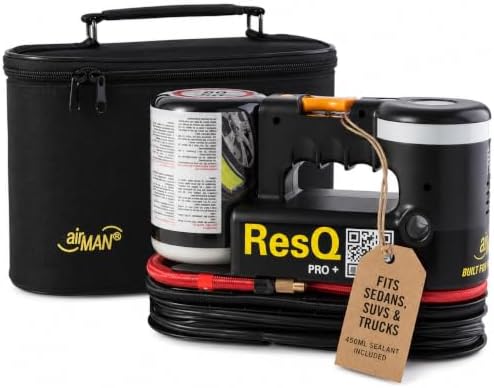
- COMPLETE TIRE REPAIR KIT WITH BUILT-IN AIR COMPRESSOR: The AIRMAN ResQ Pro+ combines a powerful 12V tire inflator with p…
- PROFESSIONAL ECO-FRIENDLY TIRE SEALANT FOR LASTING REPAIRS: Our 450ml long-lasting tire sealant provides professional fl…
- LEPOWERFUL 12V COMPRESSOR WITH SAFETY LED LIGHT: The integrated high-performance air compressor plugs directly into your…
The AIRMAN ResQ Pro+ takes the integrated approach and gives it a more finished design. The compressor and sealant system are built into one compact unit. The manufacturer describes the product as using Active Seal technology and lists a 12-volt compressor and a pressure display along with a built-in work light. AIRMAN positions it for passenger vehicles and larger vehicles such as SUVs and minivans.
What sets this kit apart is its integrated design rather than any single specification. A flat tire on a wet shoulder after dark is not the time to untangle loose parts. Here the sealant is part of the integrated system and the controls sit together. The carry case keeps everything in one place so cables and bottles are not sliding around the trunk. The built-in work light is useful when a roadside repair happens after dark.
The sealant itself is described by AIRMAN as water-based and designed to stay serviceable after use so the tire can be inspected and repaired later. The company also calls the formula TPMS safe and developed for automotive use. That is a useful detail because a technician has an easier job when the product inside the tire is easy to clean out.
This is the kit to consider when you want something more polished than a simple can. It suits drivers who cover a lot of highway miles and want an integrated unit ready to go. It also suits anyone who would rather pay for a well-organized system than assemble their own.
It is not a shortcut around the basic rules of tire repair. Once the tire is sealed and holds enough pressure to move safely the next stop should still be a repair facility. The integrated design makes the emergency easier. It does not change what happens afterward.
Next to the Slime kit the AIRMAN unit feels more like a purpose-built tool than a convenient package. Next to Fix A Flat it asks you to carry more but rewards you with a reusable compressor and a more controlled process.
3. Fix A Flat S60420 Aerosol Emergency Tire Repair and Inflator

- Emergency flat tire repair solution, connect, inflate and go! The easiest and quickest way to temporarily repair a flat …
- Fix-a-Flat is designed to seal small tread tire punctures up to 1/4 of an inch in diameter in seconds and provide enough…
- Flats happen, so be prepared with Fix-a-Flat, an easy-to-use, better alternative to the spare tire and perfect for roads…
Fix A Flat has stayed familiar for one simple reason. It takes most of the work out of an emergency repair.
The S60420 is the 16 ounce version made for standard tires. The manufacturer says it seals tread area punctures up to 1/4 inch and inflates the tire at the same time. It does not need a jack or separate tools and Fix A Flat identifies it as tire sensor safe. For someone who values speed above everything else that is a strong list of features.
Simple should not be confused with careless. You still need to confirm that the product suits the tire and follow the instructions on the can. You also need to respect the limits the manufacturer gives. Fix A Flat describes the repair as temporary and recommends professional repair within three days or 100 miles.
The aerosol format is ideal if you do not normally carry a compressor. The can lives in the trunk and comes out only when something goes wrong. It is easy to store and easy to understand and there is nothing to assemble.
The cost of that simplicity is that the can combines sealant and propellant in one disposable package. A dedicated inflator can serve you for years and is handy for routine pressure checks. A can is used once. If you already own a compressor you might prefer a separate sealant. If you do not then the can is a practical way to cover the gap.
A driver who wants more flexibility can pair a sealant with a reliable portable air compressor and rely less on a single can. That setup also makes ordinary pressure maintenance easier. Still the can remains the fastest route from a flat to a moving car for people who want no extra equipment.
4. TireJect Automotive Sedan/Crossover/Small Truck 2 in 1 Tire Sealant and Bead Sealer Kit

- 100% safe for tire and rim and TPMS sensor
- Seal bead leaks and tread punctures up to 1/4″
- Permanent seal with liquid rubber
TireJect is where the comparison gets more interesting because it works in a different way from the aerosol products. It is a liquid sealant delivered through the valve stem and it is meant for use on the road.
The Automotive formula is designed by the manufacturer to seal tread punctures up to 1/4 inch and bead leaks. TireJect describes a liquid rubber formula with aramid fibers and says it is compatible with TPMS systems. The sealant goes in through the valve stem using the supplied equipment.
The bead leak capability is the feature that makes this kit different. Not every slow pressure loss comes from a nail in the middle of the tread. A leak where the tire meets the rim can be frustrating to locate and even harder to handle away from home. The other four products in this guide are focused mainly on tread punctures. TireJect is the one that also speaks to the bead.
The company also publishes vehicle and tire size guidance. This sedan crossover and small truck version is intended for tires up to P245/65R18. Larger versions exist for bigger vehicles. That approach is better than treating every vehicle as if one dose fits all and it helps you match the product to your actual tires.
One point deserves attention. TireJect states that it does not recommend the Automotive formula as a preventative treatment for on-road vehicles. It is meant to repair an existing tread puncture or bead leak. Keep it for a real problem and do not treat it as a maintenance additive.
Application takes more involvement than a can of Fix A Flat. You work through the valve and use the supplied system to introduce the sealant. You will also need a way to bring the tire back to pressure. That makes it a better fit for a driver who already carries an inflator and likes a more deliberate process.
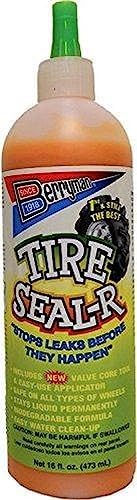
5. Berryman Seal R Tire Sealing Compound 1316
- Instantly seals pneumatic tires and tubes
- Protects against nails, screws, thorns, and other sharp objects
- Safe on all types of wheels including steel, chrome, and alloys
Berryman Seal R belongs to a different corner of the tire sealant market. It is a liquid sealing compound that stays liquid and does not cure into a hard mass inside the tire.
The manufacturer says Seal R uses fiber technology to plug leaks and prevent loss of air pressure. It is also formulated with corrosion inhibitors for steel and chrome and alloy wheels. Berryman describes it as suitable for pneumatic tires and says it can address leaks from small nails and thorns and similar sharp objects.
The appeal is flexibility. You are not buying an aerosol that combines propellant with sealant. You are buying a liquid you introduce into the tire and then inflate with whatever equipment you already have. That suits drivers who keep a compressor in the garage or the vehicle and prefer to choose their own sealant.
The corrosion inhibitors deserve a mention because anything that stays inside a tire has to get along with the wheel as well as the rubber. Berryman highlights compatibility with different wheel materials and that is worth noticing. It is a point other emergency products tend to leave out.
This is not the product I would suggest to someone who wants the absolute simplest procedure. It asks for more preparation than a can and gives you less hand-holding than an integrated kit. The buyer here is someone who is comfortable with liquid sealants and already has the means to inflate the tire. Before you buy it is wise to read the label closely and confirm that the product fits your tire and your use. Of the five this is the one that most rewards a driver who likes to understand the equipment.
How to Choose the Right Tire Sealant
The easiest way to choose is to picture the moment you will actually need the product.
If you are standing beside a freeway in the rain with a tire going soft then convenience matters more than almost anything else. An integrated kit or an aerosol can has the edge because it cuts down the number of things you have to do. Slime Smart Spair Ultra combines sealant and inflation. AIRMAN ResQ Pro+ takes the same concept further with a more integrated design. Fix A Flat is the simplest version of the idea.
If you already keep an inflator in the vehicle then a separate liquid sealant can make more sense. TireJect gives you a targeted on-road formula for tread punctures and bead leaks. Berryman gives you another liquid approach with an emphasis on fiber sealing and wheel protection.
Puncture size is another filter. Most of the automotive products here are built around punctures of about 1/4 inch or 6 mm. That does not mean they can fix any hole that size anywhere in the tire. The location of the injury matters as much as the diameter.
TPMS deserves a quick look before you buy. Several of these products are described by their makers as sensor safe and that is worth checking against your vehicle. It does not remove the need to follow the directions. Tell the tire technician what product went into the tire.
Storage is easy to ignore until the day it counts. Check the expiration date and replace old emergency supplies before you forget about them. A sealant that has sat in a trunk for years is only useful if it is still within its stated service life. Heat in a parked car can also be hard on any pressurized can or liquid so it is worth glancing at the storage guidance on the label.
It also makes sense to think about a broader roadside kit. A sealant solves one problem. A portable car jump starter solves another. A flashlight and basic safety gear can matter even more when the trouble starts after dark.
What Tire Sealant Cannot Fix
A tire sealant is not a magic repair product. It is built for particular types of punctures and leaks. A serious tire injury can exceed its abilities long before the damage looks dramatic from the outside.
The U.S. Tire Manufacturers Association limits conventional passenger and light truck repairs to the tread area and to injuries no greater than 1/4 inch or 6 mm. It excludes damage that reaches the shoulder. Sidewall damage is not something a consumer sealant can make safe. Large cuts and bulges and badly damaged wheels are also beyond what any of these products should be asked to handle.
The condition of the tire matters as well. A tire that has been driven while severely underinflated can suffer internal damage that you cannot see from the outside. That is why a proper repair means taking the tire off the wheel and inspecting the inside.
This is also why a successful seal is not the end of the story. The right sequence is simple. Use the product according to its instructions and bring the tire to the required pressure. Drive only within the manufacturer’s limits and only as far as you need to reach a safe place or a repair facility. Then tell the technician exactly what was used.
That approach is less exciting than a claim that a sealant permanently fixes a flat in seconds. It is also far more useful in the real world.
Which Tire Sealant Should You Buy?
The answer depends less on the products than on the car and the driver. Start with what your vehicle already has. If it has no spare tire then an integrated kit is the most sensible foundation because it gives you sealant and air together. The Slime Smart Spair Ultra is the most practical starting point for most drivers in that position. It combines sealant and inflation in one package and follows a straightforward procedure. The AIRMAN ResQ Pro+ is the stronger choice when you want a more polished premium kit and spend a lot of time on longer highway drives. Its compressor and sealant system and pressure display and work light make it feel purpose-built for roadside use.
If you would rather carry nothing but a single can then Fix A Flat S60420 wins on simplicity. It is meant to seal and inflate a standard tire without a separate compressor or a jack. That zero-tool approach is attractive but it means you are buying convenience and not equipment you can reuse. A driver who already owns a compressor has a different calculation. For that person a liquid formula starts to look better because the air supply is already covered.
Among the liquids the choice comes down to what kind of leak worries you. TireJect Automotive is the more interesting pick when bead leaks matter as much as tread punctures. Its published vehicle size and dosage guidance also makes it easier to match to your tires. Berryman Seal R is the specialist option for someone who likes a separate liquid compound with fiber sealing and corrosion inhibitors and already has the means to inflate the tire. Whichever liquid you choose check the tire size guidance first. The right amount for a compact sedan is not the right amount for a heavier vehicle.
Think about the kind of driving you do as well. A highway emergency is a very different problem from a slow leak found in your driveway. On a fast road you want the shortest possible stay on the shoulder and that favors integrated kits and aerosol cans. For routine tire care a dedicated inflator and a regular habit of checking pressure will do more good than any sealant. These are different jobs and it helps not to blur them.
TPMS is a good tiebreaker. If your car has sensors then lean toward products whose makers say they are sensor safe and keep the label for the technician. Compatibility claims come from the manufacturer so it is sensible to read the directions on whichever product you buy.
A tire sealant is an emergency measure and it does not replace proper tire inspection and repair. Keep the right product in the trunk and keep your tires properly inflated. Know the limits of the sealant before you need it. The best tire sealants for cars are only as good as the plan they sit inside. That plan should include getting the tire off the wheel and looked at by a professional soon after the emergency.