2021 Citroën C3 Aircross Review: Comfort Comes First
A comfort-focused crossover that puts everyday driving ahead of performance.

2021 Citroën C3 Aircross : Citroën didn’t build this crossover to impress with headline numbers. It was built for real life, and that’s either its greatest strength or its biggest limitation, depending on who’s behind the wheel.
Introduction
There’s a moment, somewhere around the third consecutive pothole on your morning commute, when you stop caring about zero-to-sixty times. You stop caring about sharp steering response and sport-tuned suspension and all the performance promises that automotive marketing departments love to make about crossovers that will never, ever see a track. What you actually want, at that specific moment, is for the car to just absorb it and move on. The 2021 Citroën C3 Aircross was built for exactly that moment.
That’s not a criticism. It’s a design philosophy, and Citroën has been unusually honest about it. While Volkswagen is pitching the T-Cross on premium interior quality and Ford is selling the Puma on driving engagement, Citroën came at the subcompact crossover market from a different angle: ride comfort, interior space, and enough personality to make the car feel like a choice rather than a compromise. Whether that strategy works depends almost entirely on what you need a car to do every day.
The C3 Aircross sits between the standard C3 hatchback and the larger C5 Aircross in Citroën’s lineup. It’s a subcompact crossover by every practical definition, riding on a raised platform that gives it just enough ground clearance to feel meaningfully different from a regular hatchback without attempting to compete with anything that takes dirt roads seriously. In European and select global markets, it competes directly against the Nissan Juke, SEAT Arona, Volkswagen T-Cross, and Renault Captur. All of those cars have legitimate strengths. None of them ride quite like this one does.
By 2021, the C3 Aircross had been around in its current generation since 2017, which means it was entering the back half of its lifecycle. Citroën made targeted updates rather than a full redesign, which is a reasonable approach if the updates address the right problems. Some of them did. Some didn’t go far enough.
Our Take
The C3 Aircross is one of those vehicles that the automotive press tends to underrate because it doesn’t dominate any single objective category. It’s not the quickest. Not the most refined. Not the most technologically advanced. But it does something that genuinely matters: it makes the daily grind less exhausting. The suspension calibration alone separates it from most of its competition in a way that you feel immediately and appreciate more over time.
Where Citroën compromised is real, though. The infotainment system improved for 2021 but still trails what Volkswagen and Ford offer. The driving dynamics are soft to the point where pushing the car even mildly into a corner reminds you that this was never the goal. Interior quality at lower trim levels feels like Citroën was watching the budget carefully. And there’s no all-wheel-drive option anywhere in the lineup, which matters in certain markets and certain weather conditions.
What you have is a car that succeeds precisely because it committed to a specific version of good rather than trying to be everything. That’s harder to achieve than it sounds. Whether those specific strengths match your specific life is the question worth asking before you sign anything.
Pros and Cons
Pros:
- Class-leading ride comfort for everyday road conditions
- Sliding rear bench adds genuine flexibility to passenger and cargo space
- Distinctive styling without the polarizing extremes of some rivals
- Efficient engine options with low running costs
- Improved driver assistance technology for 2021 across more trim levels
- Rear seat space is noticeably generous for the segment
Cons:
- No all-wheel drive available in any configuration
- Handling dynamics are among the least engaging in the class
- Base trim interior quality disappoints on close inspection
- Infotainment still behind class leaders despite 2021 improvements
- The 83-horsepower base engine struggles noticeably on highways
- Four-star Euro NCAP rating, where several rivals have earned five
What Changed for 2021
Citroën didn’t overhaul the C3 Aircross for 2021, but the updates they made were pointed. The most immediately useful change is the expanded availability of the Highway Driver Assist system, which combines adaptive cruise control with lane centering and was previously reserved for the top trim level. Moving it further down the range means more buyers can access genuinely helpful technology without paying for the fully loaded configuration.
The infotainment system received a software update that meaningfully improved responsiveness and interface clarity. Wireless Apple CarPlay became available on select higher trim levels depending on market, which is the kind of quality-of-life improvement that sounds minor until you’ve spent two years untangling a phone cable every morning. The trim structure was also simplified slightly, making it easier to identify which features come with which configuration without needing a spreadsheet.
No powertrain changes for 2021. The engine lineup carried over unchanged, which was the right call since none of the existing options had serious flaws that needed correcting.
Exterior Design
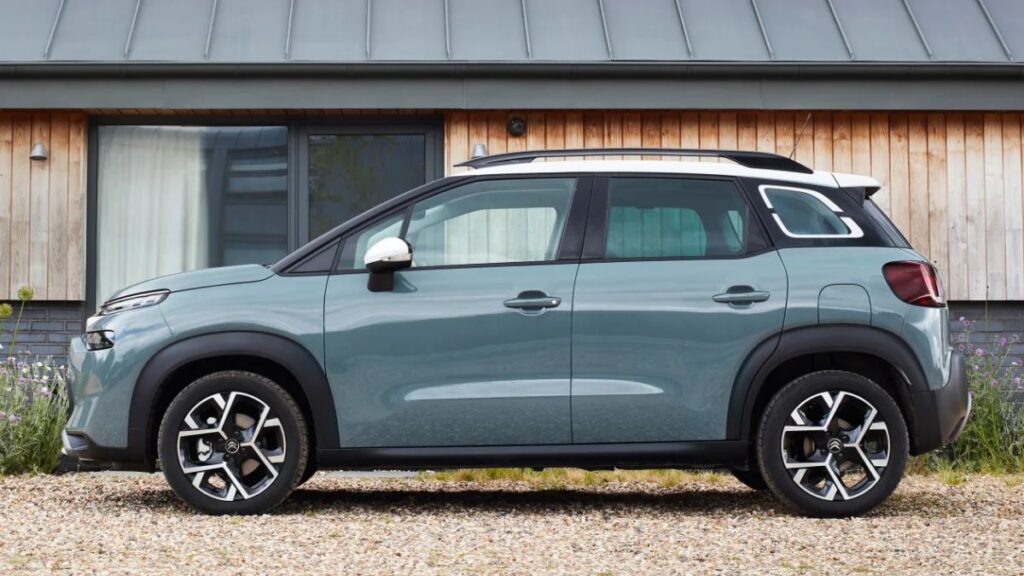
Citroën has always known how to make a car look like itself. The C3 Aircross doesn’t suffer from the generic crossover problem where you need to check the badge to know what you’re looking at. The upright proportions, the tall greenhouse, the squared-off wheel arches, and the floating roof effect created by the two-tone color combinations give it a personality that stands apart from the T-Cross’s polished conservatism or the Juke’s confrontational aggression.
The two-tone roof option is worth discussing separately because it changes the character of the car significantly. In something like Emerald Crystal over Cumulus Grey, the C3 Aircross reads as stylish and intentional rather than just functional. Citroën offers the combination in a range of pairings, and the better ones genuinely work. The bolder exterior color choices suit the design philosophy better than conservative silvers and whites, though those are available too.
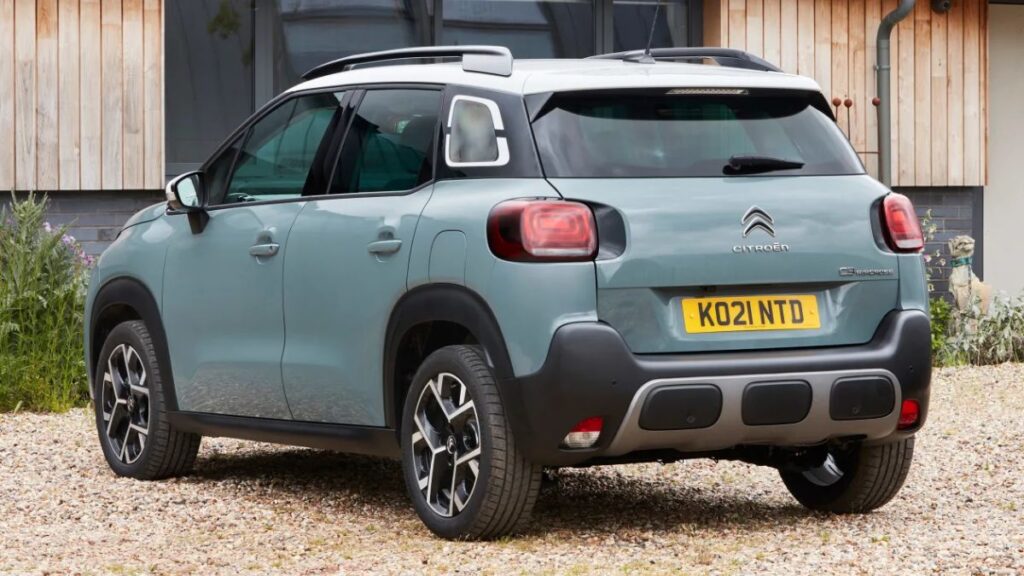
From the front, the face is friendly rather than aggressive. The chrome accent bar connecting the light clusters gives it a horizontal emphasis that makes the car look wider than it actually is. The side profile rewards the upright design with large windows that serve visibility just as much as aesthetics. The rear is clean and uncomplicated, which is a reasonable outcome for a car that wasn’t trying to be dramatic at every angle.
It’s a cohesive design. Not every angle is equally resolved, and the rear quarter can look slightly boxy in less flattering colors, but overall the C3 Aircross presents itself with more confidence than its price point would suggest. In a segment where several competitors look interchangeable, that matters.
Driving Experience
Here’s the honest account. Put the C3 Aircross on a smooth, well-maintained highway and it’s composed, quiet enough, and comfortable in a way that makes long distances feel manageable. Move it onto the kind of roads that make up the majority of daily driving in most cities, surfaces with expansion joints and patches and the occasional subsidence that local governments keep promising to fix, and the car changes character in the best possible way. The suspension just handles it. Not in a dramatic, look-at-this-technology way. More like a very good pair of shoes. You stop thinking about it because it stops being a problem.
Citroën describes their suspension philosophy as Advanced Comfort, and unlike a lot of manufacturer marketing language, this one is basically accurate. The spring and damper calibration is noticeably softer than the class average. The car absorbs imperfections rather than deflecting them. Body roll is present and accounted for in corners, which is the honest trade-off for that compliance. You’re not going to hustle this car through a winding road and enjoy the process. It communicates very little through the steering, the front end pushes wide earlier than you’d like when pressed, and the overall sensation is of a car that would prefer you drove smoothly and stopped testing it.
That’s a fair deal if your morning commute involves a school drop-off, a school zone, three stop signs, and a stretch of road that the city apparently forgot exists. For that driver, the C3 Aircross is a legitimate daily pleasure. For the driver who actually wants to feel something through the wheel on a Saturday morning drive, this isn’t the right car. The Ford Puma handles that particular brief far better.
Highway cruising is stable and reasonably refined. Wind noise around the mirrors becomes noticeable above 65 mph, and it’s the kind of noise that you become more aware of over a long trip rather than less. Not a dealbreaker, just a note.
Performance and Engines
The 2021 C3 Aircross lineup in most markets includes three engine options. Entry-level buyers get the 1.2-liter PureTech three-cylinder in 83-horsepower form. Mid-range trims offer the same displacement with 110 horsepower and, depending on configuration, either a six-speed manual or a six-speed automatic transmission. The diesel option is the 1.5-liter BlueHDi four-cylinder making 100 horsepower, paired exclusively with a manual gearbox.
The PureTech 83 is adequate in town. It pulls smoothly at low speeds, the three-cylinder character isn’t intrusive, and around-town fuel economy is genuinely impressive. But ask it to merge confidently onto a highway, or hold 75 mph on a long climb, and it communicates its limitations clearly. The engine isn’t strained to the point of being unpleasant, but you’re aware that it’s working harder than it would prefer. For urban buyers who rarely touch a highway, it works. For everyone else, it’s the wrong choice.
The PureTech 110 is the powertrain the C3 Aircross was designed around. With the six-speed automatic, it’s smooth, responsive enough for normal driving demands, and doesn’t require constant planning ahead the way the 83 sometimes does. Passing power is modest but present. The automatic gearbox shifts without drama and doesn’t hunt between ratios the way some dual-clutch setups in this segment do. It’s an honest powertrain for an honest car.
The BlueHDi 100 diesel makes its case through torque rather than peak power. The 250 lb-ft it produces means the car feels more relaxed at highway speeds and responds better to real-world demands like overtaking or loaded highway cruising. WLTP fuel economy figures for the diesel reach approximately 56 to 61 mpg depending on configuration, which is the genuinely relevant figure for high-mileage drivers. The math on diesel versus gas only favors the diesel if you’re covering significant annual mileage, which in most European markets means somewhere above 12,000 to 15,000 miles per year.
One important note on the PureTech engine family: earlier versions across multiple Citroën and Peugeot models experienced documented issues with timing belt wear and oil consumption, primarily in pre-2019 production. Citroën made running changes to address these concerns, and the 2021 engines are considered improved. Buyers should still be aware of this history when purchasing used examples from earlier model years, and verifying service records on any pre-owned purchase is advisable.
Ride Comfort and Cabin
The cabin experience in the C3 Aircross is defined more by what you don’t feel than by what you do. Rough pavement doesn’t translate into a jarring seat. Speed bumps register as a mild suggestion rather than a physical event. Over the course of a day’s driving, that absence of punishment accumulates into something that feels genuinely relaxing, which is not a word that gets used often enough in automotive reviews.
Front seat comfort is above average. The seats offer good support without the kind of aggressive bolstering that becomes uncomfortable after an hour. The driving position is elevated in the way that crossover buyers expect, with a clear view over traffic and a natural seating posture that doesn’t require adjustment every twenty minutes. Long highway trips are handled comfortably, though the seat padding could use a bit more density in the base of the cushion on extended runs.
The rear bench is where the C3 Aircross distinguishes itself from most rivals at this price. The sliding function, available on mid and upper trim levels, allows the bench to move roughly 15 centimeters fore and aft. Push it back and adult rear passengers have genuinely comfortable legroom. Push it forward and the trunk grows accordingly. It’s a simple mechanical solution, but it gives the car a flexibility that genuinely useful for families who alternate between hauling people and hauling cargo. Very few competitors at this price point offer it.
Headroom front and rear is generous, a direct benefit of the upright roofline. Three adults across the rear is tight horizontally, as it is in virtually every car in this segment, but two adults in back have a level of space that the exterior dimensions don’t prepare you to expect.
Interior Quality and Design
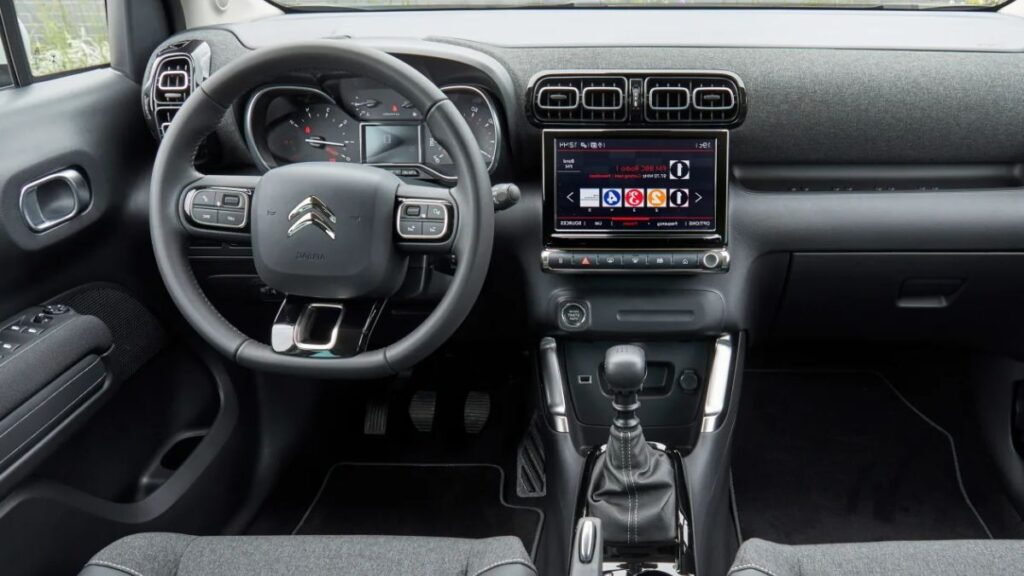
The interior of the C3 Aircross tells two different stories depending on which trim level you’re sitting in. In higher configurations, the dashboard design is clean and logically arranged, the color accent options give the cabin actual personality, and the overall impression is of a car that was thought about carefully. In base trim, the hard plastics on the lower dash and door panels are the kind that you’d find in a car that costs noticeably less, and the gap feels wider than the price difference justifies.
Citroën’s approach to interior design leans on bold color choices rather than material quality to create a feeling of character, and at its best it works. The interior accent colors coordinate with the exterior two-tone options, and the seats with contrasting stitching in better trim levels look genuinely appealing. But materials matter, and when you touch the lower door panel in a base C3 Aircross, you’re reminded that personality doesn’t always translate into quality.
Visibility is one of the cabin’s genuine strengths. Large windows all around, a thin A-pillar, and the high seating position combine to make the car easy to place on the road and comfortable in tight parking situations. For urban drivers who spend time parallel parking on crowded streets, that’s not a trivial advantage.
Storage throughout the cabin is practical and well-considered. Door pockets accommodate bottles and actual objects rather than just existing symbolically. The center console storage is usable. The glovebox is properly sized. None of this is glamorous, but it’s the kind of thoughtful detail that makes a car easier to live with than a car that focuses all its effort on the parts that look good in a brochure.
Technology and Infotainment
The 2021 update addressed some of the legitimate complaints about the previous infotainment setup. The 7-inch touchscreen interface is cleaner and more responsive than it was, and the addition of wireless Apple CarPlay on higher trim levels, depending on market, removes a daily friction point that the old wired-only setup created. Android Auto is available as well. The screen size is adequate without being impressive, and the graphics quality is functional rather than polished.
The system’s weak point is navigation. If you’re used to the Volkswagen MIB3 system or the Ford SYNC 4 interface, Citroën’s offering feels a generation behind in terms of map quality and route logic. For buyers who primarily navigate through their connected smartphone, this is a non-issue. For buyers who rely on the built-in system, it’s a real consideration.
Audio quality from the standard setup is acceptable for casual listening. The optional upgraded audio is worth considering if music quality matters to you, as the base speaker configuration lacks low-end weight.
Driver assistance technology improved meaningfully for 2021. Highway Driver Assist, combining adaptive cruise with lane centering, works reliably on well-marked highways and reduces fatigue on longer trips. Automatic emergency braking and lane departure warning became standard across more trim levels this year, which is the right direction regardless of price point. The systems work without being intrusive, which is the correct balance and one that not every manufacturer has figured out.
Fuel Economy
EPA estimates aren’t available for the C3 Aircross since it isn’t sold in the United States. European WLTP figures are the relevant reference point.
The PureTech 83 manual is rated at approximately 47 to 49 mpg on the WLTP combined cycle. The PureTech 110 with the six-speed manual returns similar figures. With the automatic transmission, the PureTech 110 comes in around 44 to 46 mpg combined under WLTP testing. Real-world figures in mixed driving typically land several miles per gallon below WLTP numbers, which buyers should factor into their expectations.
The BlueHDi 100 returns approximately 56 to 61 mpg WLTP combined, which remains genuinely impressive for a car this size and is the clearest argument for the diesel option in high-mileage use cases.
Practicality and Cargo Space
Trunk capacity measures 410 liters with the rear bench in its standard position, which is competitive for the segment. With the sliding bench pushed fully forward, that number increases to 520 liters, a meaningful gain for grocery runs or weekend trips. Fold the rear seats flat and you get a usable load floor without excessive lipping or an awkward angle where the folded seatback meets the cargo floor.
The practical details inside are well-handled. The cargo floor is at a useful height for loading without excessive lifting. Rear seat fold is simple and doesn’t require removing headrests first, which is a small thing that becomes mildly annoying when a competing car makes you do it. The overall practicality picture is one of the stronger elements of the C3 Aircross ownership case.
Safety
The C3 Aircross holds a four-star Euro NCAP rating from its original testing, which means it’s safe but not class-leading by that measure. Several competitors have achieved five stars, and that’s a factual distinction that buyers making safety a priority should weigh. The structural scores were solid, and occupant protection in frontal impact scenarios rated well. Some of the active safety scores held the overall rating below five stars.
Standard safety equipment across most 2021 markets includes automatic emergency braking, lane departure warning, and driver attention monitoring. Higher trims add Highway Driver Assist and blind-spot monitoring depending on market and configuration. The 2021 updates brought some of this technology to lower trim levels than before, which improves the overall safety proposition across the lineup.
Competitive Landscape
The Volkswagen T-Cross is the sharper, more premium alternative. Better interior quality, more precise driving dynamics, and a stronger infotainment system. It also costs more once equipped to a comparable level, and the ride is noticeably firmer on rough pavement.
The Renault Captur offers strong interior quality, a hybrid option that the C3 Aircross can’t match, and a similarly practical layout. It’s a more rounded package in some respects, particularly for buyers where the mild-hybrid fuel savings are relevant.
The Ford Puma is the choice for anyone who actually wants to enjoy the drive. Considerably more engaging chassis, competitive efficiency, and the clever under-floor MegaBox storage. Ride quality is a step down from the Citroën.
The Nissan Juke improved significantly for its second generation with a much better interior, but rear legroom remains genuinely tight for adults. The design is still polarizing, though its quality has caught up with its ambition.
Biggest Strengths and Biggest Weaknesses
The C3 Aircross’s most significant advantage is its ride quality, and it’s not close. In a segment where most manufacturers have chased sharper handling at the expense of daily comfort, Citroën made the opposite call. For buyers who live on less-than-perfect roads, which is most buyers in most places, that advantage translates directly into a better daily experience.
The most significant weakness is the complete absence of driving engagement. This is not a car that rewards pushing. It’s not a car that communicates feedback through the steering. It’s not a car that makes you look forward to a winding road. That’s a deliberate choice, but it eliminates the C3 Aircross from consideration for a meaningful portion of buyers who want a crossover that’s also enjoyable to drive.
Which Buyer Does This Car Actually Suit?
The C3 Aircross makes the most sense for urban and suburban buyers who prioritize ride comfort, interior space efficiency, and low operating costs over driving dynamics or premium interior quality. Families with children who spend regular time in the rear seat will notice the space advantage and appreciate the sliding bench flexibility. Buyers who cover modest annual mileage in mixed driving conditions will find the PureTech 110 petrol a well-matched powertrain. High-mileage commuters should take a serious look at the diesel.
It’s less well-suited for buyers who value a dynamic driving experience, need all-wheel drive for regular winter conditions, or are comparing it against premium-positioned rivals on interior quality grounds.
Conclusion: Should You Buy It?
If your priority list starts with comfort, practicality, and reasonable operating costs, the 2021 Citroën C3 Aircross earns a genuine recommendation. It won’t excite you on a back road, and the interior quality at lower trim levels asks you to accept some compromises. But it will absorb your daily commute with a degree of ease that most of its competitors simply don’t offer, and it does it at a price that’s hard to fault.
The smarter move is to step up from the base engine and base trim level. The PureTech 110 automatic in a mid-range configuration is where the C3 Aircross makes its best case. Below that, the compromises start to outweigh the strengths. Above that, it becomes a genuinely capable, comfortable, and characterful daily crossover that succeeds at everything it set out to accomplish.
Buy it for what it is. Don’t buy it for what it isn’t. That’s all the advice you actually need.
FAQ
Is the 2021 Citroën C3 Aircross a reliable car to buy?
The 2021 model benefits from improvements Citroën made to the PureTech engine family following documented reliability concerns with earlier production versions. The 2021 engines are considered improved, but buyers looking at used examples from 2017 to 2018 should verify service history carefully and be aware of the earlier timing belt and oil consumption issues.
Does the 2021 Citroën C3 Aircross come with Apple CarPlay?
Yes, but availability depends on market and trim level. Wireless Apple CarPlay was added to higher trim configurations as part of the 2021 updates. Lower trims may offer wired connectivity only. Android Auto is also supported across compatible trim levels.
What is the cargo space in the 2021 Citroën C3 Aircross?
Trunk capacity is 410 liters in the standard seating configuration. With the available sliding rear bench pushed forward, capacity increases to 520 liters. Fold the rear seats flat for maximum load space without major obstacles at the load lip.
Is the Citroën C3 Aircross available with all-wheel drive?
No. The 2021 C3 Aircross does not offer all-wheel drive in any configuration or market. It is front-wheel drive exclusively across all powertrain options.
Which engine is the best choice in the 2021 Citroën C3 Aircross?
For most buyers, the 1.2-liter PureTech 110 paired with the six-speed automatic is the most balanced choice. It offers enough power for confident everyday driving, smooth gearchanges, and reasonable fuel economy. The diesel BlueHDi 100 makes financial sense only for drivers covering high annual mileage where the fuel savings justify the higher purchase price.