The 2023 Toyota Camry is the kind of car that doesn’t show up in enthusiast conversations, doesn’t win styling awards, and rarely makes anyone’s list of dream purchases. It has been the best-selling car in America for most of the last two decades not because it excites people but because it doesn’t let them down. That’s a harder thing to build than it sounds, and Toyota has been refining the formula for forty years.
For 2023, nothing dramatic changes. No new generation, no redesigned interior, no turbocharged engine to chase the Honda Accord. Toyota made two small adjustments to the SE Nightshade Edition and added a couple of safety features as standard across the lineup. Everything else carries over. In a different car, that kind of stagnation would be a warning sign. In the Camry, it reads more like confidence. The car sold over 295,000 units in the US last year. Toyota isn’t changing what’s working.
What you’re actually deciding when you consider a Camry is whether you value long-term peace of mind over short-term driving satisfaction. This is a car built for people who want to stop thinking about their car: dependable on a Tuesday morning in January, fuel-efficient on a long highway run, still worth a reasonable amount when you eventually trade it in. If you want something that rewards a spirited back road or impresses passengers with a premium interior, the Camry will disappoint you. If you want a car that simply handles the job every day for ten years without drama, very few alternatives have the track record to compete.
2023 Toyota Camry: Our Take
The four-cylinder engine returns solid fuel economy, the cabin is spacious enough to carry four adults without complaint, and the standard safety suite covers the basics without nickel-and-diming you on trim levels. The SE adds a slightly sportier suspension that makes the car feel more planted on the highway, which is a genuine improvement for the money.
The weak spots are real, though. The base engine sounds strained when you push it, and highway noise bleeds into the cabin more than rivals at this price. The infotainment system, while functional, lags behind what Honda and Hyundai are shipping on comparable cars. None of these are dealbreakers, but they’re worth knowing before you sign anything.
Pros and Cons
Pros
- Excellent fuel economy across all engine options
- Spacious cabin with room for adults front and rear
- Available all-wheel drive on four-cylinder models, rare in this class
- Comprehensive standard safety features
- Strong long-term reliability and resale value
Cons
- Four-cylinder sounds rough under hard acceleration
- Wind and road noise noticeable at highway speeds
- Base engine 0-60 of 8.2 seconds is slow for the class
- Infotainment feels a generation behind rivals
- Interior design is functional but short on personality
What’s New for 2023
Not much. Toyota is running the current generation out toward what’s likely a replacement, so 2023 is largely a carryover year. The SE Nightshade Edition swaps its previous 18-inch black wheels for 19-inch bronze-painted alloys, which sharpens the look. Automatic headlights and road sign recognition are now standard across the lineup. Everything else holds steady. This is a year to buy a Camry, not a year to wait for one.
Exterior Design
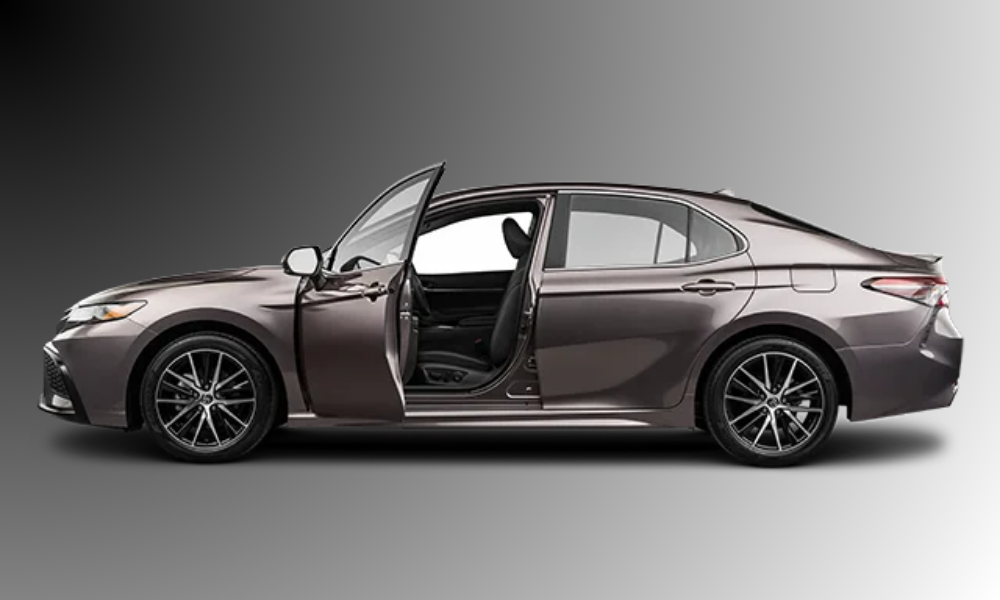
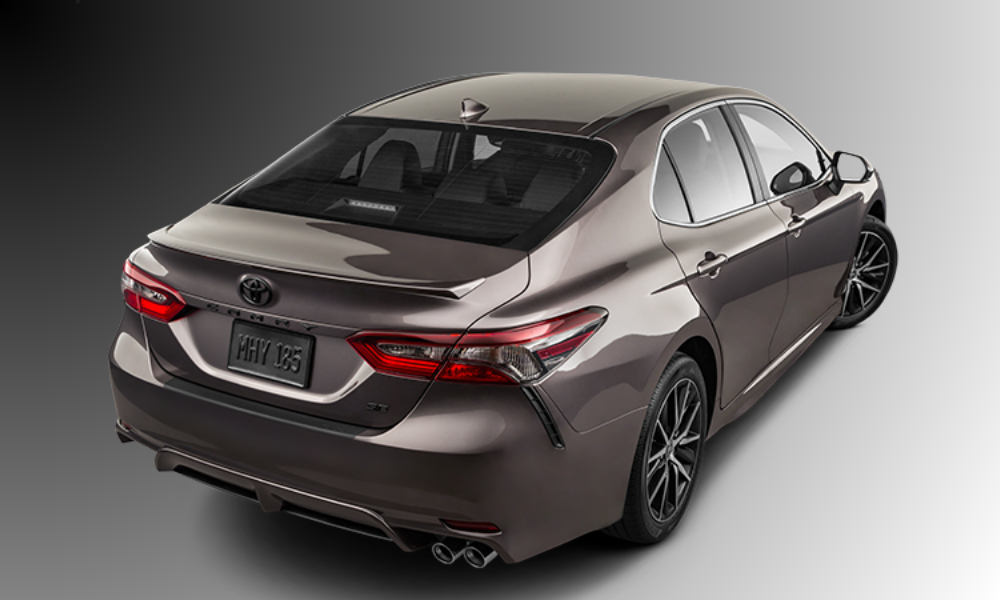
The current Camry generation has aged better than most. The sharp creases, low roofline, and aggressive front end give it a more athletic stance than the bland boxes this car used to be. The SE and XSE push that further with sportier grilles and larger wheels. The Nightshade Edition adds blacked-out trim and the new bronze wheels for buyers who want something darker and more distinctive.
Against its rivals, the Camry splits the difference. The Honda Accord leans elegant and understated. The Hyundai Sonata goes bolder and more futuristic. The Camry lands between them, sporty enough to look current, conservative enough to age well.
2023 Toyota Camry Driving Experience
The Camry drives like a car that wants to stay out of your way. The steering is light and responsive in traffic, the suspension absorbs rough pavement without drama, and the whole package feels composed at highway speeds. It won’t ask much of you as a driver, which is either a feature or a drawback depending on what you’re looking for.
The SE trim’s sportier suspension is worth calling out specifically. It tightens up the body motions through corners without making the ride harsh, and the result is a car that feels more intentional than the base LE. Not sporty in any meaningful sense, but noticeably more settled. For most buyers, the SE is the one to drive before deciding.
The noise issue is worth addressing honestly. The Camry’s cabin is not particularly well-insulated at highway speeds. Wind noise comes in around the mirrors, and the base four-cylinder produces a rough buzz under hard acceleration that you don’t forget after the first time you hear it. Some buyers won’t notice or care. Others will find it wears on them over longer drives.
Performance and Acceleration
Three powertrains are on offer, each aimed at a different buyer.
The 2.5-liter four-cylinder is the one most people choose, and it makes sense at a casual glance: 203 horsepower, an eight-speed automatic, and up to 39 mpg on the highway. The problem shows up in the numbers. We tested 0-60 in 8.2 seconds, which is genuinely slow by 2023 standards. Adequate for most daily driving, but you’ll feel the hesitation merging onto a busy highway.
The 3.5-liter V6 fixes the performance problem cleanly. 301 horsepower, 0-60 under six seconds, and it transforms the Camry into something you’d actually enjoy pressing. The tradeoff is fuel economy and the loss of AWD availability. The V6 is front-wheel drive only.
The hybrid splits the difference in its own way. 208 horsepower with a CVT, and up to 52 mpg combined, which is legitimately impressive for a car this size. The CVT keeps things smooth and quiet, which suits the hybrid’s character. It’s not quick, but it’s refined in a way the base four-cylinder isn’t.
Ride Comfort and Cabin Refinement
Ride quality is one of the Camry’s genuine strengths. The suspension irons out rough patches without passing the impact through to the seats, and the car stays composed over the kind of uneven pavement most American roads serve up daily. Front seats are supportive and accommodating for a wide range of body types, and longer trips don’t wear on you the way they might in a firmer European sedan.
The noise situation is the counterpoint. Highway wind noise and road hum are more present than in the Honda Accord or Hyundai Sonata. The four-cylinder engine compounds this when you press the throttle hard. If cabin quietness matters to you, drive the hybrid: the electric assist keeps the engine load low and the noise levels noticeably better.
Interior and Luxury Feel
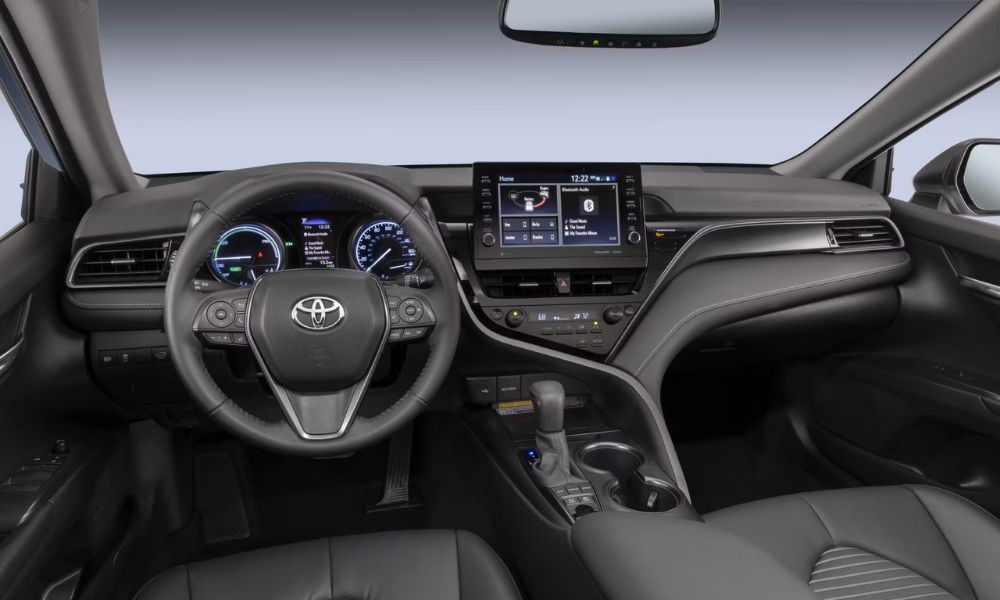
The Camry’s interior is well put together but not particularly inspiring to look at. The layout is logical, the gauges are clear, and the buttons are where you’d expect them to be. It’s easy to operate without taking your eyes off the road, which matters more than it sounds.
Materials are the limitation. The base and mid-level trims use plastics that feel durable but not premium. Higher trims introduce leather and softer surfaces, which improve the feel without quite closing the gap on the Accord’s interior quality. The Camry’s cabin is designed to last, not to impress at the dealership.
Rear seat room is genuinely good. Adult passengers sit comfortably, legroom is generous, and the seatback angle is right. Child seat installation is straightforward, with accessible Isofix anchors and easy top tether access.
Technology and Infotainment
The Camry’s technology works, but it’s a year or two behind what rivals offer. The 7-inch base screen and optional 9-inch upgrade are clear and readable, and Apple CarPlay, Android Auto, and Amazon Alexa integration are all standard. Navigation is available on upper trims.
The core issue is that the system feels slow compared to what Honda and Hyundai ship. Menu transitions lag slightly, and the interface design looks like it came from an earlier era of touchscreen development. For buyers who spend significant time with their phone mirrored anyway, this matters less. For those who use native navigation and audio controls, it’s noticeable.
Toyota Safety Sense 2.5+ is standard across the lineup and covers adaptive cruise control, automatic emergency braking, lane keeping assist, and road sign recognition. These systems are well-calibrated and genuinely useful without being oversensitive.
2023 Toyota Camry Fuel Economy
The four-cylinder’s EPA rating of 32 mpg combined (28 city / 39 highway) is among the strongest in the class for a non-hybrid. In real-world testing, we measured 33.7 mpg on a standardized 115-mile route, which tracks closely with the official number. Over 33,000 miles of long-term testing, the average settled at 29.8 mpg in mixed conditions.
The hybrid pushes that to 52 mpg combined, which remains one of the better figures available in a mainstream midsize sedan. The V6 naturally sits lower, though it’s still reasonable for a 301-horsepower engine.
For buyers who cover significant daily mileage, the hybrid’s premium pays back through fuel savings at a rate that’s worth calculating before choosing the four-cylinder.
Practicality and Storage
The trunk offers 15.1 cubic feet with a wide opening and a low liftover height that makes loading straightforward. The 60/40 rear seat folds via trunk-mounted releases, which is a practical touch. Interior cabin storage is adequate: a sliding tray under the wireless charger, a moderately sized center bin, and a small cubby on the left dash. Nothing exceptional, but nothing you’ll be searching for either.
Where the Camry Wins and Where It Falls Short
The Camry’s strongest argument is the one nobody argues about: long-term ownership. Reliability ratings consistently place it near the top of the midsize sedan class, and Toyota’s resale values hold better than most of its competitors. For buyers who plan to keep a car for seven or eight years and want to spend as little time worrying about it as possible, the Camry’s track record is genuinely hard to match. Add the availability of AWD on four-cylinder models, which the Honda Accord still doesn’t offer, and the value case becomes more specific and more defensible.
The weakness is equally honest. The Camry doesn’t deliver the kind of driving experience that makes you look forward to getting in it. The base engine’s 8.2-second 0-60 is slow, the cabin noise is above average for the class, and the interior materials at the lower trim levels don’t give you the feeling that you’ve bought something premium. The Honda Accord handles better, has a more refined powertrain, and presents a more polished interior. The Sonata offers more technology for the money. The Camry’s answer to both of those cars isn’t a feature; it’s a reputation. For some buyers, that’s more than enough. For others, it’s a reason to cross-shop.
Competitors Worth Considering
Honda Accord. The sharpest alternative in the class. Better handling, a more premium interior, and a more refined driving experience. The Camry counters with better fuel economy on comparable powertrains and the option of AWD, which the Accord doesn’t offer.
Hyundai Sonata. Strong value, a bolder design, and a more modern infotainment system. Generous feature list at competitive prices. The Camry’s reliability reputation and resale value give it an edge in total ownership cost.
Nissan Altima. Comfortable ride and available AWD, but it trails the Camry on fuel economy and long-term dependability. Worth a test drive if ride softness is a priority.
Kia K5. More distinctive styling and a generous standard feature list. A solid alternative for buyers who want something that stands out more.
Trim Comparison
The 2023 Camry runs seven trim configurations, which is more than most buyers need to sort through.
LE (~$26,320) is the entry point and more complete than its price suggests. You get LED headlights, dual-zone climate, Apple CarPlay and Android Auto, and the full Toyota Safety Sense 2.5+ suite. The 17-inch wheels and base materials are the obvious limitations, but nothing feels stripped.
SE (~$27,860) is where Cardrav recommends most buyers start. The sportier suspension is a genuine improvement to how the car feels, the 18-inch wheels fill the arches better, and SofTex upholstery is easier to clean than fabric. The $1,540 jump from LE is justified by the changes you’ll notice daily.
SE Nightshade (~$28,860) adds the 19-inch bronze wheels and blacked-out exterior trim. A style upgrade, not a substance one. Worth it if the look appeals; skip it otherwise.
XLE (~$31,070) brings leather seats, heated fronts, the 9-inch touchscreen, and a premium audio system. This is the right choice for buyers who spend significant time in the car and want a more comfortable environment for it.
XSE (~$31,620) pairs sporty styling with the XLE’s comfort features and 19-inch wheels. For buyers who want the aesthetic of the SE with the interior upgrades of the XLE, this is the one.
TRD (~$33,385) gets the 301-horsepower V6, sport-tuned suspension, and unique styling touches. The most engaging Camry to drive, though still not a sports sedan by any strict definition.
XLE V6 / XSE V6 (~$36,195-$36,745) combine V6 power with the top interior appointments. Legitimate performance with premium features, though at this price the comparison to entry-level luxury sedans becomes unavoidable.
Which Trim Does Cardrav Recommend?
The SE. It improves the two things you notice most in daily use: how the car feels through the steering wheel and how the interior holds up over time. The sportier suspension is a genuine upgrade, and the SofTex upholstery is more practical than fabric without costing significantly more. The panoramic sunroof and blind-spot monitoring are both available as options on the SE, which covers most of what buyers typically add at higher trims.
The LE makes sense if the budget is the primary constraint. The XLE is the call if you’re buying comfort and plan to keep the car long-term. Skip the TRD unless you specifically want the V6 without the luxury trim additions.
Should You Buy the 2023 Toyota Camry?
Buy it if reliability, fuel economy, and long-term ownership cost are your priorities. The Camry’s track record on dependability is as strong as any car in this segment, the fuel economy numbers are competitive, and AWD availability gives it a practical edge over most rivals.
Skip it if you care about driving engagement, interior quality at higher price points, or having the latest infotainment. The Honda Accord is the better driver’s car. The Sonata offers more technology for the money. The Camry’s case is built on what it is over time, not what it feels like on the test drive.
Final Verdict
The 2023 Toyota Camry is the car you buy when you want to stop thinking about your car. It’s not exciting, and it doesn’t try to be. What it offers instead is a quiet confidence: it will start every morning, cost you less at the pump than most alternatives, and still be worth something reasonable when you eventually sell it.
The base engine’s sluggishness and the cabin noise are real limitations that prevent the Camry from being the obvious choice in every situation. But for buyers who put high mileage on a car and want something dependable over the long run, few rivals have earned that trust as consistently as this one.
FAQ
Is the 2023 Toyota Camry a good car for families?
Yes. The cabin carries four adults comfortably, the trunk is practical with a low liftover height, and child seat access is easy. The standard safety suite adds meaningful coverage at every trim level. Fuel costs stay manageable on the four-cylinder, and reliability means fewer unexpected repair bills.
Should I get the hybrid or the four-cylinder?
It comes down to mileage. The hybrid’s 52 mpg combined versus the four-cylinder’s 32 mpg is a meaningful gap, and the hybrid’s higher purchase price recovers through fuel savings over time. If you drive 15,000 miles a year or more, the hybrid math works in your favor. Below that, the four-cylinder is the more straightforward choice.
Is the Camry fun to drive?
Not particularly. It’s competent and settled, but fun isn’t what it’s built for. The TRD trim with the V6 is the closest it gets, and even that is more brisk than engaging. If driving enjoyment is on your checklist, the Honda Accord is the better test drive.
How does the 2023 Toyota Camry compare to the Honda Accord?
The Accord handles better, presents a more premium interior, and has a more refined powertrain across the range. The Camry answers with better fuel economy on comparable engines, available all-wheel drive that the Accord still doesn’t offer, and a stronger reliability record. Neither is a clear winner; they’re built for slightly different buyers.
Is the 2023 Toyota Camry reliable?
Consistently yes. RepairPal ranks it second out of 28 midsize cars with a reliability score of 4.5 out of 5. Toyota’s long-term dependability reputation is one of the Camry’s most durable selling points, and the ownership data backs it up.