2023 Honda Accord Review: Still the Best Midsize Sedan
A Complete Redesign Pushes the Accord Closer to What Buyers Actually Want

The 2023 Honda Accord enters its 11th generation as a complete redesign, arriving at a time when the midsize sedan feels almost quaint in the American market. Crossovers have cannibalized sales. Manufacturers have abandoned this segment entirely. Yet Honda persists, and it does so by essentially asking itself: what do families need in a car? Not what sounds exciting. Not what pushes boundaries. What actually works.
The Accord’s previous generation was already a strong car. This new one doesn’t reinvent anything, but it refines nearly everything that matters. A stiffer structure. Better suspension geometry. A redesigned interior that trades flashiness for genuine usability. And here’s the controversial part: Honda killed the beloved 2.0-liter turbocharged engine. It’s gone. In its place sits either a revised 1.5-liter turbo or, for most of the lineup, an entirely new hybrid system.
Compared to the Toyota Camry, which has softened over time into something approaching a luxury car, the Accord maintains a more athletic profile. The Nissan Altima and Hyundai Sonata are competent rivals, but neither quite captures the same balance of refinement and responsiveness. The Accord understands that buyers want to drive something that doesn’t feel like an appliance, even if they’re mostly using it for family errands.
It’s not the most powerful sedan at this price. It’s not the most spacious. But the 2023 Accord is built with intelligence, and that matters.
Our Opinion
This is a car for people who aren’t dramatic about transportation but also refuse to accept mediocrity. The 2023 Accord delivers genuine quality in its construction, driving feel, and interior design philosophy. The new chassis improvements make a real difference on the road, and you notice this immediately when compared to the model it replaces. The infotainment on upper trims is genuinely useful, and the lower trims preserve what the Accord has always done well: remain straightforward and uncluttered.
The main weakness is that Honda made puzzling trim-level decisions. The hybrid is only available on higher-priced trims, which pushes capable buyers into turbo four-cylinder territory where they’d rather go hybrid. The 1.5-liter turbo sounds grainier than the hybrid and works harder, even if acceleration feels comparable. There are also some ergonomic complaints worth addressing: the front passenger seat doesn’t adjust for height on any trim, and the front seats generally lack the long-term comfort you’d want on cross-country drives. Minor issues, but they’re worth knowing about before you commit.
If you can find an Accord Hybrid at a price that works, take it. The regular turbo isn’t bad, but the hybrid is the engineering answer Honda should have given everyone.
Pros and Cons
Pros
- Handling and steering feel outclass most of the midsize sedan field
- Interior is refreshingly simple to operate with quality controls throughout
- The hybrid powertrain delivers responsiveness without the CVT drone
- Excellent fuel economy, especially in the EX-L Hybrid trim (48 mpg combined)
- Honda Sensing suite of safety features comes standard, and it’s genuinely well-tuned
- Spacious rear legroom and a sensible trunk
- Rock-solid reliability history
Cons
- 1.5-liter turbo engine sounds coarse; not ideal for those who skip the hybrid
- Front seats lack long-term comfort padding; bottom cushion feels shallow
- Hybrid models command a $4,500 to $5,000 premium over turbo equivalents
- Front passenger seat has no height adjustment on any trim level
- 12.3-inch touchscreen and Google integration restricted to Touring trim
- Base LX skips blind-spot monitoring, which is standard on some competitors
- CVT transmission on turbo models exhibits noticeable droning during acceleration
What’s New?
The 2023 Accord is a full generational redesign, so the list of changes is significant. Honda strengthened the chassis with new bracing and stiffer suspension mounts. The body itself is 2.7 inches longer, primarily in the hood area, which gives the front end a more stretched, deliberate appearance. The grille is new, the LED headlights are completely redesigned with a dual-beam setup, and the overall silhouette now features more of a fastback-inspired roofline.
Under the hood, the most dramatic change is the elimination of the previous 2.0-liter turbocharged engine that produced 252 horsepower. That was controversial when announced, and some Accord purists still aren’t over it. The replacement hybrid system gains 15 pound-feet of torque compared to its predecessor, reaching 247 lb-ft at low rpm. The revised 1.5-liter turbo now pairs with an improved CVT designed to reduce noise.
Inside, a new 12.3-inch touchscreen arrives for hybrid models and higher-trim turbos. The digital instrument cluster is completely new. Infotainment now uses Google services on the Touring trim, the first Honda to integrate this deeply with Google’s platform. Even base trims get a 7-inch touchscreen with Apple CarPlay and Android Auto.
Safety tech was updated with new camera placements for better object detection. Motion Management, Honda’s brake-based torque vectoring system, debuts on all models. The new “Individual” drive mode allows further customization of powertrain response and steering feel through the touchscreen.
Exterior Design
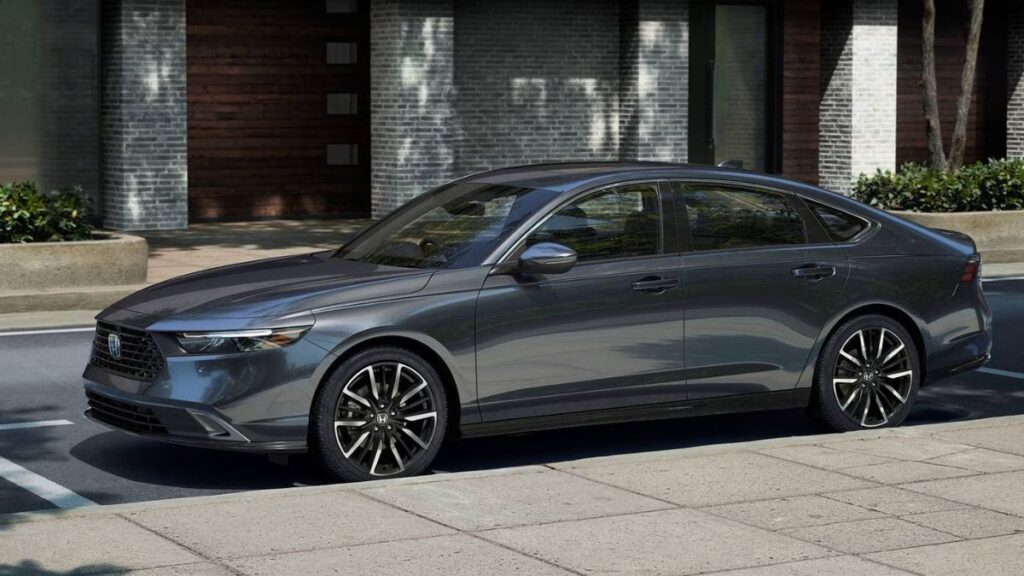
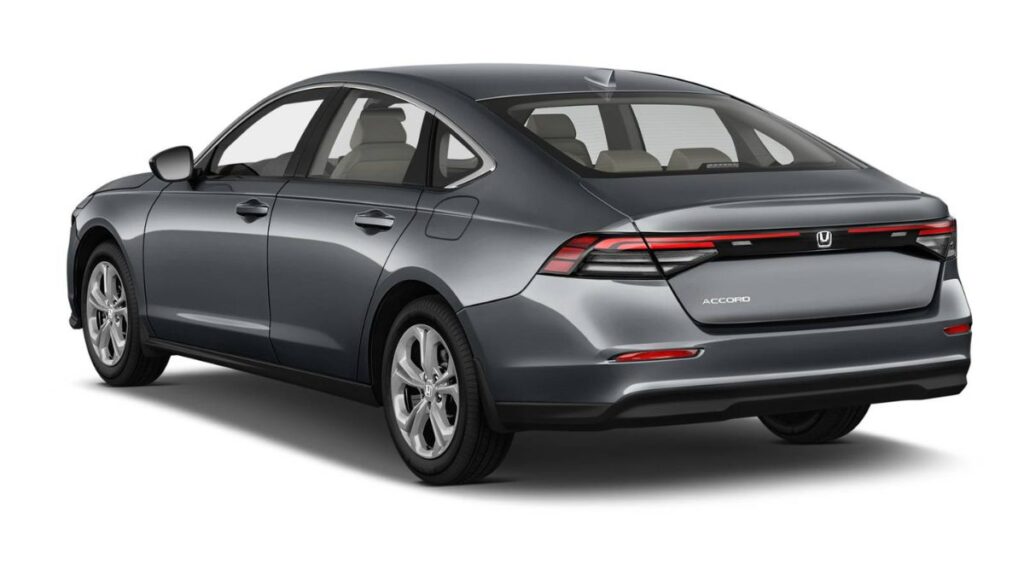
The 2023 Accord looks distinctly more modern than its predecessor without straying into trendy territory. The front fascia is the most aggressive change, featuring a lower, wider stance and an active shutter grille that adjusts air intake for efficiency. The LED headlights have more depth and character than typical family sedan fare. The taillights narrow and taper, which gives the rear a more contemporary feel.
The side profile is where Honda made its most interesting decision: a longer hood shifts the overall proportions forward, making the car feel less tall and more planted. The fastback-inspired roofline carries this theme through, creating a profile that’s closer to a two-door than a traditional four-door sedan.
Compared to the Camry, which has become increasingly plump and luxury-focused, the Accord remains visually disciplined. Next to the Sonata, the Accord is slightly less flamboyant but also less likely to look dated in five years. The design language works because it doesn’t oversell itself.
The only styling misstep is how the lower body panels look a bit disconnected on some color combinations. In darker shades like Solar Silver or Radiant Red, this reads better. In lighter colors, the proportions seem slightly off.
Driving Experience
This is where the 2023 Accord separates itself from the rest of the midsize field. Honda strengthened the chassis with thicker anti-roll bars, revised damper mounts, and a 0.4-inch-wider rear track. The result is a sedan that feels noticeably more connected to the road than competitors. The steering has genuine weight and feedback, though it’s not quite as sharp as a sport sedan. The suspension is calibrated toward balance rather than outright firmness, which means it handles bumps without feeling bouncy.
On a test drive through mixed roads, the Accord carries its speed into corners with minimal body roll. The all-wheel drive setup is front-drive only, but the Motion Management system compensates through intelligent brake application. At 55.5 mph through the Insurance Institute for Highway Safety’s accident-avoidance test, it performed better than most of its competitors.
The bigger story is the hybrid’s response compared to the turbo. The new two-motor hybrid system provides power delivery that feels more linear than the turbo. The turbo engine, meanwhile, exhibits typical CVT behavior: engine rpm spikes during acceleration, and you hear it working harder than it actually needs to. This is where the $5,000 premium for hybrid models suddenly feels justified. Acceleration from zero to 60 mph takes approximately eight seconds for both engines, yet the hybrid feels more refined during the process.
Where the Accord doesn’t excel is at highway speeds in crosswinds. The car is remarkably light on its feet, which is generally good, but highway stability could be more planted. It’s not a complaint that will affect most buyers, but it’s noticeable compared to a Camry.
Performance and Acceleration
The 1.5-liter turbocharged four-cylinder produces 192 horsepower and 192 pound-feet of torque. It’s not impressive on paper, and the sound it makes while working is grainy and less refined than you’d hope. The peak torque arrives at 1,700 rpm, which means the engine is forced to work harder during cruising, and the CVT never quite stops droning during acceleration. This engine is practical and adequate. It isn’t exciting.
The hybrid tells a completely different story. A 2.0-liter four-cylinder pairs with two electric motors, creating a combined 204 horsepower and 247 pound-feet of torque available at zero rpm. The instant availability of electric torque changes how the car feels off the line. There’s no lag, no searching for power. The hybrid also includes a new Linear Shift Control system that mimics traditional automatic transmission shifts, eliminating the constant-rpm drone that plagued earlier hybrid systems. When you accelerate in the hybrid, you feel the engine rev and fall through its range like it’s connected to a real transmission. This psychological benefit shouldn’t be underestimated.
Top speed acceleration is where both engines run out of breath. Neither will set your heart racing past 55 mph. The Accord was never meant to be a muscle sedan, and both powertrains perform exactly as expected for a practical family car.
Ride Comfort and Cabin Refinement
Honda completely redesigned the front seats for 2023, and the effort shows. The new design provides noticeably more support and cushioning than the previous generation. However, and this is a significant however, the bottom cushion’s shape is problematic. It’s built too high and too angled, which creates a sensation of sitting in a hole rather than sitting on a proper seat. On drives lasting more than two hours, this becomes noticeable. The bolstering around the hip area is good, but the overall seating geometry needs refinement.
The rear seats are a different story entirely. Honda mounted them higher relative to the floor, providing excellent leg support and a more commanding view of the road. Headroom in the back is generous, and legroom measures a generous 40.8 inches. Rear passengers will feel far less compromised than in the previous generation.
The cabin is quiet. Honda’s strengthened structure and improved damping mean that road noise is well-controlled. There’s a solidity to how the Accord feels that exceeds its price point. Panel gaps are tight. Nothing rattles. This car will age well in terms of build quality.
The suspension is firm without being punishing. Most road imperfections are adequately absorbed. Larger potholes punch through more noticeably on the hybrid models that ride on 19-inch wheels, but this is expected and acceptable for a sedan that also needs to handle well.
Interior Design and Luxury
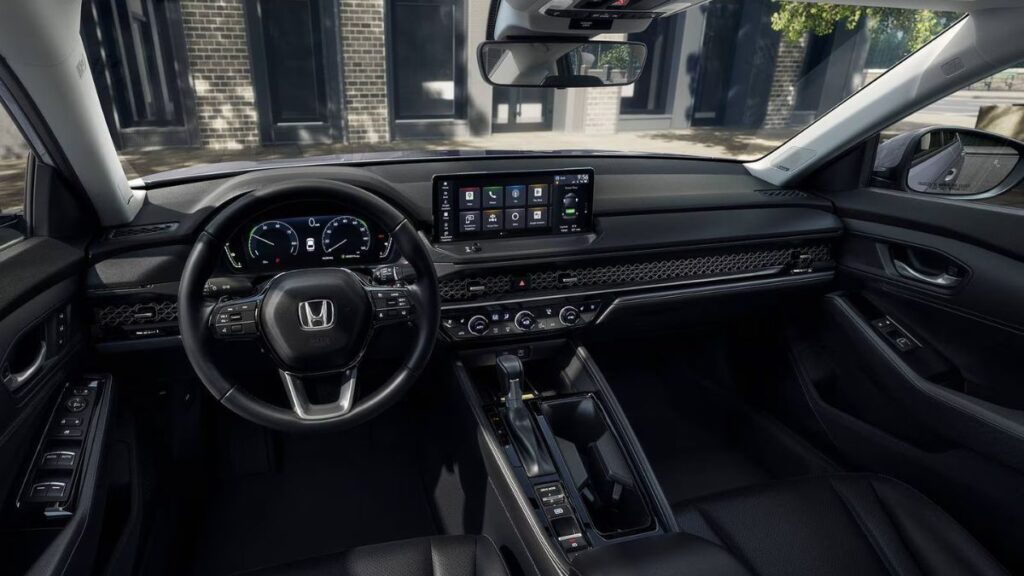
The 2023 Accord takes a decisive stance on interior design: no glossy black plastic, no unnecessary touch-sensitive controls, and plenty of traditional buttons and knobs. This philosophy extends throughout the cabin. Every control that sees frequent use has a dedicated physical button or dial. The climate control knobs rotate with a satisfying mechanical click, more like a luxury watch than a budget car.
Storage is generous, especially the center armrest bin and the door pockets. An optional wireless phone charger fits into a tray forward of the transmission shifter. The shifter itself is a traditional PRNDSL gate, which honestly deserves praise in an industry that keeps replacing functional controls with confusing electronic buttons.
The materials throughout the cabin reflect the price point exactly. The dashboard uses decent quality plastics that look and feel intentional rather than cheap. Upper trims receive leather-trimmed seats with elegant stitching. The base cloth is straightforward and durable. Nothing feels like a compromise.
The one oddity is the Honda Sensing controls. The lane-centering assistance system occasionally exhibits “ping-pong” behavior during lane markings, and the forward collision warning sometimes triggers overzealously. These are refinements that a software update could address, but they’re worth testing during a drive.
Technology and Infotainment
This is where trim level becomes critical. The base LX and EX get a 7-inch touchscreen with Apple CarPlay and Android Auto, physical shortcut buttons, and a tuning knob for audio. This interface is actually functional and less aggravating than many newer systems. The navigation is basic, and there’s no wireless connectivity for phone mirroring, but it works without fuss.
The EX-L Hybrid and above jump to a 12.3-inch screen that feels genuinely wide and clear. Wireless connectivity for Apple CarPlay and Android Auto comes standard. The interface uses tiles instead of the older list-based structure, which feels more organized and modern. Swipe functionality works smoothly.
The Touring trim adds Google Built-in, which means Google Maps for navigation, Google Assistant for voice commands, and Google services for car-related information. This is a meaningful upgrade if you’re already in the Google ecosystem. The real-time traffic and predictive features genuinely useful for daily driving.
The instrument cluster is a new 10.2-inch digital display available on all models. It’s easy to read and offers enough customization without becoming overwhelming. Navigation through the menu system using steering wheel controls is slightly fussy, but it works.
Fuel Efficiency
The turbocharged 1.5-liter engine achieves an EPA estimate of 29 city, 37 highway, 32 combined. This ties the Camry and Altima. In real-world driving with mixed conditions, expect roughly 31 to 34 mpg depending on your driving style. The turbo engine doesn’t excel, but it doesn’t disappoint either.
The hybrid is where efficiency becomes genuinely impressive. The base Sport Hybrid manages 46 city, 41 highway, 44 combined. The EX-L Hybrid, riding on smaller 17-inch wheels, reaches 51 city, 44 highway, 48 combined. In test driving conditions, several reviewers reported consistent results at or better than EPA estimates. One test achieved 53 mpg on 55 mph highway routes using regenerative braking paddle shifters.
The difference is substantial. A typical commuter driving 15,000 miles annually would save roughly 100 to 150 gallons per year by choosing the hybrid. At current fuel prices, that’s meaningful savings. The hybrid carries a $4,500 to $5,000 premium, which means the fuel savings take years to recoup. But factored over the Accord’s typical ownership cycle of five to seven years, the math begins to work in the hybrid’s favor.
Practicality and Storage
The trunk is large at 16.7 cubic feet, which is competitive for the class. The 60/40 split-fold rear seat provides flexibility for loading longer cargo. The rear door openings are wide, making it easy to position larger objects. In-cabin storage is excellent, with a generous center console bin and multiple cup holders.
Visibility is a genuine strength. The windows are large, and the driving position is naturally elevated without feeling tall and ungainly. Taller drivers will find adequate headroom, though extremely tall people may want more seat track travel to fully recline.
Parking is straightforward thanks to the tight turning radius and optional rear parking sensors on higher trims. All models include a rearview camera with guidelines. The optional front and rear parking sensors on EX-L and Touring trims provide good spatial awareness, though they can trigger with overzealous sensitivity.
The only practicality loss compared to competitors is the lack of all-wheel drive. If snow is a regular condition where you live, the Subaru Legacy or Toyota Camry offer better security in winter. For everyone else, the Accord’s front-wheel drive is adequate.
Safety and Driver Assistance Systems
Every 2023 Accord comes standard with Honda Sensing, which includes automatic emergency braking with pedestrian detection, adaptive cruise control, lane departure warning with lane-keeping steering assistance, and automatic high beams. This is comprehensive coverage, more than several luxury brands require as standard.
The EX and higher trims add blind-spot information and rear cross traffic warning. The Touring trim includes a low-speed automatic braking system for parking situations. The rear occupant alert system, which warns if a child or pet is left in the back seat, is standard across the board.
The IIHS awarded the new Accord a Top Safety Pick+ rating, which reflects superior performance in multiple crash tests. The Accord scored Marginal on the previous-generation model’s side-impact test and significantly improved in the redesigned version. The NHTSA hasn’t yet tested the 2023 model, but the previous generation earned five stars across every category.
One note of caution: The lane-centering assistance system sometimes exhibits uncertainty during off-ramps and on-ramps, making small corrections that feel slightly nervous. The forward collision warning occasionally triggers too early on certain objects. These are minor refinements, not dealbreakers.
Worthy Competitors
The Toyota Camry remains the segment’s sales leader. It offers a softer, more luxurious interior and available all-wheel drive. However, it feels less athletic to drive and doesn’t ride the same balance between comfort and engagement that the Accord delivers. The Camry is better if you prioritize cushiness and isolation.
The Nissan Altima costs slightly less and offers some interesting design choices. Its handling is less responsive than the Accord, and the interior materials feel cheaper. The safety tech is comparable, but it doesn’t feel quite as well-integrated.
The Hyundai Sonata is arguably the best value in the segment, with more features available at lower trim levels. However, its handling doesn’t match the Accord’s, and the infotainment system is less intuitive. As an Accord alternative, it works financially, not dynamically.
The Kia K5 (Sonata’s badge-engineered twin) brings similar strengths and weaknesses. The K5 looks slightly sportier and has available all-wheel drive, but the driving experience is less compelling.
The Subaru Legacy is the choice if all-wheel drive is essential. It prioritizes winter capability and safety. However, it’s less efficient, handles less responsively, and costs more.
Biggest Strengths and Weaknesses
Strengths: The 2023 Accord’s greatest asset is its refusal to complicate things. Every control makes sense. The steering and suspension work together to deliver a driving experience that feels mature and intentional. The build quality is genuinely excellent, which shouldn’t be taken for granted at this price point. The hybrid powertrain represents Honda’s best engineering for this class, delivering both efficiency and refinement. And the reliability history gives you genuine confidence in long-term ownership.
Weaknesses: Honda’s trim-level structure is frustrating. The hybrid’s forced pairing with higher-priced trims is a significant weakness that benefits the turbo four-cylinder with sales it probably doesn’t deserve. The front seats, while improved, still lack the long-term comfort necessary for people who spend hours driving. The lack of all-wheel drive eliminates the Accord for buyers in climates where it’s practically essential. And the 1.5-liter turbo, even with improvements, is noisier and less refined than the hybrid, creating an obvious gap in refinement that Honda could have addressed more elegantly.
Which Category Does Cardrav Recommend?
Best Value: 2023 Honda Accord EX (1.5-Turbo). If your budget is tight and you don’t need the hybrid’s refinement, the EX trim offers genuine equipment and reasonable pricing. Expect to negotiate and look for inventory discounts.
Best Overall: 2023 Honda Accord Hybrid EX-L. This strikes the best balance between feature set and efficiency. The 48 mpg combined rating justifies the price premium, and the second-tier hybrid positioning offers most of what you need without the Touring’s excessive cost.
Best Driving Experience: 2023 Honda Accord Hybrid Sport. This trim brings the sportier suspension and 19-inch wheels that enhance handling. Yes, the ride is firmer, but the trade-off is worth it if driving feel matters to you.
Conclusion: Is It Worth Buying?
Yes, with the right trim selected. The 2023 Honda Accord is a genuinely good car that makes sensible decisions about what matters to buyers. It handles better than competitors at this price point. It’s built with intention and quality. The hybrid powertrain delivers both efficiency and engagement in a way that few other midsize sedans manage.
However, you need to be intentional about trim selection. The turbo four-cylinder should only appeal to buyers who absolutely can’t stretch to hybrid pricing. If you’re considering the Accord, you should seriously prioritize the EX-L Hybrid or Sport Hybrid, even if it means waiting for better dealer pricing or looking at 2024 inventory with potential incentives.
The Accord won’t excite you. It will satisfy you. It will prove reliable, practical, and capable of handling whatever you ask of it. In a market where automakers have largely abandoned the sedan, that’s genuinely commendable. The Accord deserves serious consideration from anyone shopping this segment.
FAQ
Is the hybrid really worth the $4,500 to $5,000 premium over the turbo?
Yes, if you plan to keep the car beyond five years or drive more than 15,000 miles annually. The hybrid’s superior refinement, responsiveness, and fuel economy make the investment worthwhile. The turbo is adequate but not exciting.
Can I get all-wheel drive with the 2023 Accord?
No. Honda discontinued all-wheel drive on the Accord. If winter driving is a regular concern, consider the Subaru Legacy or Toyota Camry, which offer AWD options.
What’s the best trim level for buying used in 2026?
The EX-L Hybrid or Sport Hybrid represent the sweet spot between feature set and pricing. These trims offer excellent value used and should still be plentiful on the market.
How does the 2023 Accord compare to my older Accord for reliability?
Build quality is actually better on the 2023. Honda strengthened the structure and improved fit-and-finish. Historical reliability is excellent across the Accord nameplate, and the new generation should continue this trend.
Are the front seats really uncomfortable like some reviews suggest?
The bottom cushion shape is problematic for longer drives due to its high mounting point and angle. It’s not a dealbreaker, but test drive thoroughly before committing. Rear seats are far more comfortable.