2023 Nissan Altima Review: Competent, Cautious, Forgettable
A sensible midsize sedan that plays it safe in a segment full of bold competitors

The 2023 Nissan Altima sits in that awkward middle ground of the midsize sedan world. It’s not bad enough to dismiss, but it’s not good enough to excite anyone who’s just test-driven a Honda Accord or paid attention to what Hyundai is doing with the Sonata and Kia K5. For 2023, Nissan gave the Altima a redesigned front end, a bigger touchscreen, and some interior tweaks. It’s a genuine attempt to stay relevant. But here’s the thing: relevant and competitive aren’t the same word.
The Altima comes with two engines, available all-wheel drive, and a solid roster of safety features. It rides quietly, doesn’t protest too loudly during acceleration, and you won’t feel embarrassed bringing one home. That’s the Altima’s real identity. It’s a car that does its job without asking for applause. For someone shopping this segment and not willing to stretch into a Camry or Accord, it’s worth considering. Just know that you’re buying capability and sensibility, not driving engagement.
Our Take
The 2023 Nissan Altima is a competent family sedan built for people who value routine over reward. It delivers solid fuel economy, a comfortable interior, and enough safety features to keep you out of trouble. But it’s held back by underwhelming acceleration from the base engine, vague steering that disconnects you from the road, and a suspension that can’t quite figure out whether it wants to be comfortable or controlled. The refresh helps modernize its appearance and infotainment, but it doesn’t address the Altima’s core problem: it feels like a car engineered by committee rather than passion. This is practical transportation. Call it what it is.
Pros & Cons
Pros
- Excellent fuel economy, especially with the base 2.5-liter engine
- Interior is roomy with generous legroom for all occupants
- Strong safety ratings and available advanced driver-assist features
- Turbocharged SR option offers real passing power and improved response
- New 12.3-inch touchscreen is intuitive and modern
- All-wheel drive provides genuine value for winter climates
- Price point is reasonable for the segment
Cons
- Base engine acceleration is sluggish and labors under load
- Steering lacks feedback and feels disconnected at highway speeds
- CVT transmission noise becomes apparent during hard acceleration
- Suspension tuning is inconsistent, stiff over bumps but soft over dips
- Driving dynamics lag behind the Accord, Camry, and K5
- Turbo engine is expensive, pushing the price into dangerous territory
- Infotainment system lags behind luxury competitors in responsiveness
What’s New
For 2023, Nissan made meaningful updates to the Altima’s exterior presentation. The revised V-Motion grille gets fresh black chrome accents (exclusive to the SR trim), enlarged triangular elements below the headlights, and an updated Nissan badge. LED headlights are now standard, replacing halogen units, and the updated running lights give the car a stronger presence at night. The taillights received a redesign as well.
Inside, the big story is the new 12.3-inch touchscreen available on higher trims. It replaces the previous 8.0-inch screen and finally adds wireless Apple CarPlay connectivity (Android Auto still requires a wired connection). A wireless charging pad and Wi-Fi hotspot are now available options. The Platinum trim has been dropped for 2023, simplifying the lineup to five options: S, SV, SR, SL, and SR VC-Turbo. Nissan also added four new wheel designs and some fresh exterior colors to shake things up.
Exterior Design
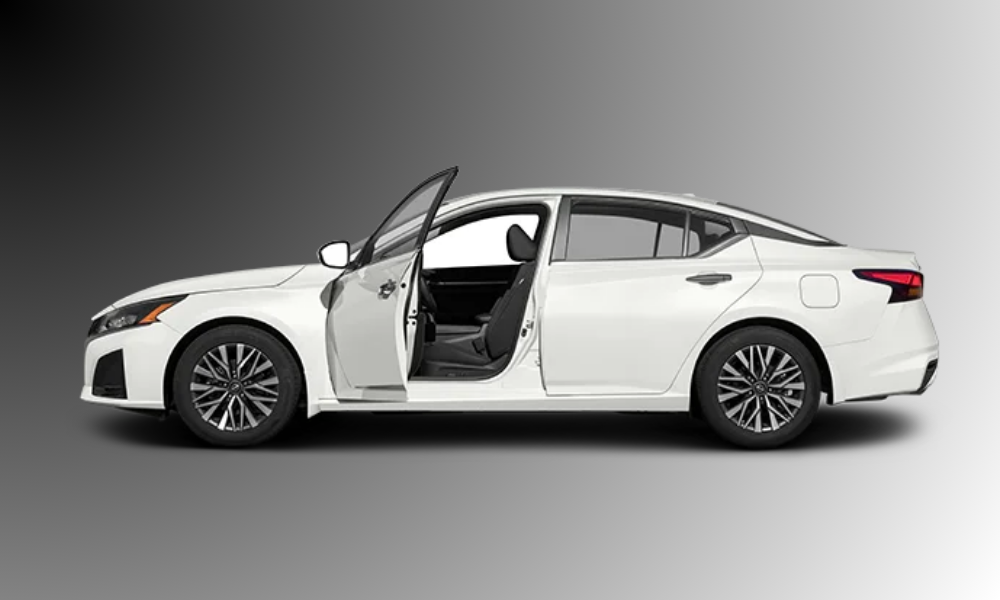
The refreshed Altima looks more confident than it did before, though it’s still playing in the shadow of designs from Hyundai and Kia. The enlarged grille gives it a sportier presence, and the new front fascia carries more visual weight than the previous generation. The side profile is lean and inoffensive. There’s nothing here that’s going to turn heads in a parking lot, but there’s also nothing that looks dated or cheap. Nissan has this V-Motion design language across its lineup, so you’re getting a cohesive brand identity rather than anything particularly distinctive.
The real strength is in how well-proportioned the Altima feels. It sits low enough to suggest performance without looking aggressive, and the belt line runs high enough to provide visual balance. The wider stance for 2023 adds some gravitas. Compared to the Camry, the Altima looks slightly more modern. Compared to the K5, it looks slightly less premium. That’s the story of this car in every dimension: solidly in the middle.
Driving Experience
This is where the Altima’s limitations become obvious. The steering is the first problem. It’s vague, disconnected, and provides almost no feedback about what’s happening at the front tires. Transition from a highway to a twisty road, and you’ll immediately notice how far removed your hands are from the actual driving experience. It’s not dangerous, but it’s not engaging either.
Push through a few corners and the handling is predictable but uninspired. The suspension does its job, soaking up small imperfections without complaint. But hit a larger bump and the response is confused, as if the engineers couldn’t decide whether to prioritize comfort or control. Tighter corners require more steering input than competitors, and the Altima doesn’t reward your effort with any sense of connection.
The CVT transmission does some heavy lifting here. It’s smooth most of the time and less obtrusive than it was in previous generations. During normal driving, you’ll barely notice it. That’s the good news. The bad news is that it actively refuses to feel sporty or responsive when you actually try to drive with some urgency. Kick down and the revs spike before anything happens, then the whole car feels like it’s pulling against itself. This is where the turbo engine in the SR makes more sense. Yes, you’re paying significantly more for it. But at least you get a driving experience that matches the turbocharged label.
Performance & Acceleration
The standard 2.5-liter four-cylinder delivers 188 horsepower and 180 pound-feet of torque. That sounds reasonable on paper. In practice, it’s adequate for highway merging and passing in moderate traffic, but it’s not quick. Our zero-to-60 estimates based on available test data put the base engine in the 8.4-second range with all-wheel drive. That’s not embarrassing for a family sedan, but it’s not impressive either. The Camry and Accord both feel more responsive off the line.
The turbocharged 2.0-liter in the SR VC-Turbo is the far more interesting engine. With 236 horsepower, it delivers 0-60 in approximately 5.8 seconds. That’s a meaningful difference and finally gives the Altima some actual personality. The power delivery builds smoothly, and you get the passing authority that the base engine refuses to provide. Highway driving becomes less stressful. The turbo lag is minimal. If you’re going to buy an Altima for more than basic transportation, this is the engine to get. Just accept that you’re pushing the price into the upper $30,000s, which is territory where the Accord and Sonata start looking like better values.
Both engines feed power through a continuously variable transmission. Nissan has been using CVT technology longer than most manufacturers, and it shows. The unit here is less noisy and more refined than it was just three years ago. It won’t make an Altima feel sporty, but it won’t undermine the experience either. The transmission is competent. That describes the entire car, really.
Ride Comfort & Cabin Refinement
Day-to-day driving in the Altima is quiet and composed. Wind noise is well-controlled, road rumble is minimized, and engine noise stays in the background during normal operation. The isolation is impressive for the price point. Longer drives are genuinely comfortable, thanks to supportive seats and a well-tuned suspension that handles most road surfaces without complaint.
But there’s a caveat. The Altima’s suspension tuning is inconsistent. Small potholes and rough pavement patches punch through with unexpected stiffness. The car feels soft when cruising over smooth roads, then turns rigid when actual broken pavement appears. It’s not uncomfortable in a way that will ruin a road trip, but it suggests the engineers compromised between different driving scenarios and didn’t fully commit to either. A Toyota Camry, by comparison, feels more purposefully tuned.
The air conditioning system is effective, and the new available dual-zone automatic temperature control is a nice touch. Heated seats are available on mid-range trims and work well in cold climates. The cabin insulation is solid enough that you won’t hear much from the outside world, even on the highway. This is where the Altima genuinely excels. It’s a quiet, comfortable, unfussy place to spend time.
Interior & Luxury Feel
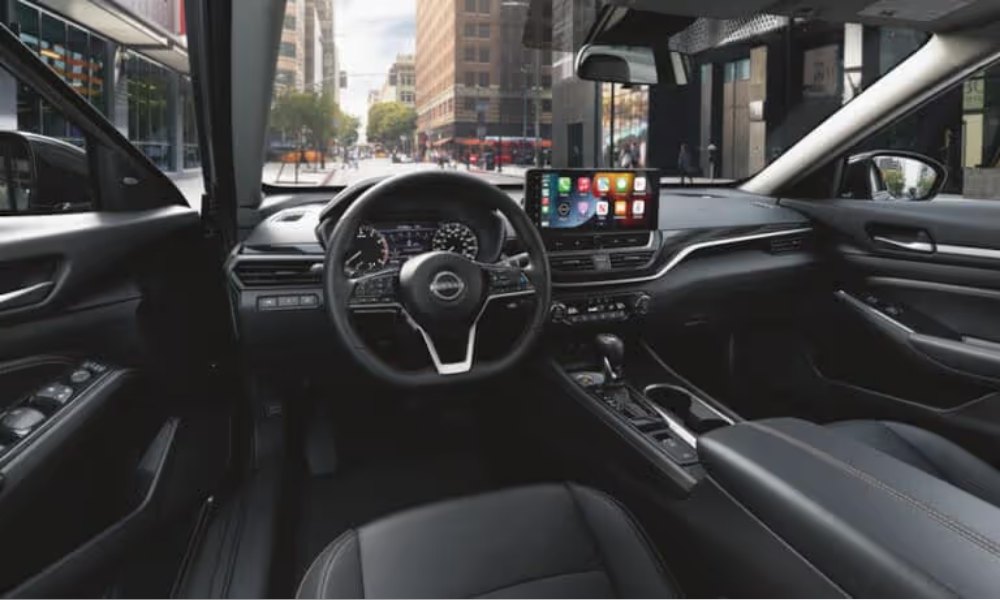
The interior is organized logically, with all controls falling easily to hand. The dashboard is divided into clean horizontal zones. The new 12.3-inch touchscreen dominates the upper portion and looks appropriately modern. Lower trims get a smaller 8.0-inch display or even a 5.0-inch unit in the base S model, which feels dated by comparison.
Material choices are price-appropriate. You’ll find soft-touch surfaces on the upper dashboard, but hard plastic on the doors and lower areas. It’s honest about what you’re paying for. Higher trims like the SR get lighter interior colors and some stitching that elevates the overall feel compared to the darker base model interiors. The center console sits high and feels substantial. Storage is adequate, with a deep center bin and reasonable door pockets.
Visibility from the driver’s seat is good, though the high beltline does reduce over-the-shoulder viewing somewhat. A panoramic sunroof is available and makes the cabin feel more spacious. Rear legroom is generous at 39.1 inches in the front and 38.0 inches in the back, so even taller passengers won’t feel cramped on longer drives. The 60/40-split rear seats fold down for extra cargo flexibility. Nothing about the interior is premium, but nothing feels cheap either. It’s a straightforward, functional space.
Technology & Infotainment
The new 12.3-inch touchscreen is the standout here. It’s responsive, bright, and the interface is intuitive without feeling cluttered. Wireless Apple CarPlay is now standard on cars equipped with the larger display, which is genuinely useful. Android Auto requires a wired connection, which is less convenient but still functional. The system handles navigation well, and the mapping feels current.
Nissan’s ProPilot system offers adaptive cruise control and lane-keeping assistance on higher trims. It works, though the frequent audible alerts can get annoying during long highway stretches. There’s no way to fully disable the alerts, which is a missed opportunity for user control. The system activates cleanly and tracks the road well, but it demands engagement and won’t allow true hands-off driving despite what the marketing suggests.
Where the system lags is in overall responsiveness. It’s not slow, but it doesn’t feel as snappy as the systems in more expensive cars or even in the new Accord. The Wi-Fi hotspot and wireless charging are nice conveniences if you’re willing to pay for them. Bluetooth connectivity is reliable and handles phone calls clearly. The infotainment isn’t going to impress anyone coming from a luxury sedan, but for a car in this price range, it’s competitive.
Fuel Economy
This is the Altima’s calling card. With the base 2.5-liter engine and front-wheel drive, you’re looking at approximately 27 miles per gallon in the city and 39 highway, with a combined estimate of 32 mpg. That’s genuinely strong for a midsize sedan. All-wheel drive drops those numbers to 26 city and 37 highway, still respectable. The turbocharged SR VC-Turbo returns 25 city and 34 highway at a combined 29 mpg.
In real-world driving, most owners report hitting those EPA estimates or exceeding them slightly under normal driving conditions. Highway driving pushes the economy even higher, regularly breaking 40 mpg on longer interstate stretches. This is where the CVT transmission actually earns its keep. That continuous power delivery helps minimize unnecessary revving during efficient cruising. The Altima won’t set any efficiency records, but you’re not going to feel like you’re constantly refueling, either. For families that drive highways regularly, this efficiency advantage is genuinely meaningful.
Practicality & Cargo Space
The trunk holds 14.6 cubic feet with all seats in place, which is adequate for groceries, luggage, and regular cargo needs. Fold the 60/40-split rear seats and you get a large, flat-floored cargo area that’s genuinely useful for bigger items. The trunk opening is large enough that loading and unloading is easy, with no weird angles or lip problems.
The rear doors open wide, making child car seats and booster seats easier to install than in some competitors. The LATCH anchors are well-positioned and not buried under padding or tucked awkwardly. Interior storage includes a deep center bin, decent door pockets, and a small shelf above the door locks. Cup holders are plentiful, with two in the front center console and four in the back. The power outlets are positioned well for charging devices on longer trips. For a family that takes regular road trips or hauls equipment for sports and hobbies, the Altima provides enough space without requiring you to step up to an SUV.
Safety & Driver Assistance
The 2023 Altima scores well in safety testing. It earns IIHS Top Safety Pick Plus recognition and five-star ratings from NHTSA. Standard equipment includes automatic emergency braking with pedestrian detection and blind-spot monitoring. Higher trims add rear automatic braking, which is helpful for avoiding parking-lot mishaps.
Nissan’s ProPilot system is available and combines adaptive cruise control with active lane control for semi-autonomous highway driving. It works responsibly and won’t allow you to fall completely asleep behind the wheel, which is a good design choice. The system makes sense for long highway commutes, though the mandatory alerts might drive you crazy if you’re just testing it out. Weather-resistant headlights are standard on all 2023 models, improving night visibility. Side-impact airbags and stability control are standard across the board. There’s nothing revolutionary here, but safety is thoroughly covered. The Altima won’t protect you better than a Camry or Accord, but it will protect you adequately.
Competitors Worth Considering
The Honda Accord is the obvious first choice if you want a sedan that feels more connected to the road. It costs more, but the steering is actually responsive and the suspension tuning suggests someone had a point of view about how it should drive. The base engine is stronger, and the whole package just feels more premium.
The Toyota Camry dominates this segment for good reason. It’s more efficient than the Altima, the interior feels slightly more upscale, and the driving dynamics are more refined overall. You’ll spend more money, but the Camry holds resale value better and the reliability reputation is stronger.
The Hyundai Sonata and Kia K5 offer more aggressive styling and surprisingly good technology at reasonable prices. The K5 in particular feels more modern inside and out. If you’re prioritizing a striking appearance and upscale interior, Hyundai’s lineup is worth serious consideration.
The Subaru Legacy brings all-wheel drive as standard, which is genuinely useful if you live in a region with snow. However, it’s less fuel-efficient than the Altima and the interior feels less modern.
The Chevrolet Malibu is usually cheaper and has some decent value propositions, but it genuinely feels like a budget sedan. The Altima’s refinement is noticeably better.
Biggest Strength and Biggest Weakness
The Altima’s biggest strength is its combination of efficiency and affordability. This car gets excellent fuel economy, costs less than most direct competitors, and doesn’t ask you to compromise on comfort or safety to save money. If you drive a lot of highway miles and want to minimize fuel costs while maintaining a practical, comfortable family sedan, the Altima delivers exactly that promise. The 2023 refresh makes it look modern enough to feel current, and the interior is nicely executed for the price point.
The biggest weakness is the complete absence of driving engagement. The steering is vague, the acceleration is uninspiring, and the overall driving experience feels disconnected. You’re not buying this car because driving it will make you smile. You’re buying it because it’s rational and sensible and gets the job done. That’s not necessarily bad, but it’s a fundamental limitation that puts the Altima behind the Accord, Camry, and K5 in the most important area: how it actually feels to drive.
Which Trim Does Cardrav Recommend?
Skip the base S model. The 5.0-inch touchscreen is too small and Android Auto isn’t available as wireless. The SV is the right call for most buyers. It adds the 8.0-inch touchscreen with wireless Apple CarPlay, heated front seats, and a more complete feature set while keeping the price in the mid-$28,000 range. It’s the best balance of value and practicality.
If you live somewhere with serious winter weather, the all-wheel drive option on the SV is worth the premium. The extra traction genuinely helps, and the Altima’s higher-riding suspension suits AWD well.
Skip the turbocharged SR VC-Turbo. Yes, it’s faster and the driving experience is slightly more engaging. But pushing toward $36,000, you’re in Honda Accord or Toyota Camry territory. Those cars deliver more refinement, better resale value, and more confident driving dynamics at that price point. The turbo makes sense only if you specifically want the Altima and don’t want to compromise on acceleration. Otherwise, that money is better spent elsewhere.
Final Verdict: Should You Buy It?
The 2023 Nissan Altima is worth buying if you know exactly what it is and what it isn’t. It’s not a car that will excite you or make your commute feel special. It’s not going to surprise you with engaging handling or make you feel connected to the road. It’s a mature, sensible choice for a family sedan that prioritizes comfort, efficiency, and straightforward practicality.
Buy it if you drive mostly highways, value fuel economy, and want a roomy interior that doesn’t demand a lot of attention during longer trips. Buy it if you live in an area with winter weather and appreciate the all-wheel drive option at a reasonable price. Buy it if you’ve sat in a Camry or Accord and decided they feel over-engineered or styled too aggressively for your taste.
Don’t buy it if you want to feel engaged while driving. Don’t buy it if you’re torn between an Altima and a K5 or Accord, because you’d be better served by either of those cars. Don’t buy the turbocharged version expecting it to transform the car into something exciting. It doesn’t. It just costs too much.
For the buyer who values efficiency, practicality, and value, the 2023 Nissan Altima SV with front-wheel drive and the standard 2.5-liter engine is a solid decision. Just be realistic about what you’re getting: transportation that works reliably and quietly, day after day, without requiring you to think about it. That’s not a weakness, really. For most people, that’s exactly what a family sedan should be.
FAQ
How does the 2023 Nissan Altima compare to the Honda Accord?
A: The Altima is more efficient and costs less. The Accord feels more refined overall and offers better driving dynamics. The Accord’s steering has actual feedback, and the interior materials feel slightly more premium. If driving engagement matters, choose the Accord. If budget and efficiency are priorities, the Altima makes sense.
Is the 2023 Altima reliable?
A: Yes. The Altima earns a reliability rating of 4 out of 5 from RepairPal and ranks #14 out of 28 among midsize cars. It has a standard 3-year, 36,000-mile warranty. Regular maintenance is important, as it is with any vehicle. The Altima has been around since 1992, so Nissan has had plenty of time to refine the formula.
Should I get all-wheel drive on the 2023 Nissan Altima?
A: Only if you live somewhere with regular snow and ice. The AWD system is effective and adds real traction control benefits. However, it costs several thousand dollars and reduces fuel economy slightly. For most climates, the front-wheel drive version is sufficient and more efficient.
What’s the difference between the 2.5-liter and 2.0-liter turbo engines in the 2023 Altima?
A: The turbocharged 2.0-liter has 236 horsepower compared to 188 in the base 2.5-liter. That translates to roughly 0-60 in 5.8 seconds (turbo) versus 8.4 seconds (base). The turbo is significantly faster and more responsive for highway driving. The tradeoff is reduced fuel economy and a cost increase of $4,000 to $6,000 depending on trim. Most buyers don’t need the turbo.
How does the 2023 Nissan Altima handle winter driving?
A: With summer tires or all-season tires, you’ll want the all-wheel drive option for winter confidence. The Altima’s suspension geometry works well with AWD, and the system engages smoothly when traction is needed. Winter tires are essential regardless of drivetrain. Without them, no sedan will handle snow and ice effectively. The Altima is no exception.