2023 Toyota Sequoia Review: All New Hybrid Powered
Toyota finally rebuilt its biggest SUV from the ground up, and the results are bold, powerful, and occasionally puzzling

For the better part of fifteen years, the 2023 Toyota Sequoia sat still while the rest of the full size SUV class moved on without it. The Chevrolet Tahoe got a full redesign. The Ford Expedition went turbocharged and touchscreen heavy. Even the aging Nissan Armada got a facelift. Meanwhile, the old Sequoia kept its ancient V8 and its dated cabin, coasting on brand loyalty alone. That era is over. The 2023 Toyota Sequoia review starts with a genuinely new vehicle, built on the same platform as the current Tundra, and it shows in almost every part of the truck.
This is not a mild refresh. Toyota tossed the old naturally aspirated V8 and replaced it with a twin-turbo hybrid V6, the same i-FORCE MAX unit doing duty in the Tundra and Lexus LX. The result is a full size SUV that finally has the power and the towing numbers to embarrass its domestic rivals on paper. Whether it embarrasses them on the road is a more complicated story, and that is where this review earns its keep.
The Sequoia now competes directly with the Tahoe, the Expedition, the Wagoneer, and the Armada, and it does so from a position of strength it has not held in a generation. Toyota buyers who have been cross shopping GM and Ford products for years finally have a reason to stay loyal. But a new engine and a new interior do not automatically fix everything, and this Sequoia has quirks that a shopper spending seventy thousand dollars deserves to know about before signing anything.
Our Opinion
The 2023 Sequoia is a genuine leap forward for Toyota’s full size lineup, and the hybrid powertrain gives it real teeth against the competition, both in horsepower and towing capacity. The redesigned cabin, especially with the available 14 inch touchscreen, finally drags Toyota into the current decade of interior tech. But this is not a flawless vehicle. The ride can feel unsettled over broken pavement, the third row is tighter than some rivals offer, and early reliability reports have raised real concerns about the new hybrid system and brake behavior. This is a strong SUV with a few growing pains, not a segment leader across the board.
Pros and Cons
Pros
- Hybrid V6 delivers 437 horsepower and 583 lb-ft of torque, more than any gas competitor in the class
- Maximum towing capacity jumps to 9,520 pounds, a 26 percent increase over the previous generation
- Available 14 inch touchscreen and 12.3 inch digital cluster are a massive step up from the old Sequoia’s cabin
- Toyota Safety Sense 2.5 comes standard across the lineup, no upsell required
- Strong resale value and Toyota’s reputation for long term durability
Cons
- Third row cargo space trails the Expedition and Tahoe
- Ride quality can feel busy and truck like over rough roads, especially on TRD Pro
- Early hybrid system reliability complaints, including reported brake squeal issues
- Infotainment system looks great but lacks a proper home screen for multitasking
- Starting price sits noticeably higher than the Tahoe and Armada
What’s New
Everything, essentially. The 2023 model year brings a full ground up redesign, the first for the Sequoia since 2008. The old 5.7 liter V8 is gone, replaced by the twin-turbo hybrid V6. Independent front suspension replaces the old solid axle setup. Towing capacity climbs to 9,520 pounds. A new Capstone trim joins the lineup at the top, aimed squarely at buyers who might otherwise look at a Lincoln or a loaded Jeep Grand Wagoneer. The interior gets a complete overhaul, with the option of a 14 inch touchscreen that dwarfs anything Toyota has put in a truck before. Five trims carry the new Sequoia forward: SR5, Limited, Platinum, TRD Pro, and Capstone.
Exterior Design
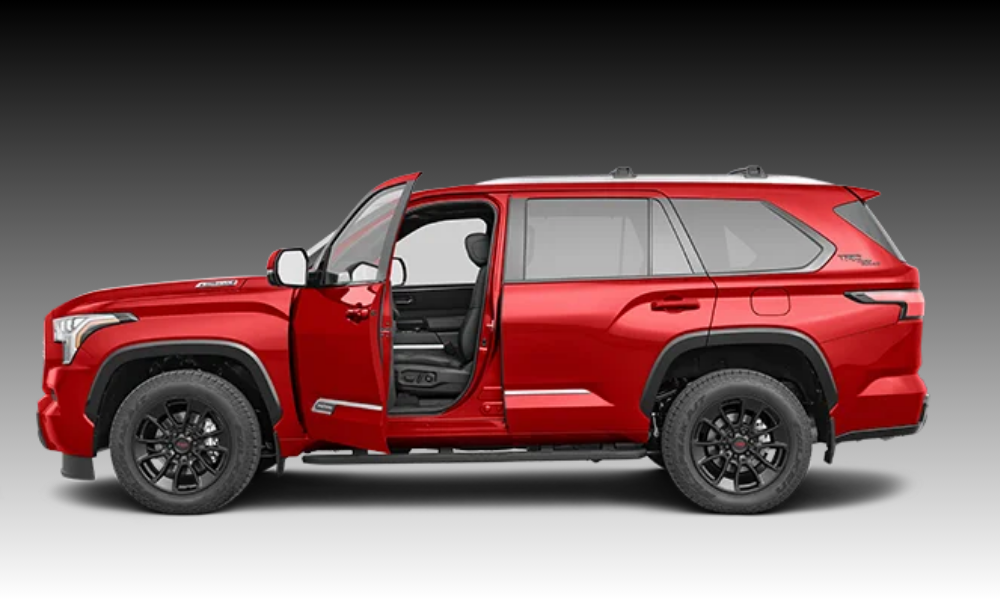
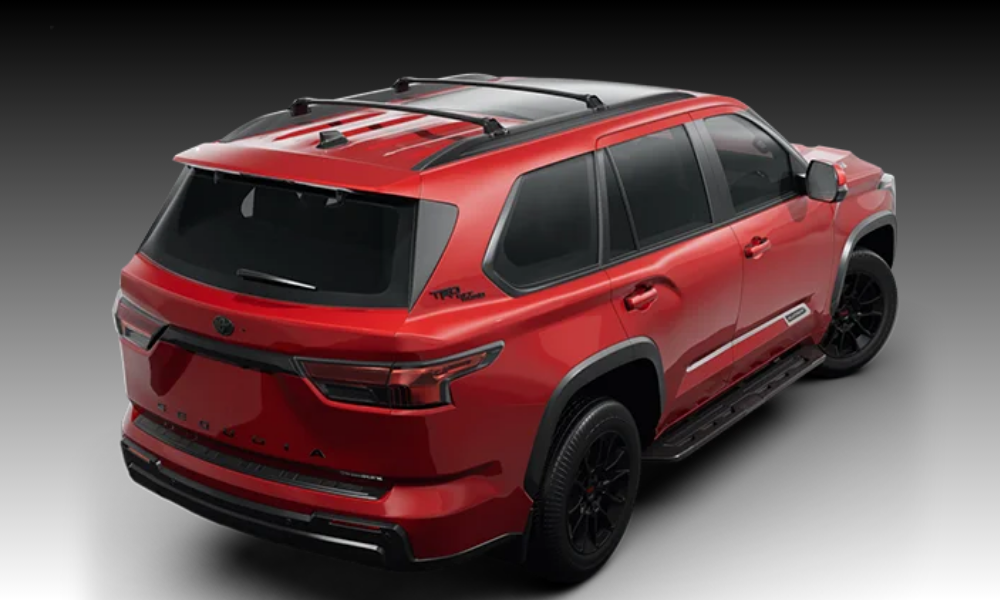
The new Sequoia shares its face with the current Tundra, and there is no mistaking the family resemblance. The grille is massive, the fenders are chunky, and the beltline sits high enough that the windows look almost squat by comparison. It reads as unmistakably Toyota, but it also reads as unmistakably big. Where the Tahoe goes for a more sculpted, almost car like presence and the Expedition leans into a clean, corporate look, the Sequoia goes for bulk and presence. It will not be confused for anything else in a parking lot, and depending on your taste, that is either a compliment or a warning.
The TRD Pro trim adds visual attitude with its own grille, unique wheels, and a raised stance that suggests real off-road intent, not just a sticker package. The Capstone, on the other end of the spectrum, dials up the chrome and adds 20 inch wheels for a more formal look. Both approaches work, but neither one is subtle. This is not a truck for buyers who want to blend in.
Driving Experience
This is where the new Sequoia gets complicated. The extra power is obvious the moment you get on the throttle. The twin-turbo V6 hybrid pulls hard from a stop and keeps building through the midrange, and the 10-speed automatic shuffles through gears smoothly enough that you rarely notice the transmission working. On paper, this should be one of the quickest full size SUVs in America, and in a straight line, it mostly is.
The problem shows up on rougher roads. Despite the switch to independent front suspension, the ride can still feel busy over broken pavement, particularly on TRD Pro models riding on the FOX shocks tuned more for trail work than daily commuting. Steering feel is light, almost too light for a vehicle this size, and the brake pedal has a soft, indistinct feel that does not always inspire confidence when you need to scrub speed quickly. This is where the excitement fades a little. The Sequoia accelerates like a performance SUV but stops and steers like the tank-like body-on-frame truck it still is underneath.
Highway cruising is where the new Sequoia feels most at home. Wind noise stays low, the cabin is quiet, and the adaptive cruise control does a good job of holding a steady gap in traffic without the jerky corrections some systems exhibit. City driving is a different challenge entirely. This is a genuinely enormous vehicle, and threading it through a tight parking garage or a crowded downtown street takes some getting used to, even with the standard 360-degree camera helping out. Buyers coming from a midsize crossover should plan on an adjustment period before the Sequoia’s dimensions feel second nature.
Performance and Acceleration
The heart of the new Sequoia is the i-FORCE MAX powertrain, a twin-turbocharged 3.4-liter V6 paired with an electric motor sandwiched inside the transmission housing. Combined output lands at 437 horsepower and 583 lb-ft of torque, figures that leave the Tahoe’s standard V8 and even the Armada’s V8 well behind. That torque arrives early and stays flat across the rev range, which is exactly what you want in a vehicle built to tow a boat or a camper.
Four wheel drive is standard on the TRD Pro and optional elsewhere for a 3,000 dollar upcharge. The 10-speed automatic transmission handles the power well, though it can occasionally hunt for the right gear at low speeds in stop and go traffic. Compared to the Expedition’s twin-turbo V6, which tops out around 440 horsepower on its highest trims, the Sequoia’s numbers are close but its torque advantage is real and noticeable when towing.
Ride Comfort and Cabin
Toyota clearly aimed for a more refined ride this generation, and in most everyday driving, it delivers. Road and wind noise are well controlled at highway speeds, and the front seats offer good support for long trips. Where things get inconsistent is over rougher surfaces. Sharp expansion joints and potholes send a noticeable jolt through the cabin, more than you would expect from a vehicle this size and this price. The available rear air suspension, a 1,045 dollar option on the Platinum trim, helps smooth things out and is worth serious consideration if ride comfort matters more to you than sportiness.
Cabin noise is well managed, but the Sequoia’s overall driving manners still feel more truck than luxury SUV, even on the range topping Capstone. That may not bother buyers coming from an older Sequoia or a Tundra, but shoppers cross shopping a loaded Wagoneer may notice the difference immediately.
Interior
The interior is genuinely transformed compared to the outgoing model. The dashboard design finally looks current, with clean horizontal lines and a mix of textures that feel more deliberate than the old truck’s slab of hard plastic. Move up the trim ladder and you get real leather, heated and ventilated seats front and rear, wood trim on the Capstone, and ambient lighting that adds some warmth to what is otherwise a fairly business like cabin.
Space in the first two rows is excellent, with plenty of head and leg room for adults. The third row is a different story. It slides forward and back about 5.5 inches to add flexibility, but it remains best suited for kids or shorter trips for adults. That puts the Sequoia at a disadvantage against the Expedition, which still offers more usable third row space, and especially against the Expedition MAX with its stretched wheelbase.
Technology and Infotainment
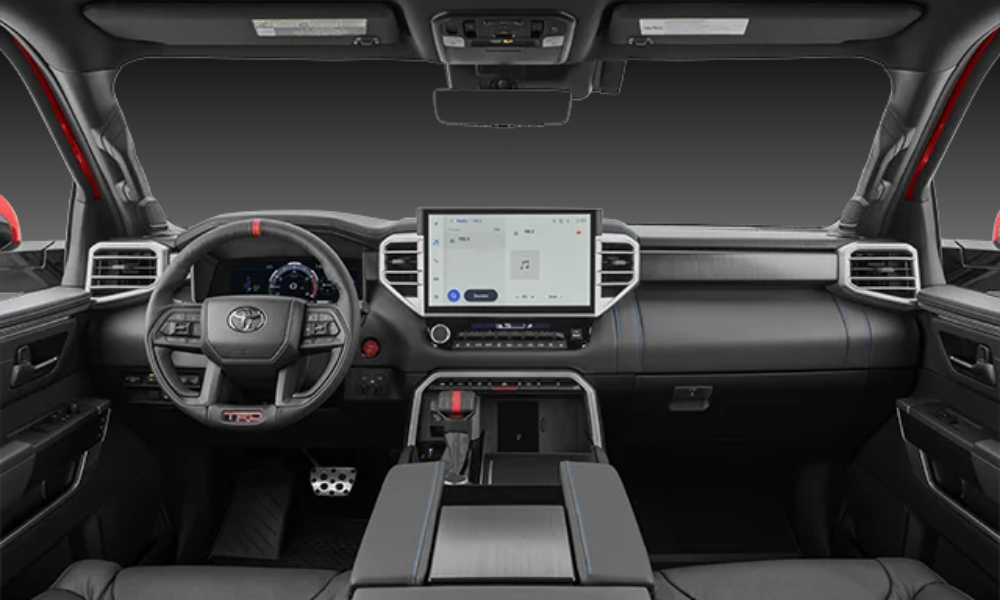
Every Sequoia beyond the base SR5 gets a massive 14 inch touchscreen paired with a 12.3 inch digital instrument cluster, and visually it is one of the most impressive displays in the segment. Graphics are sharp, the screen is bright even in direct sunlight, and wireless Apple CarPlay and Android Auto come standard across the lineup. A built in Wi-Fi hotspot and cloud based navigation with natural voice recognition round out the package.
The catch is usability. The system lacks a proper home screen that shows multiple functions at once, so you are stuck bouncing between screens for climate, audio, and navigation rather than seeing them together. On a screen this large, that feels like a missed opportunity. Systems from Ford, Jeep, and Hyundai still feel more intuitive to actually live with day to day, even if their displays are not quite as visually striking.
Fuel Consumption
The switch to a hybrid powertrain does pay off at the pump, at least relative to what this class has offered historically. The rear wheel drive Sequoia is EPA rated at 21 mpg city and 24 mpg highway. Add four wheel drive, particularly on the TRD Pro, and those numbers dip slightly to 19 city and 22 highway. That easily beats the Tahoe’s base V8, which manages just 16 city and 20 highway, and it comfortably outpaces the Armada’s thirstier V8 as well. It is not going to feel efficient in the way a hybrid sedan does, but for a nearly three ton SUV capable of towing a boat, these numbers represent real progress.
Practicality and Storage
Cargo space is where the Sequoia’s hybrid battery placement starts to show its cost. Behind the third row, you get 22.3 cubic feet, which is workable but not class leading. Fold that row down and cargo space grows to 49.0 cubic feet, and folding both rear rows opens up 86.9 cubic feet total. Those numbers are solid but trail the Expedition, which offers more room in every configuration thanks to a more forgiving packaging layout. A new adjustable cargo shelf system helps make better use of the space that is there, letting you create multiple storage levels for smaller items rather than one open cavern.
Seating maxes out at eight with the standard bench second row, or seven if you opt for the more comfortable captain’s chairs. Towing capacity, meanwhile, is a genuine strength, with a properly equipped Sequoia capable of pulling 9,520 pounds, enough for most boats, campers, and horse trailers that a typical buyer in this segment would actually own.
For everyday family use, the underfloor storage compartment behind the third row is a small but genuinely useful addition, giving you a place to stash cargo nets, tow straps, or emergency gear without eating into usable trunk space. Roof rail crossbars are available across most trims for anyone who needs to haul kayaks or a rooftop cargo box on top of what’s already inside. It’s a practical vehicle in the ways that matter most for a family SUV, even if the raw cargo numbers don’t top the class.
Safety and Driver Assistance Systems
Every 2023 Sequoia comes standard with Toyota Safety Sense 2.5, and there is no need to climb the trim ladder or add a package to get the full suite. That includes pre-collision warning with pedestrian detection, full-speed dynamic radar cruise control, lane departure alert with steering assist, lane tracing assist, automatic high beams, and road sign recognition. Blind spot monitoring with rear cross-traffic alert and trailer merge warning come standard too, a genuinely useful feature for anyone towing regularly. Front and rear parking sensors round things out.
As of this review, the Sequoia had not yet received official crash test ratings from NHTSA or IIHS, which is worth knowing if crash test scores factor heavily into your decision. That said, the standard equipment list here is more generous than most competitors offer even as optional extras.
Worthy Competitors
The Chevrolet Tahoe remains the segment’s default choice, offering more outright cargo room and a comfortable ride, though it lacks the Sequoia’s premium feel once you climb into the top trims. The Ford Expedition counters with more interior space across the board, especially in MAX form, and a slightly more intuitive infotainment system, even if it can’t quite match the Sequoia’s torque figures. The Nissan Armada feels older in almost every respect now, with a thirstier V8 and a less sophisticated cabin, though it remains a reasonable value play. The Jeep Grand Wagoneer aims higher on luxury and largely succeeds there, but it does so at a significant price premium over even a loaded Sequoia Capstone.
Biggest Strength and Biggest Weakness
The Sequoia’s biggest strength is its powertrain. No other full size SUV in this class combines this much horsepower, this much torque, and this kind of towing capacity while still beating most V8 competitors at the pump. It’s a genuine engineering win for Toyota. The biggest weakness sits right alongside it, unfortunately. Early reliability complaints involving the hybrid system and brake performance are hard to ignore on a brand new platform, and buyers considering the Sequoia for the long haul should weigh that risk carefully against the appeal of the new tech and power.
Conclusion: Is It Worth Buying?
If you need real towing capability, want more horsepower than a Tahoe or Armada can offer, and value Toyota’s long term reputation for durability, the 2023 Sequoia is worth serious consideration, particularly in Limited or Platinum trim, which represent the strongest value in the lineup. Buyers who prioritize maximum third row space and cargo room, or who are nervous about first year reliability on an all new hybrid platform, may be better served waiting a model year or two, or looking at the Expedition instead. This is a genuinely competitive full size SUV again after years on the sidelines, but it is not yet the undisputed class leader some Toyota loyalists were hoping for.
FAQ
Is the 2023 Toyota Sequoia a good SUV to buy?
Yes, particularly for buyers who prioritize towing capacity and horsepower over maximum cargo space, though early hybrid reliability reports are worth researching first.
What is the towing capacity of the 2023 Toyota Sequoia?
A properly equipped 2023 Sequoia can tow up to 9,520 pounds, a 26 percent increase over the previous generation.
How much does the 2023 Toyota Sequoia cost?
Pricing starts around 59,895 dollars including destination for the base SR5 and climbs to roughly 78,495 dollars for a fully loaded Capstone or TRD Pro.
What engine does the 2023 Toyota Sequoia use?
It uses Toyota’s i-FORCE MAX twin-turbo 3.4-liter V6 hybrid powertrain, producing 437 horsepower and 583 lb-ft of torque.
Is the 2023 Toyota Sequoia reliable?
It’s too early to know for certain since this is an all new platform, and some early owners have reported issues with the hybrid system and brake noise, so buyers should watch for updated reliability data before committing.