2023 Kia Niro EV Review: Worth Buying?
Practical, spacious, and remarkably efficient, the redesigned Kia Niro EV proves you don't need flashy styling or lightning acceleration to make the switch to electric power.

The 2023 Kia Niro EV represents a straightforward answer to a straightforward question: what if you wanted to drive electric but weren’t ready to abandon the familiar comfort of a traditional SUV layout? This is Kia’s approach to the affordable EV market, and it’s refreshingly honest about what it is and isn’t.
The redesigned Niro EV isn’t a technology showcase like the EV6, nor is it trying to be. Instead, Kia took the proven hybrid platform, dropped in a 64.8 kWh battery and a 201-horsepower electric motor, and created something that feels more like the natural next step for SUV buyers rather than a dramatic leap into an unfamiliar future. If the Hyundai Ioniq 5 is the bold statement, the Niro EV is the reliable friend who shows up when you need them.
For 2023, Kia completely redesigned the Niro lineup, which now comes in three flavors: conventional hybrid, plug-in hybrid, and fully electric. This flexibility matters. Some buyers want familiarity with an electric option, while others want the full EV experience without the anxiety. The Niro EV delivers on both fronts, though at a higher entry price than you’d expect for a compact crossover.
With 253 miles of EPA-estimated range, dual 10.25-inch screens inspired by the EV6, and a 10-year/100,000-mile powertrain warranty that ranks among the industry’s best, the 2023 Niro EV occupies interesting middle ground. It’s not the cheapest EV available. It’s not the most advanced. What it is, however, is honest, competent, and genuinely useful in ways that daily drivers actually care about.
Our Take
The 2023 Kia Niro EV is a well-rounded electric crossover that prioritizes practicality and real-world usability over thrills or cutting-edge technology. Kia has managed to pack class-leading interior space into a relatively compact footprint while maintaining a refined, quiet driving experience that makes long commutes feel effortless.
Where the Niro EV excels is in the details. The cabin feels more mature than the price suggests, with quality materials and thoughtful touches borrowed from the expensive EV6. The dual-screen setup is intuitive, and Kia’s UVO infotainment system remains one of the best in its class for responsiveness and user-friendliness. Standard safety features are comprehensive, particularly the Highway Driving Assist system.
The downsides are real but manageable. The Niro EV’s 253-mile range sits in the middle of the pack for its class, slightly behind the Hyundai Kona Electric but short of the Kia EV6. The charging speed of 85 kW DC fast charging is respectable but not spectacular, needing roughly 45 minutes to reach 80 percent capacity. The front-wheel-drive-only setup rules out winter warriors looking for all-wheel drive traction. And there’s that nagging reality: the starting price of $39,550 puts the Niro EV at a premium compared to the cheaper Chevrolet Bolt EUV, though Kia’s longer warranty and better interior quality make the difference feel less painful.
But for buyers who value interior space, quiet refinement, and a low-stress ownership experience over sheer performance metrics, the Niro EV delivers genuine value.
Pros and Cons
Pros
- Exceptional interior space for a compact vehicle, with generous legroom and 22.8 cubic feet of cargo capacity
- Dual 10.25-inch screens create a premium cabin feel without premium pricing
- Smooth, refined electric drivetrain with optional one-pedal driving and multiple regen modes
- Industry-leading 10-year/100,000-mile powertrain warranty
- Excellent efficiency, delivering real-world range that meets EPA claims
- Comprehensive standard safety features and driver assistance systems
- Quiet cabin and comfortable suspension make it ideal for daily driving
Cons
- 253-mile range is respectable but falls short of larger competitors
- Only available in front-wheel drive, limiting appeal in snow climates
- 85 kW charging speed is middle of the pack
- Higher entry price limits budget-conscious buyers compared to the Bolt EUV
- Capacitive touch controls for climate and media require toggling between functions
- Modest cargo area opening and higher floor reduce ease of loading
What’s New?
For 2023, the Niro lineup received a comprehensive redesign, and the EV variant benefits substantially from the refresh. The second-generation body is 2.5 inches longer overall while somehow managing to be lighter than before, thanks to a more efficient platform that accommodates all three powertrain options.
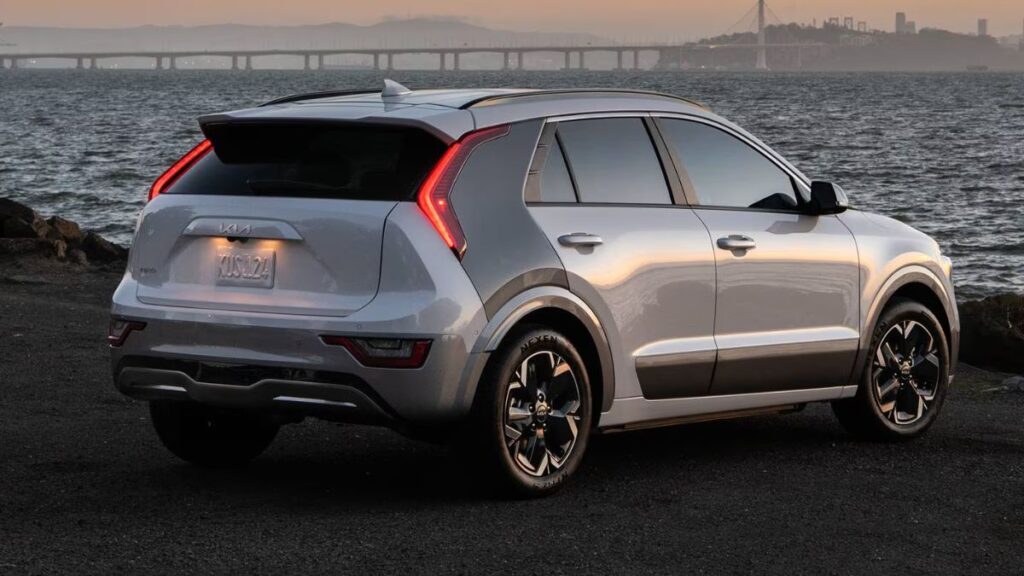
The redesigned exterior features bolder styling that makes the Niro instantly recognizable, particularly the striking contrasting Aeroblade at the C-pillar (available as a cost option). The face is now anchored by a more pronounced grille design that incorporates the charging port flap as part of the visual identity, rather than looking tacked-on.
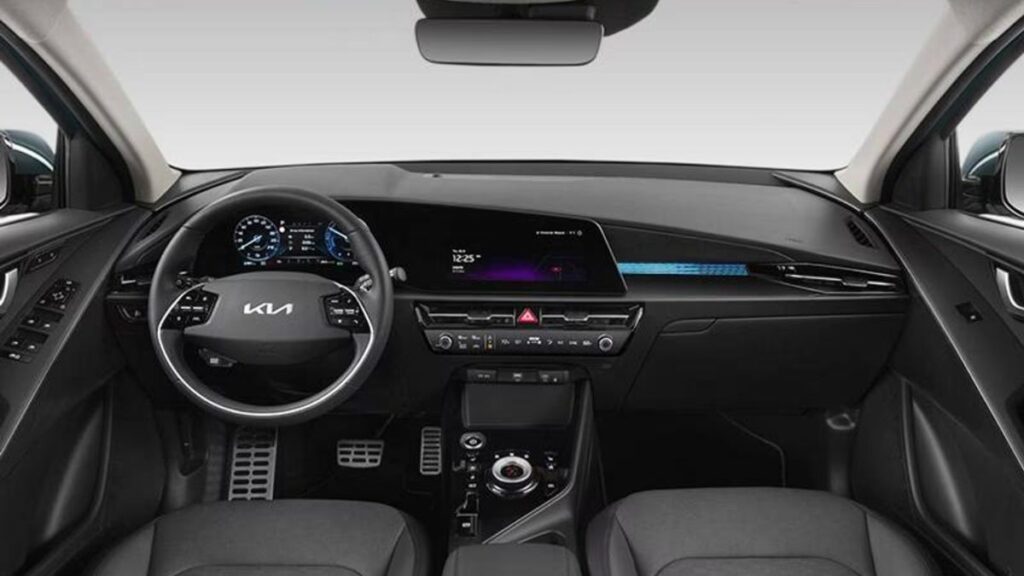
Inside, the transformation is more dramatic. The new dual-screen layout with the curved dashboard motif pulls inspiration directly from the flagship EV6. All Niro EV models now come standard with 10.25-inch screens (the previous generation started with an 8-incher), and the digital instrument cluster paired with the infotainment touchscreen creates a unified, premium appearance.
Efficiency gains across the board reflect the redesign. The EV range jumped from 239 miles to 253 miles despite using the same basic 64.8 kWh battery, thanks to improved aerodynamics and reduced weight. Charging speeds improved slightly as well, now hitting 85 kW on DC fast chargers versus the previous 77 kW.
Exterior Design
The 2023 Niro EV breaks from the beige, inoffensive styling that defined so many affordable EVs. There’s actual character here, whether you love it or find it a bit much depends on your taste.
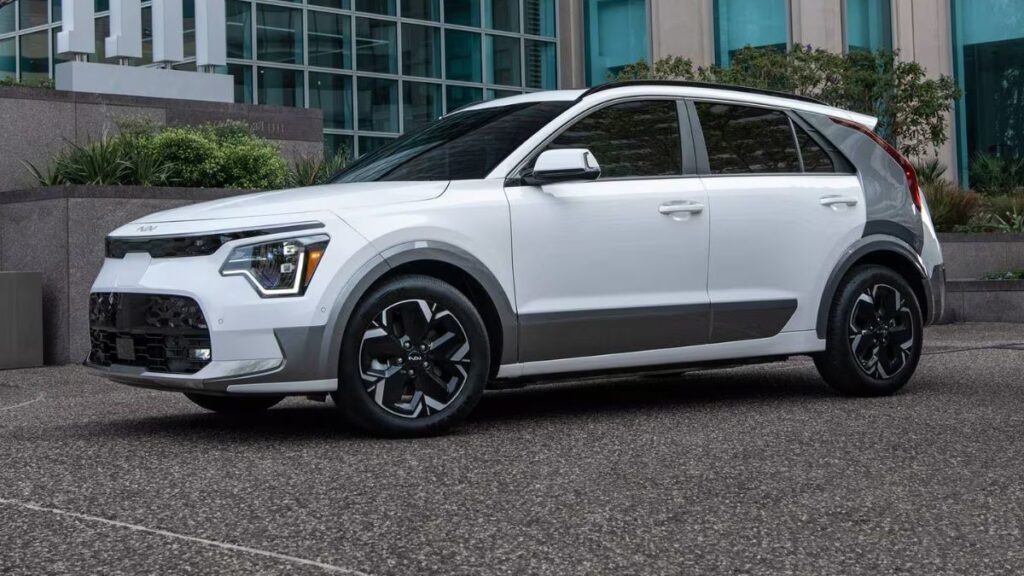
The most striking element is that Aeroblade at the C-pillar. It’s separated from the body, creating a bridge-like form that extends from the roof to the rear wheel arch. The concept draws from high-end sports cars, and on the Niro, it’s purely aesthetic. That said, if you choose the optional contrasting color like the gray blade on this tester, it transforms the entire profile. Without it, the Niro looks more conventional.
The front fascia features a bold interpretation of Kia’s tiger-nose grille, though on the EV it’s integrated with the charging port door to eliminate the awkwardness of a separate flap. The LED headlights and taillights are standard, with animated turn signals that add a touch of modernity. The wheel arches are deliberately squared off, reinforcing the rugged crossover aesthetic despite the car’s urban utility focus.
From the side, the Niro’s proportions work well. The high beltline and generous greenhouse create an airy, commanding driving position. At 174 inches long and 71.8 inches wide, it’s genuinely compact, yet it doesn’t feel like a compromised package the way some similarly sized vehicles do.
Where the design shows restraint is color availability. The Niro comes in sensible hues: Pearl White, Ebony Black, Steel Gray, and Navy Blue. The contrasting C-pillar blade option adds $195 and comes in gray, which feels understated compared to high-contrast options on competitors. This is either refreshingly honest or disappointingly conservative, depending on your perspective.
Driving Experience
This is where the Niro EV quietly impresses. It doesn’t assault you with acceleration or make you feel like you’re piloting something revolutionary. Instead, it delivers a driving experience that feels natural, almost unremarkable in the best way possible.
The electric motor produces 201 horsepower and 188 pound-feet of torque instantly, delivering smooth power delivery from a stop. The 0-60 acceleration of 7.1 seconds is modest by EV standards but perfectly adequate for a vehicle that prioritizes efficiency. What matters more is how that power arrives. There’s no nervous energy, no dramatic surge, just immediate, linear acceleration that makes merging feel effortless.
The steering is light and communicative, though not particularly involving. This isn’t a car that invites spirited canyon carving. The suspension favors comfort over sportiness, which means body roll exists but doesn’t intrude on everyday driving. Turn the wheel, and the Niro responds predictably. There’s no drama here, which is exactly the point.
Regenerative braking is adjustable via paddle levers, offering three levels of deceleration intensity. Toggle the left paddle one more time and you unlock i-Pedal mode, which enables true one-pedal driving. In this mode, lifting off the accelerator provides enough braking force to bring the car to a complete stop, bypassing the traditional brake pedal entirely for everyday driving. It takes a session or two to get the rhythm right, but once you do, errand runs around town become almost meditative.
The cabin noise floor is genuinely impressive. Road and wind noise are well isolated thanks to acoustic glass and generous sound damping. At highway speeds, you hear the tires more than anything else. Combine that with the silent electric drivetrain, and the Niro becomes an exceptionally peaceful place to spend time.
Performance and Acceleration
The Niro EV doesn’t pretend to be a performance machine, and that’s perfectly fine. Kia’s decision to focus on efficiency over raw speed is evident in the modest 201-horsepower electric motor and single-speed transmission.
The 7.1-second 0-60 time positions the Niro EV alongside the Hyundai Kona Electric but behind more aggressive competitors like the Kia EV6 or Tesla Model Y. In real-world driving, this matters less than you’d think. The instant torque nature of electric motors means the Niro EV never feels sluggish pulling onto highways or navigating city traffic. It’s the difference between quick and quick-feeling, and the Niro EV delivers the latter convincingly.
Acceleration remains smooth across the entire RPM range, which doesn’t exist on an EV but illustrates how linear the power delivery is. There’s no transmission hunting for gears or downshifting drama. Press the accelerator, and power comes immediately and proportionally. For daily driving, this refined approach trumps the drama of higher-performance alternatives.
Top speed is governed to 103.8 mph, which you’ll never approach in normal driving and frankly won’t miss. The Niro EV is designed around the reality of American highways and suburban commutes, not acceleration bragging rights.
Ride Comfort and Cabin Refinement
This is where the Niro EV shows its maturity. The suspension is tuned for comfort, which means it prioritizes absorbing bumps over sharp responses. Hit a pothole, and the Niro isolates you from it rather than involving you in the experience. On highway drives, the high-sidewall tires and well-damped suspension combine to create a serene, cocoon-like environment.
The trade-off is that the rear suspension can be slightly busy over repeated bumps, taking a moment to settle after rough pavement. This is a real weakness compared to class leaders, but it doesn’t substantially detract from overall ride quality. If you frequent roads scattered with potholes and rippling asphalt, the Hyundai Kona Electric handles these better.
Cabin quietness deserves special mention. The Niro EV’s combination of acoustic glass, sound deadening, and the naturally quiet electric drivetrain creates an interior that feels more expensive than the price tag suggests. At 70 mph on a smooth highway, the dominant sound is your music or podcast. Wind noise is minimal, and the tires produce only a low hum.
The interior temperature management is efficient, especially if you opt for the Heat Pump package on higher trims. This $1,300 addition becomes worthwhile in cold climates, reducing the energy drain of cabin heating and preserving range in winter. The base resistive heater works but consumes more battery energy.
Interior and Luxury Feel
Walking into the Niro EV’s cabin immediately challenges the assumption that affordable EVs must feel cheap. The curved dashboard sweeping horizontally creates an impression of width and spaciousness. The dual 10.25-inch screens sit in a continuous curved pod, blending together to suggest a unified, premium interface.
Material quality is respectable for the price. Soft-touch plastics dominate the upper dashboard and door panels, while harder plastics occupy lower areas where they’re less visible. Kia makes an environmental point of using recycled materials, including recycled wallpaper in the headliner and recycled plastic bottles in the upholstery, which adds warmth to what could have been a purely pragmatic interior.
The seats are comfortable for daily driving, though not particularly bolstered for athletic driving. Front seat comfort is good, with adequate thigh support and adjustable lumbar support. The rear is genuinely spacious, with 39.8 inches of legroom and a wide bench seat. The rear doors open to a wide angle, making child seat installation straightforward.
Storage is thoughtfully integrated. The center console is narrow but includes large cupholders that can flip away for utility. Door pockets are shallow but functional. Under the hood sits a small frunk with roughly enough space for a loaf of bread and some miscellaneous items, which is more than competitors offer but less than dedicated EV platforms provide.
The steering wheel is a two-spoke design borrowed from the EV6, creating a modern aesthetic that actually functions well. Controls are logically placed, though the split climate and media control system requires toggling between functions on the capacitive panel below the infotainment screen. It’s clever space-saving but less intuitive than traditional separate controls.
Technology and Infotainment
Kia’s UVO infotainment system remains one of the most user-friendly in the business. The 10.25-inch touchscreen is responsive and displays sharp graphics without excessive lag or processing delays. Apple CarPlay and Android Auto come wired on all models, which is fine though wireless connectivity would be a welcome addition at this price point.
The dual display setup, with the digital instrument cluster showing driving information and the central screen handling entertainment and navigation, eliminates menu diving. Vehicle information is always visible in your line of sight, reducing the need to glance at a center screen for speed or range information.
Kia’s digital key functionality allows smartphone and smartwatch unlocking and starting, though initial setup can be finicky. Once configured, it works reliably. The remote smart parking assist is a nice convenience, though realistically most drivers won’t use it regularly.
The seven-speaker standard audio system is adequate for commuting but lacks bass depth. Higher trims add a Harman Kardon sound system that significantly improves audio quality and is worth considering if music matters to your ownership experience.
Voice control exists and works reasonably well for basic commands like navigation and phone calls, though it’s not as natural as some competitors’ systems. The touchscreen remains faster for most interactions.
Fuel Economy
The Niro EV achieves an EPA-estimated 115 MPGe combined, with 120 MPGe city and 104 MPGe highway ratings. Real-world testing by major outlets consistently exceeds these estimates, with drivers regularly achieving 25-26 kWh per 100 miles in normal driving conditions.
That translates to roughly 3.8-4 miles per kilowatt-hour, which is genuinely efficient. To contextualize, that’s comparable to or better than more expensive competitors like the Kia EV6. The flat floor and optimized aerodynamics of the redesigned platform clearly paid efficiency dividends.
Cold weather testing shows the typical EV penalty in winter, with consumption rising to 30-33 kWh per 100 miles in freezing conditions without the heat pump package. The heat pump option mitigates this loss substantially, making it worthwhile for northern climates.
The 253-mile EPA-estimated range should be interpreted conservatively on highway driving at 70 mph, where you’ll likely achieve 230-240 miles. City driving often exceeds EPA estimates, particularly with extensive regenerative braking available. If you live somewhere with a consistent commute of under 150 miles round-trip, this is a genuine advantage.
Practicality and Cargo Space
The Niro EV surprises with how much space it contains for its exterior dimensions. Kia claims the interior is comparable to vehicles one size category larger, and after spending time with the car, that claim feels honest.
The 22.8 cubic feet of rear cargo space with the rear seats up exceeds that of the Hyundai Kona Electric (21.8 cu ft) and Chevrolet Bolt EUV (21.4 cu ft). With seats folded, capacity jumps to 63.7 cubic feet, creating a flat, expansive load floor. Kia positioned the cargo floor with dual height options, allowing you to lower it for easier loading of heavier items.
The liftgate opening is slightly taller and wider than some competitors, improving the ability to load large items without contortions. However, the opening still requires some attention for oversized cargo like furniture, and the higher floor height relative to the bumper demands more shoulder strength when loading heavy items.
Rear seat passengers get 39.8 inches of legroom, which is genuinely adult-sized. Three across is technically possible but tight, just as with most compact crossovers. The wide rear bench and large windows make the rear space feel airy and less claustrophobic than the higher-waistline designs of some competitors.
The small frunk, while barely large enough to be useful, provides space for a Level 2 charging cable and minor items that you don’t want rattling around the main cabin.
Safety and Driver Assistance
The 2023 Niro EV comes equipped with a comprehensive suite of safety features, though formal crash test ratings remain pending from both NHTSA and IIHS. The vehicle shares its crash structure with the conventionally powered Niro models, which scored well in previous testing.
Standard across the lineup are six airbags, automatic emergency braking with pedestrian and cyclist detection, blind-spot monitoring, rear cross-traffic alert with automatic braking, lane-keep assist, and highway departure warning. The base Wind trim adds all of these as standard, which is genuinely impressive for the price point.
The Highway Driving Assist system uses a camera and radar to provide hands-free steering on highway stretches, though it requires periodic driver input. Higher trims add Highway Driving Assist 2, which includes automatic lane changing and machine learning, essentially a more advanced version of the same technology. Neither system is as sophisticated as Tesla Autopilot or Kia’s own offerings on the EV6, but both function competently for highway cruising.
The safe-exit monitor prevents you from opening the door into an approaching vehicle or cyclist, a small feature that genuinely could prevent accidents. The rear occupant alert system reminds drivers not to forget rear passengers, particularly valuable for families with young children.
One caveat: multiple recall notices have been issued for floor wiring issues that could affect airbag and seatbelt deployment. If you’re considering a used 2023 model, verify that any recalls have been addressed through your Kia dealership.
Competitors Worth Considering
The Hyundai Kona Electric remains the closest corporate competitor, offering similar size and price but with a different design philosophy. The Kona is more visually distinctive and shares some interior concepts, though the Niro EV offers more space and a more mature cabin feel. The Kona’s slightly better range (258-305 miles depending on the year and battery) makes it appealing if you prioritize distance over space.
The Chevrolet Bolt EUV undercuts the Niro EV on price by roughly $13,000 and offers comparable range and interior space. The Bolt’s weakness is brand perception and interior quality, which falls behind the Kia’s refinement. For budget-focused buyers, the Bolt remains hard to beat.
The Volkswagen ID.4 sits at a higher price point but delivers more advanced infotainment, better all-wheel-drive options, and stronger performance. The ID.4 appeals to buyers willing to spend more for a dedicated EV platform and slightly more engaging driving dynamics.
The Nissan Leaf, while more affordable, offers less interior space and range, positioning itself in a different market segment. For compact practicality at a lower price, the Leaf remains viable, but it’s not truly a competitor for space-minded buyers.
Biggest Strengths and Weaknesses
The Niro EV’s greatest strength is its pragmatism. This car delivers genuine value through thoughtful design decisions that prioritize everyday usefulness. The interior space, quiet refinement, efficient powertrain, and comprehensive standard features create a package that actually improves your quality of life. You’re not sacrificing comfort or functionality to go electric. That’s rare at this price point.
The weakness, equally straightforward, is its relative mediocrity across single dimensions. The range is good but not class-leading. The charging speed is adequate but not impressive. The performance is acceptable but not exciting. The design is striking but dividing. The price is reasonable but not the lowest. For buyers seeking the absolute best in any category, the Niro EV asks you to look elsewhere. For those seeking an honest all-rounder, it’s compelling.
Which Trim Does Cardrav Recommend?
The Wind trim is the smart choice for most buyers. It starts at $39,550 and includes the dual 10.25-inch screens, comprehensive safety features, and the efficient electric drivetrain. You’re getting the essential Niro EV experience without paying for features you might not need.
The $5,400 step to the Wave trim adds Highway Driving Assist 2 (a more advanced driver assist system), LED headlights, a head-up display, and smartphone-as-key functionality. If highway driving features matter and you keep cars long-term, Wave offers better value than piecing together options.
The optional Heat Pump package ($1,300) deserves serious consideration if you experience freezing temperatures regularly. The efficiency and range preservation in cold weather justify the cost for northern climates.
Skip the higher-trim exclusive options unless you specifically need features like the Harman Kardon audio or heated rear seats. The base Wind delivers the complete Niro EV experience without unnecessary expense.
Final Verdict: Should You Buy It?
The 2023 Kia Niro EV is genuinely worth buying, but only if you understand what you’re getting. This is not a technology statement. It’s not a performance showcase. It’s not the cheapest electric car available. What it is, however, is honest.
You get a spacious interior that rivals vehicles substantially larger on the outside. You get a quiet, refined cabin that makes time behind the wheel feel calming rather than tedious. You get an electric drivetrain that’s efficient enough to make daily charging unnecessary for most commutes. You get Kia’s industry-leading warranty backing the entire experience.
If you drive 150 miles or fewer daily, live in a climate where all-wheel drive isn’t critical, and value refinement and space over maximum range or performance, the Niro EV makes exceptional sense. It’s the perfect car for someone asking, “How do I make electric work for my life?” rather than “How do I get the coolest EV?”
The higher price compared to the Bolt EUV is real, but it reflects genuine interior quality and a more mature design. You’re paying for years of pleasant ownership, not just miles of range.
Yes, you should buy it. Just buy it for the right reasons.
FAQ
How far can the 2023 Kia Niro EV really go on a charge?
The EPA-estimated range of 253 miles is achievable in real-world driving, particularly in city environments where regenerative braking provides substantial range extension. Highway driving at sustained 70 mph speeds typically sees range fall to 230-240 miles. Cold weather reduces range by 15-20 percent. Actual range varies based on driving habits, temperature, and driving conditions, but Kia’s estimates prove accurate for the Niro EV compared to competitors.
Is the 2023 Kia Niro EV worth $39,550?
For the Wind base trim, yes. The comprehensive standard features, spacious interior, excellent warranty, and refined driving experience justify the price compared to competitors. The Chevrolet Bolt EUV costs $13,000 less but delivers inferior interior quality and smaller cargo space. If budget is your primary constraint, the Bolt wins. If overall value matters, the Niro EV competes favorably.
How long does it take to charge the Niro EV?
A Level 2 home charger (240V, 7.2 kW) requires approximately 7-8 hours for a full charge from empty. DC fast charging reaches 80 percent capacity in roughly 45 minutes at an 85 kW charger, which is standard. Level 1 charging (120V household outlet) takes overnight or longer and isn’t practical for regular use.
Does the Niro EV come with all-wheel drive?
No. The 2023 Niro EV is front-wheel drive only, which limits appeal for buyers in regions with heavy snow and ice. The hybrid and plug-in hybrid versions similarly lack all-wheel drive. For winter-critical climates, the Hyundai Kona Electric or Volkswagen ID.4 offer better all-wheel-drive options.
How does the Niro EV compare to the Hyundai Kona Electric?
Both vehicles share similar platforms and pricing, but the Niro EV offers more interior space and a more mature cabin design. The Kona Electric provides slightly better range and more distinctive styling. The Niro EV wins on practicality, while the Kona appeals to buyers wanting more personality in the design. Test drive both before deciding.