2023 Chevrolet Bolt EUV Review: Aging but Affordable
The electric vehicle market moved faster in 2023 than it had in the previous five years combined. The Bolt EUV did not move at all, and that turned out to be a more interesting story than anyone expected.

2023 Chevrolet Bolt EUV: In 2023, the conversation around electric vehicles (EVs) shifted. It was no longer simply about range or value for money. 2022 was the era of value, with the focus on affordability and how well an economical EV could meet your everyday needs. 2023 marked a radical change, with the challenge becoming survival in a new generation of EVs characterized by faster charging platforms, stricter federal tax regulations, and a market that no longer rewards simplicity alone. The anti-inflation law transformed the automotive industry into a competitive weapon, and not all EVs emerged unscathed.
The Chevrolet Bolt EUV entered this new landscape as a known quantity, built on a platform that predates most of its rivals. The Hyundai Ioniq 5 and Kia EV6 arrived with 800 volt architecture and design language that looked like it came from a different decade. The Tesla Model Y kept slashing prices to defend its market share. Ford’s Mustang Mach-E leaned further into performance trims. Against that backdrop, the Bolt EUV looked, on paper, like the oldest kid in a class full of transfer students.
Yet something unexpected happened when the new federal tax credit rules took effect at the start of 2023. Vehicles assembled overseas, including the Ioniq 5 and EV6 built in South Korea at the time, lost access to the full purchase credit. The Bolt EUV, assembled at GM’s Orion Township plant in Michigan, kept it. Suddenly a car everyone assumed was falling behind found itself sitting in a stronger competitive position than several newer, more advanced rivals, at least on paper and at tax time.
That twist is the real story of the 2023 Bolt EUV. Not whether it is the newest EV on the lot, because it clearly is not, but whether an established, unglamorous platform can still earn its keep in a market that increasingly rewards speed of innovation over consistency.
Our Opinion
Calling the Bolt EUV a bargain misses what actually makes it interesting this year. It is a car built on proven engineering, not bleeding edge technology, and there is something to be said for that in a segment where several competitors are still working out early production kinks on brand new platforms. The Bolt EUV is not chasing anyone. It already exists, it already works, and dealers already have inventory sitting on lots.
That said, the gap is visible once you look past the tax credit conversation. Charging speed lags well behind the newest 800 volt architecture cars, the infotainment system, while functional, does not carry the same software polish as what Hyundai and Kia now offer, and the platform itself has not evolved meaningfully since its debut. Whether that matters to you depends entirely on how you weigh proven simplicity against genuine technological progress. This is not a car that wins on ambition. It wins, when it wins, on being finished and available right now.
Pros and Cons
Pros
- Qualifies for the full federal tax credit due to its Michigan assembly
- Established platform with a known reliability track record
- 247 miles of EPA estimated range, competitive even against newer rivals
- Super Cruise hands free driving available on Premier, a rarity at this level
- Wide dealer availability compared to newer, supply constrained competitors
Cons
- Charging architecture has not kept pace with 800 volt competitors
- Infotainment and driver software feel a generation behind Hyundai and Kia’s latest efforts
- No styling or platform updates since the model’s original launch
- Cargo space remains modest for a vehicle marketed as an SUV
What’s New for 2023
Chevrolet’s changes for 2023 were incremental rather than transformative. Pricing shifted twice within the model year as GM adjusted to the return of the federal tax credit, eventually settling with a base price increase over the prior year’s aggressive cuts. A Redline Edition appearance package joined the lineup, adding black exterior trim, red accented wheels, and a thin red line along the mirrors, purely cosmetic but a welcome bit of personality.
The more consequential update was not visible on the spec sheet at all. It was the tax credit itself. For much of 2023, the Bolt EUV was one of the only affordable electric SUVs that qualified for the full $7,500 federal incentive without requiring a lease workaround, a distinction that briefly reshuffled the value equation across the entire segment.
Exterior Design
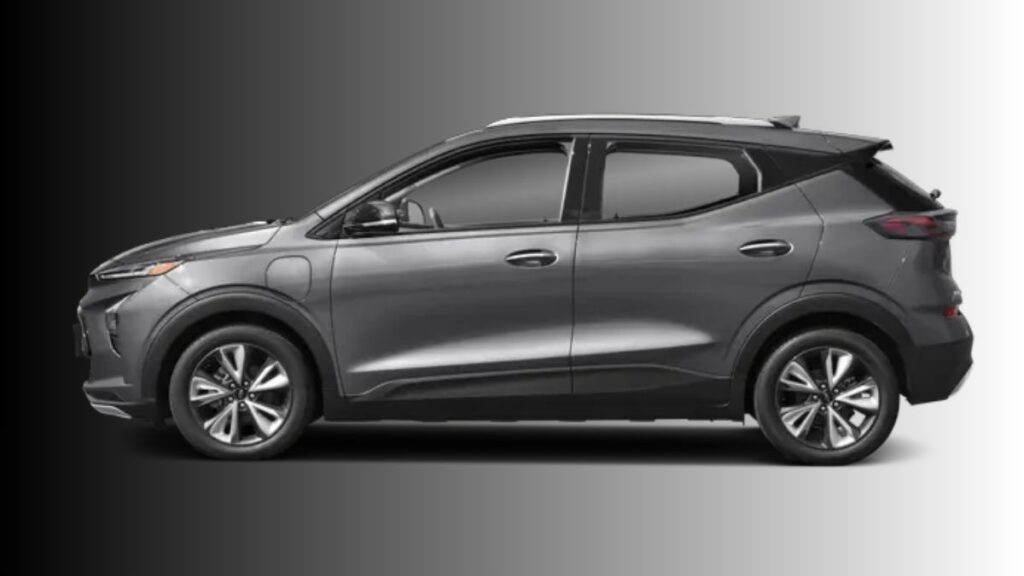
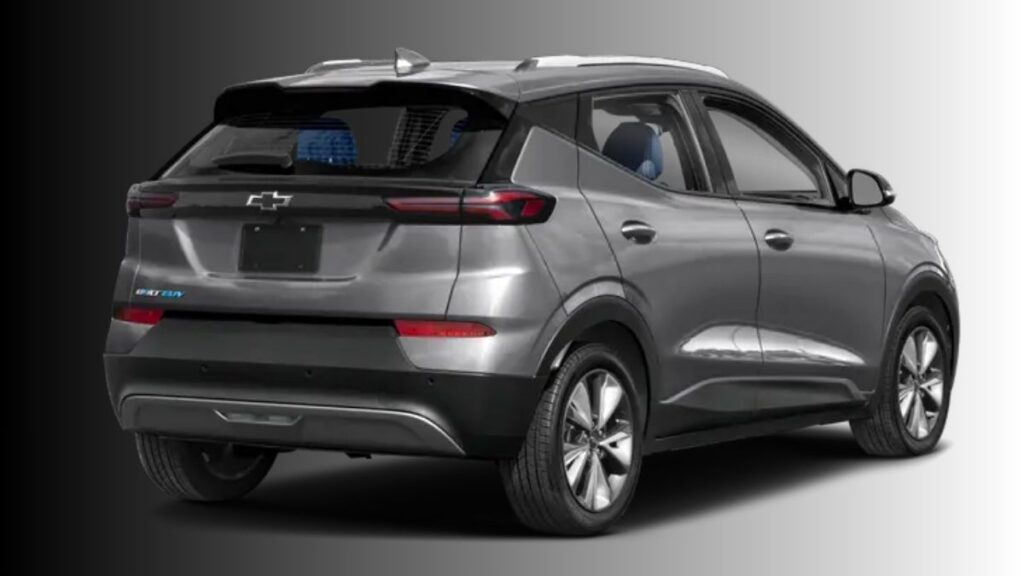
Chevrolet has not touched the Bolt EUV’s sheet metal in any meaningful way since its debut, and in 2023 that starts to show. Angular headlights and a wide stance still give it a reasonably modern face, but parked next to an Ioniq 5’s crisp, retro futurist lines or an EV6’s sculpted flanks, the Bolt EUV reads as conservative bordering on plain. It is a design that was competent when it launched and has simply stood still while the segment around it moved on.
That is not necessarily a flaw. Some buyers are tired of EVs that look like concept cars, and the Bolt EUV’s straightforward hatchback proportions will age more gracefully in a parking lot than some of its flashier rivals might. But anyone cross-shopping purely on curb appeal will notice the Bolt EUV is playing a different game than the newer arrivals.
Driving Experience
Get behind the wheel and the Bolt EUV still delivers the instant torque response that made electric cars appealing in the first place. It is not trying to be exciting in the way a Mustang Mach-E GT is exciting. It is trying to be predictable, and largely succeeds. Around town, the throttle response feels immediate without being twitchy, and the one pedal driving mode remains one of the more intuitive implementations in the segment, once you adjust to it.
Where the driving experience starts to feel dated is in refinement. Road noise intrudes more than it should at highway speeds, and the steering, while accurate enough for daily use, lacks the tighter, more deliberate feel that newer EV platforms have brought to market. This is where the gap between generations becomes obvious, not in a dramatic way, but in a hundred small details that add up over a longer drive.
Super Cruise remains the trump card. On the Premier trim, true hands free highway driving is something neither the Ioniq 5 nor the EV6 currently offers at any price, and it is worth experiencing before dismissing the Bolt EUV as simply the older option in the room.
Performance and Acceleration
Every 2023 Bolt EUV runs the same 65 kWh battery and single front mounted motor, producing 200 horsepower and 266 pound feet of torque, numbers that have not changed since launch. Zero to 60 mph arrives in roughly 6.7 seconds, respectable but no longer segment leading now that dual motor variants of the Ioniq 5 and EV6 can comfortably beat it by two full seconds or more.
The Bolt EUV was never built to win drag races, and it still does not need to. Around town and on typical commutes, the power delivery feels appropriate to the car’s mission. It only becomes a talking point when you start comparing spec sheets against rivals that have clearly been engineered with a broader performance range in mind, from efficient base trims all the way up to genuinely quick GT versions.
Ride Comfort and Cabin
Suspension tuning still favors comfort over sharpness, and that has not changed since the car’s debut. Potholes and rough pavement get absorbed without much drama, which matters more for daily livability than a stiffer, sportier setup would. The Bolt EUV is not trying to be a driver’s car, and the ride quality reflects a consistent, unfussy priority on comfort.
Cabin noise is the area where the platform’s age is hardest to ignore. Newer competitors have invested in better sound deadening and more sophisticated NVH engineering, and the difference is noticeable on longer highway stretches. It is not uncomfortable, but it no longer feels cutting edge the way it might have when the Bolt EUV was newly launched.
Interior Design and Luxury
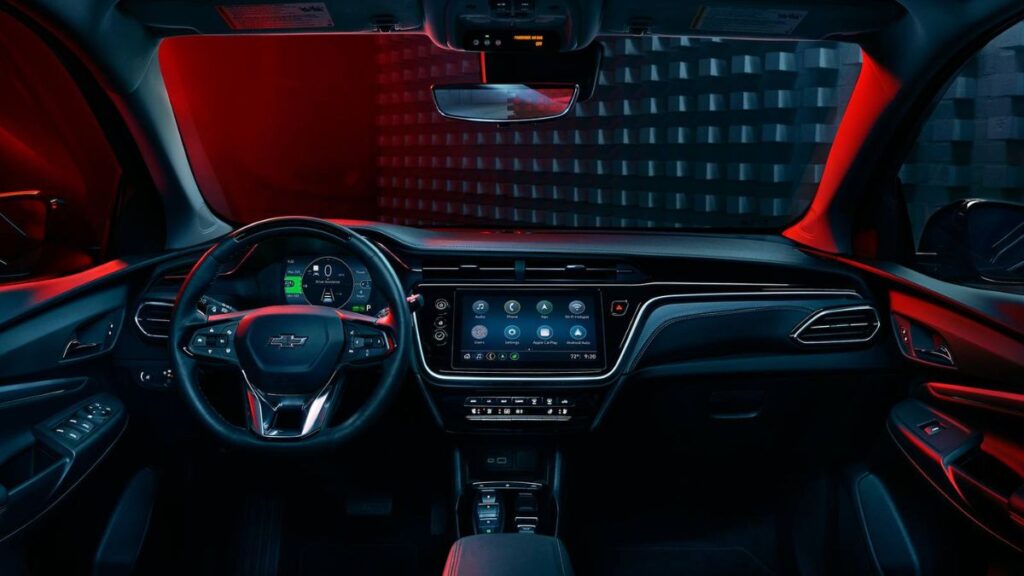
The cabin layout remains clean and sensible, with a flat bottom steering wheel and push button gear selector carried over unchanged. The Premier trim’s available perforated leather, heated and ventilated front seats, and heated rear seats still represent strong value relative to the car’s price, especially compared to how much competitors charge for similar comfort features.
Material quality is the spot where the Bolt EUV’s age becomes tactile rather than just visual. Hard plastics on the lower dash and door panels have not been refreshed, and next to the softer touch materials found in newer rivals like the Ioniq 5, the difference is immediately apparent the moment you rest a hand on the console.
Technology and Infotainment
The 10.2 inch touchscreen running Chevrolet Infotainment 3 Plus remains functional and easy to navigate, with wireless Apple CarPlay and Android Auto standard across every trim. For a platform that has not been substantially updated, the software holds up reasonably well, and the customizable driver display continues to offer useful, uncluttered information at a glance.
Where it falls behind is in the broader software experience that newer EVs now treat as table stakes. Over the air update capability is limited compared to what Hyundai and Tesla now offer, and the overall system feels like it belongs to an earlier chapter of EV development, competent but no longer pushing any boundaries.
Fuel Efficiency
The Bolt EUV’s EPA rating of 125 MPGe city and 104 MPGe highway, for a combined 115 MPGe, remains genuinely strong even against newer competition. Efficiency, unlike styling or infotainment, is one area where the platform’s relative simplicity has not put it at a disadvantage.
Charging tells a more complicated story. A 240 volt home charger still takes about 10 hours for a full charge, which is unchanged and fine for overnight use. DC fast charging remains capped around 55 kW, adding roughly 95 miles in 30 minutes. Against 800 volt rivals capable of adding well over 200 miles in a similar window, this is the clearest technical marker of the Bolt EUV’s age, and the one gap that no software update or trim package can close.
Practicality and Storage
Interior passenger space continues to be a genuine strength, with 44.3 inches of front legroom and 39.1 inches in the rear, roughly three inches more than the standard Bolt EV offers. Adults can ride comfortably in either row, which is not something every compact electric SUV can claim.
Cargo capacity remains the recurring weak point, with 16.3 cubic feet behind the rear seats and 56.9 cubic feet with them folded flat, numbers that have not grown since the car’s debut and that trail what several newer competitors now offer in a similarly sized footprint. If your usage leans toward hauling gear rather than passengers, this is where the Bolt EUV’s unchanged packaging works against it.
Safety and Driver Assistance Systems
Standard Chevy Safety Assist continues to bundle automatic emergency braking, front pedestrian braking, forward collision alert, and lane keep assist across every trim, a generous baseline that has aged well even as competitors have added their own suites. The Premier trim’s available 360 degree camera and Super Cruise option remain genuine differentiators in this price range.
Crash test performance carries over from the closely related Bolt platform, which earned a five star overall rating from NHTSA. Nothing has changed here, but nothing needed to. The safety fundamentals were solid at launch and remain solid now.
Worthy Competitors
The Hyundai Ioniq 5 represents the clearest look at where the segment is heading, with faster 800 volt charging and sharper design, though its South Korean assembly meant it lost access to the full federal tax credit for much of 2023, a gap that partially offsets its technical advantages.
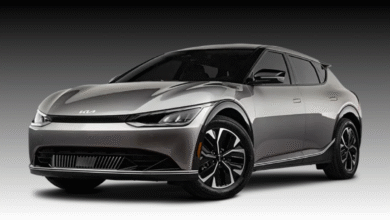
The Kia EV6 shares the Ioniq 5’s strengths and its same tax credit limitation, making it a stronger technical package but a less certain financial one depending on when and how you buy.
The Tesla Model Y continues to out-range and out-charge the Bolt EUV comfortably, and aggressive 2023 price cuts brought it closer to the Chevy’s territory than ever before, eroding one of the Bolt EUV’s traditional advantages.
The Ford Mustang Mach-E offers more performance variety across its lineup, but pricing climbs quickly once you move past its base configuration, keeping the value gap between the two vehicles intact.
Key Strengths and Key Weaknesses
The Bolt EUV’s defining strength in 2023 is not a spec on a page. It is availability and eligibility, a finished, known platform that qualified for the full tax credit while some flashier rivals were tangled up in sourcing rules they had not yet solved.
Its clearest weakness is charging speed, a technical shortfall that no incentive or pricing strategy can paper over. If your household regularly relies on public fast charging, the gap between the Bolt EUV and its 800 volt competitors will become obvious on the very first road trip.
Which Category Does Cardrav Recommend?
Buyers who value a finished, dependable platform available today, without waiting on inventory or navigating shifting sourcing eligibility, should feel comfortable choosing the Bolt EUV. Buyers who prioritize the newest charging technology and software experience will likely find more satisfaction in an Ioniq 5 or EV6, tax credit uncertainty included. Families who lean on frequent long distance travel should weigh the Bolt EUV’s slower charging carefully before committing.
Conclusion: Does the Bolt EUV Still Make Sense?
The honest answer is that it depends on what you are optimizing for. As a piece of technology, the Bolt EUV is no longer the newest idea in the room, and pretending otherwise would be dishonest. But 2023 proved that being new is not the same as being right for every buyer. A stable platform with proven reliability, wide dealer availability, and, for much of the year, uncontested access to the full federal tax credit gave the Bolt EUV a real, defensible reason to exist alongside far more advanced competitors. It is not the car for someone chasing the latest EV architecture. It is the car for someone who wants something that already works, is already built, and does not ask them to gamble on next year’s software update. That is a smaller pitch than “newest and best,” but it is still a legitimate one.
FAQ
Does the 2023 Chevrolet Bolt EUV qualify for the federal EV tax credit?
Yes. Because it is assembled in Michigan, the 2023 Bolt EUV qualified for the full $7,500 federal tax credit for most of the model year, an advantage several imported rivals did not share at the time.
How does the Bolt EUV compare to newer 800 volt EVs like the Ioniq 5?
The Bolt EUV charges significantly slower than 800 volt competitors, but it offers comparable range, a lower relative price, and tax credit access that some of those newer rivals lacked in 2023.
Is the 2023 Bolt EUV outdated compared to its competition?
The underlying platform has not changed since launch, so it lacks some of the charging speed and software polish found in newer EVs, though its core mechanicals remain competitive on range and reliability.
Does the Bolt EUV offer all wheel drive?
No. Every 2023 Bolt EUV uses a single front mounted motor and front wheel drive only, with no all wheel drive option across any trim.
Is Super Cruise available on the 2023 Bolt EUV?
Yes, but only as an option on the Premier trim, giving buyers access to hands free highway driving that remains unavailable on rivals like the Ioniq 5 and EV6.