2025 Hyundai Ioniq 5 N Review: The Driver’s EV
A performance EV that actually feels alive

The 2025 Hyundai Ioniq 5 N arrives at a moment when the EV performance car feels almost contradictory. Performance electric vehicles tend to be either brutally quick in a straight line but numb in the corners, or refined but expensive luxury machines that prioritize the show over the drive. The Ioniq 5 N splits the difference in a way that shouldn’t work but somehow does. This is not a software tweak applied to an existing model. Hyundai’s N division has gone back to fundamentals, adding 42 additional welding points, nearly seven feet of structural adhesive, stiffened suspension components, and completely reimagined steering and brake systems specifically engineered for track work at the Nürburgring.
What’s remarkable is that Hyundai has accomplished this without dropping the practicality or everyday livability. You still get a five-seat family crossover with 240 cubic feet of cargo space and a 221-mile EPA range. The added benefit is 641 horsepower, a chassis that actually communicates what the tires are doing, and the sort of engaged driving experience that’s become increasingly rare even in dedicated performance cars. The base price of $66,100 undercuts the Tesla Model Y Performance while delivering a fundamentally different,and arguably more satisfying,driving experience.
This is a genuine engineering achievement. Whether it’s right for you depends entirely on how much you value driver engagement and playfulness over the kind of efficiency and charging networks Tesla has built.
Our Take
The 2025 Hyundai Ioniq 5 N is the most engaging EV we’ve tested, period. It’s genuinely fun to drive on twisty roads, responsibly quick in a straight line, and it doesn’t feel like a software update applied to an existing model. The compromises are real—221 miles of range will concern road-trippers, and the high-strung suspension and performance-oriented tuning means this isn’t the smoothest commuter. But for buyers who prioritize how a car feels over absolute practicality, the Ioniq 5 N is the EV equivalent of a hot hatchback, and it’s exactly what Hyundai promised.
Pros & Cons
Pros:
- Brilliant steering response and chassis balance that makes backroads genuinely fun
- 641 hp with instant torque delivery and no turbo lag
- Sharp, communicative handling without excessive body roll
- Retro interior design feels intentional and driver-focused, not gimmicky
- Excellent warranty: 10 years/100,000 miles on the battery
- Significantly cheaper than Tesla Model Y Performance with superior handling
Cons:
- 221-mile range is limiting for frequent road trips compared to Model 3 Performance (303 miles)
- Firm suspension and narrow tires mean a stiff, sometimes harsh ride on poor pavement
- Fake engine sounds and simulated shifting won’t appeal to everyone
- Relatively tight interior space compared to standard Ioniq 5
- Front frunk is tiny (0.85 cubic feet)
- Base price starts at $66,100, though no real options exist
What’s New
The 2025 model year marks the debut of the Ioniq 5 N, so there’s no “what’s new” in the traditional sense. This is an entirely fresh variant created by Hyundai’s N performance division. Key hardware includes revised suspension geometry tuned specifically for track duty, four-piston front brakes with nearly 16-inch rotors, a unique N-specific steering wheel with direct access to performance modes, and lightweight 21-inch forged aluminum wheels wrapped in high-grip Pirelli P Zero summer tires.
Exterior Design
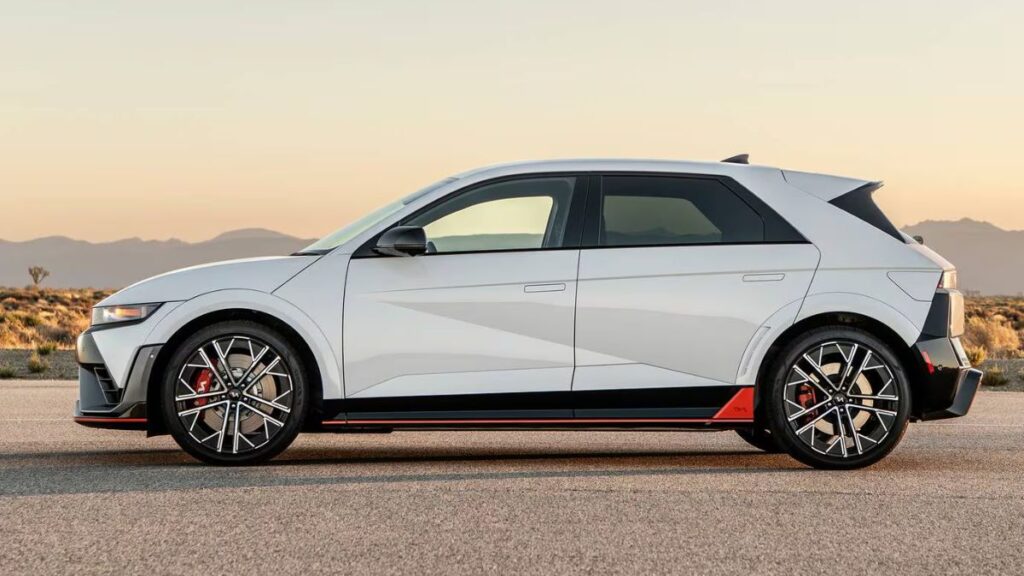
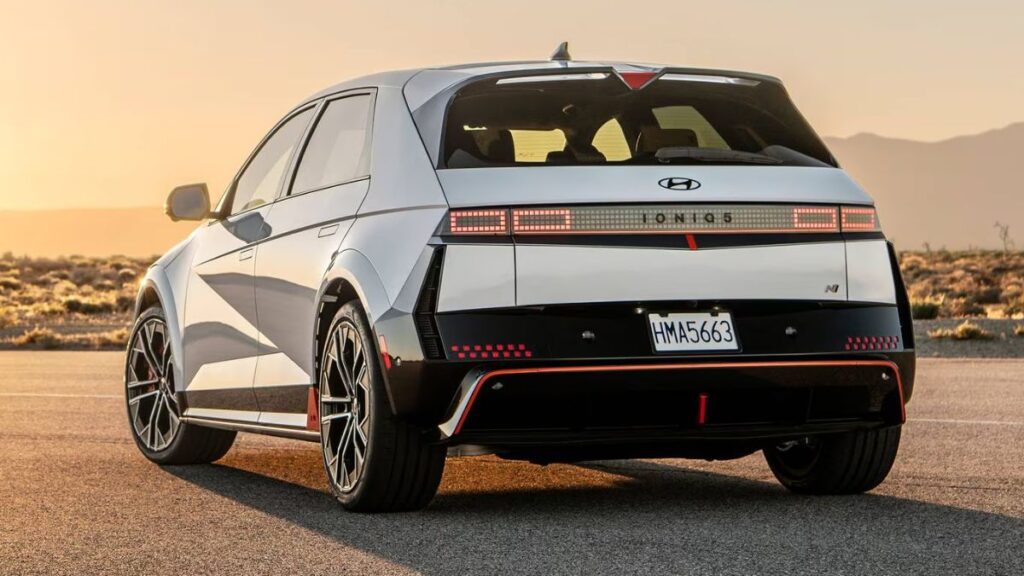
The Ioniq 5 N wears its performance intent visibly. The stance is noticeably wider and lower than the standard Ioniq 5, thanks to a 50mm track increase and fully redesigned suspension geometry. The front fascia gets a more aggressive N-specific mask with functional cooling vents and active air flaps. Around back, you’ll find a rear diffuser and a fixed spoiler with luminous orange accents that do more than just look purposeful, they actually work at speed.
The retro-futuristic design language remains intact, but the N treatment gives it more presence. Opt for the Performance Blue Matte paint ($1,000), and this thing absolutely dominates the visual landscape. It doesn’t look like a mild performance variant; it looks like something genuinely different.
Driving Experience
This is where the Ioniq 5 N separates itself from nearly every other EV on the market. The steering is genuinely sharp without feeling artificially heavy. Feedback is immediate and linear, and the front end responds to mid-corner inputs in a way that makes you want to keep pushing. The chassis balance is exceptional, weight transfers feel controlled, and the adaptive suspension allows you to really explore the limits without the whole experience becoming a white-knuckle affair.
Even at legal speeds, the Ioniq 5 N invites you to engage with it. You’ll find yourself taking slightly tighter lines through corners, holding throttle slightly longer on exits. This is the opposite of what happens in the Tesla Model Y Performance, which makes you hyperaware of raw power but doesn’t necessarily make you feel connected to the road.
On straights, the initial acceleration is startling. The dual-motor setup delivers maximum torque instantly with no delay, and the sensation is genuinely quick. Press the N Grin Boost button on the steering wheel for a 10-second power surge, and the extra 40 horses barely register because the baseline thrust is already overkill. The steering wheel buttons let you save multiple drive modes, which proves invaluable if you’re mixing street driving with track time.
The trade-off is compliance. This is a purpose-built performance car, and the suspension reflects that. Over broken pavement or highway expansion joints, the stiffened chassis transmits feedback directly to your spine. It’s not punishing on smooth roads, but if you’re accustomed to the isolated float of a standard Ioniq 5, you’ll notice the difference immediately.
Performance & Engines
Dual-motor all-wheel-drive system with 601 horsepower and 545 lb-ft of torque, or 641 hp with the 10-second N Grin Boost button. Real-world testing shows 3.2–3.3 seconds to 60 mph, which puts it faster than the BMW i4 M50 and competitive with the Kia EV6 GT.
What matters more than the numbers is how the power arrives. The motors stay pulling hard well past the triple-digit mark—unusual for EVs, which typically fade as speeds climb. The Ioniq 5 N maintains that aggressive thrust, making highway passing feel visceral even at 80 mph. The N Grin Boost button delivers extra punch for 10 seconds, though honestly, the baseline power is already overkill for public roads. Top speed of 162 mph is purely academic but still appreciated.
Ride Comfort & Cabin Refinement
The ride quality is the legitimate weak point for urban and highway driving. The 275/35R21 summer tires and stiffened suspension prioritize feedback and cornering precision at the expense of cushioning. Over rough pavement, every pothole and seam telegraphs into the cabin. If you live in an area with pristine roads, this is less of an issue. If you’re dealing with broken urban streets, you’ll feel it.
Noise levels are otherwise controlled. Wind and tire noise are minimal at highway speeds, and the absence of engine clatter is one of the perpetual advantages of electric powertrains. Hyundai offers three synthetic engine sounds—”Ignition” (which mimics a four-cylinder ICE engine), “Evolution,” and “Supersonic, that pipe through the stereo when you’re in dynamic driving modes. If simulated sounds aren’t your thing, you can disable them entirely. The cabin is genuinely quiet without them.
Interior
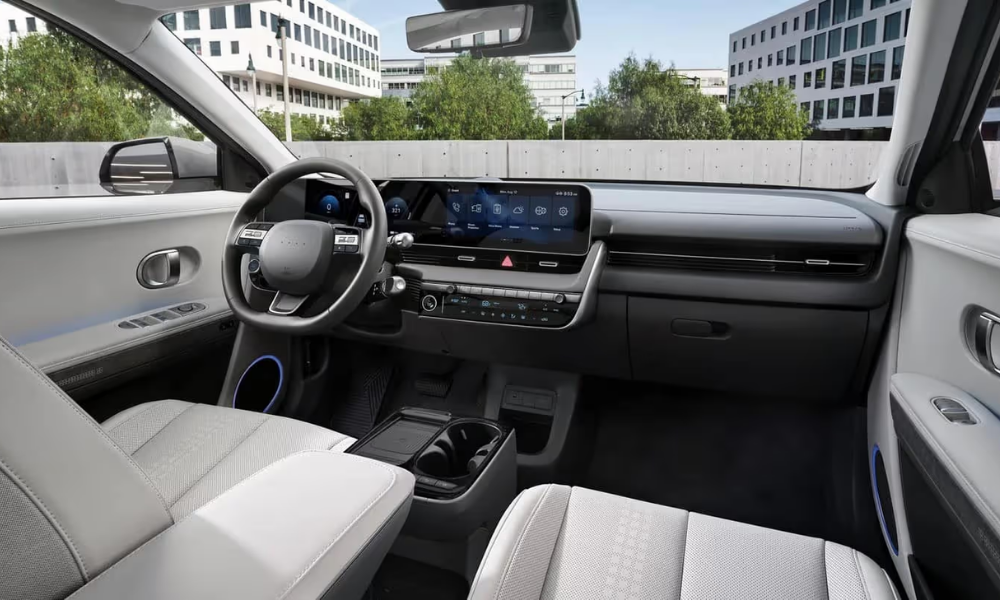
Step inside and the driver-focused design is obvious. The seat bolstering is aggressive without being uncomfortable, and the low driving position gives you the sensation of sitting in something smaller and sportier than the external dimensions suggest. That’s intentional—Hyundai engineered the cockpit to feel like a two-seater sports car despite the rear bench and fold-flat cargo area.
The N-exclusive steering wheel is thick and supportive with clear finger detents for the N buttons. Material quality is solid—soft-touch plastics on the upper dashboard, metallic accents, and suede-like trim on the steering wheel. But here’s the catch: the overall cabin design still feels like Hyundai playing it safe rather than taking a real risk. The layout is competent, not bold. You won’t mistake this for an AMG or M performance car interior; it’s a fast Hyundai, not a performance brand statement.
Visibility is decent. The front windshield is large, and the side windows are well-positioned. Cargo space is adequate at 14.2 cubic feet with rear seats up, expanding to 56 cubic feet folded flat. The frunk, however, is a genuine frustration at 0.85 cubic feet—barely enough for charging cables. For a $67,000 performance car, this feels penny-wise and pound-foolish.
Technology & Infotainment
The 12.3-inch touchscreen is responsive and uses Hyundai’s latest software, which is clean and functional without being overly complex. Apple CarPlay and Android Auto are both available wirelessly. Navigation is native to the system and works well, though most users will default to their phone’s maps app anyway.
The driver assistance suite is comprehensive: adaptive cruise control, lane keeping assist, blind-spot monitoring, and forward collision avoidance. All of it works as advertised without being intrusive. You can customize the aggression level through the settings menu, which is appreciated.
Here’s where Hyundai made a misstep: the simulated engine sounds. The N Active Sound+ system offers three preset sounds (“Ignition,” “Evolution,” “Supersonic”) that pipe through the stereo during spirited driving. Fun for the first 10 minutes. After that, it starts feeling like a gimmick that undermines the genuine driving experience. You can disable it entirely, which most owners probably should. The car is plenty engaging without pretending to be something it isn’t.
The Bluelink app handles remote functions like climate preconditioning and charging schedules. It’s functional though not as feature-rich as Tesla’s offering. The infotainment system is one of those areas where the Ioniq 5 N doesn’t try to oversell itself—it does the job without demanding attention.
Efficiency
The EPA rates the 2025 Ioniq 5 N at 78 MPGe combined (84 city, 72 highway). In real-world testing, expect 75–80 MPGe depending on driving style. That’s respectable for 641 horsepower and completely acceptable efficiency for a performance-focused EV. Track driving will drop this considerably, but that’s expected and accepted by the target audience.
The 84-kWh battery can charge from 10 to 80 percent in approximately 18 minutes on a DC fast charger, putting it at the faster end of the EV charging spectrum. Level 2 home charging takes about seven hours from a standard outlet. The 221-mile EPA range is sufficient for commuting but will require planning on longer road trips. Hyundai’s battery management software does an excellent job of preserving range estimates and managing thermal conditions during hard driving.
Practicality
This is a five-seat electric crossover, so practicality exists but takes a back seat to performance. The rear seats are genuinely spacious with nearly 40 inches of legroom, making it practical for families or long-distance passenger duties. Rear-seat passengers won’t feel performance-car sacrifice; the cabin is quiet and refined when you’re not aggressively driving.
The cargo area is functional. With rear seats up, you get 14.2 cubic feet. Fold them flat and it expands to 56 cubic feet, which is adequate for a road trip or shopping run. The frunk’s 0.85 cubic feet is the real limitation—barely enough for charging cables and paperwork.
For daily commuting and typical suburban duties, the Ioniq 5 N is entirely practical. For road trips with multiple passengers and luggage, you might find yourself wishing for more space or range.
Safety
The standard Ioniq 5 earned a Top Safety Pick+ award from IIHS and a five-star rating from Euro NCAP, with strong protection scores across the board. The N variant shares the same rigid E-GMP platform and safety architecture, so those ratings apply directly. NHTSA is currently testing the 2025 and 2026 Ioniq 5 models for federal crash ratings, with results rolling out throughout 2025 and 2026.
Standard safety features include automatic emergency braking, adaptive cruise control, lane keeping assist, blind-spot warning, and 360-degree camera monitoring. The comprehensive driver assistance suite is functional and unobtrusive. The battery floor provides excellent structural rigidity and a low center of gravity that reduces rollover risk compared to traditional gas-powered SUVs.
Competitors Worth Considering
Tesla Model Y Performance: Quicker in a straight line (3.0 seconds to 60), significantly more range (303 miles EPA), and access to the best-developed charging network in America. But the Model Y’s steering feedback is minimal, the suspension is more focused on ride smoothness than engagement, and the minimalist interior with a single screen for all functions feels less driver-focused. The Model Y wins on range and charging infrastructure; the Ioniq 5 N wins on how it actually feels to drive.
Ford Mustang Mach-E GT Performance: After recent updates, the Mach-E has become substantially better. It offers more range (280+ miles), genuine Mustang-derived steering personality, and starts at a lower price point. However, it doesn’t match the Ioniq 5 N’s track capability or chassis feedback. If you prioritize everyday comfort and charging access over pure driving engagement, the Mach-E is the safer choice.
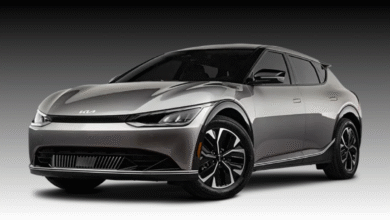
Kia EV6 GT: Shares the same E-GMP platform as the Ioniq 5 N and delivers similar performance (576 hp, 3.4 seconds to 60). The EV6 GT feels more refined in everyday driving but less playful on spirited roads. Choose the Ioniq 5 N if you want maximum driver engagement; choose the EV6 GT if you want performance with a smoother daily experience.
BMW i4 M50: More range (295 miles) and a more refined interior, but it’s substantially more expensive, delivers less power (536 hp), and feels less eager to drive hard. It’s a different proposition entirely, performance EV as luxury sedan rather than performance-first experience.
Biggest Strength and Biggest Weakness
Biggest Strength: The steering and chassis feedback. This car actually tells you what’s happening at the road. The precision is exceptional, the body control is excellent, and the Ioniq 5 N actively invites you to engage with it rather than just point it and push a pedal. Most performance EVs are fast; this one is genuinely rewarding to drive well.
Biggest Weakness: Range limitations (221 miles EPA) combined with a firm, unforgiving suspension that prioritizes feedback over comfort. If you’re taking a multi-hour road trip or you live on broken pavement, the compromises become apparent fast. This is a weekend car and daily commuter combined, and it sacrifices some daily-driver comfort to achieve its performance targets.
Final Verdict
The 2025 Hyundai Ioniq 5 N is worth buying if you prioritize how a car feels over absolute efficiency, range, or charging convenience. At $67,800, it’s significantly cheaper than the Tesla Model Y Performance while delivering superior steering feedback, better handling balance, and a fundamentally more engaging driving experience. The compromises—221 miles of range, a stiff suspension, firm brakes that require some practice, are deliberate engineering choices, not oversights.
For buyers who spend weekends on back roads, who genuinely value steering feedback and chassis communication, and who can live with some ride harshness in exchange for precision, the Ioniq 5 N is genuinely the best performance EV money can buy at this price point. For buyers who prioritize comfort, range, and charging infrastructure, the Tesla Model Y Performance remains the safer choice despite its numb steering and clinical driving experience.
Hyundai has proven that electric performance cars don’t have to feel disconnected or soulless. The Ioniq 5 N actually has personality. That matters.
FAQ
How much range does the 2025 Ioniq 5 N get?
The EPA rates it at 221 miles per charge. Real-world testing suggests 220–250 miles depending on driving conditions. Aggressive driving or sustained highway speeds will reduce this. For commuting and regional trips, it’s adequate. For frequent long-distance travel, you’ll need to plan charging stops.
Can the 2025 Ioniq 5 N use Tesla Superchargers?
Not directly. The 2025 model uses CCS charging. Hyundai has announced NACS compatibility for 2026 models, which will grant access to the Supercharger network. For now, you’ll rely on public Level 2 and DC fast chargers.
What’s the warranty on the 2025 Ioniq 5 N battery?
Hyundai offers 10 years or 100,000 miles of coverage on the battery and electric drive components, along with five years or 60,000 miles of basic new-vehicle coverage. This is one of the industry’s better warranties for EVs.
How does the 2025 Ioniq 5 N compare to the Tesla Model Y Performance?
The Model Y is quicker in a straight line (3.0 seconds) and has significantly more range (303 miles). The Ioniq 5 N has superior steering feedback, better handling balance, and a more engaging driving experience overall. If you value range and charging infrastructure, choose the Model Y. If you value how the car feels to drive, choose the Ioniq 5 N.
How fast does the 2025 Ioniq 5 N accelerate?
EPA-rated 0–60 in 3.25 seconds with N Grin Boost active. Real-world testing shows 3.2–3.3 seconds is achievable. Top speed is 162 mph. That’s genuinely quick, faster than most enthusiasts will ever need on public roads