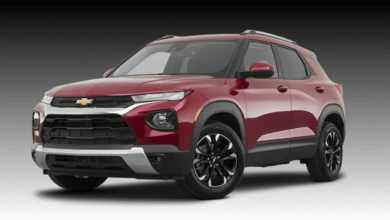
2025 Kia Niro Hybrid Review: Efficient and Practical
The underrated hybrid crossover that outpaces the Corolla Cross and challenges even the Prius, proving fuel economy doesn't mean settling for less

The 2025 Kia Niro Hybrid occupies a practical corner of the market that most buyers overlook. It’s competent where others compromise and efficient without downsizing the cabin. You won’t get Toyota’s brand legacy, Honda’s interior craftsmanship, or Mazda’s driving engagement. What you do get is a hybrid SUV that delivers measurable value without marketing theatrics.
The numbers reveal the gap. The Niro Hybrid achieves 53 MPG combined in base trim, matching the Corolla Cross Hybrid despite being larger and roomier. The Toyota starts $160 cheaper at $26,830 versus the Kia’s $26,990, but the vehicles serve different priorities. The Niro reads as a genuine compact SUV with space. The Corolla Cross feels more sedan-based, prioritizing efficiency over room.
Kia positioned the Niro hybrid as the middle option between a plug-in hybrid and a fully electric variant. For 2025, the company made only minor revisions. An aeroblade was removed from certain trims. Rear seatbelt pre-tensioners became standard. The Cold Weather Package is now included on PHEV SX Touring models. That’s the complete list of changes. No platform overhaul. No cabin redesign. The stability suggests the vehicle already delivers what buyers expect from it.
This SUV appeals to commuters who prioritize fuel cost savings, value reliable transportation, and don’t need the prestige that brand reputation provides.
Our Opinion
The 2025 Kia Niro Hybrid is one of the least celebrated competent vehicles in its segment. It doesn’t aspire to emotional engagement. Nobody chooses it for styling cues or driving excitement. It simply executes its core mission efficiently.
Where the Niro succeeds is in the fundamentals. The powertrain runs smoothly. The cabin stays quiet during highway driving. Seating accommodates five adults without complaint. Fuel economy tracks closely to EPA estimates in real-world use. Build quality has improved noticeably compared to earlier Kia models, though it doesn’t match Toyota’s material consistency.
The primary limitation isn’t mechanical. It’s the design language, which communicates corporate compromise rather than intentional vision. The interior uses a straightforward layout that works but doesn’t inspire. The exterior wears styling that offends nobody while exciting nobody either.
For practical-minded buyers, the Niro hybrid merits consideration. For those seeking a vehicle with distinctive character or premium interior materials, this won’t satisfy. It’s a deliberate choice, not a compromise choice.
Pros and Cons
Pros
- Outstanding fuel economy across all driving conditions, matching or beating larger competitors
- Roomy cabin with excellent rear legroom and 22.8 cubic feet of cargo space
- Strong standard features including 10.25-inch touchscreen on most trims
- Impressively low pricing for what you get, starting under $27,000
- Quiet hybrid operation with no jarring engine intrusion
- 10-year/100,000-mile powertrain warranty demonstrates Kia’s confidence
- Available in three powertrains (hybrid, plug-in hybrid, EV) for different needs
Cons
- Uninspired exterior design that blends into parking lots
- Underwhelming acceleration in base mode without switching to Sport
- Interior materials feel middle-of-the-road, not cheap but not premium
- Wireless Apple CarPlay and Android Auto absent, requiring cable connection
- Lacks 360-degree camera system even on higher trims
- No heads-up display, which feels like a missed opportunity
- Minimal design updates for 2025 suggest Kia has moved on creatively
What’s New for 2025
Changes are minimal. The black aeroblade that ran along the C-pillar on previous models is deleted from most configurations. Whether this improves the design is subjective. Some owners preferred the visual contrast. Others found it cluttered.
Rear seatbelt pre-tensioners become standard across the lineup. This addresses a safety gap that should have been included from the start.
On the plug-in hybrid variant, the Cold Weather Package is now standard on SX Touring trims. This includes heated rear seats and a Positive Temperature Coefficient heater that preserves all-electric range in freezing conditions. For PHEV owners in cold climates, this is genuinely useful.
No powertrain revisions. No interior redesign. No technology upgrades beyond 2024. Kia’s conservative approach suggests the vehicle already delivers what buyers expect. If you preferred the 2024 Niro, the 2025 experience is virtually identical.
Exterior Design
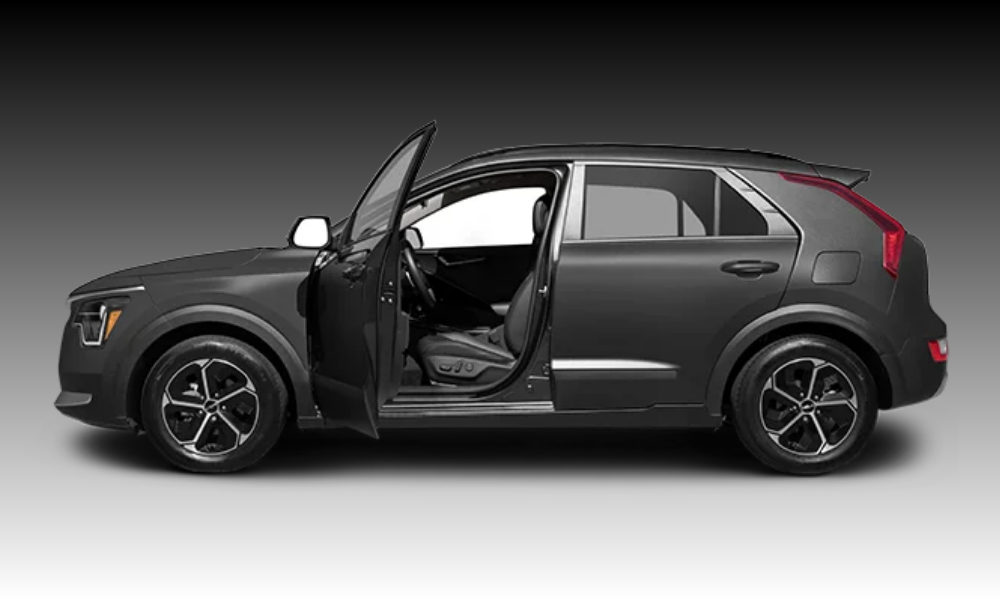
The Niro Hybrid presents a functional design philosophy. The front fascia uses a mesh grille that attempts contemporary styling but reads more corporate than distinctive. The body sides use flat panels and minimal sculpting, which maximizes interior width while eliminating visual dynamism.
A direct comparison to competitors clarifies the positioning. The Toyota Corolla Cross features a lower roofline and tapered rear that suggest a sedan-crossover blend. The Honda CR-V uses more aggressive front end styling and character lines that project confidence. The Niro avoids both approaches, opting instead for visual neutrality.
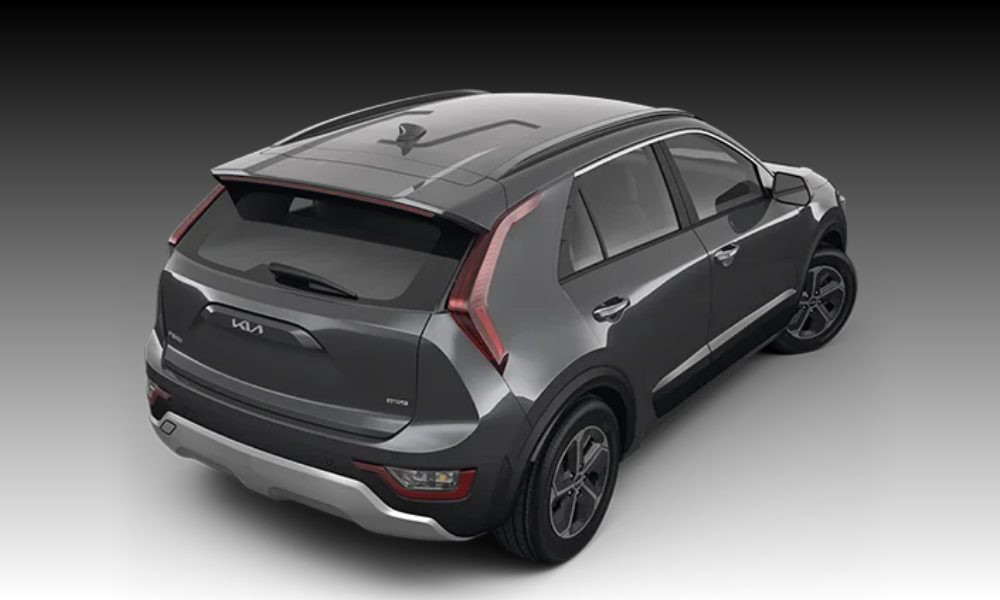
The LED daytime running lights are competent. The optional 18-inch wheels look proportionate, though they sacrifice 4 MPG in combined fuel economy compared to the standard 16-inch setup. The rear bumper design is simple to the point of anonymity. No distinctive taillights. No bold character lines. Just straightforward surfaces that protect cargo while communicating little about the vehicle’s personality.
The aeroblade that ran along the C-pillar on previous trims has been deleted, which removes a visual element that some owners preferred for contrast and others found cluttered. Either way, the design will disappear in parking lots and won’t be remembered by casual observers.
For transport-focused buyers, this functional approach is perfectly adequate. For those evaluating vehicles partly on design presence, the Niro projects less intention than either the Corolla Cross or CR-V.
Driving Experience
The 1.6-liter four-cylinder paired with an electric motor produces 139 horsepower and 195 pound-feet of torque. These numbers understate the real-world responsiveness. The electric motor delivers immediate torque response, which compensates for the small displacement and makes the Niro feel peppier than specifications suggest.
The hybrid system operates seamlessly. Transitions between electric power, gas power, and combined output happen without perceptible shudder or lag. Eco mode prioritizes electric assistance to conserve fuel. Sport mode shifts to gasoline-dominant operation. The shift in character is noticeable. You feel it immediately.
Steering is direct without excessive feedback. There’s enough road sense to know what the front tires are doing without twitchiness. The suspension balances compliance with control. Bumps are absorbed rather than transmitted. The ride never feels settled, but longer drives don’t fatigue passengers.
Zero-to-60 acceleration takes 8.2 seconds in testing. That’s not competitive with turbo-gasoline alternatives. Highway merging is adequate. Quick launches from stoplights are underwhelming. Buyers who prize responsiveness will immediately notice the gap.
The six-speed automatic transmission deserves credit. It’s more responsive than CVT designs in competitors. Gear changes are smooth without hunting for the right ratio.
Highway driving reveals a well-composed package. Road noise stays minimal with optional sound-dampening windows. Wind noise remains reasonable up to 75 MPH. The Niro plants itself at highway speeds without feeling disconnected.
Performance and Engines
The 2025 Kia Niro Hybrid offers exclusively one powertrain configuration. There is no non-hybrid gasoline option. Kia has committed entirely to electrification for this model.
The 1.6-liter four-cylinder and electric motor produce 139 horsepower and 195 pound-feet of torque. The six-speed automatic transmission and front-wheel-drive are standard. All-wheel-drive is unavailable on the standard hybrid.
This is a strategic limitation. Buyers in snow climates must step up to the plug-in hybrid, which costs $7,000 to $8,000 more and requires charging infrastructure. The Corolla Cross Hybrid offers all-wheel-drive at comparable pricing, making it more versatile for regional buyers.
Power delivery is linear. The electric motor compensates for the small displacement. In Eco mode, the system prioritizes efficiency. In Sport mode, gasoline power dominates and responsiveness improves noticeably.
Fuel economy varies by trim. Base LX, EX, and SX models achieve 53 MPG city, 54 MPG highway, and 53 MPG combined. The EX Touring and SX Touring models, equipped with 18-inch wheels, achieve 53 MPG city, 45 MPG highway, and 49 MPG combined. Real-world testing confirms these figures for typical drivers. Aggressive Sport mode driving reduces economy to 35 to 40 MPG, which remains well above gasoline alternative averages.
The efficiency consistency between city and highway driving is noteworthy. Most hybrids see significant MPG drops on interstates. The Niro maintains relatively stable efficiency across both scenarios.
Ride Comfort and Cabin Atmosphere
The Niro prioritizes tranquility over engagement. Vibration control is competent. The suspension absorbs road imperfections without bouncing. Larger impacts register without violence. Long drives don’t induce fatigue. Short commutes are never uncomfortable.
Climate control uses dual-zone technology on EX trims and above. It maintains temperature accurately. Heated seats come standard on most trims. Cooled seats and heated steering wheel appear on higher trims, which matters in extreme climates more than buyers realize.
Headroom and legroom measurements are generous for the class. Front passengers get 41.5 inches of legroom. Rear passengers get 39.8 inches, which notably exceeds the Corolla Cross Hybrid’s rear room. Three passengers fit in the rear bench without excessive crowding, though long trips are more comfortable for two.
The cargo floor sits relatively high, requiring more lifting effort for heavier items. It’s not a design flaw, just a practical consideration. Rear seat releases are intuitive. Seats fold flat with minimal resistance.
Interior Design and Material Quality
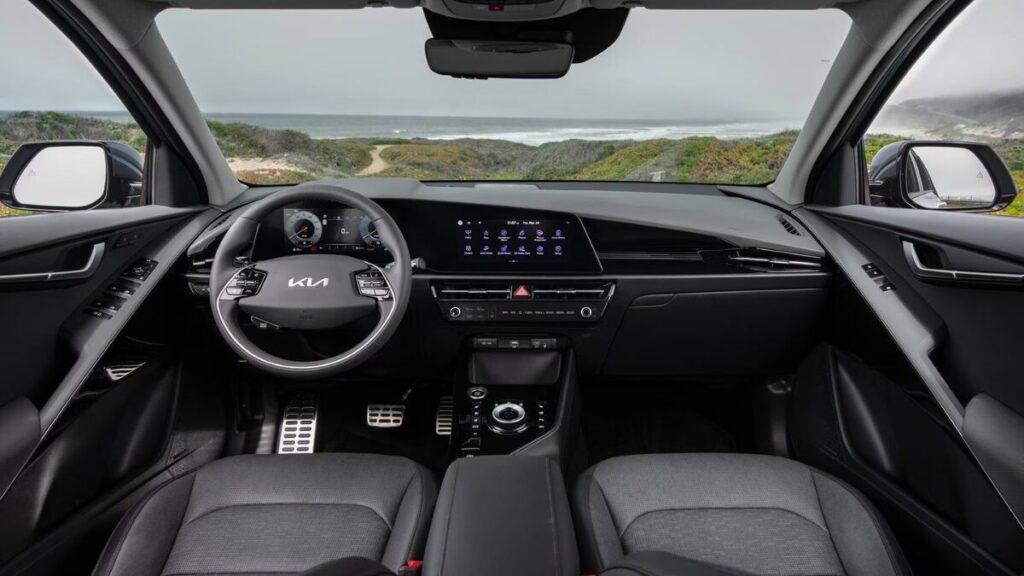
The dashboard prioritizes function over luxury. Climate buttons and audio controls occupy intuitive positions. The steering wheel provides multi-function capability without touch-sensitive gimmicks.
Materials reflect honest design choices. Soft-touch plastics appear where hands frequent. Hard plastics occupy less-touched surfaces. Synthetic leather upholstery on higher trims looks presentable and feels adequately soft. Kia doesn’t pretend it’s genuine leather, which is refreshing.
The 10.25-inch touchscreen is vivid and responsive. Menu navigation is reasonable, though not as intuitive as some competitors. Voice control exists but requires learning specific commands. Most drivers use the screen more frequently.
Storage compartments show practical thinking. Door pockets accommodate bottles. The center console provides small-item storage. Lower dashboard cubbies hold additional items. None of this is innovative, but it reflects competent design.
Visibility is good. The windshield is large and nearly vertical. Side windows are appropriately sized. The backup camera is standard. A 360-degree camera would aid parking situations, but it’s unavailable even on premium trims.
Technology and Infotainment
The infotainment system is functionally competent without technological innovation. The 10.25-inch display handles navigation, music, and vehicle settings without lag. Updates are stable. System crashes are rare.
Bluetooth connectivity works immediately. Music streaming functions seamlessly. Voice control exists but requires memorized command syntax rather than understanding natural speech. You’ll use the screen more often than voice commands.
The cable-only Apple CarPlay and Android Auto integration is the technology weakness. Wireless connectivity is standard at this price across competitor lineups. Kia’s omission feels retrograde and creates daily frustration for regular users.
Climate control uses physical buttons rather than touchscreen adjustments. This is actually preferable. Temperature adjustments don’t require taking your eyes off the road.
The heads-up display, which projects speed and navigation onto the windshield, is absent from all trims. This feature would improve highway safety for minimal cost. Its omission even on premium trims represents a missed opportunity.
Fuel Efficiency of the 2025 Kia Niro Hybrid
The EPA-estimated 53 MPG combined rating on base models reflects realistic real-world performance. Owners consistently achieve this figure or slightly better with typical mixed driving. Drivers operating the vehicle in Sport mode report 35 to 40 MPG, which remains well above average for an SUV carrying five passengers.
Controlled testing shows the Niro Hybrid matching or exceeding the Corolla Cross Hybrid’s efficiency despite its larger dimensions. This stems from the hybrid system’s maturity. The regenerative braking strategy optimizes equally well in city traffic and highway cruising. Most hybrids see significant MPG drops on interstates due to reduced electric recovery opportunity. The Niro maintains consistency between both scenarios.
With an 11.1-gallon fuel tank, typical fill-to-fill range spans 550 to 600 miles depending on driving conditions. That represents roughly one week of commuting for the average driver. Competitors with larger tanks extend this range, but the Niro’s efficiency partially compensates. The net result is fewer annual fill-ups than non-hybrid SUVs.
Long-term ownership fuel costs favor the Niro. Over ten years, expect roughly $800 to $1,000 in annual fuel savings compared to a gasoline alternative achieving 28 to 30 MPG combined. That’s meaningful cumulative savings, though the Niro’s lower purchase price compared to premium competitors is arguably more significant.
Practicality and Storage Space
The Niro seats five with reasonable comfort. The rear bench accommodates two adults comfortably or three if necessary for short trips.
Cargo space measures 22.8 cubic feet with rear seats up, expanding to 63.7 cubic feet with them folded. This suits weekend trips, groceries, and occasional equipment. A bicycle requires removing one wheel. Two bicycles fit with both wheels attached only if seats are folded.
The cargo floor is relatively low, reducing lifting effort for heavier items compared to some competitors. The rear seats fold flat, creating a continuous load surface for larger items.
The fuel door is on the driver side. The fuel cap is manual. It requires an extra three seconds at the pump compared to capless systems found on some Honda models.
Daily practicality is strong. The vehicle handles diaper bags, sports equipment, and family clutter without complaint. It’s more spacious than the Corolla Cross Hybrid for passenger and cargo needs. It’s less spacious than the Honda CR-V, which offers noticeably more volume and would be better for families with significant gear requirements.
Safety and Driver Assistance Systems
Kia has loaded the Niro hybrid with standard safety features across all trims. Forward collision warning alerts drivers to potential impacts. Automatic emergency braking applies brakes if danger is imminent. Lane departure warning activates when unintentional drifting occurs. Lane-centering assist gently steers to maintain lane position.
These features are standard, not optional. Blind-spot monitoring appears on all trims. Rear cross-traffic avoidance assists when backing. Smart cruise control is available on higher trims. Parking sensors and a backup camera aid maneuvering.
The airbag suite is comprehensive. Frontal, side-impact, and overhead airbags provide coverage throughout the cabin. The driver knee airbag offers additional protection.
Previous model-year Niro vehicles earned above-average safety ratings from the NHTSA and IIHS. The 2025 body structure remains unchanged, suggesting similar performance in future testing.
The 10-year/100,000-mile warranty extends to the hybrid battery, demonstrating Kia’s confidence in long-term reliability. This coverage length is uncommon and provides meaningful peace of mind for ownership longevity.
Worthy Competitors
Toyota Corolla Cross Hybrid. Starting at $26,830, the Corolla Cross undercuts the Niro by $160. EPA estimates rate it at 42 MPG combined, which trails the Niro’s 53 MPG by 11 MPG. Owners report genuine resale value retention higher than Kia, typically holding 55-60% of original value after five years versus Kia’s 50-54%. The Corolla Cross is shorter and narrower, creating a smaller interior footprint. If you prioritize brand prestige and resale value over interior space and fuel economy, the Corolla Cross is the stronger choice.
Honda CR-V. At $32,370 base MSRP, the CR-V costs approximately $5,300 more than the Niro. It achieves 40 MPG combined on front-wheel-drive, 37 MPG with all-wheel-drive. The CR-V is measurably larger, offering 39.3 cubic feet of cargo space versus the Niro’s 22.8 cubic feet. Resale retention tracks slightly below Toyota but above Kia, typically 52-56% after five years. The CR-V appeals to buyers needing genuine three-row space or preferring Honda’s interior quality. For compact SUV space, the Niro offers more. For genuine cargo capacity, the CR-V wins.
Toyota Prius. The Prius achieves 50+ MPG efficiency but in sedan form with four-seat capacity. It prioritizes aerodynamics and efficiency over versatility. If you need sedan practicality with maximum fuel economy, the Prius is the stronger alternative. If you need SUV seating and cargo space, the Niro’s efficiency advantage becomes meaningful.
Hyundai Tucson Hybrid. Kia’s corporate sibling also offers a hybrid Tucson that is larger and more expensive than the Niro. The Tucson appeals to buyers wanting more space. The Niro serves buyers prioritizing efficiency and compact dimensions.
Biggest Strengths and Key Weaknesses
Biggest Strengths
The fuel economy delivers real savings. Achieving 53 MPG combined in a five-seat, 600-mile-range SUV without feeling compromised represents genuine engineering execution. This translates to roughly $800 annually less in fuel costs compared to typical gasoline competitors.
The warranty confidence is tangible. The 10-year/100,000-mile coverage on hybrid systems and battery is longer than most competitors offer. It reflects internal reliability data and reduces long-term ownership anxiety for buyers prioritizing peace of mind.
The price-to-features ratio is genuinely competitive. Base models include 10.25-inch touchscreen, wireless charging, and advanced safety features. Competitors at similar pricing lack this feature density.
Key Weaknesses
The lack of all-wheel-drive on the standard hybrid immediately disqualifies it from snow-country buyers. That $8,000 step-up to the plug-in hybrid for AWD capability is a significant premium that eliminates cost advantages.
The design is forgettable. The vehicle communicates competence rather than intention. It won’t inspire ownership or generate any emotional connection. For buyers who spend hours daily in their vehicle, this matters.
The cable-only Apple CarPlay and Android Auto is genuinely frustrating. Every competitor offers wireless connectivity. Its absence in 2025 suggests Kia underestimated customer expectations or chose cost savings over user experience.
Which Category Does Cardrav Recommend?
Best for Budget-Conscious Buyers. If your priority is genuine value without pretending your vehicle is a luxury item, the Niro hybrid delivers. The combination of $26,990 base price, 53 MPG efficiency, and 10-year warranty creates real long-term savings. Fuel costs will be 25-30% lower than typical gasoline alternatives.
Best Hybrid SUV for Daily Commuters. If you drive 30 to 40 minutes daily on mixed roads, the Niro hybrid excels. The consistent fuel economy between city and highway rewards this usage pattern. The quiet cabin makes extended commutes less fatiguing than gasoline alternatives.
Not Recommended for Buyers in Snow Climates. The absence of all-wheel-drive on the standard hybrid eliminates it from consideration. The $8,000 step-up to the plug-in hybrid for AWD capability is a premium that defeats the value proposition.
Not Recommended for Performance-Oriented Drivers. The 8.2-second 0-60 time and modest acceleration will feel underwhelming. Buyers seeking any driving engagement should look elsewhere.
Conclusion: Is It Worth Buying?
The 2025 Kia Niro Hybrid is worth buying if your priorities align with its strengths. If fuel economy, interior space, and upfront affordability matter more than brand prestige or design presence, the Niro delivers.
Real-world value emerges over the ownership timeline. A typical owner driving 12,000 miles annually will spend approximately $800 less on fuel per year compared to a 28 MPG gasoline SUV. Over five years, that’s $4,000 in fuel savings. The initial purchase price is $5,000 to $8,000 lower than equivalent Honda CR-V or Toyota RAV4 models. Combined with the 10-year powertrain warranty, the Niro’s long-term ownership cost is genuinely competitive despite slightly lower resale values.
The Niro hybrid is not a compromise choice. It’s a deliberate selection for buyers who prioritize practical benefits over emotional engagement. You’re deliberately choosing a vehicle optimized for commuting efficiency, not for driving excitement or status signaling. If those priorities align with your needs, buy it. You’ll benefit from years of low fuel costs and predictable maintenance.
If you value distinctive design, premium interior materials, or genuine driving engagement, spend the extra money on a competitor. The Niro hybrid isn’t trying to be everything to everyone. It succeeds at serving a specific buyer profile with clarity and competence.
FAQ
How does the Niro Hybrid’s fuel economy compare to the Toyota Prius?
The 2025 Kia Niro Hybrid achieves 53 MPG combined versus the Prius’s 50+ MPG. The Niro offers five seats and genuine cargo space, while the Prius seats four with limited room. For SUV buyers, the Niro’s efficiency is competitive. For maximum MPG in sedan form, the Prius edges ahead.
Does the 2025 Kia Niro Hybrid come with all-wheel-drive?
No. Only front-wheel-drive is available on the standard hybrid. All-wheel-drive requires stepping up to the plug-in hybrid variant, which costs roughly $8,000 more and requires home charging access. This is a major limitation for snow-prone regions.
What’s the difference between the Niro Hybrid and the Niro Plug-in Hybrid?
The standard hybrid uses gasoline exclusively with electric assist. The plug-in hybrid has a larger battery allowing 33 miles of all-electric driving before the engine engages. The plug-in suits short commutes with home charging. The standard hybrid is better for longer-distance drivers without charging infrastructure.
How does the Niro Hybrid’s warranty compare to the CR-V and Corolla Cross?
Kia offers 10 years/100,000 miles on powertrain and battery. Toyota and Hyundai match this. Honda typically provides 5 years/60,000 miles on powertrain. For hybrid systems, Kia’s extended battery warranty demonstrates confidence in long-term reliability.
Will the Niro Hybrid hold its value better than other hybrid SUVs?
Typically no. Toyota and Honda hybrids historically retain 52-60% of value after five years. Kia typically retains 50-54%. The initial purchase price savings help offset slightly lower resale values over time, but resale depreciation is steeper than Toyota or Honda competitors.