2023 Toyota RAV4 Prime Review: Power Meets Efficiency
Plug-in Hybrid Performance, Real-World Efficiency, and the Truth Behind Toyota’s Most Balanced SUV

Here’s something nobody tells you about the 2023 Toyota RAV4 Prime. The first time you drive somewhere, come home, plug it in, and wake up to a full battery, something shifts. It’s a small domestic ritual, plugging in a car the way you’d plug in a phone, but it reframes the entire ownership experience in a way that’s hard to articulate until you’ve actually done it. Suddenly the gas station becomes optional. Not theoretically optional in the way electric vehicle marketing loves to suggest. Actually, genuinely, most-days-of-the-week optional.
That’s the RAV4 Prime’s real trick. Not the 302 horsepower, though that number deserves more attention than it gets. Not the all-wheel drive, though it’s better than most people realize. The concept behind the Toyota RAV4 Prime is simple: a plug-in hybrid designed to work seamlessly with everyday driving habits, without forcing drivers to change how they live or commute.
The competition has been trying to crack this same problem for a few years now. Hyundai’s Tucson PHEV is genuinely good and deserves credit for how far Hyundai has come in this segment. The Kia Sportage PHEV looks better inside than anything Toyota is offering at this price, and that’s not a close call. Ford’s Escape PHEV drives with a car-like lightness that some buyers will prefer on principle. None of them have quite assembled the full package the way the RAV4 Prime has. It’s not that they’re bad. It’s that Toyota has had a few years of production and refinement on most of them, and it shows in the details that matter during year three of ownership rather than during week one of shopping.
By 2023, the RAV4 Prime had already become one of those rare vehicles where demand consistently outpaced supply without aggressive marketing or fleet sales inflating the numbers. That kind of sustained, word-of-mouth momentum usually means one thing. The product is delivering on what it promises.
Our Opinion
The RAV4 Prime is the most convincingly complete plug-in hybrid crossover in this class right now. That opinion comes with full awareness of the interior quality gap, the infotainment frustrations, and a ride that can feel busier than the segment’s best on rough pavement. Those are real criticisms and they don’t disappear because everything else is good.
But this vehicle solves the daily transportation equation better than its competitors do, and for buyers with home charging access, the long-term case is difficult to argue against. Toyota didn’t build the most exciting or most luxurious option. They built the one that makes the most consistent sense.
Pros and Cons
Pros:
- Real-world electric range that actually approaches the EPA’s 42-mile estimate
- 302 combined horsepower that genuinely surprises people who weren’t expecting it
- AWD standard on every trim, no asterisks
- 2,500-pound tow rating is legitimate and useful
- Toyota reliability record that competitors are still trying to match
- Cabin space and cargo layout work for actual daily family use
Cons:
- Interior material quality doesn’t justify the price tag honestly
- Infotainment system still feels like it’s processing your request
- Suspension tuning produces a noticeably firm response on damaged urban roads
- No DC fast charging support
- Market pricing reality in some areas still diverges from MSRP significantly
What’s New for 2023?
Toyota didn’t reinvent it. They didn’t need to. The meaningful update is Toyota Safety Sense 2.5 going standard across the board, and more specifically, the recalibration of the lane-keeping system, which in earlier model years had a habit of grabbing the wheel with a certainty that didn’t always match the road situation. The 2023 version intervenes more gently and reads lane markings with better consistency at highway speeds. Anyone who’s spent time with a 2021 Prime on an interstate will feel the difference immediately.
Wireless CarPlay and Android Auto arrived on the XSE trim. This matters more than it sounds because it effectively removes the primary interface frustration from daily use. A few color changes, some minor interior trim updates on the SE, and refinements to the multimedia system round out the changes. Measured evolution rather than reinvention, which is exactly the right approach at this stage of the vehicle’s life.
Exterior Design of the 2023 Toyota RAV4 Prime
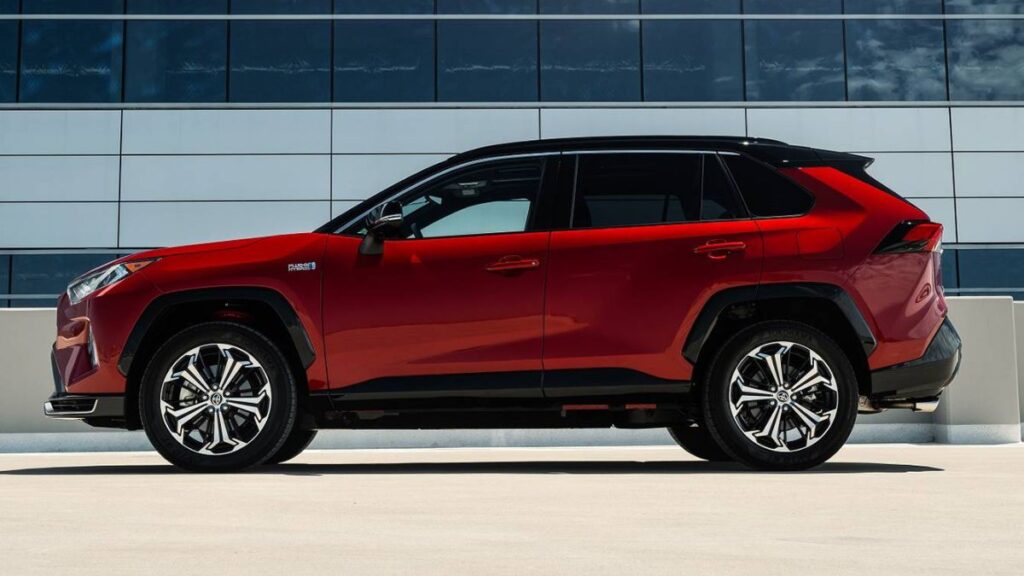
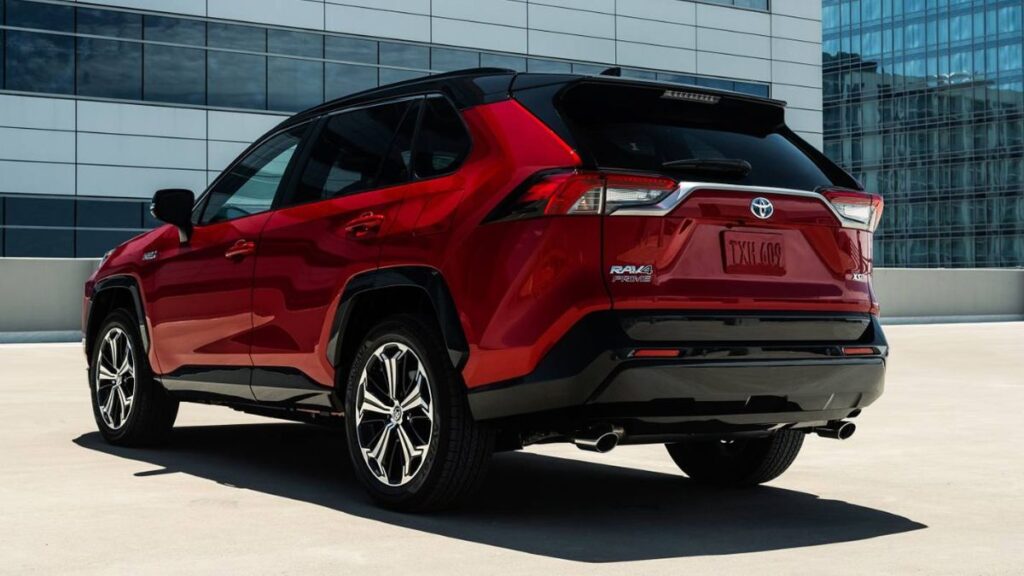
The RAV4 has never been interested in being subtle, and the Prime leans into that without apology. The body cladding is assertive. The wheel arches project outward with the confidence of something that expects to be taken off-road occasionally, even if most examples will spend their lives on well-maintained suburban pavement. The Prime gets blue grille accents and badges to identify the plug-in powertrain, and the charge port door sits on the front left fender with enough visual integration that you’d notice it if you were looking but probably miss it otherwise.
Put it next to a Sportage PHEV and the Korean car looks more considered, more deliberately designed in a contemporary sense. The RAV4 Prime looks like it would rather go somewhere than sit at a design awards ceremony. Neither approach is wrong. They’re targeting different buyers and different self-images, and that’s fine.
Magnetic Gray Metallic. That’s the one. It suits the proportions without trying too hard.
Driving Experience of the 2023 Toyota RAV4 Prime
The city is where the RAV4 Prime makes its argument most eloquently. On a full charge, you pull away from lights with an immediacy that combustion engines genuinely cannot replicate, not because the total power output is stratospheric, but because electric torque doesn’t negotiate. You ask for it and it’s there. No rev buildup, no hesitation, just motion. After three days of commuting on electricity alone, driving a conventional gasoline vehicle starts to feel slightly backward.
When the gasoline engine joins the equation, Toyota has done enough work on the transition that you’re not hunting for it. There’s no shudder, no surge, no dramatic audio event. The handoff happens and you continue driving. This sounds like a low bar but plenty of plug-in hybrids haven’t cleared it.
Now put it in Sport mode on an on-ramp. The 302 combined horsepower, which is the number that consistently catches people off guard, is not a marketing construction or a peak-condition claim. The acceleration is linear, immediate, and the 0-to-60 time in the neighborhood of 5.7 seconds is something you feel in your chest rather than just read about. People buying this vehicle for fuel economy get a performance number that puts them ahead of a lot of things that cost considerably more. That’s genuinely enjoyable to discover.
The steering is accurate. It’s not communicative in any meaningful way, and it was never trying to be. This is a family crossover with good vehicle dynamics, not a sports SUV fishing for compliments about driver engagement. The distinction matters because buyers who understand what this vehicle is won’t miss what it isn’t.
Broken pavement is where the experience gets complicated. The battery pack beneath the rear cargo floor adds weight and the suspension tuning reflects that reality. Hit a bad seam or a pothole at anything above city speeds and the cabin registers the impact more directly than the standard RAV4 would. Not harshly. Not in any way that accumulates into fatigue over a longer drive. But compared to a Mazda CX-5 on the same stretch of deteriorated urban road, the difference is obvious and worth knowing before you sign anything.
Highway driving is composed and quiet. In EV mode at 70 miles per hour the cabin is genuinely serene, with tire noise as essentially the only acoustic intrusion. That’s a legitimate achievement.
Performance and Acceleration
Two electric motors, one per axle, working alongside a 2.5-liter Atkinson cycle four-cylinder. The rear motor is what makes the AWD system function, and the absence of a traditional driveshaft connecting front to rear isn’t an engineering compromise. It’s a cleaner solution that saves weight and allows torque distribution that a mechanical differential can’t match in response time.
In real conditions, wet pavement or a dusting of snow, the system reacts before you’ve consciously registered the slip. It doesn’t make a production of it. The vehicle just continues in the intended direction. For buyers in regions where winter weather is a factor rather than an occasional inconvenience, this matters.
The 42-mile electric range is, for once, a number you can actually plan around. Mild weather, sensible speeds, a commute that doesn’t involve sustained 80-mph highway stretches, and most people will see 38 to 44 miles on a full charge. Cold weather extracts its penalty like it does from every battery chemistry on earth, and the range in genuine winter conditions drops to somewhere in the upper 20s or low 30s. This is physics, not a Toyota-specific problem, and it’s worth factoring into expectations before winter arrives.
Ride Comfort and Cabin
Long highway drives are where the RAV4 Prime is at its most composed and its most livable. The cabin is quiet enough that conversation doesn’t require raised voices, the front seats support long distances without complaint, and the powertrain invisibility in EV mode gives the whole experience a slightly premium character that the interior materials don’t quite earn on their own.
Urban road quality tells a different story. There’s a firmness to the suspension response on imperfect surfaces that’s noticeable and slightly at odds with what you’d expect from something positioned as a comfortable family crossover. It’s the battery weight. It’s a physics problem that Toyota has managed reasonably but not completely solved. The ride isn’t punishing. It just reminds you it has limits more frequently than the competition’s best efforts do.
Rear seat room is adequate in a way that satisfies most real-world family configurations without exciting anyone. Two adults in the back are fine. Three adults in the back for anything beyond a short trip is a negotiation.
Interior Design in the 2023 Toyota RAV4 Prime
Let’s not dress this up. The RAV4 Prime’s interior quality doesn’t match its price. A base trim starting above $43,000 before destination and dealer adjustments should not have hard plastic door panels that feel like they belong in a vehicle a full segment below. The gap between what this vehicle costs and how parts of its cabin feel is the most persistent criticism from long-term owners, and it’s a fair one.
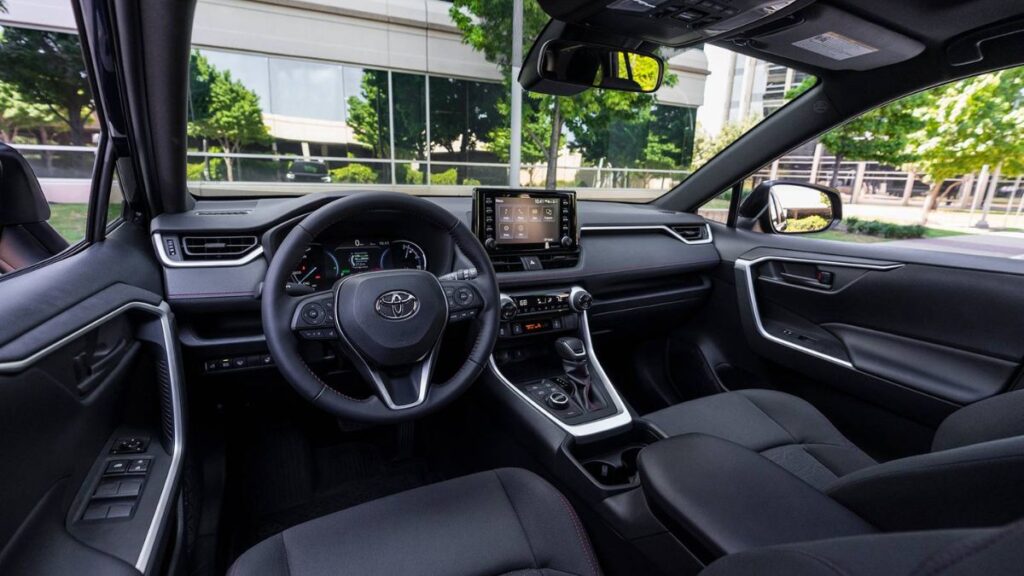
The XSE trim improves the situation meaningfully. SofTex seating surfaces, a leather-wrapped steering wheel, power adjustment for the driver’s seat. The black cabin with red contrast stitching looks genuinely good and doesn’t feel like a concession. But the underlying material quality on surfaces you touch frequently throughout the day is still a step behind what Hyundai and Kia are offering their buyers at comparable price points.
The layout itself is intelligent. Controls fall to hand without a learning curve. The ergonomics reflect genuine thought rather than an afterthought. And the center console storage is large enough to be actually useful. These aren’t small things. Logical daily ergonomics compound positively over years of ownership in ways that showroom-impressive materials don’t always sustain.
Technology and Infotainment
The infotainment situation is this: the system works, it’s improved, and it’s still slower than it should be for a vehicle at this price. Navigate through menus with any purpose and you’ll find the interface processing your previous input while you’re already two steps ahead. It’s not broken. It’s not the source of daily rage. It’s just behind, and in 2023 being behind Hyundai’s or Kia’s systems is a more significant gap than it would have been a few years ago.
Wireless CarPlay on the XSE largely dissolves the problem for daily use. Connect your phone and the Toyota interface becomes mostly irrelevant. This is the practical solution most owners land on and it works well enough that the native system’s limitations become background noise rather than active frustration.
The PHEV-specific functionality, scheduling charging for off-peak rates, monitoring energy flow, adjusting drive modes, is clearly where Toyota concentrated its software development effort. Those features are intuitive and genuinely useful in a way the general multimedia experience isn’t quite.
The JBL system on XSE is good. More than good, actually. Solid staging, controlled low end, consistent coverage across the cabin. It doesn’t draw attention to itself, which is usually the best thing you can say about audio equipment in a moving vehicle.
Fuel Efficiency of the 2023 Toyota RAV4 Prime
Ninety-four MPGe combined in hybrid operation. Thirty-eight MPG combined when the battery is depleted and you’re running on gasoline alone. The first number is the one that makes the ownership case for buyers who can charge nightly. The second number is the insurance policy for everyone else.
For a buyer whose round-trip commute fits within the electric range and who plugs in at home every night, the gas station becomes a monthly event at most. That’s not a promise constructed for effect. It’s what the ownership reality looks like for a significant portion of RAV4 Prime drivers, and it’s the central reason this vehicle’s demand has remained as strong as it has.
Practicality and Storage
Thirty-three and a half cubic feet behind the rear seats. That’s the number, and it’s less than the standard RAV4, the difference accounted for by the battery packaging beneath the floor. For most families running school pickups, grocery runs, and occasional weekend trips, it’s sufficient without being generous. Anyone who regularly loads large or awkward cargo should measure before committing.
Cabin storage is well-executed. The console box is large, the door pockets work, and the USB port placement for both rows reflects actual thought about how people use a vehicle day to day. The rear seats fold flat enough to be useful. Loading height is reasonable. Nothing here is remarkable, but nothing is frustrating either, and in practicality terms that’s a quiet win.
Safety and Driver Assistance Systems
Toyota Safety Sense 2.5 across every trim. Pre-collision warning with pedestrian and cyclist detection, adaptive cruise with lane centering, blind spot monitoring on XSE, automatic high beams. The full package, standard, no option box required.
The lane-centering recalibration for 2023 is the most noticeable safety-related change. Earlier systems intervened with a forcefulness that sometimes felt combative. The 2023 version reads the lane markings, makes its adjustments earlier, and applies steering input with more subtlety. Long highway driving is genuinely more relaxed for it.
Blind spot monitoring is well-tuned. It flags real situations without generating the false positive frequency that makes some systems feel like the boy who cried wolf. Real-world useful, which is the actual measure of whether this technology matters.
Worthy Competitors
The Hyundai Tucson PHEV has the better interior and the more sophisticated cabin feel. It doesn’t have the performance, and the AWD integration isn’t as seamlessly resolved.
The Kia Sportage PHEV is the one I’d choose if the inside of the car mattered more than anything else to me. It genuinely looks and feels more expensive than the Toyota. It’s also newer, and years of reliability data don’t exist yet in the way they do for the RAV4.
The Ford Escape PHEV drives lighter and more car-like, which some buyers will strongly prefer. The electric range trails slightly and Ford’s long-term reliability in this segment hasn’t earned the same trust.
The Mitsubishi Outlander PHEV offers three rows, which nobody else in this class does. The daily driving refinement still lags, but the unique packaging deserves acknowledgment.
Key Strengths and Key Weaknesses
No competitor in this class has matched the specific combination of 42 miles of genuine electric range, 302 horsepower, standard AWD on every trim, and a reliability record built over decades rather than promised for the future. That combination is the RAV4 Prime’s most durable argument and it remains unmatched in 2023.
The interior material quality relative to asking price is the most legitimate criticism in the ownership experience, and it doesn’t get easier to justify as Korean competitors continue raising the expectation of what a $43,000-plus crossover should feel like inside.
Which Category Does CarDrave Recommend?
The buyer who gets the most from the RAV4 Prime is the one with a home charging setup, a daily commute under 40 miles, and a multi-year ownership horizon where reliability and fuel savings compound into a meaningful financial difference. That profile describes a very large number of crossover buyers in the current market.
For buyers without home charging access, the standard RAV4 Hybrid delivers most of the efficiency story without the plug-in premium. For buyers who spend more time inside the vehicle than they do driving it and who consider interior quality the primary consideration, the Sportage PHEV deserves serious time at the top of the list.
Conclusion: Is It Worth Buying?
Yes. With complete confidence, for the right buyer, yes.
The 2023 RAV4 Prime is not the most emotionally compelling vehicle in this price range. It won’t make you feel particularly special at a stoplight and the interior won’t draw compliments from passengers who don’t know what they’re sitting in. What it will do is work, reliably and efficiently, every day, in every condition, for as many years as you choose to keep it. And somewhere in year two or three, when the fuel savings have accumulated into something visible and the reliability record has held without drama, the decision will feel obvious in a way it might not have in the showroom.
Charge it every night. Stop thinking about gas. Let the numbers do what they were built to do.
FAQ
How close to the EPA’s 42-mile electric range can I actually get in the 2023 Toyota RAV4 Prime?
In moderate temperatures with normal driving, 38 to 44 miles is realistic for most owners. Cold weather, sustained highway speeds, or heavy climate control use will reduce that. In genuine winter conditions, expect somewhere in the upper 20s to low 30s. Plan accordingly and the range story holds up well.
What are the home charging options and how long does a full charge realistically take?
A standard 120V household outlet takes around 12 hours for a complete charge from depleted. A 240V Level 2 home charger brings that down to approximately 4.5 hours. The RAV4 Prime does not support DC fast charging, which limits public charging usefulness for longer trips and is a genuine limitation worth knowing before purchase.
Does the 2023 RAV4 Prime qualify for the federal tax credit?
Possibly, depending on your income, the final transaction price, and current assembly location requirements. Federal EV credit eligibility has changed enough in recent years that verifying your specific situation with a tax professional before signing is genuinely worthwhile rather than just standard legal advice.
How capable is the AWD system in winter and on slippery roads?
More capable than most buyers expect. The rear electric motor responds to traction loss with a speed that mechanical systems can’t match, and the real-world winter driving confidence is high. Winter tires make a significant additional difference in areas with sustained snow and ice, as they do on any vehicle.
Is the 2023 Toyota RAV4 Prime worth the price over the standard RAV4 Hybrid?
The Prime delivers 302 horsepower versus the Hybrid’s 219, adds up to 42 miles of electric-only range, and comes with AWD standard across all trims. The trade-off is a slightly reduced cargo area and a higher starting price. For buyers who can charge at home and whose daily driving fits within the electric range, the Prime pays for the premium difference in fuel savings over a reasonable ownership period. For buyers without charging access, the standard Hybrid’s value proposition is more straightforward.