2023 Hyundai Ioniq 6 Review: Better Than Tesla?
The 2023 Hyundai Ioniq 6 combines impressive efficiency, rapid charging, and everyday comfort to challenge the best electric sedans in its class.

There is a moment in the EV world when a car stops being a science project and starts being a car. The 2023 Hyundai Ioniq 6 had that moment the second it hit American roads. For years, buyers choosing an electric sedan were essentially choosing between Tesla’s minimalist tech obsession and a handful of European options that cost more than a small house. Then Hyundai showed up with the Ioniq 6 and quietly changed the conversation.
This isn’t the Ioniq 5. That is the boxy, retro-cool crossover that got everyone’s attention a couple years back. The Ioniq 6 is the sedan sibling, and honestly, it is the more interesting car. Sleeker. More aerodynamic. In some ways more focused. If the Ioniq 5 was Hyundai proving it could play in the EV space, the Ioniq 6 is Hyundai proving it can actually win.
The competition here is serious. The Tesla Model 3 is the obvious rival, still the benchmark for range and software integration. The BMW i4 brings the premium angle. The Polestar 2 appeals to the Scandinavian minimalist crowd. Each has a genuine argument. But the Ioniq 6 walks into that fight with a drag coefficient of 0.21, among the lowest ever measured on a production vehicle. Physics makes that possible, and physics translates directly into efficiency and range.
What Hyundai has done with the 2023 Ioniq 6 is build a car for people who want an electric vehicle that does not constantly remind them it is an electric vehicle. No giant touchscreen gimmicks. No autopilot theater. Just a genuinely well-engineered machine that happens to run on electrons.
Our Opinion
The Ioniq 6 is, without reservation, one of the best electric sedans you can buy in 2023 at any price. The rear-wheel-drive long-range version in particular hits a sweet spot of efficiency, performance, and livability that most rivals are still chasing. It is not perfect. The interior, while thoughtful, uses some materials that feel out of place at this price point, and the styling will divide opinion sharply. But those are minor complaints against a car that genuinely delivers where it matters.
If you are cross-shopping this against a Model 3, the Ioniq 6 wins on range, charges faster, and feels more finished inside. The Tesla still has the edge in software and the Supercharger network, but that gap is closing. The Hyundai will not make everyone happy, especially buyers who want something more conventional-looking. But for anyone willing to trust the numbers and the engineering behind them, this car makes a compelling case for itself.
Pros and Cons
Pros:
- Outstanding real-world range, especially in the rear-wheel-drive long-range version
- 800-volt charging architecture means genuinely fast charging stops
- Cabin is spacious and well-organized, despite the low roofline
- Exceptionally low drag coefficient that pays real dividends in efficiency
- Competitive pricing compared to German rivals with similar performance
- Smooth, refined ride that works well in daily driving situations
- Vehicle-to-load (V2L) capability lets you power external devices
Cons:
- Rear headroom is noticeably tight for taller passengers
- Some interior plastics feel below expectations at this price
- The infotainment system works fine but is not particularly intuitive
- Styling is polarizing and will not appeal to traditional sedan buyers
- Smaller trunk than you would expect given the car’s overall footprint
- No fully native over-the-air update capability like Tesla offers
What’s New for 2023?
The 2023 Ioniq 6 is essentially the first full model year for this car in the United States, so calling anything “new” requires a little context. Hyundai launched it late in the 2022 calendar year, but the 2023 model year is when dealers actually had meaningful inventory and buyers could realistically get their hands on one.
For 2023, Hyundai added the Standard Range rear-wheel-drive variant, which gives budget-conscious buyers a way into the Ioniq 6 family below $40,000. The extended range dual-motor all-wheel-drive version also becomes more widely available this year. Hyundai also refined some software elements from the early production builds, addressing minor quirks in the climate control interface and improving navigation integration with the charging network. Not sweeping changes, but the kind of detail work that shows a manufacturer paying attention.
Exterior Design
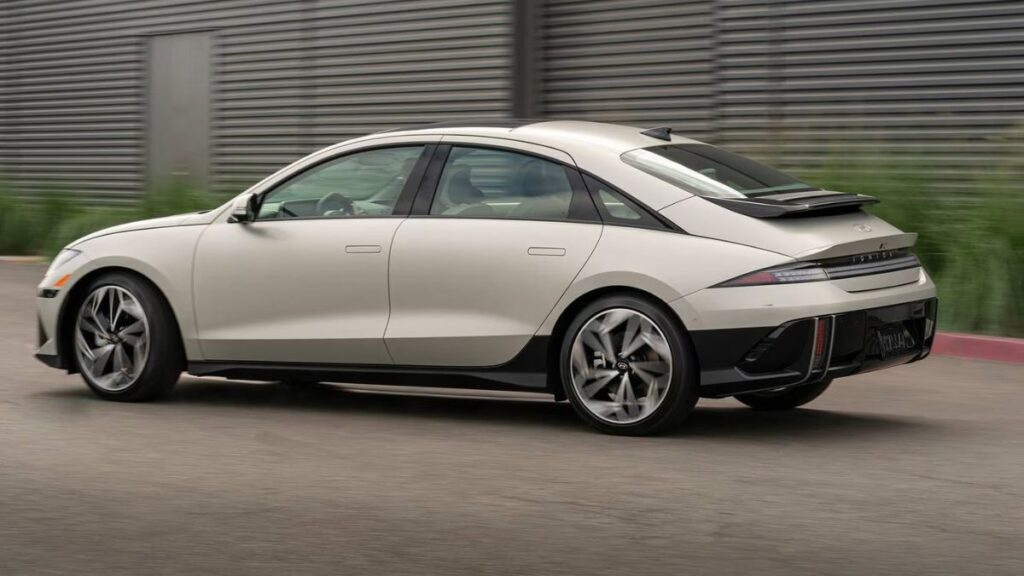
Love it or hate it, the Ioniq 6 does not look like anything else on the road. Hyundai calls the design language “Streamliner,” and the reference to classic aerodynamic forms from the 1930s and 1940s is intentional. The car has a fastback silhouette with a steeply raked roofline and a long, uninterrupted hood. From the front, the closed-off grille and pixel-style LED lights give it a face that is distinctly futuristic without being cartoonish.
The side profile is where the design earns its engineering credentials. The 0.21 drag coefficient is not an accident. Every surface has been shaped to manage airflow, from the flush door handles to the integrated rear spoiler. The result is a car that looks fast even standing still, though not everyone will appreciate how dramatically the roofline drops toward the rear.
Compared to the Model 3, which has settled into a comfortable but somewhat anonymous shape, the Ioniq 6 is far more visually committed. The BMW i4 looks more traditionally elegant, which some buyers will prefer. But in a parking lot full of crossovers and three-box sedans, the Ioniq 6 is the one people walk over to look at.
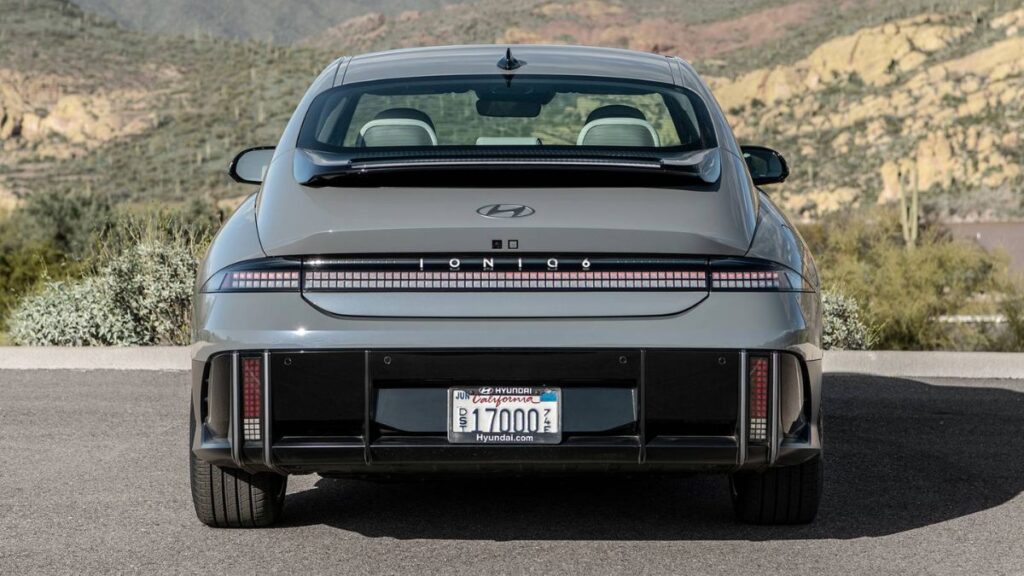
The rear end is the most controversial angle. The integrated spoiler and the narrow taillight strip work together well, but the overall shape can look a bit stubby depending on the color. Darker colors hide it better. The color palette itself is well chosen, with options ranging from conservative grays to a genuinely striking Gravity Gold Matte that looks unlike anything in the segment.
Driving Experience
This is where the Ioniq 6 separates itself from the spreadsheet and becomes a real car. Around town, the steering feels light enough for easy parking, but it gains reassuring weight as speeds climb. The suspension, tuned for the Korean and European markets where the car was developed, translates remarkably well to American roads. There is genuine communication through the wheel, which sounds obvious but is not common in EVs.
The rear-wheel-drive version is the one to have for driving feel. Power goes to the back wheels only, and the balance is noticeably better than the all-wheel-drive variant, which adds weight over the front axle. Pushing the Ioniq 6 through a series of sweeping on-ramps, the car rotates cleanly and feels planted without being stiff.
In Sport mode, throttle response sharpens immediately, and the car pulls hard through the mid-range in a way that genuinely surprises. The regenerative braking system has multiple levels, and the strongest setting is strong enough for genuine one-pedal driving in city traffic. It takes about a day to calibrate your foot to it, and after that you will not want to go back.
The sound insulation is excellent. At highway speeds, the Ioniq 6 is genuinely quiet, helped in no small part by that aerodynamic body reducing wind noise at the source. Road noise is well managed. The overall refinement level on the highway rivals cars that cost significantly more.
One honest note: this car does not have the synthetic excitement of something like the Kia EV6 GT or the raw urgency of a Model 3 Performance. It is more composed, more mature. Whether that is a strength depends entirely on what you are looking for.
Performance and Engines
The 2023 Ioniq 6 comes in three main configurations, and they have genuinely different personalities.
The Standard Range rear-wheel-drive model uses a 53 kWh battery and produces 149 horsepower. It is honest transportation, nothing more. Range is estimated around 220 miles, and while it does not embarrass itself, this version exists primarily to hit a price point. Most buyers should look past it.
The Long Range rear-wheel-drive version is the one that makes headlines. A 77.4 kWh battery feeds a single rear motor producing 225 horsepower. The EPA range estimate of 361 miles is the standout number in this class. In real-world mixed driving, expect somewhere in the 320 to 340 mile range, which is still exceptional. Zero to 60 comes in around 7.4 seconds. Not quick by EV standards, but entirely adequate for the way most people actually drive.
The Long Range all-wheel-drive version adds a front motor for a combined output of 320 horsepower. The dual-motor setup drops the 0 to 60 time to around 5.1 seconds, which feels properly quick in everyday driving. The trade-off is range, down to approximately 266 miles. The AWD version also costs more, which makes the math harder to justify unless you genuinely need all-wheel traction.
The 800-volt charging architecture is shared across all versions and is one of the strongest arguments for the Ioniq 6 over the Model 3. At a compatible DC fast charger, the car can add roughly 68 miles of range in just five minutes. A 10 to 80 percent charge takes about 18 minutes under ideal conditions. When you account for the time to actually pump fuel and pay, that is not far from a gas station stop.
Ride Comfort and Cabin
The suspension setup strikes a balance that most EV sedans struggle to find. Firm enough to feel composed during spirited driving, compliant enough that expansion joints and rough patches do not punish passengers. The Ioniq 6 uses a multi-link rear suspension that handles impacts cleanly without transmitting harshness into the cabin.
Front seat comfort is excellent. The seats themselves are well shaped with enough lateral support to hold occupants in place during cornering, and the standard 8-way power adjustment gives most drivers a natural position quickly. Long highway stints do not produce the fatigue that plagues some competitors with harder seat cushions.
The rear seat is more complicated. There is reasonable legroom, helped by the flat floor that EVs with centrally mounted batteries enjoy. But headroom is genuinely compromised by that sloping roofline. Anyone over six feet sitting in the back will feel it. This is the one area where the design ambition costs real passengers real comfort, and it is worth considering seriously if you regularly carry adults in the rear seats.
Interior Design
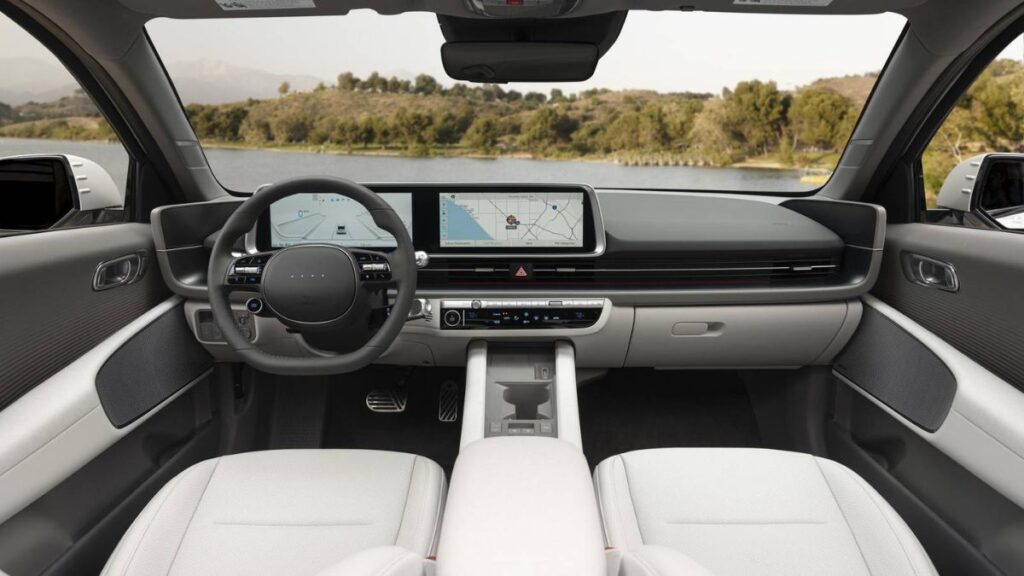
Step inside the Ioniq 6 and the first impression is space. The cabin feels wider and more open than the exterior suggests, aided by a minimalist dashboard design that sweeps cleanly across the full width. Two curved screens sit at the center, a 12-inch instrument cluster and a 12-inch infotainment screen arranged together in a single housing. The effect is clean and modern without the aggressive futurism of some competitors.
The materials tell a more mixed story. The upper dashboard surfaces and door panel inserts use textures that feel considered and intentional. Lower sections use hard plastic that is entirely adequate for the price but noticeable in a segment where buyers are spending upwards of $45,000. Hyundai offers some eco-processed interior options using sustainable materials, which is a genuine attempt to align the interior with the car’s electric identity, not just a marketing exercise.
The center console is unusually wide, with a sliding cover that reveals useful storage underneath. Physical controls for climate sit below the infotainment screen in a row of tactile buttons, which is a deliberate and welcome choice. You can adjust the temperature without looking away from the road, which sounds simple but increasingly is not.
Ambient lighting is standard and surprisingly effective, with 64 color options that can be set to follow the drive mode. In a dark garage, the Ioniq 6’s interior looks considerably more premium than the daylight materials audit would suggest.
Technology and Infotainment
The dual-screen setup runs Hyundai’s latest connected car operating system, which supports wireless Apple CarPlay and Android Auto on most trim levels. Navigation integrates with the charging network to automatically route you through compatible chargers when needed. These are features that work.
The interface itself is functional but takes getting used to. The menu logic is not always obvious, and some frequently used settings require more screen taps than they should. The system responds quickly and does not lag, but the organizational structure feels like it was designed by engineers rather than the people who have to use it every day. It is not broken. It is just not delightful.
Voice recognition is present and handles basic commands reliably. Asking it to set a destination or change climate settings works most of the time. Asking it anything slightly outside its expected parameters leads to frustration.
The 14-speaker Bose audio system available on higher trims is worth having. Sound quality is genuinely good, with clear separation and a soundstage that suits the quiet cabin well. The standard audio system is merely adequate.
Over-the-air software updates are supported but limited in scope compared to what Tesla owners receive. Hyundai has been improving this, but if seamless software evolution is a priority, the Model 3 still holds the advantage.
Fuel Consumption
The 2023 Ioniq 6 Long Range RWD carries an EPA rating of 151 MPGe combined, among the highest figures recorded for any electric sedan. In real-world driving, that efficiency advantage shows up consistently. Drivers in mild climates who use the car primarily for highway commuting and occasional longer trips will find the range claims credible.
Cold weather reduces range meaningfully, as it does with all battery-electric vehicles. In temperatures below freezing, expect range to drop by 20 to 30 percent depending on how aggressively the cabin heater is used. The Ioniq 6 includes a heat pump standard, which helps recover some of that efficiency compared to resistive heating alone.
The Standard Range model is rated at 133 MPGe, and the AWD Long Range version drops to 120 MPGe. The single motor rear-drive version is clearly the efficiency leader, and for most buyers, it will be the practical choice unless AWD traction is a genuine need.
Practicality and Storage
The trunk measures 11.1 cubic feet, which is honestly underwhelming for a car this size. The sloping roofline that looks so striking from the outside directly eats into cargo volume. A Model 3 offers over 15 cubic feet. If you regularly move luggage or large items, this matters.
The front trunk, or frunk, adds 1.6 cubic feet of additional storage, useful for smaller items like charging cables but not enough to rescue the overall cargo situation. Interior storage is handled well, with the wide center console, reasonable door pockets, and a good-sized glovebox.
The rear seat folds in a 60/40 split, extending cargo capacity when needed. In practice, this works for bikes, flat-pack furniture, and awkward shapes, but the narrow trunk opening can make loading bulky items an exercise in patience.
Daily commuter and weekend road trip use cases are handled easily. The Ioniq 6 genuinely struggles only when cargo volume is the priority, and for those buyers, the taller Ioniq 5 crossover is probably the right car anyway.
Safety and Driver Assistance Systems
Hyundai’s safety suite on the Ioniq 6 is comprehensive and standard across all trim levels. Forward collision avoidance with pedestrian and cyclist detection, lane keeping assist, blind spot collision warning, and rear cross-traffic alert all come without optional package requirements. The result is a car that protects occupants without asking owners to pay extra for basics.
Highway Driving Assist 2, Hyundai’s hands-on semi-autonomous highway system, is available on higher trims. It manages lane centering and adaptive cruise control simultaneously and works reliably in well-marked highway conditions. It requires driver attention and will prompt you if it detects hands off the wheel for too long. It will not write itself into a fender bender the way some more aggressive systems occasionally do.
The Ioniq 6 earned a five-star overall NHTSA safety rating, and the Insurance Institute for Highway Safety gave it its Top Safety Pick+ designation. These are not participation trophies. The structure and the safety engineering behind this car are genuinely strong.
Worthy Competitors
Tesla Model 3: Still the sharpest tool for software and charging network access, but the Ioniq 6 beats it on range in RWD form and charges faster on compatible hardware. The interior is a matter of personal taste.
BMW i4 eDrive40: More polished interior and a stronger brand legacy, but costs noticeably more and does not match the Ioniq 6’s range efficiency. Worth it if driving feel is your absolute priority.
Polestar 2: Attractive to buyers who want Scandinavian restraint and Google-based software, but range falls short and the pricing premium is harder to justify against the Hyundai.
Kia EV6: Shares its platform with the Ioniq 6 and is genuinely excellent, particularly the GT-Line and GT versions if performance is the priority. Slightly different design philosophy and interior execution. More of a sibling rivalry than a real competitor.
Volkswagen ID.4: Bigger and more practical as a crossover, but not in the same conversation for efficiency or performance. Different buyer entirely.
Key Strengths and Key Weaknesses
The biggest strength of the 2023 Ioniq 6 is straightforward: the combination of range, charging speed, and real-world efficiency in the Long Range RWD version has no direct equal at this price. Hyundai built a genuinely efficient machine and priced it competitively. Most rivals have not managed to do both.
The biggest weakness is the cargo volume. Eleven cubic feet is genuinely limiting, and no amount of impressive range numbers fixes that if you need to move gear regularly. The rear headroom situation is a secondary concern but a real one for taller rear passengers. These are not dealbreakers for most buyers, but they are honest limitations worth understanding before signing.
Which Category Does CarDrav Recommend?
The 2023 Hyundai Ioniq 6 is the recommendation for the buyer who wants the most capable and efficient electric sedan under $55,000. Specifically, the Long Range rear-wheel-drive version represents the best value in the lineup, offering the highest range, the most favorable efficiency numbers, and an engaging enough driving character to keep daily driving interesting.
For buyers who need all-weather traction and live in snow country, the AWD version makes sense despite the range trade-off. For buyers who frequently carry four adults on longer trips, the rear headroom issue deserves a serious test drive before committing.
Conclusion: Is It Worth Buying?
Yes. Clearly and without much qualification, the 2023 Hyundai Ioniq 6 is worth buying for the right person, and that person is broader than you might think.
If you have been waiting for an electric sedan that does not require you to either spend Tesla money or accept a compromised driving experience, this is the car. The range is real, the charging is fast, and the driving experience is more satisfying than the spec sheet suggests. Hyundai built this car with engineering conviction rather than trend-chasing, and it shows.
FAQ
What is the real-world range of the 2023 Hyundai Ioniq 6?
The Long Range RWD model is EPA-rated at 361 miles. In real-world mixed driving, owners typically see 320 to 340 miles. The AWD version is rated at 266 miles, and the Standard Range RWD version is rated at 220 miles. Cold weather, highway speeds, and aggressive driving will reduce these figures.
How fast does the 2023 Hyundai Ioniq 6 charge?
The 800-volt architecture enables 10 to 80 percent charging in about 18 minutes on a 350kW DC fast charger. A 5-minute charge can add roughly 68 miles of range. On a Level 2 home charger, a full charge takes approximately 6 to 7 hours.
How does the 2023 Hyundai Ioniq 6 compare to the Tesla Model 3?
The Ioniq 6 offers longer range in RWD form (361 miles vs. 272 miles for the Model 3 RWD), faster charging, and a more traditional interior with physical climate controls. The Tesla has superior software, a larger charging network, and better over-the-air update capability. It is a choice between range and practicality versus software and ecosystem.
What is the cargo capacity of the 2023 Hyundai Ioniq 6?
The trunk offers 11.1 cubic feet of space, which is smaller than the Tesla Model 3’s 15.4 cubic feet. The frunk adds another 1.6 cubic feet. The rear seats fold in a 60/40 split to accommodate larger items.
Is the 2023 Hyundai Ioniq 6 eligible for the federal tax credit?
Yes, under the Inflation Reduction Act, the 2023 Hyundai Ioniq 6 is eligible for a $3,750 tax credit for vehicles purchased in 2023, assuming income and price caps are met. Buyers should check current eligibility and consult a tax professional.