Best Fuel Stabilizers for Cars and Seasonal Storage
Choose the right fuel treatment for seasonal storage, regular driving, and fuel system maintenance.

The best fuel stabilizers matter most in a very ordinary situation. A car gets parked in November because of a long work assignment, a hard winter, or a project that stalled in the garage. When the owner returns in spring, the engine cranks longer than it should, idles roughly, or catches with a hesitation it never had before. The tank still holds gasoline, but it is no longer the fuel that went in months earlier.
Gasoline is a blend of hydrocarbons and additives, and it begins changing as soon as it leaves the pump. Exposure to oxygen causes slow chemical reactions, and the lighter, more volatile components that help an engine start easily gradually evaporate. The byproducts of that aging can form sticky gum and varnish on injectors, carburetor passages, and fuel lines. That is why a car that sat idle may feel off even though nothing mechanical broke while it waited.
How quickly that happens depends on conditions that vary a great deal from one garage to the next. Heat speeds up aging, a vented tank allows air and moisture to move in and out, and the amount of ethanol in the fuel affects how readily it attracts water. A car stored in a climate controlled space with fresh fuel is in a different position from one sitting under a tarp through humid summers. Fuel quality at the time of purchase also varies by region and station, so two owners using the same product can see different results.
This is also why fuel treatments should not be treated as interchangeable. Some formulas are built around long term storage, some around cleaning the fuel system during regular driving, and some try to cover both jobs with a single concentrate. Their dosages differ widely, and so do the situations they are meant for. Choosing well starts with being honest about how you actually use the vehicle, and the five products below make that decision easier because each one occupies a different spot on the spectrum.
Our Take
The central choice is between a product designed first to protect fuel while it sits and a product designed first to keep the fuel system clean while you drive. A dedicated storage stabilizer is built around one task: slowing the aging of gasoline in a tank or can that will go unused for weeks or months. A fuel system treatment is built around detergents and additives meant to be used repeatedly, with stabilization as a secondary benefit or an occasional feature. Both can be useful, but they answer different questions.
If your car is parked seasonally, kept as a collector piece, or set aside for an extended trip, a storage focused formula is the more direct match. If the vehicle is driven every week and you want ongoing treatment, a product intended for use at regular fill ups makes more sense, and the storage claim becomes a bonus rather than the reason to buy. If you want one treatment that can handle occasional storage and general maintenance across a few engines, a multipurpose formula may fit your garage better, as long as you accept that you must follow the label carefully for each use.
None of these products is the right answer for every vehicle. The best match depends on how long the car sits, what fuel you use, how many engines you maintain, and whether you prefer a single purpose bottle or a flexible one. The sections that follow explain what stabilizers can and cannot do, what to weigh before buying, and where each of the five products fits.
What Fuel Stabilizers Actually Do
A fuel stabilizer is a preventive treatment. Its additives are intended to slow oxidation and limit the formation of gum and varnish, which means the fuel is more likely to stay in usable condition through a period of storage. The key word is slow. A stabilizer does not stop time, and it does not turn fuel that has already broken down into fresh gasoline. No product here should be expected to restore badly degraded fuel, and old, cloudy, or sour smelling gasoline is a problem to deal with properly rather than something to mask with another additive.
The results also depend on what goes into the tank. A stabilizer works best when added to fresh gasoline, because it can only protect the fuel that exists when it is mixed in. The dosage printed on the label matters for the same reason, since too little may not deliver the intended protection and too much does not make the treatment stronger. Finally, the vehicle still needs to be stored according to the owner’s manual. A car’s own storage guidance covers things the bottle cannot, such as battery care, tire pressure, and how the fuel system should be handled.
What to Consider Before Choosing
Start with how long the vehicle will actually sit. A car parked for a month is in a different situation from one stored through an entire off season, and the manufacturer claims for the products below vary accordingly. Then think about the fuel itself. Gasoline formulation and ethanol content change how a treatment performs, and one manufacturer in this group states different stabilization periods depending on ethanol level. Reading the exact claim for the fuel you buy is more useful than relying on a general reputation.
Bottle concentration and ease of measuring are practical considerations that people overlook. A concentrated formula takes less liquid per tank, but only if you can measure small amounts accurately. A product that calls for a larger dose per gallon will use up a bottle quickly in a large tank. The largest bottle is not automatically the best value either. If you store only a few gallons for one seasonal vehicle, a very large container may sit half full for years, while a smaller bottle covers the job without waste. Compatibility matters just as much, whether the engine is a car, a small piece of equipment, or something that uses a different fuel.
It is also worth separating cleaning from stabilizing. A fuel system cleaner is meant to address deposits and keep injectors working properly, and that is a different job from protecting stored gasoline. A cleaner may include some stabilizing ability, but it should not be assumed to replace a dedicated storage product, and a stabilizer should not be expected to do the work of a cleaner. Neither one stands in for routine maintenance. Fuel treatments sit alongside regular service, not in place of it, and things like fresh oil, clean air intake, and quality oil filters are still part of keeping an engine healthy.
Above all, follow both the product label and the vehicle manufacturer’s instructions. Storage procedures are not universal, and the right fuel level for a parked vehicle depends on the car and the guidance in its manual. If you are building a seasonal checklist, a handful of practical car accessories such as a battery maintainer, a breathable cover, and a small kit of basic tools can help keep a stored vehicle ready for the road.
The Five Products
STA-BIL Storage Fuel Stabilizer, 16 oz

This is the most directly storage focused product in the group. The manufacturer designed it for gasoline powered vehicles and equipment that will go unused for 30 days or longer, and the clear purpose is part of its appeal. For a seasonal car, a collector vehicle, or a daily driver that will be parked while the owner travels, there is no ambiguity about what the bottle is meant to do.
The label rate is one fluid ounce for every 2.5 gallons of fuel, so the 16 ounce bottle treats up to 40 gallons. The manufacturer recommends adding it to fresh gasoline, filling the tank or fuel container to about 95 percent where that suits the storage situation, and running the engine for roughly five minutes so the treated fuel circulates through the system. Whether a 95 percent fill is right for your vehicle is something to confirm in the owner’s manual rather than assume.
The manufacturer states that properly treated fuel can stay fresh for up to 24 months of storage, depending on fuel quality and storage conditions. That is a claim made under specified conditions, not a promise that gasoline will remain perfectly usable for that long in every climate or garage. The product does not clean injectors and is not meant to be a routine in season additive, so it fits owners who store fuel more than they burn it.
Star Tron Enzyme Fuel Treatment, Gasoline Formula

- ENZYME TECHNOLOGY – Uses enzyme technology designed to help engines start more reliably and run cleaner, even after peri…
- SAY GOODBYE TO ETHANOL-RELATED PROBLEMS – Prevents and cures most ethanol-related issues, including poor performance, ro…
- MAXIMIZE FUEL ECONOMY – By removing and preventing gum, carbon deposits, and varnish build-up, Star Tron keeps your fuel…
- WORKS FOR ALL ENGINES AND FUEL TYPES – Whether you have a car, boat, RV, or lawn mower, Star Tron works in all engines a…
- PREVENT WATER BUILD-UP – Helps prevent phase separation by dispersing water throughout fuel as submicron-sized droplets …
- REVITALIZE OLD FUEL – Stabilizes fuel up to 2 years and can help rejuvenate old, sub-spec fuel
- SUPPORTS FUEL SYSTEM CLEANLINESS – Helps maintain fuel system cleanliness to support efficient engine operation and may …
- COST-EFFECTIVE SOLUTION – At just one fluid ounce per sixteen gallons of fuel, Star Tron Fuel Treatment Formula 930 is a…
Star Tron takes a different approach, positioning itself as a treatment that supports both fuel stability and fuel system cleanliness. This listing is the gasoline formula specifically, and that detail matters because the brand sells other versions with their own directions. The manufacturer states that one fluid ounce treats up to 16 gallons of fuel, which makes it a highly concentrated option compared with several others in this group.
The manufacturer also describes benefits related to moisture handling, combustion quality, and reducing symptoms associated with poor fuel quality, and says the formula can help stabilize fuel for up to two years under its stated conditions. Those are manufacturer claims, and the enzyme technology should not be read as a cure. It is not described as restoring severely degraded gasoline, repairing mechanical faults, or preventing every ethanol related problem.
The concentrated dose suits an owner who prefers a multipurpose gasoline treatment to a bottle devoted only to storage. A driver who uses a car regularly, parks it occasionally, and wants a single product for both situations may find that balance useful. Because it is a gasoline formula, it should not be used where the label calls for something else, so read the exact application and compatibility directions before adding it to any tank.
Sea Foam Motor Treatment, 16 oz

- DEEP FUEL SYSTEM CLEANING – Cleans the entire fuel system (injectors, carburetor passageways, intake valves, and chamber…
- FUEL ADDITIVE FOR GASOLINE AND DIESEL ENGINES – Breaks down fuel residues and varnish for smoother idling and cleaner co…
- OIL TREATMENT FOR ENGINE CLEANING – Cleans sludge and deposits that can restrict oil flow and lubrication in motor oil c…
- FUEL STABILIZER – Keeps gas or diesel fresh for up to 2 years. Ideal as a fuel stabilizer and gas stabilizer for stored …
- SAFE FOR ALL ENGINES & FUELS – Compatible with all gasoline and diesel fuels and blends, including E10 and E85. Trusted …
Sea Foam is the versatile option. It is a petroleum based treatment intended for gasoline and diesel applications covered by the manufacturer’s instructions, and that breadth is its main distinction here. The other gasoline products in this group are limited to gasoline engines, so this is the one for an owner who maintains more than one kind of engine and wants a single familiar bottle.
For fuel maintenance and storage stabilization, the manufacturer recommends at least one fluid ounce per gallon of fuel, so the 16 ounce bottle treats up to 16 gallons at that rate. The manufacturer states that it can stabilize stored fuel for up to two years when used according to its storage instructions. That dose is much heavier than the concentrated formulas, so a larger tank will go through the bottle faster.
The manufacturer also promotes Sea Foam for fuel system cleaning and other maintenance uses, and those applications come with their own directions, some of them more concentrated than the normal maintenance dose. It is important not to assume one dosage works for every purpose. The right amount depends on whether you are stabilizing stored fuel or cleaning, and the manufacturer’s instructions for each use should be followed closely. It also does not eliminate the need for mechanical maintenance or repairs.
Royal Purple Max-Clean Fuel System Cleaner and Stabilizer, 20 oz

- 3-in-1 fuel additive keeps new engines clean and improves vehicle’s performance
- Improves fuel economy an average of 3.2 percent
- Increases horsepower an average of 2.6 percent
- Reduces hydrocarbon, NOx and CO emissions (on average 12, 13 and 18-percent respectively)
- Fit type: Vehicle Specific
Max-Clean is primarily a concentrated gasoline fuel system cleaner that also carries a stabilizing function, and that order of priorities is important. The manufacturer describes a formula built on polyether amine detergents intended to remove deposits and improve injector cleanliness and fuel delivery. It should be understood as a cleaner first, not as a direct equivalent of a dedicated long term storage product.
The 20 ounce bottle treats up to 20 gallons of gasoline at the recommended rate, and the manufacturer suggests using it every 10,000 miles or annually, whichever comes first. That schedule makes it more of a periodic treatment than something added at every fill up. According to the manufacturer’s FAQ, it can stabilize fuel containing less than 10 percent ethanol for up to two years, while fuel with 10 percent ethanol or more may be stabilized for up to one year under the recommended conditions.
That ethanol distinction is useful to remember because many pump fuels contain ethanol. The product suits an owner who wants to clean the fuel system on a regular schedule and occasionally store the car, without buying two separate bottles. It should not be expected to repair faulty injectors, guarantee better fuel economy, or reverse mechanical wear, and any performance figures from the manufacturer are claims rather than outcomes promised for every vehicle. Check the current product page for the exact dosage and application.
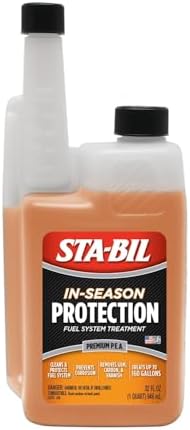
STA-BIL In-Season Fuel System Treatment and Injector Cleaner, 32 oz
- FUEL SYSTEM CLEANER: Cleanses the entire fuel system, including fuel injectors, lines, & fuel pumps, this formula remove…
- CORROSION PROTECTION: Industry-leading rust and corrosion protection for all internal fuel system parts
- MPG BOOSTER: Designed to optimize fuel performance which contributes to enhanced gas mileage & improved engine power. Th…
- DIRECTIONS: New name, same formula as our 360* Protection. Pour directly into fuel tank prior to fill up. Use 1 oz for e…
- YEAR-ROUND PROTECTION: Pair STA-BIL In-Season Protection with STA-BIL Storage, providing a complete solution for both in…
Despite the shared brand name, this is a very different product from the storage formula above. The In-Season treatment is made for regular use during the driving season, and the manufacturer highlights fuel system cleaning, PEA based detergents, injector cleaning, corrosion protection, and treatment of gasoline containing ethanol. It is a gasoline formula and should not be confused with the Marine or Diesel versions sold under related names.
The recommended rate is one fluid ounce for every five gallons of fuel, and the manufacturer suggests using it at every fill up for ongoing protection. At that rate, the 32 ounce bottle treats up to 160 gallons. That figure describes how many tanks the bottle can cover, and it says nothing about how long fuel will last in storage. Capacity and storage protection are separate measures, and the large treatment volume should not be read as longer protection than the dedicated storage product.
The manufacturer does state that a single use can stabilize fresh fuel for up to 12 months if the vehicle is stored, so it can help when a car is parked unexpectedly. Still, an owner who knows a vehicle will sit for a long stretch may prefer the dedicated storage formula. This one suits a commuter or frequent driver who wants steady, low effort treatment built into the routine of filling the tank.
Choosing the Right Fuel Treatment for Your Situation
If the main goal is protecting fuel through a long period of inactivity, the dedicated STA-BIL Storage formula is the most direct fit in this group. If you drive regularly and want a treatment that becomes part of every fill up, the STA-BIL In-Season product is built for that routine. If you want a concentrated treatment that supports both stability and fuel system cleanliness, Star Tron is the multipurpose option for gasoline. If you maintain several engines, including diesel, Sea Foam offers the broadest range. If you want periodic fuel system cleaning with a stabilizing function included, Royal Purple Max-Clean is aimed at that need.
The bottle matters less than the habits around it. Fresh fuel, the correct dosage, and proper storage conditions shape the outcome as much as the product name, and a well chosen stabilizer cannot rescue fuel that was already stale or a tank stored carelessly. Match the treatment to how you actually use the vehicle, read the label for the exact directions, and follow the owner’s manual for storage.
Decide first whether you are protecting a parked car or maintaining a working one, then pick the formula built for that job. A car that comes out of storage and starts without drama is usually the result of a few simple choices made on the day it was parked.