Choosing the Best Jumper Cables for Cars and SUVs
Compare five jumper cable sets by length, wire gauge, and practical features to find the right fit for your car or SUV and roadside needs.

A dead battery rarely picks a convenient moment. It might happen in a crowded parking lot after a long shift, in your own driveway on a cold morning, or on a quiet stretch of road far from the nearest service station. The engine clicks or does nothing at all, and suddenly the whole day depends on whether someone nearby has a working vehicle and whether you own the right equipment. Roadside battery emergencies are common, and they are far less stressful when a decent set of cables is already in the trunk.
Finding the best jumper cables is mostly a matter of matching the equipment to the way you actually drive. A compact sedan that rarely leaves town has different needs from a three-row SUV parked nose-in against a garage wall. Car battery jumper cables look similar on a shelf, yet they differ in conductor thickness, length, clamp design and the extras packed in the bag. This guide explains those differences and then looks at five specific sets so you can decide which one deserves space in your vehicle.
Our Take
No single set of cables is right for every driver. The choice comes down to a trade between reach and portability on one side and conductor thickness on the other. A 16 foot set with 6 gauge cable is a sensible, compact choice for ordinary situations. A 20 foot set with 4 gauge cable gives you more room to maneuver the donor vehicle and a thicker conductor. A 0 gauge set is the thickest of the group but comes in a shorter 10 foot length that demands careful parking.
Advertised amperage numbers deserve some skepticism. A large figure on the packaging is not a promise that the cable will start any engine, and it often describes a brief peak instead of sustained output. Gauge, length, clamp construction and your vehicle manufacturer’s guidance tell you far more than a headline number. Pick the cable that fits how you park, what you drive and where you will store it.
What Matters When Choosing Jumper Cables
Wire gauge is the first specification to understand. It follows the American Wire Gauge system, in which a lower number means a thicker conductor. A 4 gauge cable is thicker than a 6 gauge cable, and 0 gauge is thicker still. A thicker conductor generally carries current with less resistance, which helps when a battery is badly discharged. The right gauge still depends on the vehicle manufacturer’s requirements, the battery system, the quality of the cable and its length, and the way the cables will be used. Thicker cable is also heavier and stiffer, so the gain in capability comes with a cost in handling and storage.
Length is the second major decision, and many buyers underestimate it. Cables that are too short can force you to park vehicles bumper to bumper, which is not always possible in a tight driveway or a crowded lot. A longer set gives you freedom to approach from the side or reach across an awkward gap. The downside is bulk, since a longer set takes up more room in a trunk or under a seat. Shorter cables store easily but only suit situations where the two vehicles can sit close together.
Clamps, insulation and flexibility matter more than they appear to on a spec sheet. Clamps need to bite firmly onto a terminal or approved connection point and stay there without slipping. Insulation protects both the cable and your hands, and it should stay supple enough to uncoil without fighting you. A cable that kinks or resists straightening is frustrating at the moment you least want frustration. A bag or case keeps the set tidy and prevents the clamps from tangling or touching each other in storage. Accessories such as gloves and cleaning brushes are small conveniences, and they only add value if the rest of the cable is well made.
Vehicle compatibility is the final consideration. Small cars, large SUVs, trucks and diesel engines place different demands on a jump start. Any cable set may be adequate for one of those and marginal for another, so treat marketing claims about universal fitment with caution. When you shop, look at the type of vehicle you drive and consult its owner’s manual for guidance on jump starting.
Energizer 16 Foot, 6 Gauge Jumper Cables: A Familiar Name in a Practical Size

- ENERGIZER 16 FEET JUMPER CABLES – 6 Gauge, 16 FT booster battery jumper cables for jump starting a dead or weak battery….
- THICK VINYL COATING – Includes a strong spring and a comfortable handle for secure placement and easy positioning. Thick…
- CARRYING CASE INCLUDED – Our Energizer jumper cables come with a high-grade travel bag for easy transport and compact st…
This Energizer set pairs a 16 foot length with 6 gauge cable. That combination suits a driver who wants a straightforward emergency set without a lot of weight. Sixteen feet is long enough to bridge two vehicles parked nose to tail or slightly offset in a typical lot. It also folds down into a small footprint, which matters in a compact car with limited trunk space.
The 6 gauge conductor is thinner than the 4 gauge cable in several other sets here. That makes the cable lighter and easier to coil, but it also means less conductor material for current to travel through. For ordinary roadside needs on typical cars and small crossovers it is a reasonable configuration. It is not the natural pick for someone who regularly deals with large engines or who wants the most headroom for stubborn starts, and nothing about this listing should be read as a guarantee for every vehicle.
Reach is the other limit. At 16 feet this set works best when you can park the donor vehicle fairly close. If you often park in driveways with tight clearances or you drive something long, you may find yourself wishing for extra length. This is a sensible choice for a driver who values compact storage and brand familiarity and who expects to use the cables occasionally on an everyday vehicle.
TOPDC 20 Foot, 4 Gauge Heavy Duty Jumper Cables for Flexible Positioning

- Strong And Safe Clamps: The TOPDC Jumper Cables booster cable has four giant alligator clamps with strong jagged teeth a…
- 20 Feet Jumper Cables: The TOPDC 20 Feet Jumper Cables has an extremely long usage distance, which is suitable for use w…
- UL-Listed & qualified quality: The TOPDC Jumper Cables surface is made with premium PVC which is resistant to freezing, …
TOPDC describes this configuration as a heavy duty set with insulated clamps and a carrying bag. Its 4 gauge conductor and 20 foot length make it a more flexible option than a shorter, thinner set. The extra four feet over a 16 foot cable may sound modest, but it changes how you can approach a stranded vehicle.
Extra reach is useful because roadside emergencies rarely allow perfect positioning. A car may be stopped at an angle on a shoulder, or boxed in along a curb with no room to bring a second vehicle straight in front of it. Twenty feet lets the donor vehicle sit at a safer and more convenient distance. It also helps when the dead battery is in the trunk or under a seat and the connection point is far from the front bumper. This is one of the reasons many drivers consider 20 feet a more forgiving length than 16.
Moving from 6 gauge to 4 gauge increases conductor thickness, which is generally better for carrying current. The tradeoff is a heavier and slightly bulkier coil. The included bag helps contain that bulk and keeps the clamps from snagging other items in the trunk. This set is a good fit for drivers of larger cars and SUVs who want a thicker cable and generous reach without moving up to the thickest gauge. No cable can promise to start every engine, so the vehicle’s condition and the manufacturer’s instructions still decide the outcome.
EXTRESPO 20 Foot, 4 Gauge Jumper Cables with a Full Accessory Kit

- 20 FT JUMPER CABLES – These battery jumper cables are 20 feet long and easily connect from one car battery to another wi…
- PREMIUM FLEXIBLE CABLE – High density copper clad aluminum ensures excellent electrical conductivity. The car jumper cab…
- UL LISTED & SAFETY – ExtreSpo heavy duty jumper cables feature a thick vinyl coating, excellent insulation. These booste…
EXTRESPO also uses a 4 gauge, 20 foot configuration, and this listing states a 600 amp rating. What separates it from the previous set is the contents of the kit. It includes a carrying case, gloves and cleaning brushes, and the product information describes insulated cable construction.
The accessories have real practical value. Corroded terminals can interfere with a solid connection, and a cleaning brush gives you a way to deal with that before attaching a clamp. Gloves add a layer of protection and keep your hands cleaner when you are working in a dark or wet parking lot. A case keeps everything together so the pieces are still there when you need them. These extras do not make the cable itself any better, but they make the set more complete for a driver who does not already own those items.
The 600 amp figure needs to be read carefully. It is described as an instantaneous current rating, which means a brief peak and not a continuous level. It should not be treated as the amount of current the cable can deliver for an extended period. It also says nothing certain about whether the cable will start a particular vehicle. This product is a sensible choice for someone who wants a 4 gauge, 20 foot set and values having the accessories included. It makes no claims about independent laboratory testing or universal compatibility, and you should not assume either.
NOONE 10 Foot, 0 Gauge Jumper Cables: Thick Cable with Limited Reach

- UNIVERSAL FITMENTS :NOONE 10 FT car jumper cables support 200A peak current for jumping start 12/24V car battery. So NOO…
- SUPERB PERFORMANCE :With rubber covered, NOONE battery booster cables can provide you insulated protection to prevent le…
- HIGH QUALITY CLIPS :Super strong bite, tight crimping and more conductive. Extra thick PVC sheath at the handle, can be …
The NOONE set is the outlier in this group. It offers 0 gauge cable, the thickest conductor here, in a short 10 foot length. Product information for this configuration describes a kit that includes a carrying bag, gloves and a cleaning brush. Before purchase it is worth confirming that the listing you open matches the 10 foot, 0 gauge version and its accessory details.
The appeal of a 0 gauge conductor is its thickness, which suggests lower resistance than a 4 or 6 gauge cable of comparable quality. Drivers who deal with larger engines or who simply want maximum conductor mass may find that attractive. The compromise is the 10 foot length. That reach works best when the two vehicles can be parked very close together, such as nose to nose in a driveway or garage. In a roadside situation where you cannot control positioning, ten feet can quickly become a problem.
That limitation should be weighed honestly. A shorter cable is easier to store and handle, and its thickness may suit a home garage where you control the parking arrangement. It is less suited to emergencies in unpredictable locations. If you choose this set, plan to keep it for situations where the vehicles can be placed close together, and consider whether a longer set would serve you better as your only pair of cables.
EPAuto 20 Foot, 4 Gauge Heavy Duty Jumper Cables with Storage Accessories
- HEAVY DUTY 4 GAUGE JUMPER CABLES: These 4 AWG booster cables provide superior current flow compared to lighter standard …
- TANGLE-FREE & FLEXIBLE DESIGN: The cables are engineered with a specialized insulation jacket that resists tangling and …
- COPPER-PLATED JAW CLAMPS: The alligator clips feature high-quality copper plating and strong tension springs to ensure a…
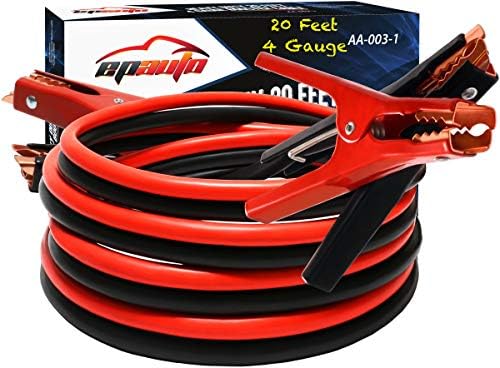
EPAuto offers a 4 gauge, 20 foot configuration described as heavy duty. The product information mentions copper plated clamps, a travel bag and safety gloves. On paper it overlaps with the TOPDC and EXTRESPO sets, but its mix of features suits a slightly different buyer.
The 20 foot length and 4 gauge conductor give it the same positioning flexibility and conductor thickness as the other 4 gauge sets. Copper plated clamps are intended to help with conductivity at the connection point, though clamp quality always comes down to how firmly they grip and how well they are built. The travel bag keeps the cable organized, and the gloves add a basic layer of protection. Together these make it a practical emergency kit for a driver who wants storage and safety accessories without buying them separately.
It is worth treating any stated amperage rating on a listing with the same caution described above. An advertised figure does not guarantee compatibility with every car, SUV, truck or diesel engine, so confirm the details on the exact listing before buying. This set makes the most sense for drivers who want a balanced, ready to use emergency set built around a 20 foot reach and a 4 gauge cable. It does not need to be the thickest or the shortest to be a sensible pick.
Cables or a Self-Contained Jump Starter
Jumper cables depend on a second vehicle. If you regularly drive alone or park in places where help is scarce, that dependency is a genuine limitation. A self-contained unit does not need a donor car, which is why many drivers also look at portable car jump starters. Cables cost less in most cases and have no battery of their own to keep charged, while a jump starter gives you independence. Some drivers keep both, and that is a sound approach for anyone who wants to be covered in more than one scenario.
A battery that dies repeatedly is a signal worth acting on. A battery maintainer can help keep a vehicle that sits for long periods in better condition. Persistent starting trouble may also point to an aging battery or a charging problem, which is better addressed with a proper inspection than with repeated jump starts.
Safety Before You Connect Anything
Jumper cables are a tool and not a substitute for knowing your vehicle. Check the owner’s manual before attempting a jump start and follow the manufacturer’s specific connection procedure. Procedures vary between vehicles, and the correct approach for one may not be suitable for another. Never assume that the same method applies to every conventional, hybrid or electric vehicle, since many have designated jump points or specific warnings.
A damaged, leaking or visibly compromised battery should not be jump started. Cracks, bulging cases and fluid around the terminals are signs to stop and call for professional help. If you are unsure about any step, waiting for roadside assistance is the safer decision.
Roadside preparation goes beyond cables. A reflective triangle, a flashlight and basic first aid supplies are all worth carrying, and our guide to car safety essentials covers more of what belongs in the trunk. Keeping the cables stored in their bag in an accessible spot means you are not digging through luggage when the situation is already stressful.
Making the Decision
The best jumper cables for you come from a handful of straightforward questions. How long a reach do you need given the places you park and the vehicles you might help? How thick a conductor makes sense for your car or SUV and the manufacturer’s requirements? How much storage space do you actually have? Answering those matters more than chasing the biggest number on a package.
For many drivers a 16 foot, 6 gauge set like the Energizer is enough for occasional use on an ordinary vehicle. If you want more reach and a thicker conductor, the three 4 gauge, 20 foot sets from TOPDC, EXTRESPO and EPAuto are the logical step up, with differences mainly in accessories and clamp details. The NOONE set suits a narrower purpose, where 0 gauge thickness is valued and the vehicles can be placed close together.
Price and advertised amperage should not be the deciding factors. Gauge and sufficient reach shape how well a set works in practice, and clamp quality, insulation and storage shape how easy it is to use under pressure. Choose the set that fits your vehicle and your habits, read the owner’s manual before you ever need it, and keep the cables where you can reach them quickly.