2023 Corolla Hybrid SX: Efficiency Done Right
Mid-spec hybrid hatchback offers remarkable fuel economy and improved driving dynamics, but you'll sacrifice cargo space for those gas savings.

The 2023 Toyota Hybrid SX Hybrid arrives at an inflection point in the compact car market. It’s no longer enough to be reliable and forgettable, which is precisely what Toyota seems to understand with this mid-life refresh. The Corolla has spent the better part of a decade coasting on reputation alone, but the new hybrid system fundamentally changes what this car can do. This isn’t a marginal update. The fifth-generation hybrid powertrain brings real power gains and efficiency that, for the first time, makes the compact hybrid worth the premium over the non-hybrid version.
The SX sits in the middle of Corolla’s lineup as the practical choice. You get better equipped than the entry-level Ascent, but without the sportier pretensions of the ZR. In the Australian market, where this trim competes against the Hyundai i30, Mazda 3, and Volkswagen Golf, the Corolla SX Hybrid carries a $34,280 price tag before on-road costs. That buys you a genuinely useful everyday car, assuming you accept one significant compromise: the boot space is genuinely small.
What makes the 2023 Toyota Corolla SX Hybrid interesting isn’t that it’s transcendent. It’s that it’s competent where competence actually matters. The driving experience is refined. The infotainment system is finally modern. The fuel economy is legitimately staggering. And unlike some compact hybrids that feel like uncomfortable experiments, this car actually wants to be driven by normal people every day.
Our Take
The 2023 Toyota Corolla SX Hybrid is a straightforward execution of a straightforward idea: make a car that uses almost no fuel and doesn’t punish you for it. Toyota pulls this off more convincingly here than at any point in Corolla’s recent history. The hybrid system delivers real-world benefits you can feel every day, not just in fuel consumption numbers. The interior feels genuinely modern for the first time in years. The ride is composed. Handling is competent. It’s a commute car that actually wants you to enjoy the commute, or at least not actively make you miserable.
The catch isn’t subtle. The boot is cramped enough to be a genuine problem if you regularly carry cargo. The back seat is tight with minimal amenities. Neither of these issues is new to the Corolla, but they’re particularly obvious when you’re paying mid-tier money. If you’re buying this car, you’re committing to the hatchback format. And if you’re committing to that format, you need to know that practicality is compromised compared to competitors like the Volkswagen Golf or Mazda 3.
Buy the Corolla SX Hybrid if your daily driving is predictable, fuel economy matters, and you don’t need to haul things regularly. Skip it if you need genuine cargo space or want a car that’s genuinely fun to drive aggressively.
Pros and Cons
Pros
- Fuel economy that actually delivers on the promise of the hybrid badge
- Infotainment system is responsive and genuinely intuitive
- Independent rear suspension provides a noticeably refined ride
- New hybrid system brings meaningful power gains over previous generations
- Wireless Apple CarPlay and Android Auto connectivity
- Five-star ANCAP safety rating
- LED headlights come standard
- Comfortable for everyday commuting
Cons
- Boot space is inadequate for regular cargo hauling
- Back seat offers minimal legroom and poor amenities
- Narrow Bridgestone Ecopia tires provide limited grip in wet conditions
- CVT transmission creates highway drone at cruising speed
- Cloth upholstery feels inexpensive at this price point
- Regenerative braking system can feel grabby and inconsistent
- Limited towing capacity
What’s New
The 2023 refresh marks the most significant update the Corolla has received in years. The headline change is the fifth-generation hybrid system, which adds a new drive-motor design and dual magnets to the electric motor. This nets a meaningful power increase: 103 kilowatts (138 horsepower) and 142 Newton-meters of torque. That’s not earth-shattering performance, but it’s a genuine improvement that you notice in real-world acceleration.
The infotainment system deserved updating, and Toyota delivered. The new eight-inch touchscreen processes information faster than before, eliminating the lag that plagued earlier Corollas. Everything loads quicker. The navigation is genuinely usable. Touch response is snappy. Wireless Apple CarPlay and Android Auto connectivity arrives standard across the lineup.
The cluster received attention as well. You now get a seven-inch digital display that’s bright, clear, and packed with useful information. Safety tech advanced too. Toyota Safety Sense 3.0 is now standard, bringing adaptive cruise control that can apply brakes to maintain your set speed, lane-keeping assist, automatic emergency braking, and automatic high beams.
The styling refresh is subtle but effective. New LED headlights frame the front end. New alloy wheel designs replace last year’s dated items. The color palette expanded to include Sunstone Orange metallic, a new finish that actually looks modern instead of an afterthought.
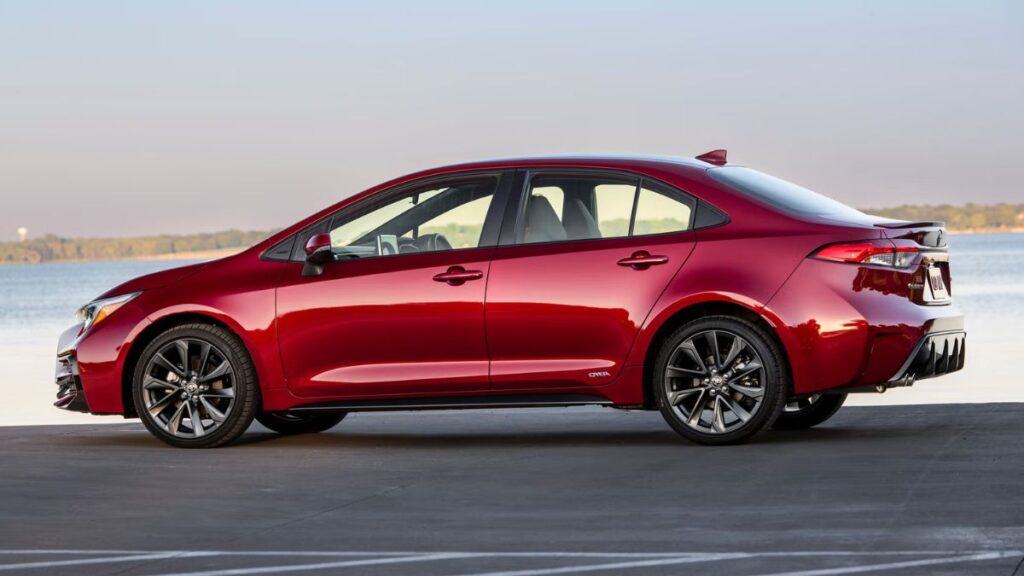
Exterior Design
The 2023 Corolla SX Hybrid doesn’t announce itself. It looks like a Corolla, which is precisely what Toyota intended. The company made deliberate choices not to differentiate the hybrid visually with aggressive styling or special badging. You get hybrid badges on the sides and rear. That’s it. Everything else is pure Corolla.
This restraint is actually honest. There’s no pretense about what this car is: a practical commuter. The overall profile is conservative, with clean lines and proportions that fit somewhere between the contemporary Mazda 3 and the slightly older Hyundai i30. The front end feels modern thanks to the new LED headlights, which integrate neatly into the redesigned bumper. The grille is straightforward. The hood is flat and simple. There’s nothing here that challenges or divides opinion.
The side profile is where the design actually works. The independent rear suspension necessitated a different rear haunches design compared to the Ascent model, and that curves upward in a way that feels deliberate rather than accidental. It’s not exciting, but it’s competent. The SX’s 16-inch alloy wheels look appropriately sized, proportional to the body, unlike some compact cars that look pinned to undersized tires.
At the rear, the design is busy but functional. The boot lid slopes sharply, which sounds spacious until you open it and realize the independent rear suspension consumed much of that potential cargo volume. The tail lights are full-width and LED equipped. The overall silhouette works. It’s not a car anyone will look twice at in a parking lot, but it’s a car that looks like it has its priorities straight.
Sunstone Orange metallic, the new color, is the standout. On glossy paint it actually looks contemporary and less like an attempt at sporty. Most Corollas are silver, white, or gray. This one stands out without trying too hard.
Driving Experience
This is where the 2023 Toyota Corolla SX Hybrid actually gets interesting. The independent rear suspension is a structural change that transforms how the car behaves on the road. In rough conditions or on gravel roads, the reduction in pitch and vibration translates to a significantly more refined ride. You feel fewer impacts channeling into the cabin. The damping is well-tuned. Bumps are absorbed rather than transmitted.
The tradeoff is real: that independent rear suspension consumes boot space. But if you’re buying a hybrid, you’re prioritizing efficiency and smoothness over cargo capacity anyway. Toyota made the right call.
Around town, the hybrid system feels competent. Electric torque assists at low speeds, making pull-away sharper than previous Corollas. The CVT is smooth and responsive at city speeds. Acceleration feels adequate, not quick. When you punch it harder, the gasoline engine engages, and here’s where things get honest: a V-brum fills the cabin, the engine hangs in the 3,000 to 4,000 RPM range, and the noise becomes apparent. This is the compromise of the hybrid system. You accept engine noise when you ask for real power.
Highway behavior reveals the CVT’s limitations. At cruising speed the transmission creates an audible drone that builds as RPMs climb. It’s not unbearable, but it’s noticeable in quiet conditions. Road and wind noise are well controlled, but the powertrain noise dominates at motorway speeds.
Handling is neutral and uninspired. The steering is light and responsive but lacks feedback. There’s no sense of connection to the road. Cornering is flat thanks to the well-damped suspension, but body roll is noticeable if you try pushing it. The car doesn’t punish aggressive driving, but it doesn’t reward it either. The Mazda 3 and Volkswagen Golf both handle this chassis considerably better.
The Bridgestone Ecopia tires deserve specific criticism. They’re optimized for fuel economy, not grip. In wet conditions, they struggle. One test in wet weather produced a 0-100 km/h time of 10.6 seconds despite near-perfect launch conditions. Under normal driving, that’s adequate. Under challenging conditions, confidence evaporates.
Braking deserves mention. Regenerative braking integrates with mechanical brakes, and the system can feel inconsistent. The transition between electric and friction braking isn’t always seamless. Sometimes the brakes feel natural. Other times they feel grabby, as if the system is fighting your input. It’s not unsafe, but it requires adaptation.
Performance and Acceleration
The fifth-generation hybrid system is the real story here. Toyota increased power output to 103 kilowatts, up from the previous generation’s 72 kilowatts from the engine alone. Combined system output hits 138 horsepower and 142 Newton-meters of torque. On paper, this sounds modest. In real-world driving, it makes a measurable difference.
Pull-away from a stop is noticeably sharper than the previous Corolla Hybrid, thanks to immediate electric motor torque. The 0-100 km/h sprint, in dry conditions, targets just under nine seconds according to some tests, though real-world figures vary based on road surface and tire grip. On wet roads, that stretches to over 10 seconds. For context, the non-hybrid Corolla with its 2.0-liter engine achieves roughly the same acceleration, defeating much of the reason to buy the hybrid for performance.
Highway acceleration is where the limitation becomes obvious. Passing another vehicle requires planning. You can’t just dip into the throttle and expect instant response. The engine hangs at elevated RPMs. The transmission doesn’t downshift quickly. It happens, eventually, but it demands patience. Wind the accelerator fully open on the motorway and the Corolla Hybrid will build speed, but you’re asking a lot from what is fundamentally a low-revving, efficiency-focused engine.
The CVT transmission is smooth but characterless. There’s no downshift kick, no mechanical drama, just a constant seamless progression from low speed to high speed. This is intentional. Toyota prioritized smoothness and efficiency over engagement. A conventional automatic would provide better throttle response and engine sound feedback. The CVT delivers neither.
The electric motor does real work, but it’s most noticeable under city driving. Highway speeds reveal the hybrid system’s reality: you’re carrying electric motors that add weight and complexity, all to save fuel you’d barely use driving harder anyway. This is a car that makes most sense in heavy urban or suburban use where the electric motors earn their keep. On open roads at motorway speeds, the weight penalty becomes more apparent.
Ride Comfort and Cabin Refinement
The independent rear suspension is the defining hardware change and directly impacts ride quality. Over poor surfaces, the Corolla SX Hybrid absorbs impacts with notable composure. Rough roads that jar other compact cars barely register. The damping is just firm enough to control motion without feeling harsh. Long journeys on gravel roads or rough tarmac reveal the benefit of this suspension design.
The trade-off is legitimate: you lose boot space. The mechanics of independent rear suspension consume cargo volume that a more conventional beam axle wouldn’t. Toyota was transparent about this decision, and it’s the right choice for a car marketed primarily on efficiency and comfort rather than practicality.
Cabin noise is well-controlled across most scenarios. Wind noise is minimal. Road noise through the tires is subdued. The real noise culprit is the hybrid powertrain. At low speeds, electric motors are silent, which highlights road noise slightly more. At highway speeds, CVT drone dominates everything else. Engine noise, when the gasoline engine engages, is also apparent. These are inherent characteristics of the hybrid system, not design oversights.
Vibration isolation is good. Steering vibration is minimal even on rough surfaces. There’s minimal shake through the controls. The overall cabin environment feels stable and composed.
Temperature control is single-zone in the SX trim, unlike pricier variants. This is a compromise at this price tier. The climate system works effectively, but adjustment requires the passenger to accept the driver’s temperature choice. With a hatchback’s windows and glass area, the cabin does warm up in sun, though the climate system catches up reasonably quickly.
Seat comfort is straightforward. Front seats are supportive for typical commute driving, with adequate cushioning and decent lateral support. They won’t win awards for sport driving, but for daily use they’re fine. The cloth upholstery is durable but feels inexpensive given the price point.
Interior and Luxury Feel
The interior is where the 2023 refresh proves most effective. The eight-inch infotainment display transforms the driving experience. The old systems felt laggy and dated. This new touchscreen is genuinely modern. Input lag is nearly eliminated. The interface is intuitive. Graphics are clean. Speed and responsiveness feel premium by compact car standards.
The seven-inch digital instrument cluster is bright and legible. Information presentation is logical. Customization options let you prioritize the displays you actually want to see. It’s not fancy, but it’s well-executed.
Everything else in the cabin is honest plastic. This isn’t a luxury car interior. Touchpoints are hard plastic. The dash is hard plastic. The door cards are hard plastic. Door handles are simple and functional. There’s no fake wood trim, no leather-look finishes trying to fake premium materials. Toyota chose transparency over pretense, which is respectable.
Storage is adequate but not generous. Cup holders are standard. There’s a center console bin with decent depth. Door pockets are reasonable. Rear passengers get USB-C charging ports, a practical addition that other competitors don’t always include. The lack of wireless phone charging is a miss at this price.
The back seat is the legitimate weak point. Legroom is tight. The seat bottom is narrow, making it uncomfortable for three adults. Windows are large but the seating position is cramped. Back seat passengers on longer journeys will complain. Headroom is acceptable but not generous. This is where the Corolla’s compact car dimensions become apparent and limiting.
Build quality is solid. Panel gaps are even. There are no creaks or rattles. Doors close with authority. The overall feeling is put-together and durable, not special.
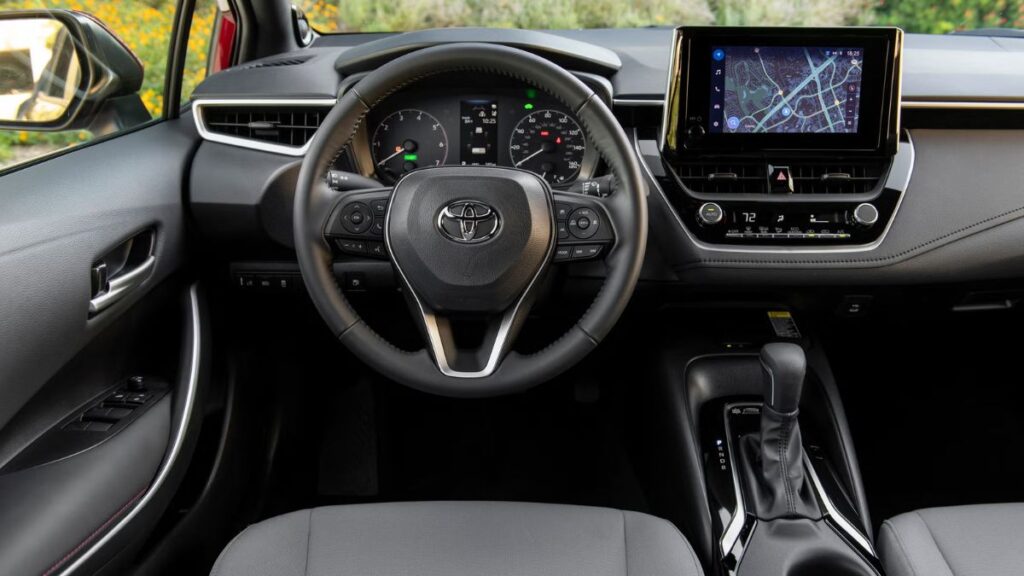
Technology and Infotainment
The new multimedia system is the standout technology achievement. The eight-inch touchscreen makes the jump to modern feel after years of Corolla systems that felt behind the curve. The processor is quick enough to eliminate the lag that plagued earlier Corollas. The touch responsiveness is snappy. Applications load fast. The interface is genuinely usable.
Wireless Apple CarPlay and Android Auto are standard, not optional, which is appropriate at this price tier. Connectivity worked flawlessly in testing. Connection handoff was seamless. Siri voice control through CarPlay operates reliably. The same applies to Android Auto. This was not a given five years ago. Now it’s standard.
The integrated navigation system is solid. Maps load quickly. Routing is logical. Voice guidance is clear and accurate. It’s not as powerful as Google Maps or Apple Maps running through smartphone integration, but it’s capable for its purpose. The navigation screen clarity is excellent, especially in daylight.
The audio system is straightforward. A six-speaker configuration provides adequate sound without being impressive. The system lacks any attempt at premium audio. It plays music clearly without distortion. Bass is present without overwhelming. Treble is clear. It’s competent, not particularly enjoyable for music lovers.
Climate control is single-zone and intuitive. The interface is simple and responsive. Function trump form, which is appropriate.
Toyota Safety Sense 3.0 is now standard, bringing a collection of active safety features. Adaptive cruise control operates smoothly for most of the time, though it likes to brake early when traffic conditions change. Lane-keeping assist works well, occasionally getting confused by faded lane markings but generally effective. Automatic emergency braking is responsive. Automatic high beams operate seamlessly, though the transition is sometimes abrupt.
One criticism: the rearview camera quality is adequate but not stellar. In low light conditions, visibility drops noticeably. The backup process requires attention to detail rather than pure confidence.
Fuel Economy
This is where the 2023 Toyota Corolla SX Hybrid absolutely delivers. Real-world fuel consumption in mixed driving sits around 4 liters per 100 kilometers. Convert that to US terms and you’re looking at roughly 59 miles per gallon in typical mixed driving. Highway cruising delivers even better efficiency. Urban stop-and-go driving suffers slightly but still maintains remarkable efficiency.
These aren’t theoretical numbers. Multiple independent tests confirm that the Corolla Hybrid achieves fuel consumption figures close to factory claims. The electric motors actually do the work they promise. City driving, where the electric motor assists heavily, delivers the best efficiency. Highway cruising sees the engine work harder, but the system still maintains efficiency that non-hybrid competitors simply cannot match.
The new lithium-ion battery sits under the rear seat, taking up less space than older designs. Charging happens through regenerative braking during normal driving. The system requires no external charging. Cost per kilometer is genuinely low. Monthly fuel bills for a typical commuter will shock you with their affordability.
The tradeoff is understood: you pay a fuel economy premium at purchase, recouping it through lower operational costs. The SX Hybrid costs roughly $2,500 more than the non-hybrid SX. Depending on driving patterns, that premium recoups in three to four years of typical use. After that point, you’re operating at lower cost than non-hybrid competitors.
Practicality and Cargo Space
This is the significant weakness. The boot space measures 217 liters, which sounds adequate until you open it. The independent rear suspension eats into the space that would otherwise be available. A space-saver spare tire sits under the floor. Real cargo space is tight. You should expect to fit a single large suitcase comfortably. Two suitcases become awkward.
Deep storage areas on the sides provide some mitigation, but the overall shape of the boot makes it challenging to pack efficiently. Bulky items are difficult to fit. Soft luggage works better than rigid cases. The rear seats fold flat, creating additional space, but at the expense of back-seat functionality. For a couple traveling light or a solo driver commuting daily, it’s manageable. For a family needing regular cargo space, it’s limiting.
The hatchback format itself is compromised by these dimensional realities. The Volkswagen Golf and Mazda 3 both offer considerably more practical cargo solutions with similar overall length. Competitors in the compact hatchback segment don’t universally use independent rear suspension, meaning they’ve maintained more usable boot space.
Rear-seat space is similarly tight. Legroom is limited. Three adults across the back seat is uncomfortable. Two is tolerable. One is fine. Any journey longer than thirty minutes will have back-seat passengers shifting uncomfortably.
Interior storage is adequate. Cup holders work. The center console bin has decent capacity. Door pockets are reasonable. There’s adequate space for daily items. Long-term storage for jackets or other items is limited.
If you regularly need cargo capacity or frequently carry passengers, the Corolla SX Hybrid will frustrate you. If you’re primarily a solo commuter with an occasional passenger, practicality is acceptable.
Safety and Driver Assistance
The Corolla earns a five-star ANCAP safety rating, which is appropriate for a modern compact car. The rating is based on testing carried out in 2018, which is becoming dated. Frontal impact protection is solid. Side impact protection is adequate. Rollover protection benefits from the rigid hatchback structure.
Toyota Safety Sense 3.0 brings substantial active safety equipment. Adaptive cruise control with braking capability reduces driver workload on long drives. Lane-keeping assist prevents unintended drift and provides gentle steering correction when needed. The system occasionally gets confused by faded markings or unusual lane configurations, but generally performs well. Automatic emergency braking operates responsively. Automatic high beam activation works transparently.
Child safety is straightforward. The rear doors have child locks. Seatbelt mounting is adequate. The rear seat is simple enough that child seat installation is straightforward.
Visibility is good from the driver’s seat. The windscreen is large. Side windows are substantial. The rear window provides decent rearward visibility. The rearview camera, while adequate, could be clearer in low light conditions.
Handling of emergency situations is competent rather than exceptional. The Corolla is stable at highway speeds. Braking response is linear and predictable, aside from the regenerative braking integration quirks. Steering response is positive. Nothing here will surprise you, which is appropriate for a car marketed on everyday practicality.
Competitors Worth Considering
Hyundai i30 Hybrid: A direct competitor in the compact hatchback segment, the i30 Hybrid offers more aggressive styling and a more engaging driving experience. The i30’s interior feels slightly more premium. Cargo space is comparable. Fuel economy is similar. The i30 is a valid alternative if you want more visual excitement without sacrificing efficiency. The Hyundai warranty is more comprehensive than Toyota’s.
Mazda 3: The driver’s car in the compact hatchback segment, the Mazda 3 offers superior handling and a more connected driving experience than the Corolla. Cargo space is marginally better. The Mazda interior feels more premium. Fuel economy lags behind the hybrid Corolla but remains competitive. Choose the Mazda 3 if engaging driving matters more than outright efficiency.
Volkswagen Golf: The Golf is larger and more upscale than the Corolla. It offers significantly better cargo space, superior interior materials, and a more refined driving experience. Non-hybrid versions offer good fuel economy. The Golf costs considerably more. It’s the choice if budget allows and practicality is paramount.
Toyota Corolla Non-Hybrid: The standard Corolla with the 2.0-liter engine offers more power and better driving dynamics than the hybrid. Performance is noticeably better. Fuel economy is notably worse. Pricing is $2,500 less. Choose this if you prioritize driving engagement over fuel efficiency.
Toyota Corolla Cross Hybrid: The Corolla Cross is taller, heavier, and less efficient than the Corolla Hybrid, but offers more cargo space and elevated driving position. Pricing is marginally higher. Choose the Cross if practicality and visibility matter more than pure efficiency.
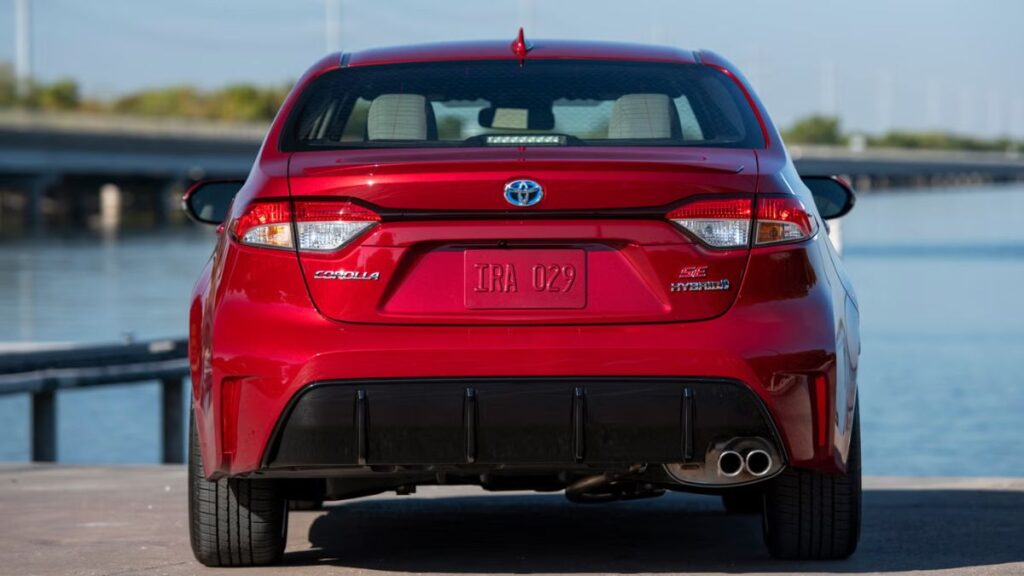
Biggest Strength and Biggest Weakness
The biggest strength is unambiguous: the fuel economy is genuinely impressive and genuinely achievable. This car delivers on the hybrid promise better than almost any compact car in the segment. Real-world consumption figures remain close to official claims. The fifth-generation hybrid system does real work without compromising drivability. Monthly fuel costs are shockingly low compared to non-hybrid competitors. For a daily commuter, this advantage compounds across years of ownership.
The biggest weakness is equally clear: the cargo space is inadequate for a vehicle at this price tier. The independent rear suspension made the ride more refined, but the tradeoff of losing practical storage capacity was a questionable priority. The boot is genuinely small. The back seat is cramped. For a car marketed as a practical everyday hatchback, those limitations undermine the fundamental promise. You’re compromising practicality to optimize efficiency, which narrows the appeal considerably.
Which Trim Does Cardrav Recommend?
The SX is the right choice in the Corolla lineup if you’re committed to the hybrid system. You get better equipment than the base Ascent Sport, including LED fog lights, privacy glass, and the full complement of Toyota Safety Sense 3.0. The Ascent Sport costs less but requires option packages to access features the SX includes standard. The ZR offers more visual aggression and premium finishes but costs considerably more for benefits that matter less on an efficiency-focused hybrid.
The SX represents the practical middle. You’re paying for genuine functionality and equipment, not cosmetic upgrades or performance enhancements that don’t align with the hybrid’s purpose. The 16-inch alloy wheels aid ride quality compared to the larger wheels on higher trims. The cloth upholstery is durable and practical compared to the leather-look alternatives.
Final Verdict: Should You Buy It?
Yes, if your daily driving is commuting in city or suburban environments, fuel economy genuinely matters to your budget or values, you don’t regularly haul cargo or carry passengers, and you appreciate competent everyday engineering over excitement.
No, if you need genuine cargo space, want a car that engages you behind the wheel, require back-seat space for regular passengers, or prioritize driving enjoyment above efficiency.
The 2023 Toyota Corolla SX Hybrid is an honest car that does what it promises. It delivers remarkable fuel efficiency without asking you to suffer through an unpleasant driving experience. The infotainment system is finally modern. The ride is refined. Daily driving is competent and untroubling. What you sacrifice is cargo space and any sense of driving excitement.
It’s an introvert’s car. It doesn’t announce itself. It doesn’t demand attention. It simply does the job day after day with minimal drama and minimal expense. For the right buyer, that’s exactly what matters.
FAQ
What real-world fuel economy should I expect from the 2023 Corolla Hybrid SX?
Most owners report 4.0 to 4.3 liters per 100 kilometers in mixed driving, with city driving delivering better efficiency and highway cruising slightly higher consumption. This translates to roughly 55 to 60 miles per gallon in US measurements. These figures are genuinely achievable and close to official claims, which is rare in the hybrid segment.
How much larger is the boot compared to the non-hybrid Corolla SX?
The hybrid boot measures 217 liters versus approximately 280 liters in the non-hybrid version. The difference stems from the independent rear suspension and hybrid battery placement. If cargo space matters regularly, the hybrid is not the right choice despite its other strengths.
Is the Corolla SX Hybrid suitable for a family with children?
The front seats are comfortable. The back seat is cramped for more than two adults or for carrying children regularly on long journeys. The boot space limits luggage capacity for family trips. It works for small families or as a second car. As a primary family vehicle, the practical limitations become apparent.
How does the hybrid acceleration compare to the non-hybrid Corolla SX?
City driving performance is similar. The electric motor assists adequately from a stop. Highway acceleration is comparable, though the hybrid’s higher initial torque provides subtle benefits. The non-hybrid 2.0-liter engine offers perceptibly more power and better passing response on the motorway.
What is the warranty coverage on the 2023 Corolla Hybrid SX?
Toyota provides standard manufacturer warranty covering mechanical components. The hybrid battery carries extended coverage for 8 years or 160,000 kilometers. This is competitive but not exceptional compared to some competitors. Hyundai’s warranty is notably more comprehensive, while BMW’s is comparable.