2026 Honda Accord Review Hybrid Efficiency Comfort and Value
A closer look at the 2026 Honda Accord’s fuel economy, interior comfort, available trims, technology, and value for everyday driving.

For most of its life the Accord has done a plain job well. It is a midsize sedan with a trunk you can load easily, a back seat adults can use, and a drivetrain that asks very little of its owner. The 2026 model keeps that approach intact, but it now splits into two quite different cars. The LX and SE use a 1.5 liter turbocharged gasoline engine and a continuously variable transmission. The Sport, EX-L, Sport-L, and Touring use a two motor hybrid system that Honda rates at up to 48 mpg combined. All six trims are front wheel drive, all seat five, and all share a 16.7 cubic foot trunk, so the decision comes down to the powertrain, the screen and seat equipment, and how much you want to spend.
This 2026 Honda Accord Review looks at the car through Honda’s published specifications, equipment lists, and pricing. It is an analysis of what the manufacturer documents, not an account of time behind the wheel, and it will say so where the documentation runs out. The goal is to help you work out which Accord, if any, fits the way you drive and the money you plan to spend.
A Closer Look at What Makes the Accord Worth Considering
What makes the 2026 Honda Accord interesting is not that it tries to do something dramatically different. It is that it understands what many sedan buyers still need, even as the market continues to give more attention to SUVs. A car does not have to be fast, oversized, or packed with flashy features to make sense for everyday life. Sometimes the more meaningful qualities are the ones that become part of a routine: enough room for adult passengers, a trunk that can handle ordinary family needs, technology that works without unnecessary effort, and an engine that does not demand frequent stops at the gas station.
The Accord’s choice of powertrains gives that everyday approach more depth. The gasoline models make sense for buyers who want to keep the initial cost lower, while the hybrids offer a stronger case for people who spend much of their time commuting or driving through busy streets. What matters here is that the hybrid option is not confined to one expensive flagship model. Buyers can choose between different levels of equipment and comfort without giving up the basic advantages of the hybrid system. The EX-L Hybrid is particularly appealing on paper because it combines leather trimmed seating with the highest published fuel economy in the lineup. That combination makes it worth considering for someone who wants a well equipped car but does not necessarily need every feature available.
There is also a limit to how far the Accord’s value argument goes. As the price climbs, the decision becomes less about getting a practical sedan and more about deciding which additional comforts are worth paying for. Features such as ventilated front seats, a head up display, and a premium audio system may be welcome, but they will not matter equally to every driver. The less expensive trims already cover many everyday needs, so choosing a higher trim should come down to how much use someone expects to get from its extra equipment, not simply the assumption that the most expensive version must be the best one.
The bigger consideration is whether a traditional sedan fits the buyer’s life in the first place. The Accord provides useful passenger space and a generously sized trunk, but it does not offer all wheel drive, and its relatively low ground clearance will not suit everyone who regularly deals with rough roads or difficult winter conditions. Those are not small details that can be overlooked because the fuel economy looks good. They are practical limitations that should shape the buying decision from the beginning.
What Honda Changed for 2026
The 2026 Accord is a refresh of the 11th generation, not a redesign. According to Honda’s pricing and equipment announcement, cars began reaching dealers in December 2025, and the changes cluster around the two gasoline trims and a few cosmetic touches on the hybrids.
The change most buyers will notice is inside the LX and SE. Both now come with a 9 inch touchscreen that Honda says is almost 30 percent larger than the previous one, and it keeps a physical volume knob. Wireless Apple CarPlay and Android Auto compatibility and a 15 watt Qi wireless charger are now standard across the whole lineup. For a buyer who picks the cheapest Accord, these are the features used every day, so this update does more than a new wheel design would.
The SE also moves up two inches to 19 inch wheels with a five spoke design, which changes the look and presumably the feel of the car, though Honda’s documents do not describe ride quality. On the hybrid side, the Sport adds black window trim and black decklid badging, and the Sport-L gets the same badging, joining the black mirrors, shark fin antenna, and gloss black B pillar trim the two trims already share. Nothing mechanical changes. Think of 2026 as a sensible equipment update that fixes the base car’s weakest area, its technology, rather than a reason to upgrade from a recent Accord.
Exterior Design
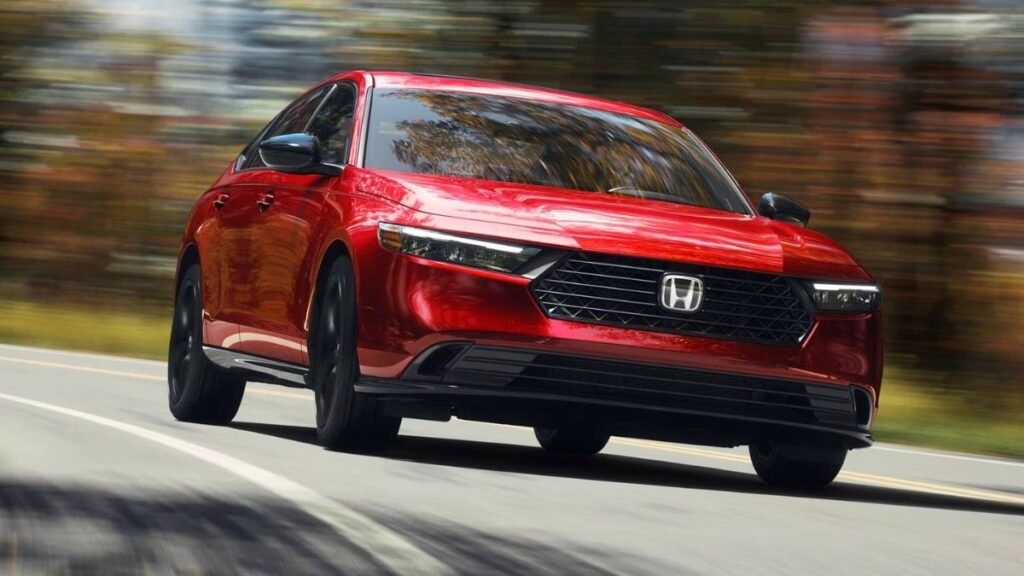
The Accord is a low, long, wide sedan. Honda lists a 111.4 inch wheelbase, a 195.7 inch overall length, a 73.3 inch width, and a height of 57.1 inches. Ground clearance is 5.3 inches unladen. Those figures describe a traditional three box sedan shape that sits close to the road, and they also explain one of the car’s practical limits: it is not built for rutted or deeply snowed roads, a point worth keeping in mind later in the article.
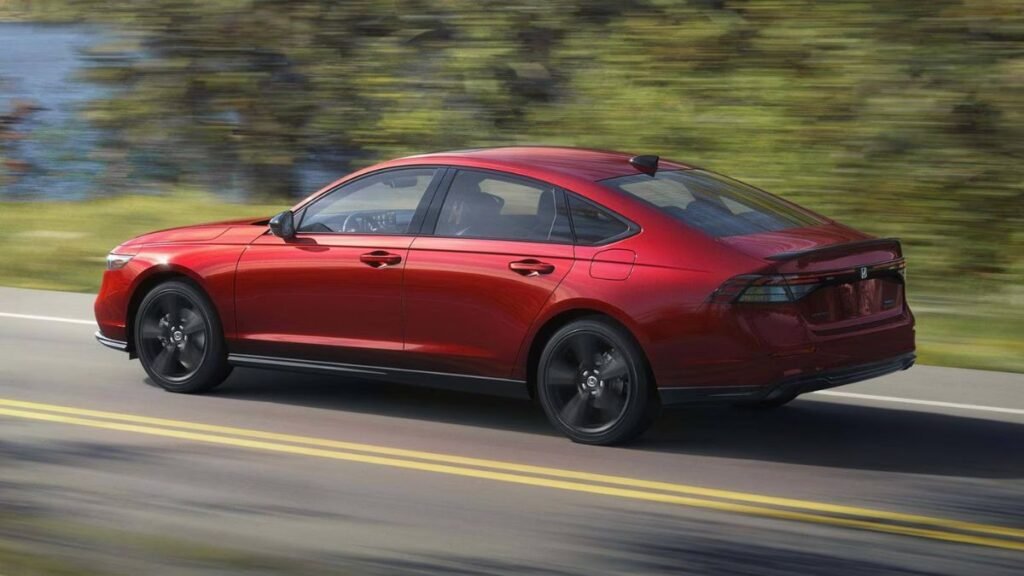
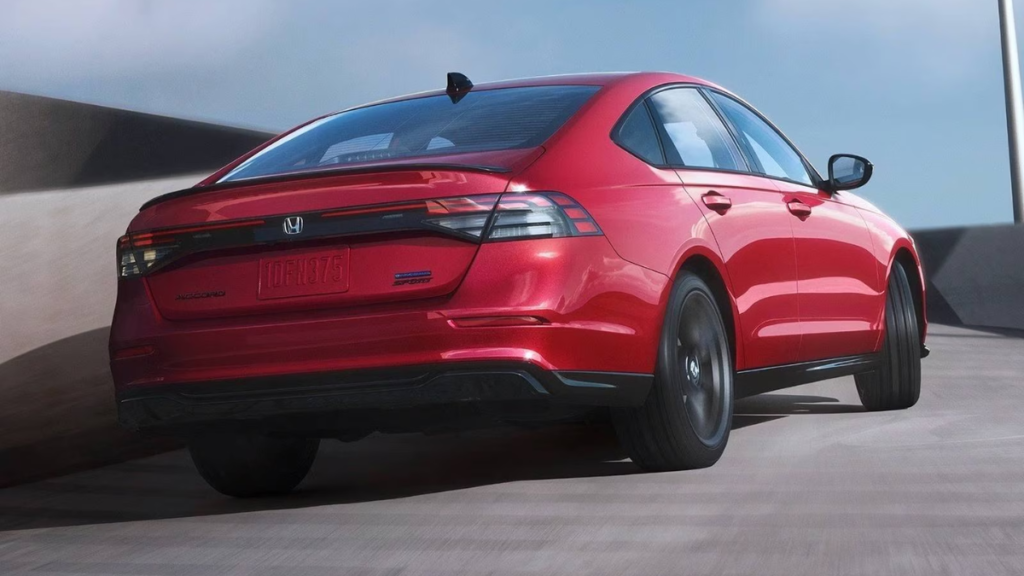
Honda does not publish aerodynamic or handling data for the Accord in the material reviewed here, so any claim that the shape improves efficiency or road manners would be guesswork. What the documents do show is how much styling depends on trim. The LX rides on 17 inch wheels in Blade Silver. The SE, Sport, Sport-L, and Touring use 19 inch wheels in different finishes, while the EX-L stays with 17 inch wheels. The Sport and Sport-L carry a gloss black spoiler and gloss black mirror covers, and the EX-L and Touring use mirrors with integrated LED turn indicators. LED headlights, taillights, and daytime running lights are standard everywhere.
Color choice is reasonable without being exotic. Four standard colors include Solar Silver Metallic, Crystal Black Pearl, Meteorite Gray Metallic, and Canyon River Blue Metallic, and four premium colors add Platinum White Pearl, Still Night Pearl, Urban Gray Pearl, and Radiant Red Metallic. Honda restricts some colors by trim, and its pricing notes that color upgrades are not included in the published MSRP.
Engines and Performance
The two powertrains deserve separate treatment because they are built on different ideas.
The LX and SE use a 1.5 liter turbocharged four cylinder with VTEC. It produces 192 horsepower at 6,000 rpm and 192 pound feet of torque from 1,700 to 5,000 rpm, according to Honda’s specification sheet. That torque plateau is the interesting figure. Peak pull arrives at low engine speed and holds across most of the usable range, which generally suits town driving and merging better than a horsepower number alone. Honda pairs it with a continuously variable transmission that uses Step Shift programming to simulate gear changes at full throttle, and the gasoline cars offer two drive modes, Econ and Normal, along with an idle stop function. Honda explains the engine in more detail on its 1.5 liter turbo page.
The hybrid pairs a 2.0 liter Atkinson cycle four cylinder with two electric motors, and the figures here need careful reading. The gasoline engine alone makes 146 horsepower and 134 pound feet of torque. The traction motor produces 181 horsepower and 247 pound feet of torque, and that torque is available from zero to 2,000 rpm. Honda lists total system horsepower at 204, defined as the peak concurrent output of the two electric motors and the engine together. These numbers are not additive in the way people tend to assume. The 247 pound feet belongs to the motor, not to the engine, and the specification sheet does not publish a separate combined torque figure for the whole system. Anyone comparing the hybrid’s torque against the turbo’s 192 should keep that distinction in mind.
Honda describes the hybrid as a direct drive arrangement with no conventional transmission, CVT, torque converter, or belt, relying instead on the interplay of the two motors, with the engine joining in for efficient cruising. It also describes Linear Shift Control, which imitates the speed linked rev feel of a geared drivetrain under acceleration. The hybrids add a four mode drive system with Econ, Normal, Sport, and Individual settings, deceleration selectors, an electric servo brake, and larger front brakes.
What do the numbers imply for daily use? A motor that delivers its full torque from a standstill should make the hybrid feel responsive in traffic and when pulling away from a light, and the higher system output suggests a bit more in reserve for passing than the turbo offers. The turbo’s wide torque band points to comfortable, unhurried performance, while the CVT is a simpler and more familiar design. These are inferences from specifications. Honda publishes no acceleration times, braking distances, or handling figures in the documents reviewed, so none appear here.
Fuel Economy
Honda reproduces the 2026 EPA estimates for every trim, and they separate the two powertrains clearly. These are official ratings for comparison, not results measured by Cardrav, and Honda stresses that real mileage varies with driving style, maintenance, conditions, and, for hybrids, battery pack age and condition.
The LX is rated at 29 mpg city, 37 highway, and 32 combined. The SE trails slightly at 28, 36, and 31, a one mpg penalty that likely reflects the larger wheels and extra weight, although Honda does not state the cause. Among the hybrids, the Sport, Sport-L, and Touring all share 46 city, 41 highway, and 44 combined. The EX-L is the standout at 51 city, 44 highway, and 48 combined.
Two patterns are worth drawing out. The hybrid’s advantage is largest in the city, where the electric motors carry the car at low speed. On the highway the gap shrinks, since the LX’s 37 mpg is only four mpg below the Sport’s 41. And the EX-L’s four mpg lead over the other hybrids is real and official, but Honda’s documents do not explain it. The sheet lists the EX-L on 17 inch wheels and the others on 19 inch wheels, yet nothing in the material says wheel size is the reason, so treat the connection as plausible rather than confirmed.
A rough calculation shows what the gap means over time. Assume 12,000 miles a year and that your driving matches the combined rating exactly, which it will not. At 32 mpg, an LX would use about 375 gallons. A Sport at 44 mpg would use about 273 gallons, and an EX-L at 48 mpg would use 250. That makes the EX-L about 125 gallons cheaper to run than the LX over that distance. Multiply by your local fuel price to put a dollar figure on it, and remember the result is arithmetic, not a promise. The tanks hold 14.8 gallons in the gasoline cars and 12.8 in the hybrids, so the same combined ratings imply a theoretical range of roughly 470 miles for the LX and 610 miles for the EX-L. Both numbers assume the combined rating holds for every mile.
Interior and Passenger Comfort
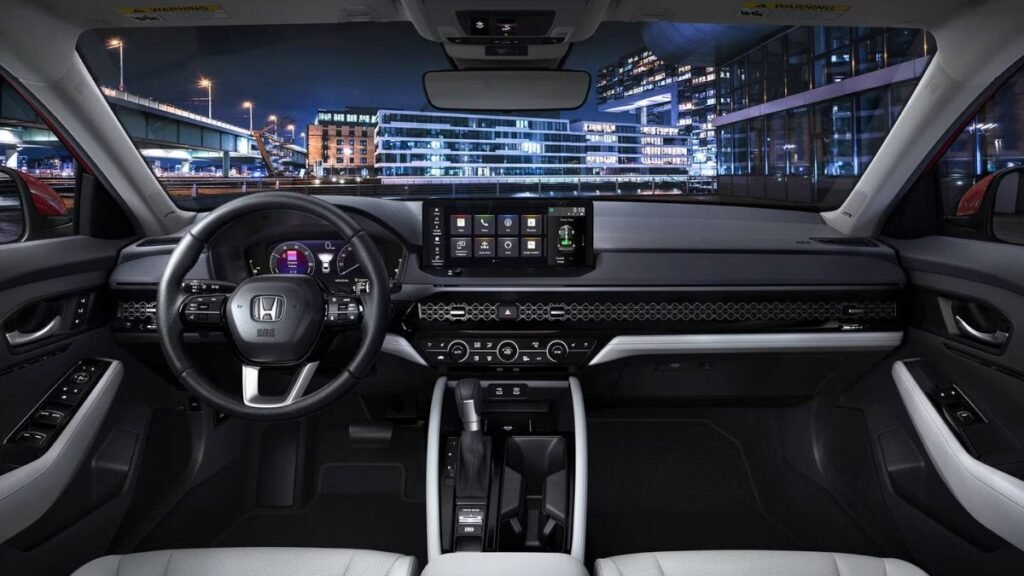
Honda’s measurements describe a roomy cabin for the class. Front legroom is 42.3 inches and rear legroom is 40.8, shoulder room is 57.9 inches in front and 56.5 in back, and hiproom is 55.4 inches in both rows. EPA passenger volume is 105.7 cubic feet in the LX and 102.8 in the other trims. The LX also lists more front headroom, 39.5 inches against 37.5, and the trims with less headroom are the ones that carry a moonroof, so that is probably the cause. Rear headroom is nearly identical across the lineup at 37.3 and 37.2 inches.
These are measurements, and they say nothing about how the seats feel after a few hours. Honda’s documents give no description of cushioning, cabin noise, or ride quality, so this review does not either. What the documents do reveal is a clear ladder of comfort equipment. The LX has air conditioning with an air filtration system, white ambient lighting, and a one piece fold down rear seatback. The SE adds heated front seats, a 10 way power driver’s seat with two way power lumbar support, dual zone climate control, a moonroof, and a 60/40 split rear seat. The Sport adds a leather wrapped steering wheel and shift knob. The EX-L and Sport-L bring leather trimmed seats, a two position driver’s memory, and a four way power passenger seat. The Touring adds ventilated front seats, heated rear outboard seats, a heated steering wheel, and acoustic laminate glass for the windshield and front doors.
Power adjustment and heating are the features that matter most to daily comfort, and the SE is where they first appear. Leather and memory settings are quality of life additions that suit buyers who share the car or keep it for years. Ventilated seats and the heated wheel are climate extras that depend on where you live. Every trim includes a 10.2 inch digital instrument cluster, push button start, remote engine start, an electronic parking brake with automatic brake hold, and two USB C charging ports for the rear seats, a small detail that helps families and anyone carrying passengers.
Infotainment and Technology
The two screens divide the lineup. The LX and SE use the new 9 inch display, and the Sport and above use a 12.3 inch display. Wireless Apple CarPlay and Android Auto, Bluetooth streaming, a Qi wireless charger, HondaLink, and a Wi-Fi hotspot capability are standard on all six trims. Honda notes that the hotspot needs an AT&T data plan and that the HondaLink subscription services come with a trial of the Remote service, after which a subscription is required to continue.
Voice and connected features scale with price. Alexa built in starts at the Sport. Google built in, which includes a three year unlimited data plan for in vehicle apps, is limited to the Touring, and so are the 6 inch head up display and HD Radio. Audio follows the same pattern, with a 160 watt four speaker system in the LX, a 180 watt eight speaker system in the SE through Sport-L, and a Bose premium system with twelve speakers in the Touring.
For buyers who mostly mirror their phone, the standard wireless connectivity means the base screen is no longer a handicap, and the larger display may not justify a $3,100 step to the Sport on its own. For those who want native voice assistants and built in navigation, the progression matters more. Honda’s features by trim guide is the place to confirm exactly what a given trim includes.
Cargo Space and Practicality
Honda lists cargo volume at 16.7 cubic feet on every trim, measured to the SAE J1100 standard, and it does not shrink for the hybrids. That is a generous trunk for a midsize sedan, and the identical figure across the lineup means buyers do not trade space for efficiency. For commuting, weekly grocery runs, a couple of suitcases, or a child’s stroller, the numbers suggest a trunk that handles ordinary family use without fuss. Honda does not publish tests of particular items, so no claims are made about what will or will not fit.
Flexibility differs by trim. The LX has a one piece folding rear seatback, while the SE and every hybrid have a 60/40 split, which allows a long item and a passenger to share the back. Honda also lists a compact spare tire on the LX and SE and a tire repair kit on the hybrids, a difference that matters to anyone who prefers a spare for long trips.
Safety and Driver Assistance
Every 2026 Accord comes with the Honda Sensing suite, which Honda describes on its Honda Sensing page. It includes the Collision Mitigation Braking System, Forward Collision Warning, Road Departure Mitigation, Lane Departure Warning, Lane Keeping Assist, Adaptive Cruise Control with Low Speed Follow, Traffic Jam Assist, Traffic Sign Recognition, and automatic high beams. A Driver Attention Monitor, Rear Seat Reminder, and seat belt reminders for every seating position are also standard.
Equipment varies at the edges. Blind Spot Information and Rear Cross Traffic Monitor are absent on the LX and arrive with the SE, so a buyer choosing the cheapest trim loses those aids. Parking sensors, four in front and four in the rear, are limited to the EX-L and Touring. Low Speed Braking Control and the multi angle rearview camera with dynamic guidelines are Touring only.
On the passive side, every Accord uses Honda’s Advanced Compatibility Engineering body structure, advanced front airbags, front knee airbags, front and rear side airbags, and side curtain airbags. LATCH lower anchors cover the outboard rear seats and tether anchors cover all three rear positions.
Honda calls the 11th generation Accord a safety performance leader in the midsize class, but that is its own characterization. The official material reviewed here does not establish a crash test rating or safety award, so this article does not assign one. Driver assistance also has limits that Honda spells out in its own notes: the systems cannot detect every object or lane marking, their accuracy varies with weather and speed, and the driver remains responsible for operating the vehicle safely.
Trim Levels and Pricing
Honda’s published prices begin at $28,395 for the LX and rise through the SE at $30,695, the Sport at $33,795, the EX-L at $35,095, the Sport-L at $35,495, and the Touring at $39,495. Each figure excludes a $1,195 destination charge, as well as taxes, registration, options, and color upgrades, and Honda notes that dealer prices may vary. These are manufacturer suggested prices, not what you will necessarily pay at a dealership, and this review makes no claims about current discounts or financing offers. Honda’s pricing release also contains combined price entries that do not add up for the Sport-L and Touring, so this article gives MSRPs and the destination charge separately rather than repeating a total.
The LX is the cheapest way into the car and now has the standard technology to back it up, but it lacks blind spot monitoring, heated seats, a moonroof, and the power driver’s seat. The SE costs $2,300 more and adds all of those along with dual zone climate control, 19 inch wheels, and a split folding rear seat. For a buyer who wants a gasoline Accord, that step buys more everyday equipment than any other in the lineup, and it is where most turbo shoppers should look first.
Moving to the Sport costs another $3,100 and changes the car more than any other step. It brings the hybrid powertrain, the 12.3 inch screen, Alexa built in, the four mode drive system, and a leather wrapped wheel. It is the least expensive hybrid, and the one for buyers who want efficiency without paying for leather.
The EX-L and Sport-L sit only $400 apart and suit different priorities. The EX-L costs less, carries the best efficiency rating in the lineup, and includes parking sensors, an automatic dimming mirror, and LED mirror indicators. The Sport-L offers 19 inch wheels, a spoiler, sport pedals, and darker exterior trim, but gives up four mpg combined and the parking sensors. Both share leather seating and driver memory. Someone who cares about running costs and comfort will probably prefer the EX-L, while someone who cares about appearance may prefer the Sport-L.
The Touring tops the range at $39,495, which is $4,400 above the EX-L. It adds ventilated seats, heated rear seats and steering wheel, the head up display, Google built in, the Bose system, acoustic glass, rain sensing wipers, and Low Speed Braking Control. It is the most complete Accord, but it returns the same 44 mpg combined as the Sport. Unless those specific features appeal to you, the EX-L covers most of the same ground for less.
Ownership Considerations
Honda’s specification sheet lists a tune up interval of about 100,000 miles with no scheduled tune ups, and it includes the Honda Maintenance Program for one year or 12,000 miles on every trim. Recommended fuel is unleaded regular for both powertrains, which keeps running costs simple. Honda does not give warranty terms in the documents reviewed for this article, and this article will not guess at them. Current coverage is best confirmed through a dealer or Honda’s owner’s manual and warranty resources. Reliability, resale value, insurance, and repair costs are also left out, because the official sources do not establish them, and a manufacturer’s reputation is not a guarantee of trouble free ownership.
Practical Buying Advice
The gasoline Accord suits buyers who want the lowest purchase price and the simplest drivetrain, and now that the base screen and phone connectivity have caught up, the LX is a more complete car than before. The SE is the better version of that idea for most people, because blind spot monitoring and power seating arrive together.
The hybrid is the more compelling choice for anyone who spends much time in town or in commuter traffic, where the EPA numbers favor it most. At 44 mpg combined for the Sport, and 48 for the EX-L, the efficiency gap over the turbo is large enough to matter at the pump over a few years, even though the hybrid costs more up front. The strongest all rounder is probably the EX-L, which combines the best efficiency, leather seating, and parking sensors at a price well below the Touring.
The limits are specific. Honda lists front wheel drive and nothing else, so buyers who face heavy snow or unpaved roads and want all wheel drive will need a different vehicle. With 5.3 inches of ground clearance the Accord is also a poor fit for rough surfaces. And a sedan, even one with a 16.7 cubic foot trunk, cannot match the tall opening and cargo flexibility of a crossover. Buyers who want that practicality may prefer to read our 2026 Honda CR-V review before committing. Those looking at other midsize sedans can consult our 2023 Toyota Camry review, keeping in mind that it covers the 2023 model year and not a current Camry.
The Bottom Line
Many of the questions a buyer would ask about this car come down to a few facts. The Accord starts at $28,395 before the $1,195 destination charge, and the six trims climb to $39,495 for the Touring. The gasoline LX and SE use a 192 horsepower turbocharged engine and return 32 and 31 mpg combined, while the four hybrids use a 204 horsepower two motor system and return 44 mpg combined, or 48 in the EX-L. Everything is front wheel drive, with no all wheel drive offered, and every trim has the same 16.7 cubic feet of cargo space.
That framing points to who should buy which version. A driver who wants the lowest price and a straightforward drivetrain should look at the SE, which adds the safety and comfort equipment the LX lacks. A driver who commutes or runs errands around town should look at the EX-L, where the efficiency advantage is largest and the equipment list is generous. Someone who wants every feature, including the Bose system, ventilated seats, and Google built in, will find them in the Touring, but should be honest about whether the extra $4,400 over the EX-L buys things they will use. Buyers who live where winters are hard, or who drive on poor roads, should look beyond the Accord, because front wheel drive and low ground clearance are real constraints.
Judged on what Honda documents, the 2026 Accord is a sensible, well rounded sedan whose update fixes its most obvious shortcoming and whose hybrid trims offer a meaningful efficiency advantage. It makes no pretense of being exciting, and the documents give no basis to claim it is. For buyers who want a spacious sedan with low running costs and a clear step up the equipment ladder, it deserves a place on the shortlist.