Best Impact Wrenches for Cars and Garage Work
A practical buyer's guide to choosing the right impact wrench for automotive repairs, lug nuts, and stubborn fasteners

Finding the best impact wrenches for automotive work starts with a simple problem: a lug nut that will not budge. You have the breaker bar out, you are putting your full weight into it, and the bolt still will not move. Maybe it is a rusted suspension bolt that has not seen a wrench since the car left the factory. Maybe you just need to swap a wheel before a trip, and a hand ratchet is going to turn a ten-minute job into an hour of frustration. This is exactly the kind of situation an impact wrench exists to solve.
Not every impact wrench solves it the same way, though. Some are built for occasional garage use, light enough to keep in a trunk and pull out when a tire needs changing. Others are built for people who work on cars regularly and need enough torque to break loose fasteners that have corroded in place for years. Power, control, drive size, battery platform, and how the tool actually feels in your hand over the course of a job all factor into which wrench makes sense for a given owner.
This guide looks at five cordless impact wrenches that represent different approaches to automotive and garage work. One is a practical, accessible kit for routine garage tasks. One is a mid-range option built around a complete kit and a widely used battery ecosystem. One is the clear performance leader in published torque figures, sold as a bare tool for buyers who already have a compatible battery platform. One is an extremely powerful complete kit with strong control features. And one combines high torque with genuine speed control and an unusually generous kit. None of these tools is universally “the best.” Each one earns its place on this list for a different reason, and the goal here is to help you figure out which reason matters most to you.
We selected five impact wrenches for different automotive and garage needs, from everyday lug-nut work to high-torque repairs. You can view all five recommendations together in our Amazon Idea List.
View All 5 Impact Wrenches on Amazon
Quick Comparison
| Product | Configuration | Torque | RPM | IPM | Main Strength |
|---|---|---|---|---|---|
| PORTER-CABLE PCC740LA | Kit, 4.0Ah battery included | 330 ft-lbs | Up to 1,700 | Not specified | Practical, accessible kit for routine automotive work |
| RYOBI PCL265K1 | Kit, 4.0Ah battery and charger included | 375 ft-lbs fastening | Up to 2,700 | Up to 3,100 | Mid-range power with a complete kit and ONE+ ecosystem access |
| Milwaukee 2967-20 M18 FUEL | Bare tool | Up to 1,200 ft-lbs fastening, up to 1,600 ft-lbs nut-busting (battery-dependent) | 0 to 2,000 | 0 to 2,400 | Highest published torque among these five |
| DEWALT DCF900P1 | Kit, 5.0Ah battery, charger, and bag included | 1,030 ft-lbs fastening, 1,400 ft-lbs breakaway | Not specified | Not specified | Very powerful complete kit with strong control features |
| Makita XWT08T | Kit, TWO 5.0Ah batteries, rapid charger, and tool bag included | 740 ft-lbs fastening, 1,180 ft-lbs nut-busting | 0 to 900 / 0 to 1,000 / 0 to 1,800 | Up to 2,200 IPM | High torque with three-speed control and a generous kit |
What Is an Impact Wrench?
An impact wrench uses a rotating hammer mechanism inside the tool to deliver short, rapid bursts of rotational force to a fastener, rather than applying one steady twisting motion the way a hand ratchet or a standard drill does. Each of those bursts is called an impact, and they happen very quickly, which is why a good impact wrench can snap loose a bolt that would otherwise fight you for several minutes with hand tools. The hammering action changes how reaction torque is delivered compared with a steady-drive tool, but the wrench can still react sharply as the impact mechanism engages, so a firm grip and proper stance still matter.
This is different from an impact driver, which is the smaller cousin most people know from woodworking and household projects. Impact drivers use a quarter inch hex shank meant for screwdriver bits and small hex fasteners. Impact wrenches use a square drive anvil, most commonly 1/2 inch for automotive work, designed to hold sockets that can handle the torque loads involved in wheel lug nuts, suspension bolts, and other structural hardware on a vehicle. Trying to use the wrong tool for automotive fasteners is a common mistake, and it is one of the reasons drive size matters as much as it does.
Cordless models have become the standard choice for garage and mobile work because there is no compressor to drag around and no hose to trip over. You pick up the tool, pull the trigger, and go. For anyone working in a driveway, on the side of the road, or in a garage without a dedicated air line, that convenience is not a minor detail. It is often the deciding factor.
Torque, Speed, and What the Numbers Actually Mean
Fastening Torque vs Breakaway Torque
Manufacturers typically publish two different torque numbers, and mixing them up leads to confusion. Fastening torque describes how much force the tool can apply while tightening a fastener. Breakaway torque, sometimes called nut-busting torque, describes how much force the tool can apply to loosen a fastener that is already tight or seized. These are not the same job. A bolt that has been sitting in salt and road grime for years often needs more force to break free than it ever needed to be installed in the first place, which is why breakaway figures tend to run higher than fastening figures on the same tool.
It also matters that different manufacturers do not always test and report these numbers under identical conditions. A torque figure from one brand is not automatically an apples to apples comparison with a figure from another brand, and actual results at the fastener can vary further depending on the battery used, the condition of the fastener, the socket, corrosion, and how the joint was originally assembled. Treat published numbers as a useful guide to a tool’s general power class and relative positioning, not as a precise, universally comparable measurement.
RPM and IPM
RPM tells you how fast the anvil spins, which affects how quickly a fastener runs down once it starts moving. IPM, or impacts per minute, describes how often the hammer mechanism strikes as it delivers torque. A higher IPM does not automatically mean a stronger tool, and a higher RPM does not automatically mean a better one. Both numbers matter more in combination with how the tool is controlled, since blasting through a fastener at maximum speed with no ability to back off can strip threads or overtighten hardware just as easily as it can save time.
Brushless Motors
A brushless motor removes the physical brushes that wear down in older motor designs, which typically means more efficient power delivery, less heat build-up, and generally more runtime out of the same battery compared to a brushed motor. It is one of the more meaningful upgrades in cordless tool technology over the last decade, and several of the tools on this list use one.
Battery Platform
Cordless power tools are built around battery platforms, and a wrench’s usefulness in your garage depends partly on whether you already own batteries and chargers for that brand. Someone who already has a shelf of 18V ONE+ batteries for other RYOBI tools gets more value out of a ONE+ wrench than the torque number alone suggests. The same logic applies across M18, 20V MAX, and 18V LXT ecosystems, and it becomes especially relevant for a bare tool purchase, where you are buying into a battery platform as much as you are buying the wrench itself.
Drive Size
The 1/2 inch drive size shows up on all five tools here for a reason. It is the standard for automotive lug nuts and most suspension and drivetrain hardware, strong enough to handle real torque loads without the socket itself becoming the weak point.
Weight and Ergonomics
A tool that puts up huge torque numbers is not necessarily the right choice if it is heavy enough to wear out your arm during a longer job. Weight matters more than it seems like it should, especially when you are working overhead, under a vehicle, or through a job that involves more than a handful of fasteners.
How We Chose These Impact Wrenches
This selection is based on published manufacturer specifications, documented product configurations, and how each tool’s characteristics line up with real automotive and garage use cases. Cardrav did not physically test these five wrenches for this article, and none of the comparisons here should be read as lab results or measured performance data. What we did evaluate is torque capability as reported by each manufacturer, drive size, speed and control features, battery platform and kit configuration, included accessories, ergonomics as described in listed weight and dimensions, and how each tool’s overall package suits a particular kind of buyer. Where Amazon customer information is referenced, it is treated as a supplied reference point rather than an independent Cardrav test result.
Best Impact Wrenches for Cars and Garage Work
1. PORTER-CABLE PCC740LA
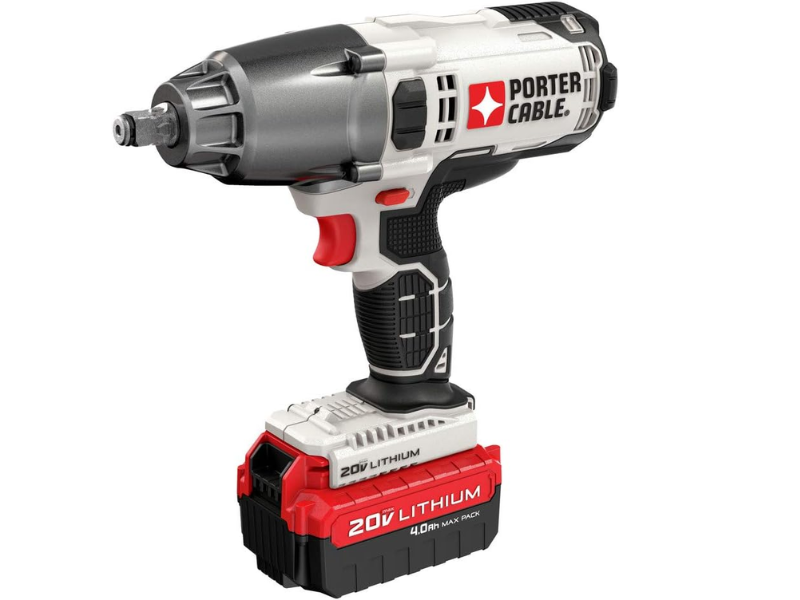
The PORTER-CABLE PCC740LA earns its spot here as a practical, accessible entry point into cordless 1/2 inch automotive impact wrenches. It runs on the 20V MAX platform, delivers up to 330 ft-lbs of maximum torque, and spins up to 1,700 RPM through a hog ring anvil. Those numbers put it well below the high torque tools further down this list, and that is worth saying plainly rather than glossing over.
What this tool is good at is straightforward, everyday garage tasks. Swapping a set of wheels, removing hardware that is not badly corroded, or handling smaller mechanical jobs around the garage are all reasonable uses for a wrench in this power range. The variable speed trigger gives you some control over how aggressively the tool spins into a fastener, which matters when you are working with anything that could be overtightened or stripped, and the built-in LED work light is a genuinely useful addition when you are reaching into a dim wheel well or under a dash. This model comes as a kit with a 4.0Ah battery included, so there is no separate battery purchase to plan around. At a listed 6 pounds with the battery installed, it is light enough to use for extended periods without your arm giving out partway through a job.
Where it makes less sense is heavy duty automotive work. Deeply rusted suspension bolts or hardware on larger trucks are likely to be a stretch for 330 ft-lbs. This is not a criticism of the tool so much as an honest description of the category it belongs to. Someone shopping for their first cordless impact wrench, who mostly needs help with lug nuts and light maintenance, is the person this tool was built for.
Important features:
- 20V MAX platform
- 1/2 inch drive with hog ring anvil
- 330 ft-lbs maximum torque, up to 1,700 RPM
- Variable speed trigger
- LED work light
- Kit includes a 4.0Ah battery
- Listed weight of 6 pounds with battery
Pros:
- Practical, accessible kit that includes a battery
- Lightweight and easy to control during longer sessions
- Variable speed trigger and LED light aid control and visibility
- Straightforward choice for routine garage and automotive tasks
Cons:
- 330 ft-lbs torque is modest next to the high torque competitors on this list
- Not well suited to heavily corroded or high resistance automotive fasteners
- Fewer control modes than the more advanced tools on this list
Best for: Occasional DIY automotive work, light maintenance, and buyers who want an affordable, complete cordless kit.
2. RYOBI PCL265K1
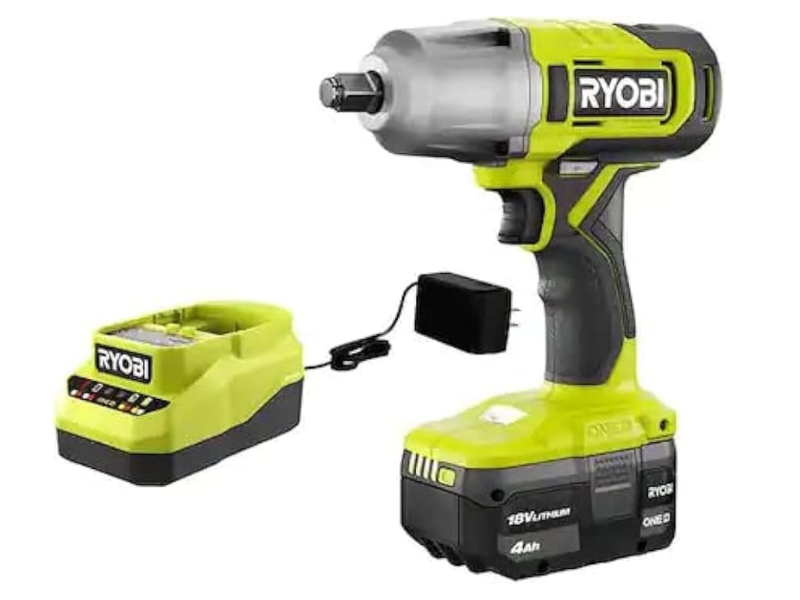
The RYOBI PCL265K1 takes a different approach than a bare tool sold purely on torque numbers. This is a complete kit, built around the 18V ONE+ platform, and it ships with a 4.0Ah battery and charger included. For someone who does not already own an 18V ONE+ battery, that changes the math considerably. You are not just buying a wrench, you are buying everything needed to start using it the same day it arrives.
Ryobi lists up to 375 ft-lbs of fastening torque for this model, with speeds up to 2,700 RPM and up to 3,100 IPM through a friction ring anvil. That puts it in a genuinely useful mid-range position: more capable than the entry-level PORTER-CABLE, but still well short of the high torque professional-class tools on this list, and it should be evaluated as such rather than compared directly against them. The variable speed trigger and LED work light add real usability, and on-board wrench storage is a small but practical convenience for anyone keeping the wrench in a truck or garage cabinet.
What makes this tool worth including is less about chasing a torque ceiling and more about the complete package. A battery, a charger, and compatibility with the broader ONE+ lineup of tools make this a sensible pickup for someone who is either just getting into cordless tools or already has a ONE+ drill, driver, or other tool sitting in the garage. That ecosystem angle is a real part of the value proposition here, separate from raw torque output. This is not the wrench to reach for if you are specifically chasing maximum torque for stubborn, high resistance fasteners, but as a mid-range automotive option with a complete kit, it holds up well.
Important features:
- 18V ONE+ platform
- 1/2 inch drive with friction ring anvil
- Up to 375 ft-lbs fastening torque
- Up to 2,700 RPM and up to 3,100 IPM
- Variable speed trigger and LED work light
- 4.0Ah battery and charger included
- On-board wrench storage
Pros:
- Complete kit with battery and charger included, ready to use out of the box
- Meaningful torque and speed for a mid-range automotive tool
- Fits into the widely used ONE+ ecosystem
- Strong value for someone building a garage tool collection
Cons:
- Falls well short of the high torque tools on this list
- Not intended for heavy duty or severely corroded automotive fasteners
- Buyers focused purely on maximum torque should look further down this list
Best for: Buyers who want meaningful mid-range power in a complete kit, especially those already invested in the RYOBI ONE+ ecosystem.
3. Milwaukee M18 FUEL 2967-20
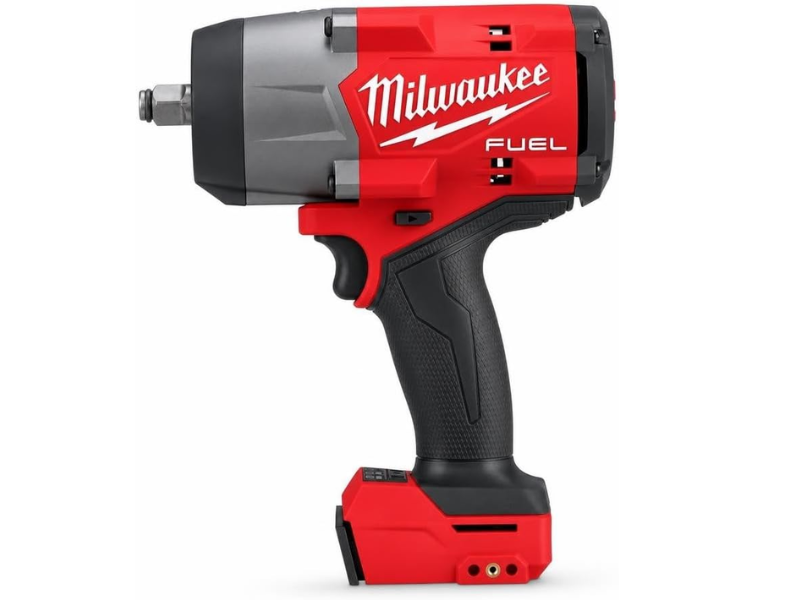
The Milwaukee 2967-20 is the performance leader in this comparison, and by a real margin. It uses Milwaukee’s brushless POWERSTATE motor and is rated for up to 1,200 ft-lbs of fastening torque and up to 1,600 ft-lbs of nut-busting torque, both of which are the highest published figures among the five wrenches in this guide. That said, these maximum numbers are associated with Milwaukee’s specified high-output M18 battery configuration, so they should not be read as a blanket claim that any M18 battery you happen to pair with the tool will produce the same output. The battery you run alongside this wrench is part of what determines how close you actually get to those ceiling figures.
REDLINK PLUS electronic intelligence and a 4-Mode DRIVE CONTROL system give this tool a level of flexibility that the more entry-level options on this list simply do not offer. You can dial the output down for more delicate work or open it up fully when you are dealing with something that has been rusted in place for a decade, and features like Auto Shut-Off and Bolt Removal Control are aimed squarely at preventing overrun or damage during automotive-specific tasks. Combined with a 0 to 2,000 RPM range and up to 2,400 IPM, this is a tool built with serious mechanical work in mind, not just occasional lug nut duty. Despite that power ceiling, Milwaukee kept the design reasonably compact, with a 7.6 inch length and a bare tool weight of 5.9 pounds, which keeps it manageable in tighter engine bay or undercarriage spaces where a bulkier high torque tool would be awkward to maneuver. Tri-LED lighting rounds out the feature set for working in low light conditions.
The tradeoff here is straightforward: this is a bare tool. There is no battery, charger, or case included, which is worth knowing before checkout if you are not already inside the M18 ecosystem. For someone doing regular automotive repair, suspension work, or anything involving fasteners that fight back, and who already owns or is willing to invest in M18 batteries, the capability on offer here is the strongest in this lineup.
Important features:
- Brushless POWERSTATE motor
- Up to 1,200 ft-lbs fastening torque
- Up to 1,600 ft-lbs nut-busting torque (with Milwaukee’s specified high-output M18 batteries)
- REDLINK PLUS intelligence with 4-Mode DRIVE CONTROL
- Auto Shut-Off and Bolt Removal Control
- 0 to 2,000 RPM, 0 to 2,400 IPM
- Tri-LED lighting
- 1/2 inch friction ring anvil
- 7.6 inches long, 5.9 pounds as a bare tool
Pros:
- Highest published torque figures among these five tools
- 4-Mode DRIVE CONTROL and automotive-specific safeguards offer real flexibility
- Reasonably compact and light for its power class
- Backed by Milwaukee’s widely adopted M18 battery ecosystem
Cons:
- Maximum torque figures depend on the specific M18 battery used
- Sold as a bare tool with no battery, charger, or case included
- Overkill for buyers who only need occasional light duty use
Best for: Buyers who need the strongest published torque in this lineup for serious automotive and mechanical work and already have, or are willing to invest in, the M18 battery platform.
4. DEWALT DCF900P1
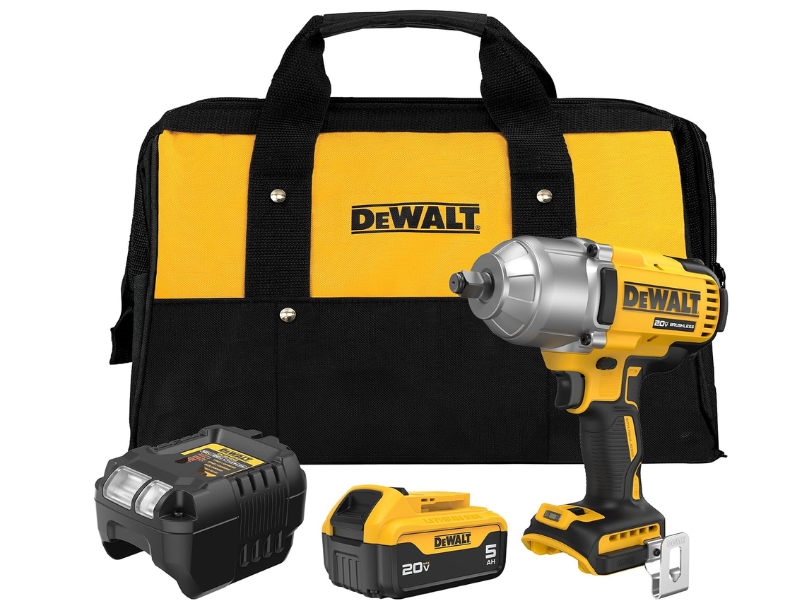
The DEWALT DCF900P1 remains one of the most capable complete kits in this lineup, even though it is no longer the highest torque option once the Milwaukee’s corrected figures are accounted for. DEWALT lists 1,030 ft-lbs of maximum fastening torque and 1,400 ft-lbs of maximum breakaway torque for this 20V MAX XR model, both of which are the manufacturer’s stated ceiling figures. The breakaway number in particular is worth framing accurately rather than dramatically. It is not a claim that this wrench will remove any bolt on any vehicle without effort, it is the published maximum figure for the kind of stuck or corroded fastener that breakaway torque is designed to address.
The brushless motor and 4-mode speed settings give you a way to modulate that power depending on the job, and the Precision Wrench control feature is aimed at reducing the risk of overtightening or damaging a fastener when you do not need the tool running at full output. This model comes as a genuinely complete kit, with a DCB205 5.0Ah battery, a DCB115 charger, and a kit bag included, which adds real value for someone who does not already own a 20V MAX battery. A 3-year limited warranty backs the purchase.
For someone doing occasional lug nut changes, this level of power and size is unnecessary. For someone regularly dealing with seized suspension hardware, heavy truck fasteners, or general high resistance automotive work, and who wants everything they need in one box rather than buying batteries separately, the DCF900P1’s combination of strong torque, complete kit, and useful control features is easy to justify.
Important features:
- Brushless motor, 20V MAX XR platform
- 1,030 ft-lbs maximum fastening torque
- 1,400 ft-lbs maximum breakaway torque
- 4-mode speed settings with Precision Wrench control
- 1/2 inch hog ring anvil
- DCB205 5.0Ah battery and DCB115 charger included
- Kit bag included
- 3-year limited warranty
Pros:
- Very strong torque figures and a genuinely complete kit
- Battery, charger, and bag included, ready to use out of the box
- 4-mode control and Precision Wrench control aid fastener-specific handling
- Backed by a 3-year limited warranty
Cons:
- No longer the highest torque tool in this comparison once the Milwaukee is factored in
- More power than most occasional users will ever need
Best for: Buyers who want a very powerful, ready to use kit for demanding automotive fasteners without having to source a battery and charger separately.
5. Makita XWT08T
The Makita XWT08T sits in a well-rounded middle ground and pairs strong torque with genuine speed control. It offers 740 ft-lbs of fastening torque and 1,180 ft-lbs of nut-busting torque, which is a meaningful step up from the PORTER-CABLE and RYOBI while staying below the Milwaukee and DEWALT figures. What sets it apart is the 3-speed power selection, with a listed range of 0 to 900, 0 to 1,000, and 0 to 1,800 RPM across those three settings, along with up to 2,200 IPM, giving the user more granular control across different types of fastening work than a single-speed or even a 2-mode tool would allow.
That control matters in practice. Being able to drop the tool into a lower speed setting for smaller or more delicate fasteners, then step up to full power for something seized, is a genuinely useful feature rather than a marketing checkbox. The brushless motor contributes to that flexibility by delivering efficient power across the speed range rather than just at the top end. Makita also builds this as a kit, and it is worth calling out specifically: the box includes two 18V LXT 5.0Ah batteries, not one, along with a rapid charger and a tool bag. That is a more generous kit than most competitors in this category offer, and it means less time waiting on a charger between jobs. At a listed 7.9 pounds with a battery installed, it stays reasonably manageable given its power class.
This is not the tool for someone chasing the absolute highest torque number available, and it is not the cheapest entry point either. What it offers instead is a well-rounded package for someone who wants strong torque, real speed control, and an unusually complete kit without stepping all the way up to a bare tool purchase.
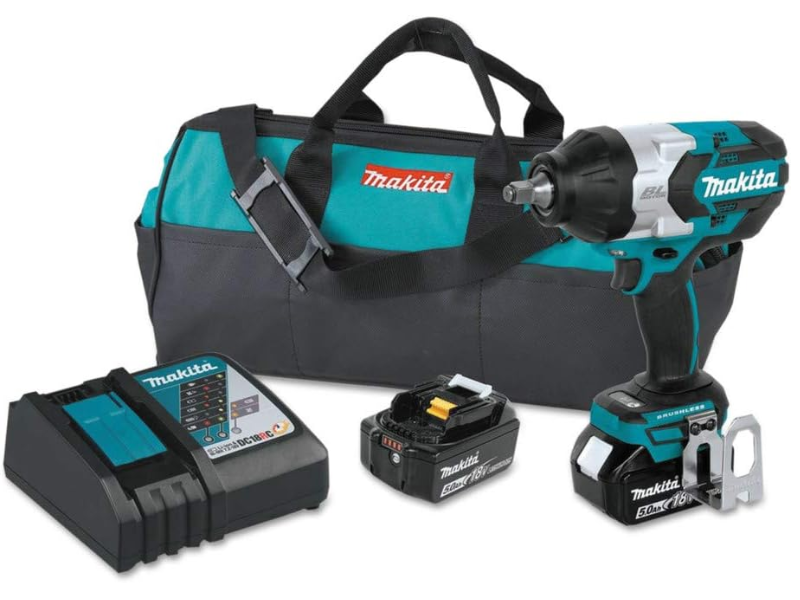
Important features:
- Brushless motor, 18V LXT platform
- 740 ft-lbs fastening torque, 1,180 ft-lbs nut-busting torque
- 3-speed power selection (0-900 / 0-1,000 / 0-1,800 RPM), up to 2,200 IPM
- 1/2 inch friction ring anvil
- Two 18V LXT 5.0Ah batteries, rapid charger, and tool bag included
- Listed weight of 7.9 pounds with battery
Pros:
- Strong balance of torque, speed, and control
- 3-speed selection allows real adaptability across different fasteners
- Kit includes two 5.0Ah batteries plus a rapid charger and tool bag, an unusually complete package
- Solid torque figures without stepping up to a bare tool purchase
Cons:
- Falls short of the Milwaukee and DEWALT torque figures
- Not the least expensive option for buyers on a tight budget
- Multiple speed settings mean a slightly steeper learning curve than a single-mode tool
Best for: Buyers who want a strong balance of power and control, along with an unusually complete kit, without going to the highest torque, bare tool end of the category.
What to Consider Before Buying
Torque
A torque figure tells you the ceiling of what a tool can theoretically do, but it should not be the only number you look at. Two tools with similar torque ratings can feel very different in practice depending on control features, speed settings, and how the tool delivers that power. Buying based purely on the biggest number on the box is one of the more common mistakes people make with this category of tool.
Breakaway vs Fastening Torque
Removing a stuck fastener is a different job than installing one. If you are regularly dealing with rusted or seized hardware, pay closer attention to breakaway or nut-busting torque figures rather than fastening torque alone, and remember that these numbers are not always directly comparable across brands or even across battery configurations within the same brand.
Drive Size
For automotive work, 1/2 inch drive is the practical standard. It is strong enough for lug nuts, suspension bolts, and most drivetrain hardware without needing to step up to a larger, heavier drive size meant for industrial or commercial use.
The right sockets are just as important as the impact wrench itself. If you are building a complete garage setup, see our guide to the Best Socket Sets for 2026.
Battery and Charger
Some of these tools come as complete kits with a battery and charger included, while others, like the Milwaukee 2967-20, are sold as bare tools that require a compatible battery purchased separately. If you do not already own batteries on a given platform, factor that additional cost into your decision rather than comparing sticker prices directly.
Brushless Motors
A brushless motor generally means more efficient power delivery and better runtime from the same battery capacity compared to an older brushed design. It is a worthwhile upgrade where available, though it is not the only factor that determines how a tool performs.
Speed and Impact Rate
Higher RPM and IPM numbers can speed up a job, but they are most useful when paired with real control, such as multiple speed settings or a responsive variable speed trigger. Raw speed without control can lead to overtightened or damaged fasteners just as easily as it saves time.
Size and Weight
A wrench that is difficult to hold steady for an extended period is going to slow you down no matter how much torque it produces. Pay attention to listed weight and length, especially if you expect to be working overhead or in tight spaces under a vehicle.
Control Modes
Multiple speed or power modes let you match the tool’s output to the job in front of you, rather than running everything at maximum output by default. This becomes more valuable the more varied your garage work tends to be.
Battery Ecosystem
If you already own cordless tools on a particular platform, staying within that ecosystem for your impact wrench means one less charger to keep track of and batteries that can be shared across tools. This is a real, practical form of value that does not show up in a torque spec sheet, and it becomes especially relevant with a bare tool purchase.
Automotive Application
The right wrench depends heavily on what you actually plan to do with it. Someone changing wheels a few times a year has very different needs than someone doing regular suspension or drivetrain work, and being honest with yourself about which category you fall into will save you from over or under buying.
Common Mistakes to Avoid
One of the most common mistakes is shopping by the single highest torque number without considering how that power is delivered or controlled. A tool with a huge torque ceiling and no speed modes can be harder to use safely than a lower torque tool with good control.
Ignoring weight is another frequent misstep. A tool that feels fine picked up off a shelf can become genuinely tiring after twenty minutes of overhead work, and that fatigue affects both the quality of your work and how safely you can hold the tool steady.
Buying a bare tool without realizing a battery and charger are not included is a surprisingly common frustration, especially for buyers new to a particular brand’s cordless lineup. Always check whether a listing includes a battery and charger before comparing price against a competing kit.
Choosing the wrong battery platform is easy to do if you shop purely on the wrench itself and ignore what tools you already own. If you have a garage full of one brand’s batteries, a wrench on a different platform means starting a new battery collection from scratch.
Assuming all impact wrenches are equally suitable for automotive work is another trap. Drive size, torque class, and control features all vary enough between models that a tool built for light household tasks is not automatically appropriate for suspension or drivetrain work on a vehicle.
Perhaps most importantly, using an impact wrench for final torque-critical tightening without a proper calibrated torque wrench is a real safety concern. Impact wrenches are excellent for breaking fasteners loose and for general assembly, but when a vehicle manufacturer specifies an exact torque value, particularly for wheels, suspension components, or anything safety related, that final step should be checked or completed with a calibrated torque wrench. Multi-mode or automotive-specific control features on a given tool can help reduce the risk of overtightening, but they are not a substitute for verifying final torque with a calibrated tool.
A well-equipped vehicle should also have basic emergency equipment for situations that have nothing to do with mechanical repairs. Our guide to the Best Portable Car Jump Starters for 2026 covers several practical options for roadside battery emergencies.
Finally, do not compare manufacturer torque figures across brands, or even across battery configurations for the same tool, as though they were all measured under identical laboratory conditions. Use them as a general guide to a tool’s power class rather than a precise, universally comparable number.
Final Verdict
These five wrenches are not interchangeable, and the right pick depends on what you are actually going to do with it. Once the specifications are correctly aligned, the Milwaukee 2967-20 has the highest published fastening and nut-busting torque figures among these five, making it the performance leader for stubborn, high resistance automotive fasteners, provided you are prepared to buy it as a bare tool and pair it with the appropriate M18 battery.
The DEWALT DCF900P1 remains extremely powerful in its own right and has the practical advantage of being a genuinely complete kit, with a battery, charger, and bag included, making it a strong choice for buyers who want serious torque without sourcing a battery platform separately.
The Makita XWT08T offers strong torque alongside excellent kit value and control, with two 5.0Ah batteries, a rapid charger, and a tool bag included, plus three-speed operation that adds real flexibility across different fastening jobs.
The RYOBI PCL265K1 is the more moderate option of the group, and it earns its place through a complete kit and access to the broad ONE+ ecosystem rather than through outright torque.
The PORTER-CABLE PCC740LA is aimed more squarely at routine garage and automotive work than maximum-output applications, and for a buyer who mostly needs help with lug nuts and light maintenance, that is exactly the right amount of tool.
There is no single correct answer here. There is a correct answer for your garage, your existing tool collection, and the kind of fasteners you actually deal with.
FAQ
What size impact wrench is best for automotive work?
A 1/2 inch drive is the standard choice for automotive applications, including lug nuts, suspension hardware, and most drivetrain bolts. It offers enough strength for these fasteners without the added bulk of larger industrial drive sizes.
How much torque do I need to remove lug nuts?
Lug nuts on most passenger vehicles can typically be handled by impact wrenches across a wide torque range, though a corroded or overtightened lug nut will benefit from higher breakaway torque. Checking your specific vehicle’s lug nut torque specifications is a good starting point before assuming any particular tool is sufficient.
Is a high-torque impact wrench necessary?
Not for every buyer. A high-torque tool like the Milwaukee 2967-20 or DEWALT DCF900P1 makes sense for regularly dealing with seized or heavy duty fasteners, but for routine lug nut changes and light maintenance, a more moderate tool like the PORTER-CABLE or RYOBI is often all that is needed.
Can an impact wrench remove lug nuts?
Yes, this is one of the most common uses for a 1/2 inch impact wrench, and any of the five tools in this guide are capable of handling typical passenger vehicle lug nuts.
What is the difference between fastening and breakaway/nut-busting torque?
Fastening torque describes how much force a tool applies while tightening a fastener. Breakaway, or nut-busting, torque describes how much force it can apply to loosen a fastener that is already tight or seized, which is often a higher figure since stuck hardware typically requires more force to break free than it did to install.
Do you still need a torque wrench if you have an impact wrench?
Yes. An impact wrench is excellent for removing fasteners and for general assembly, but it is not a precision tool for final torque values. A calibrated torque wrench remains necessary for torque-critical applications, particularly wheels and suspension components, regardless of how many control modes a given impact wrench offers.
Is a brushless impact wrench worth it?
Generally, yes. Brushless motors tend to offer better efficiency, more consistent power delivery, and improved runtime compared to older brushed designs, which matters over the life of the tool and across repeated use.