2026 Toyota Tundra Review: Toyota’s Long-Term Full-Size Strategy
A practical look at Toyota’s hybrid full-size pickup and how it performs in the real world.

2026 Toyota Tundra: The full-size truck market is crowded with heavy hitters. The Ford F-150 dominates sales charts. The Ram 1500 sets the standard for ride comfort. The Chevrolet Silverado offers endless configurations. And the 2026 Toyota Tundra? It sits quietly in the corner, doing things its own way. No V8 rumble. No class-leading tow numbers. Just a hybrid powertrain that delivers 437 horsepower, a coil-spring rear suspension that actually makes empty-bed driving tolerable, and a reputation for longevity that American brands simply cannot match.
The 2026 Toyota Tundra is not the flashiest truck in the segment. It is not the most powerful, the most luxurious, or the most capable on paper. But it might be the one you keep for 200,000 miles without a second thought. And for buyers who understand that value, that is worth more than any spec sheet claim.
Our Take
The 2026 Toyota Tundra is a competent, comfortable, and well-built full-size pickup that does almost everything well without excelling at any one thing. The hybrid i-Force Max powertrain delivers smooth, effortless power. The cabin is spacious and thoughtfully designed. The ride quality, thanks to the coil-spring rear suspension, is noticeably more civilized than leaf-spring rivals when the bed is empty. And the Tundra is the only full-size truck in its class to earn an IIHS Top Safety Pick designation.
But the Tundra lags behind competitors in maximum towing and payload capacity. Fuel economy, while improved, still falls short of EPA estimates in real-world driving. And the interior, while functional, cannot match the luxury of a top-trim Ram or the sheer variety of a Ford F-150.
For buyers who value long-term reliability, strong resale value, and a comfortable daily driving experience over class-leading specs, the 2026 Toyota Tundra is a compelling choice. It is the truck you buy when you plan to keep it for a decade.
Pros
- The i-Force Max hybrid produces 437 horsepower and 583 lb-ft of torque, with full torque available at just 2,400 rpm
- Coil-spring rear suspension delivers a noticeably smoother ride than leaf-spring rivals, especially with an empty bed
- Spacious, well-built cabin with intuitive controls and available 14-inch touchscreen
- Only full-size truck in its class to earn IIHS Top Safety Pick designation
- Toyota’s reputation for reliability and strong resale value is a genuine ownership advantage
- Available TRD Pro trim offers serious off-road capability with Fox shocks and an electronic locking rear differential
Cons
- Real-world fuel economy disappoints; observed averages often fall below EPA estimates
- Maximum towing of 11,175-12,000 pounds trails competitors like Ford and Ram
- Some interior plastics feel cheap relative to the price point
- No V8 option; the twin-turbo V6 sounds efficient rather than muscular
- Top trims push past $70,000, competing with better-equipped rivals
- Reports of engine debris issues in some 2026 models raise reliability questions
What’s New for the 2026 Toyota Tundra
The 2026 model year brings subtle refinements rather than wholesale changes. The Tundra remains in its third generation, which debuted in 2022. For 2026, a tow hitch with a 7/4 trailer harness pin is now standard across the board, as is a larger 32.2-gallon fuel tank. The Limited trim receives standard leather seat upholstery, and Double Cab models get HVAC vents on the rear console for better air distribution.
The TRD Pro trim gains a new eye-catching paint color called Wave Maker, a bright blue-raspberry hue that turns heads. The Capstone trim adds a new interior color theme, and the TRD Pro now features ISO dynamic seats borrowed from the Tacoma.
Mechanically, the Tundra remains unchanged. The twin-turbo 3.4-liter V6 and the i-Force Max hybrid carry over with the same output figures. The TRD Performance package, available on certain trims, adds 29 horsepower to the hybrid system through engine calibration and intake/exhaust modifications, bringing total output to 466 horsepower.
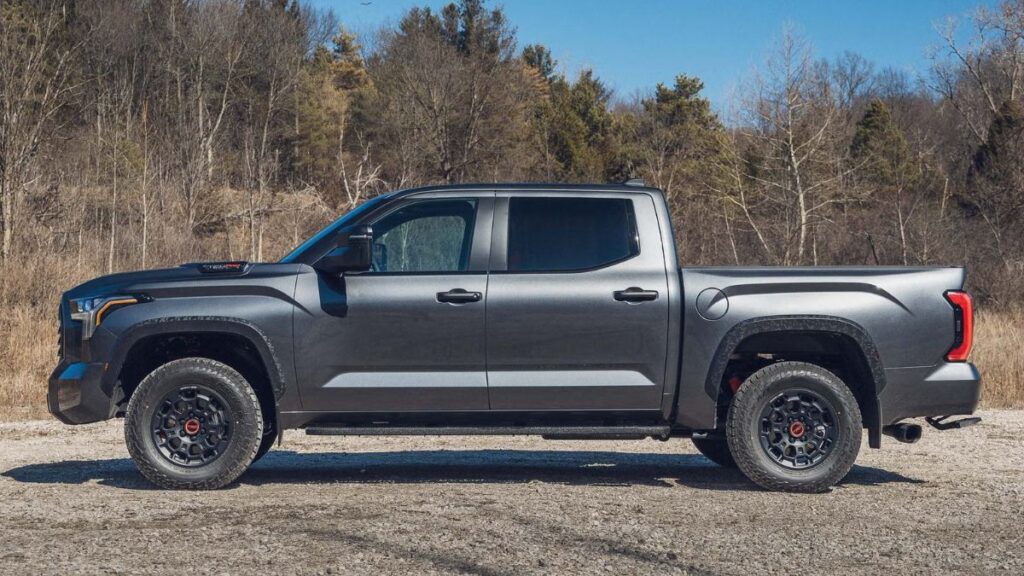
Exterior Design: Big, Bold, and Instantly Recognizable
The 2026 Toyota Tundra is a large truck that does not hide its size. The front end features a prominent grille that dominates the fascia, flanked by sharp LED headlights. The overall design is boxy and muscular, with a striking front-end shape that some describe as resembling a handlebar mustache.
TRD models add beefy accents with underbody skid plates and black wheels, while the TRD Pro’s Wave Maker paint ensures the truck stands out in any parking lot. The overall design is modern and purposeful, though it lacks the shouty graphics and logos found on some competitors.
Driving Experience: More Civilized Than You’d Expect
The 2026 Toyota Tundra is a truck that drives smaller than it looks. The coil-spring rear suspension, a rarity in the full-size segment, tames the typical truck ride harshness, especially when the bed is empty. On the highway, the Tundra feels planted and confident, with plenty of power available whenever needed.
The steering is well-weighted and responsive, and the 10-speed automatic transmission shifts smoothly. The hybrid system’s electric motor delivers instant thrust, giving the Tundra confident acceleration when merging onto highways or passing slower traffic. Independent testing shows the hybrid Tundra can reach 0 to 60 mph in roughly 5.7 seconds, impressive performance for a full-size off-road truck.
The TRD Pro suspension, with its Fox shocks, occasionally reminds you that the truck is tuned for rugged terrain rather than silky city pavement. But that firmness is part of what gives the TRD Pro its impressive off-road capability.
Performance and Acceleration: Hybrid Power, Not Fuel Savings
The 2026 Toyota Tundra offers two powertrain options. The base twin-turbo 3.4-liter V6 produces 389 horsepower and 479 lb-ft of torque on higher trims, with the entry-level SR detuned to 348 horsepower. The i-Force Max hybrid adds a 48-hp, 184-lb-ft electric motor between the engine and transmission, boosting total output to 437 horsepower and 583 lb-ft of torque.
The hybrid system is less about fuel savings than it is about torque and responsiveness. Full torque is available at just 2,400 rpm, making the Tundra feel effortlessly powerful in everyday driving. The TRD Performance package, available on select trims, adds 29 horsepower to the hybrid system through engine calibration and intake/exhaust modifications, bringing total output to 466 horsepower.
In testing, a TRD Pro with the Performance package reached 60 mph in 5.6 seconds and completed the quarter-mile in 14.2 seconds at 97 mph. The non-hybrid V6 is no slouch either, but the hybrid’s instant torque makes it the more satisfying engine to live with.
Ride Comfort and Cabin Refinement: Smoother Than Most
The coil-spring rear suspension is the Tundra’s secret weapon. It delivers a more comfortable and controlled ride than the leaf-spring setups found in the Silverado and F-150, particularly when the bed is empty. The Tundra absorbs bumps and road imperfections with a composure that rivals the Ram 1500, long considered the segment’s comfort champion.
The cabin is well-insulated, with wind and road noise kept to a minimum. The seats are supportive and comfortable, with available heating, ventilation, and massage functions on higher trims. The TRD Pro’s ISO dynamic seats, borrowed from the Tacoma, add an extra layer of comfort on rough terrain.
Rear passengers in the CrewMax configuration enjoy generous legroom and headroom, though the Double Cab is more cramped. The Tundra’s cabin is not the most luxurious in the segment—the Ram 1500 still holds that crown—but it is a comfortable and pleasant place to spend time.
Interior and Luxury Feel: Functional, Not Flashy
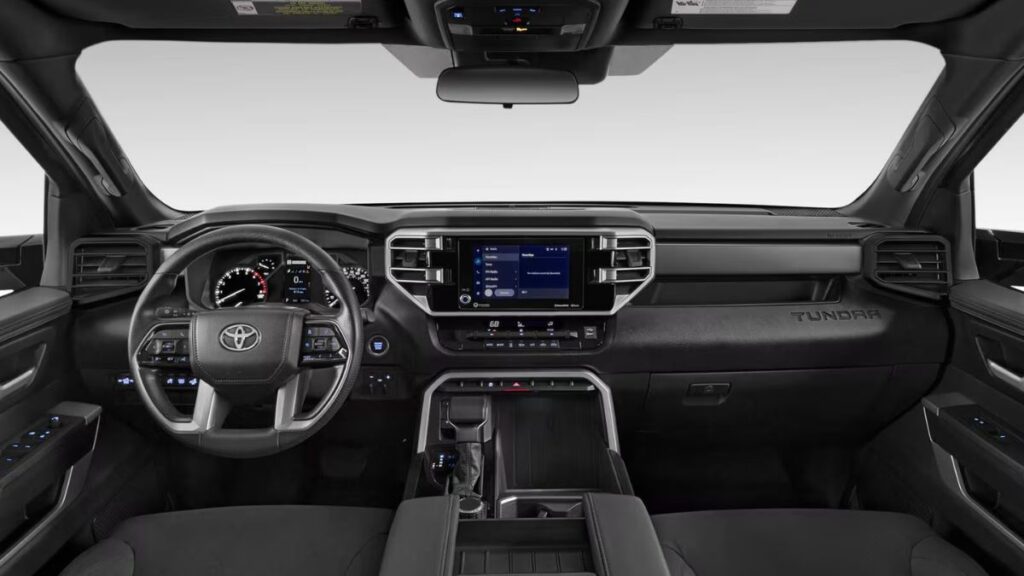
The 2026 Toyota Tundra’s interior is a study in practicality. The layout is clean and logical, with controls placed where you expect them. The available 14-inch touchscreen dominates the dashboard on higher trims, while the base 8-inch unit is adequate for basic needs.
Materials are generally good, with soft-touch surfaces on the dash and door panels. However, some interior plastics feel cheap relative to the price point, particularly on lower trims. The Limited trim and above add leather upholstery, while the Capstone trim offers near-luxury refinement with premium materials and distinctive styling.
Storage is generous, with a massive center console, deep door pockets, and a large glove box. The rear underseat compartment provides additional hidden storage, perfect for valuables or tools.
Technology and Infotainment: Intuitive and Responsive
The 2026 Toyota Tundra’s infotainment system is one of its strengths. The available 14-inch touchscreen features crisp graphics and responsive inputs, making it one of the most impressive interfaces in the segment. Wireless Apple CarPlay and Android Auto are standard on higher trims, along with wireless charging, ambient interior lighting, and a 12.3-inch digital gauge cluster.
The voice recognition system works well, even in noisy environments, and the built-in navigation provides clear directions with real-time traffic updates. Toyota’s decision to retain physical controls for climate and volume is a welcome touch, especially when driving on rough roads.
The digital instrument cluster and optional head-up display present vital information cleanly, keeping the driver’s focus on the road. The JBL premium audio system delivers deep, balanced sound across all seating positions.
Fuel Economy: The Numbers Don’t Tell the Whole Story
The EPA estimates for the 2026 Toyota Tundra hybrid are 19 mpg city, 22 mpg highway, and 20 mpg combined. The non-hybrid V6 is rated at 17-18 mpg city and 22-23 mpg highway.
In real-world driving, the numbers often fall short. Car and Driver observed only 19 mpg on their 75-mph highway test, while Consumer Guide reported an observed average of 16.7 mpg in mixed driving. The TRD Pro with the Performance package averaged 15 mpg over a test period.
The hybrid’s fuel economy advantage over the non-hybrid is marginal at best. The system adds power and smoothness, not efficiency. For buyers expecting significant fuel savings, the Tundra hybrid will disappoint.
Practicality and Cargo Space: Capable, but Not Class-Leading
The 2026 Toyota Tundra offers a maximum towing capacity of 11,175 to 12,000 pounds when properly equipped. That is sufficient for most recreational towing needs but trails the segment leaders. Payload capacity tops out at 1,600 pounds.
The composite bed is durable and resistant to dents, scratches, and corrosion. It includes tie-down points and an available 120-volt AC power outlet, useful for work sites, camping trips, or tailgating. The bed is available in various lengths depending on the cab configuration.
Inside the cabin, storage is generous, with a massive center console, deep door pockets, and a large glove box. The rear underseat compartment provides additional hidden storage for valuables or tools.
Safety and Driver Assistance: The Tundra’s Secret Weapon
The 2026 Toyota Tundra is the only full-size pickup truck in its class to earn an IIHS Top Safety Pick designation. In Crew Cab configuration, the Tundra earns a five-star overall safety score from the NHTSA.
All versions are equipped with Toyota Safety Sense 2.5, which includes front automatic emergency braking, lane keep assist, adaptive cruise control, road sign recognition, and automatic high beams. Higher-end models add blind-spot monitoring and rear cross-traffic alert with trailer coverage.
The Tundra’s safety credentials are a genuine advantage over competitors like the Ford F-150, Ram 1500, and Chevrolet Silverado, none of which meet the same safety standards.
Competitors Worth Considering
Ford F-150: The segment leader offers more powertrain choices, higher towing capacity, and the genius Pro Power Onboard system. The F-150 is the better choice for buyers who need maximum capability and variety.
Ram 1500: The Ram remains the comfort champion, with a more luxurious interior and a smoother ride. It is the better choice for buyers who prioritize cabin quality and refinement.
Chevrolet Silverado 1500: The Silverado offers the most bed options and a wide range of configurations. It is the better choice for buyers who need maximum versatility.
GMC Sierra 1500: The Sierra adds a layer of premium polish to the Silverado formula, with a more upscale interior and distinctive styling.
2026 Toyota Tundra: The Tundra is the best choice for buyers who prioritize long-term reliability, strong resale value, and safety. It is the truck you buy when you plan to keep it for a decade.
Biggest Strength and Biggest Weakness
Biggest Strength: The 2026 Toyota Tundra’s greatest asset is its combination of reliability, safety, and long-term value. Toyota trucks routinely outlast their American rivals, and that is worth real money over a decade of ownership. The Tundra is the only full-size truck in its class to earn an IIHS Top Safety Pick designation, and its resale value is among the best in the segment. For buyers who plan to keep their truck for the long haul, the Tundra is the smart choice.
Biggest Weakness: The Tundra’s biggest weakness is its mediocrity in key metrics. It cannot match the towing and payload capacities of its rivals. Its fuel economy, especially in real-world driving, is disappointing. And its interior, while functional, cannot match the luxury of a top-trim Ram or the sheer variety of a Ford F-150. The Tundra is a competent all-arounder that excels at nothing except longevity.
Which Trim Does Cardrav Recommend?
Cardrav recommends the SR5 trim for most buyers. It offers the best blend of features, capability, and price. The SR5’s twin-turbo V6 puts out 41 more horsepower than the base SR, and it brings alloy wheels, a tow/haul drive mode with a trailer-brake controller, and access to safety tech beyond the standard Toyota Safety Sense 2.5 suite.
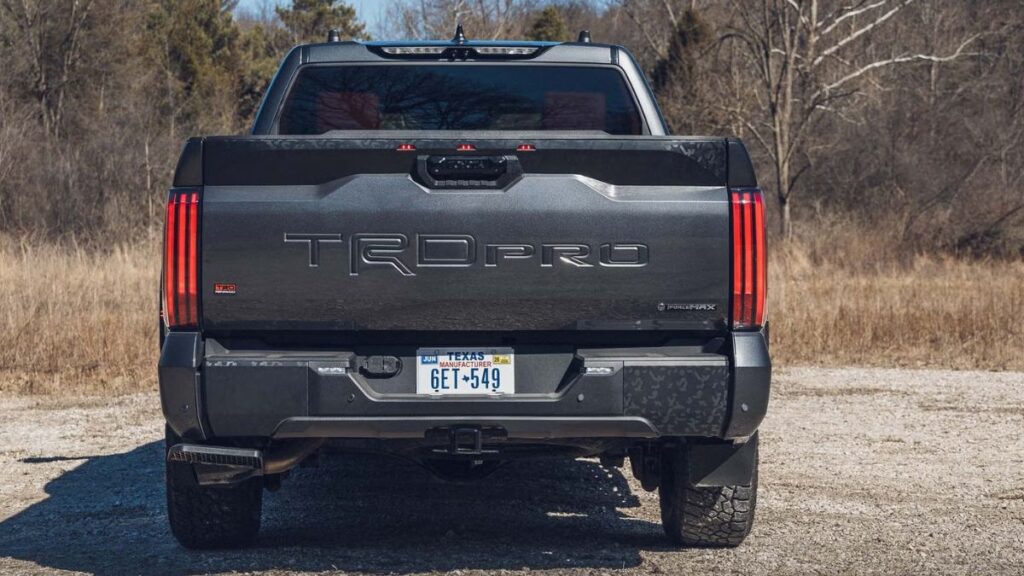
For buyers who want the hybrid powertrain, the Limited trim is the entry point. The TRD Pro is for serious off-road enthusiasts, with Fox shocks, an electronic locking rear differential, and multi-terrain select. The Capstone is the luxury flagship, with premium materials and near-luxury refinement.
Final Verdict: Should You Buy the 2026 Toyota Tundra?
Who should buy it: Buyers who prioritize long-term reliability and resale value over class-leading specs. Those who want a comfortable, well-built truck that is easy to live with every day. Buyers who value safety—the Tundra is the only full-size truck in its class with an IIHS Top Safety Pick designation.
Who should avoid it: Buyers who need maximum towing or payload capacity. Those who want the most luxurious interior or the most advanced technology. Buyers who expect significant fuel savings from the hybrid powertrain. Those who want a V8 sound and character.
The 2026 Toyota Tundra is not the best truck in any single category. It is not the most powerful, the most luxurious, or the most capable. But it might be the smartest choice for buyers who plan to keep their truck for the long haul. It is a truck that plays the long game. And in a segment obsessed with spec sheet bragging rights, that counts for something.
FAQ
Is the 2026 Toyota Tundra a reliable truck?
The Tundra has a strong reputation for reliability, but the 2026 model has faced some concerns. Some owners have reported engine debris issues, with metallic flakes found in oil filters after just 3,800 miles. Consumer sentiment is mixed, with 57% of owners recommending the vehicle. Some reviewers report quality and reliability issues such as noisy brakes, misaligned doors, clunking seats, and electrical problems. The 2026 Toyota Tundra has not been recalled for powertrain issues, but buyers should be aware of these reports.
How does the 2026 Toyota Tundra compare to the Ford F-150?
The Ford F-150 offers more powertrain choices, higher towing capacity, and the Pro Power Onboard system. The Tundra counters with a coil-spring rear suspension for a smoother ride, a more refined hybrid system, and superior safety credentials as the only full-size truck with an IIHS Top Safety Pick designation. The F-150 is better for maximum capability; the Tundra is better for long-term reliability and safety.
What is the fuel economy of the 2026 Toyota Tundra?
The EPA estimates for the hybrid are 19 mpg city, 22 mpg highway, and 20 mpg combined. The non-hybrid V6 is rated at 17-18 mpg city and 22-23 mpg highway. In real-world driving, observed averages often fall below EPA estimates. Car and Driver observed 19 mpg on the highway, while Consumer Guide reported 16.7 mpg in mixed driving. The TRD Pro with the Performance package averaged 15 mpg.
How much does the 2026 Toyota Tundra cost?
The 2026 Toyota Tundra starts at $41,260 for the SR Double Cab Short Bed. The SR5 starts at $46,510. The Limited starts at $54,860. The top Capstone trim starts at $80,800. Prices exclude destination charges and options.
Does the 2026 Toyota Tundra have a hybrid option?
Yes, the i-Force Max hybrid is available on Limited, Platinum, 1794 Edition, TRD Pro, and Capstone trims. It combines a twin-turbo 3.4-liter V6 with a 48-hp electric motor for a total output of 437 horsepower and 583 lb-ft of torque. The hybrid is not available on the entry-level SR and SR5 trims.
Is the 2026 Toyota Tundra safe?
Yes. The 2026 Toyota Tundra is the only full-size pickup truck in its class to earn an IIHS Top Safety Pick designation. In Crew Cab configuration, it also earns a five-star overall safety score from the NHTSA. All versions are equipped with Toyota Safety Sense 2.5, which includes front automatic emergency braking, lane keep assist, adaptive cruise control, road sign recognition, and automatic high beams.