2023 Silverado 1500 Review: Honest Full-Size Truck
The 2023 Chevrolet Silverado 1500 review reveals a truck that's quietly becoming the thinking buyer's alternative to the Ford F-150 and Ram 1500.

2023 Chevrolet Silverado 1500 Review: The full-size pickup market has become a theater of absurdity. Every truck claims to ride like a Cadillac, handle like a sports car, and deliver fuel economy like a hybrid. They all lie. The 2023 Chevrolet Silverado 1500 doesn’t bother with the performance. It builds a truck for people who use trucks, then gets out of the way.
That sounds simple. It isn’t. Because while Ram is chasing luxury and Ford is chasing technology, Chevy’s out here making practical decisions. The diesel engine picked up 28 horsepower and 35 pound-feet of torque, pushing it to 305 hp and 495 lb-ft. Not because it needed to dominate dynamometer charts, but because people actually tow with these trucks. The infotainment now runs Google services. Not because Google is fashionable, but because it works better than proprietary nonsense. These choices reveal Chevy’s actual philosophy: let the competitors chase headlines. Build something that functions.
Whether that philosophy resonates with you depends entirely on what you’re shopping for. The F-150 offers more capability. The Ram offers more comfort. The Tundra offers Toyota’s reliability halo. The Silverado offers something increasingly rare: a truck that knows exactly what it is and doesn’t pretend otherwise.
Four engines. Four different purposes. The 2.7-liter turbo (310 hp, 430 lb-ft) for buyers who appreciate efficiency without sacrifice. The 5.3-liter V8 (355 hp) for those who want familiar, proven power. The 6.2-liter (420 hp) for people who’ve decided that fuel economy is someone else’s problem. The diesel (305 hp) for highway warriors who actually do the math. Pick one. Live with your choice. That’s the Silverado way.
Our Opinion
The Silverado is built by engineers who understand the actual job. Not marketing people. Not design consultants. Engineers who know what a crew cab interior should feel like, what storage actually solves, and how suspension tuning affects towing stability. You can sense that philosophy every time you open the door.
The interior genuinely surpasses the F-150 and Ram 1500 in practical space. That’s not marketing hyperbole. The crew cab rear legroom accommodates real people for real distances. Storage solutions scatter throughout the cabin in places where you actually need them, not where designers decided they looked good. The driving position is logical, the controls intuitive. You don’t wrestle the truck. Most manufacturers should study this cabin.
But here’s where Chevy loses. The perception war. Ford controls the narrative. Ram sold a lifestyle fantasy and buyers believed it. Chevy makes a genuinely capable truck and people shrug. The disconnect would be funny if it didn’t matter for resale value and owner satisfaction. The updated diesel proves Chevy’s engineering team is serious. The Google integration actually solves problems instead of creating them. The warranty is competitive. These are strengths that should matter more than they do, and they’re often overlooked because the Silverado refuses to shout about itself.
The suspension demands honesty. Chevy selected firmness. Excellent body control during towing. Rock-solid platform during cornering. The cost? Rough roads become aggressively communicative. Cracked asphalt, pothole impact, expansion joint jolts. None of that is subtle. Larger wheels amplify everything. Some owners embrace this. Others regret the purchase. There’s genuine middle ground. This is the truck’s fundamental tradeoff, and Chevy owns it deliberately.
The electrical issues scattered through owner forums aren’t catastrophic, but they’re real. Transmission hesitation shows up. The fuel tank is notably small, which contradicts the truck’s work identity. Premium fuel with the 6.2L V8 compounds operating costs in ways daily driving reveals.
Pros and Cons
Strengths
- Interior space and ergonomics lead the segment; visibility is genuinely excellent
- Updated 3.0-liter diesel adds real power without sacrificing efficiency
- Google-integrated 13.4-inch touchscreen is intuitive and responsive
- All trims come standard with comprehensive safety suite (automatic emergency braking, forward collision alert, pedestrian detection)
- Eight-speed transmission delivers smooth, predictable shifts
- Towing capacity reaches 13,300 pounds when properly equipped
- High-quality material selection on upper trims; trim levels offer real choices
- Multi-Flex tailgate provides genuine utility without gimmicks
Weaknesses
- Suspension tuning creates harsh ride quality on rougher roads, especially with larger wheels
- Fuel economy lags competitors with smaller turbo engines in everyday driving
- 6.2-liter V8 requires premium fuel, pushing operating costs higher
- Infotainment system requires learning curve; wireless CarPlay can disconnect unexpectedly
- Transmission hesitation and electrical issues reported by owners across forums
- Styling hasn’t fundamentally changed since 2019; interior looks dated next to new F-150
- Limited availability of higher-performance powertrains (6.2-liter) on popular configurations
- Smaller fuel tank means more frequent fill-ups than competitors
What’s New for 2023
The diesel matters. Chevy added 28 horsepower and 35 pound-feet of torque, and you feel the difference immediately during merging and grade climbing. It’s not dramatic. It’s competent. The truck pulls with more authority, tows with more confidence. For people who actually accumulate diesel miles, this update makes the engine worth the premium. Highway cruising rewards the choice with fuel economy that competes with hybrid marketing claims. The mathematics flip only when you calculate diesel fuel costs. That’s the honest trade Chevy makes available.
The infotainment matters more. Google integration doesn’t sound revolutionary until you actually use it. Apple Maps and Google Maps work natively. Voice commands understand English instead of demanding robotic phrasing. Apps download directly to the truck. Over-the-air updates arrive without dealer visits. The 13.4-inch touchscreen on most trims finally feels current. The seven-inch on base models serves its purpose but underscores the value proposition between trim levels.
Safety systems arrived standard across the board, which is the right call. Automatic emergency braking, collision alert, pedestrian detection, lane assist. Chevy doesn’t gate fundamental protection behind option packages. That’s engineering leadership disguised as standard features.
Exterior Design
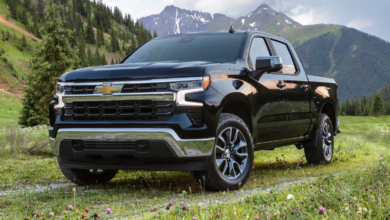
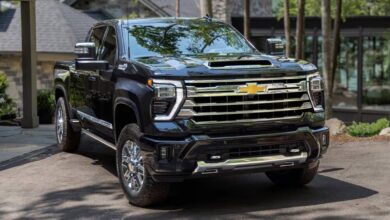
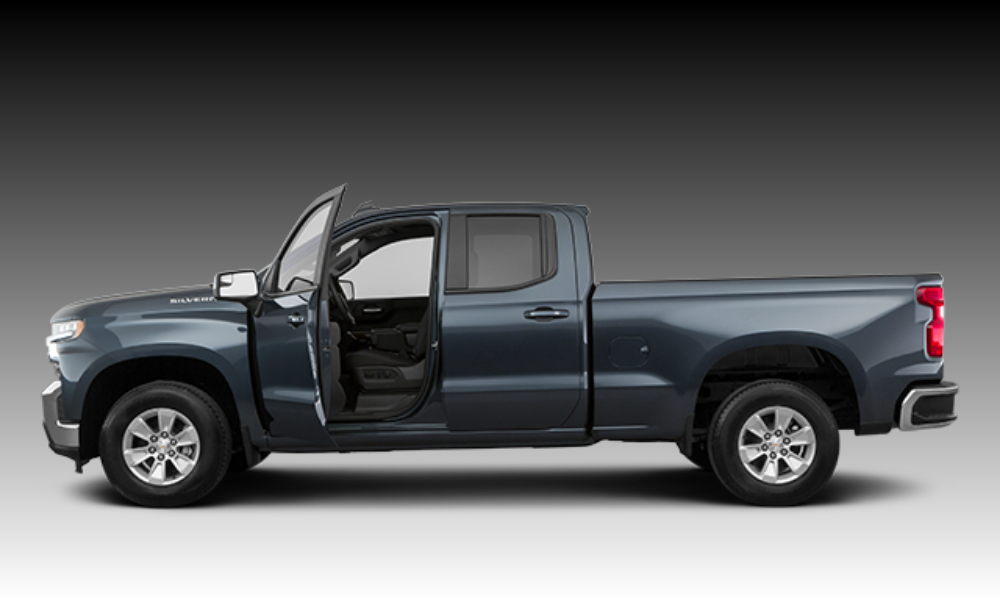
Chevy preserved the body for 2023. The decision reveals philosophy. The design has aged decently, which isn’t the same as aging well. The proportions suggest capability without announcing it. The LED headlights with their S-curve signature work. The hood geometry reads powerful. The body side character lines avoid gimmickry. It’s functional design that knows what it is.
The comparison question answers itself immediately. The F-150’s latest generation looks noticeably more modern, a transformation Chevy elected not to pursue. Ram’s interior redesign makes the Silverado feel like it’s from an earlier era. The Tundra’s styling remains polarizing at best. The Silverado simply doesn’t offend. It also doesn’t seduce. For buyers treating a truck as equipment, that’s acceptable. For those shopping on visual presence, it matters.
Practical elements scatter without pretense. Power-sliding rear windows. Spray-in bedliners. The Multi-Flex tailgate that offers three configurations depending on loading needs. The feature set speaks to actual usage patterns rather than feature lists. Wheel options range from sensible steel to unnecessary 20-inch alloys. Paint selections include the genuinely attractive Deep Ocean Blue. The rest are safe, forgettable choices.
Driving Experience
Step into the Silverado and Chevy’s design priorities announce themselves. The steering is responsive without wandering, weighted appropriately without feeling heavy. The truck tracks straight on the highway without the constant minor corrections that plague less precise platforms. Brake pedal feedback is firm and informative, giving you genuine sense of what’s happening. You’re not fighting the truck. That matters more than it should in a market dominated by numb, isolated driving experiences.
The eight-speed transmission works hard to disappear, and mostly succeeds. Shifts are smooth, nearly imperceptible during normal driving. That’s the entire point of eight-speed engineering, and Chevy executes it. The alternative would be the transmission announcing itself constantly, a problem that plagues too many trucks at this price point.
The suspension is where Chevy makes its stand. Firmness. Not softness masquerading as comfort. On broken pavement, that choice becomes obvious. Expansion joints announce themselves. Potholes demand attention. Cracked asphalt communicates directly. Larger wheels exacerbate everything. Some drivers recognize this as excellent body control and superior towing stability. Others see it as unnecessary harshness. Both interpretations are correct. Chevy prioritized work capability over highway insulation, and the suspension tuning reflects that choice deliberately and completely. You need to know which side of that equation you stand on before signing paperwork.
Parking a truck this size shouldn’t be easy. The steering radius proves it can be. Visibility is genuinely excellent. The windshield is large. Side mirrors function properly. The tailgate doesn’t obstruct rearview. You possess actual spatial awareness of where this truck occupies space. Highway driving at 70 mph reveals wind noise that’s noticeable but not intrusive.
Off-road, the ZR2 trim transcends the normal Silverado. Full-time four-wheel drive, electronic lockers, disconnecting sway bar. It surprises people expecting a tame truck. Regular trims handle occasional dirt and rock competently, though the suspension’s work focus doesn’t translate to trail performance.
Performance and Acceleration
The 2.7-liter turbo four is the revelation. Three hundred ten horsepower and 430 pound-feet arriving at 1,500 RPM means the truck responds immediately. The acceleration surprises drivers accustomed to V6 trucks offering less drama. Real-world towing of six-thousand-pound trailers feels confident even on grades, though staying below the 9,500-pound official rating demonstrates respect for component limits. Fuel economy runs fifteen to seventeen mpg in city driving, twenty to twenty-six highway depending on driving patterns. That’s honest efficiency without pretense.
The 5.3-liter V8 represents the known quantity. Three hundred fifty-five horsepower, 383 pound-feet. Power delivery is exactly what a V8 should feel like: immediate, smooth, abundant. This engine earned its reputation across millions of trucks. EPA estimates of 19-21 mpg combined prove achievable on highway driving. City dynamics pull those figures lower. The engine works.
The 6.2-liter V8 is the performance statement. Four hundred twenty horsepower, 460 pound-feet. Zero-to-60 acceleration feels commanding for a truck this size. The truck pulls with a sense of authority that rivals vehicles costing substantially more. The compromise is brutal and unambiguous: premium fuel mandatory, fuel economy dropping to fifteen to seventeen mpg combined. This engine makes sense exclusively for buyers who’ve decided that performance trumps operating economics.
The 3.0-liter Duramax diesel is the efficiency play that actually delivers. Three hundred five horsepower, 495 pound-feet. Highway mileage regularly exceeds twenty-five mpg, with owners consistently hitting twenty-eight to twenty-nine mpg on Interstate runs. The mathematics complicate when diesel fuel costs more per gallon than gasoline. Run the numbers for your actual driving patterns before assuming diesel automatically saves money. The updated power output justifies the platform choice for genuine highway warriors.
All engines pair with the eight-speed transmission. That transmission is the hero here. It maintains seamless power delivery across the entire driving range. It disappears. That’s engineering success.
Ride Comfort and Cabin Noise
The interior layout proves thoughtful. Frequently used controls position themselves logically. The steering wheel adjusts horizontally and vertically, providing genuine positioning flexibility. Upper trim seats include power adjustments and integrated heating. Climate-controlled seats on LT trim and above represent legitimate luxury. These aren’t marketing flourishes. They’re functional features that accumulate into genuine comfort.
Noise isolation is competent without being exceptional. Wind noise at 70 mph registers as noticeable rather than intrusive. Engine noise filters through appropriately. The diesel generates more mechanical clatter, a characteristic some drivers interpret as character and others find tiresome. It depends entirely on your philosophical stance toward turbodiesel engines.
The suspension firmness is uncompromising. Chevy selected a specific mission and executed it completely. The trade is genuine and unambiguous. You gain excellent body control during towing and superior stability during cornering. The cost is ride quality that won’t satisfy buyers prioritizing highway comfort. Expansion joints announce themselves. Potholes demand acknowledgment. Cracked asphalt communicates. Buyers shopping for soft, insulated highway cruising will discover frustration. Buyers focused on work capability will recognize the tuning as appropriate. This isn’t a design flaw. It’s an intentional choice with clear consequences.
Climate control operates without drama. The dual-zone system on upper trims allows independent driver and passenger temperature settings. Rear seat passengers receive their own controls on crew cab configurations. Heating performance is strong in winter climates. Air conditioning response is quick in heat. No complaints register here.
Interior Design and Materials
The cabin represents thoughtful material strategy. Upper trims embrace genuine leather and soft-touch surfaces rather than the hard plastic approach that dominates budget segments. Base cloth upholstery balances durability and appearance acceptably. The interior executes its design brief without pretension.
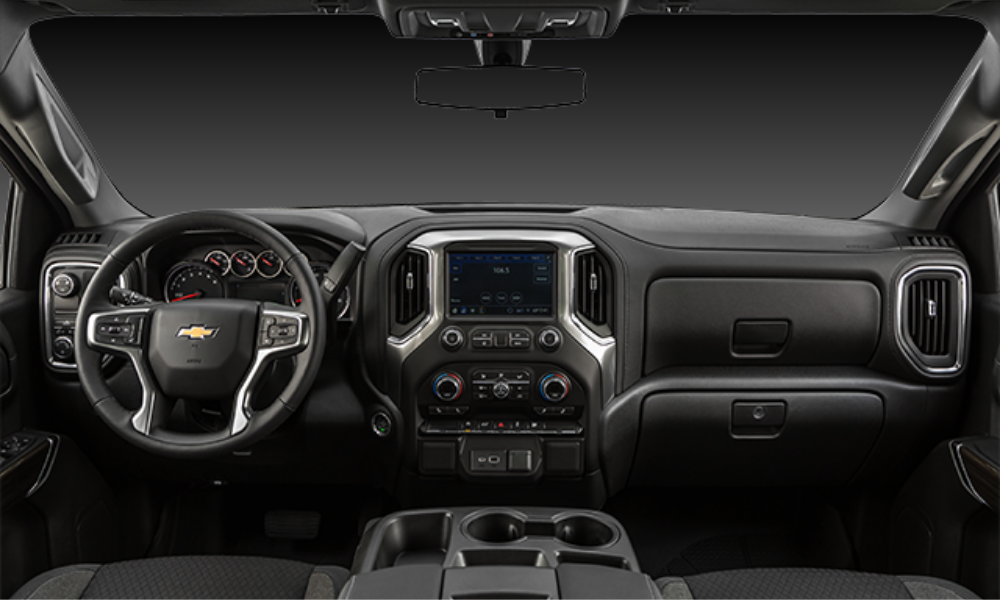
The dashboard employs horizontal geometry that mirrors the truck’s exterior design language. The digital gauge cluster is sizeable and legible, offering customizable displays. The 13.4-inch touchscreen dominates the center stack. Google integration is the critical advantage here. Unlike proprietary infotainment systems that feel isolated from genuine user experience, the Silverado actually understands voice commands and learns preferences if you maintain a Google account. The platform delivers practical functionality.
Storage solutions demonstrate genuine design thinking. The center console provides multiple compartments and a standard power outlet for device charging. Under-seat rear storage addresses practical organization without marketing theatrics. Door panels include adequate cupholders and map pockets that don’t feel like afterthoughts. The design acknowledges actual usage patterns.
Rear seat configuration depends on cab choice. Regular cabs provide no rear seating. Double cabs offer minimal rear seating suitable for short trips. Crew cab rear seats provide genuine accommodation for four adults on regular drives. Headroom and legroom accommodate average-sized passengers adequately.
The missing element is a head-up display. Ford offers this across its lineup. Chevy restricts it to specific configurations. That’s a tangible disadvantage in driver interface modernization, particularly for buyers evaluating technological leadership.
Technology and Infotainment
Google Maps integration proves genuinely useful. Apple Maps and Google Maps function exactly as they do on your phone. Voice commands understand natural language instead of demanding specific speech patterns that sound robotic. The experience feels modern and functional. That’s the improvement Chevy’s platform delivers over previous generations.
Wireless Apple CarPlay and Android Auto connectivity works reliably most of the time. Occasional disconnections require restart, a known wireless systems issue that transcends the Silverado. It’s worth acknowledging as a reality rather than pretending it doesn’t occur.
The seven-inch touchscreen on base models serves its function adequately without inspiring. The 13.4-inch screen on higher trims provides genuine visual real estate. Menu structure is logical. Font sizes remain readable while driving. Haptic feedback from button presses is responsive and informative.
Software maturity remains incomplete. Glitches appear in owner forums with regularity suggesting they’re not anomalies. Infotainment freezes requiring restart happen. Google Maps occasionally hesitate to load when they should be instantaneous. These aren’t daily frustrations that destroy ownership experience, but they exist as reality. The system works most of the time in ways that matter. It stumbles occasionally in ways that don’t.
Chevy OnStar arrives standard, providing emergency assistance and remote vehicle features through a smartphone app. Remote locking, fuel level checking, engine start capability, and roadside assistance requests are all available. The first month is complimentary. Ongoing service requires subscription.
Audio systems range from six-speaker adequacy to Bose premium systems that deliver genuine aural improvement. The Bose platform offers excellent bass response and clear midrange reproduction. It’s worth the upgrade if audio quality factors into your priority weighting.
Fuel Efficiency
The Silverado doesn’t lead fuel economy rankings. That’s the honest assessment that separates editorial credibility from marketing enthusiasm. The F-150 EcoBoost delivers better mileage. It’s factual. It matters.
The 2.7-liter turbo four delivers the best Silverado numbers. EPA estimates of seventeen city/twenty-two highway/nineteen combined represent reality for rear-wheel drive configurations. Real-world testing shows owners achieving fifteen to seventeen mpg in city driving and twenty to twenty-six highway depending on driving patterns and conditions. Those estimates prove consistent.
The 5.3-liter V8 rates at sixteen city/twenty highway/eighteen combined for rear-wheel drive, declining modestly with four-wheel drive. This puts it directly competitive with F-150 EcoBoost, though the Ford often achieves marginally better numbers in real ownership. The V8 represents proven reliability across millions of trucks, a characteristic that transcends dynamometer results.
The 6.2-liter V8 achieves fifteen city/nineteen highway/sixteen combined, which is acceptable for 420 horsepower but nothing to celebrate. Premium fuel is mandatory, which compounds the cost of ownership through daily driving patterns.
The 3.0-liter diesel wins the efficiency narrative. EPA estimates of twenty-two city/twenty-seven highway/twenty-four combined are genuinely achievable, and highway-focused driving regularly exceeds those figures. Some owners consistently achieve twenty-eight to twenty-nine mpg on extended Interstate runs. The mathematics complicate when diesel fuel prices exceed gasoline costs per gallon at your local market. Run the actual numbers for your driving pattern before assuming diesel automatically saves money.
The fuel tank capacity of twenty-six gallons is notably small for a full-size truck. That means frequent fill-ups despite decent mileage, a minor annoyance that compounds on long road trips.
Practicality and Storage
The Silverado excels at pragmatic cargo solutions. Three bed lengths address different missions. The five-foot-eight works effectively on crew cabs, maintaining manageable overall length in parking situations. The six-foot-six represents the Goldilocks option, providing genuine cargo capacity without excessive overhang penalty. The eight-foot bed serves serious hauling and trailer applications, though parking complexity increases correspondingly.
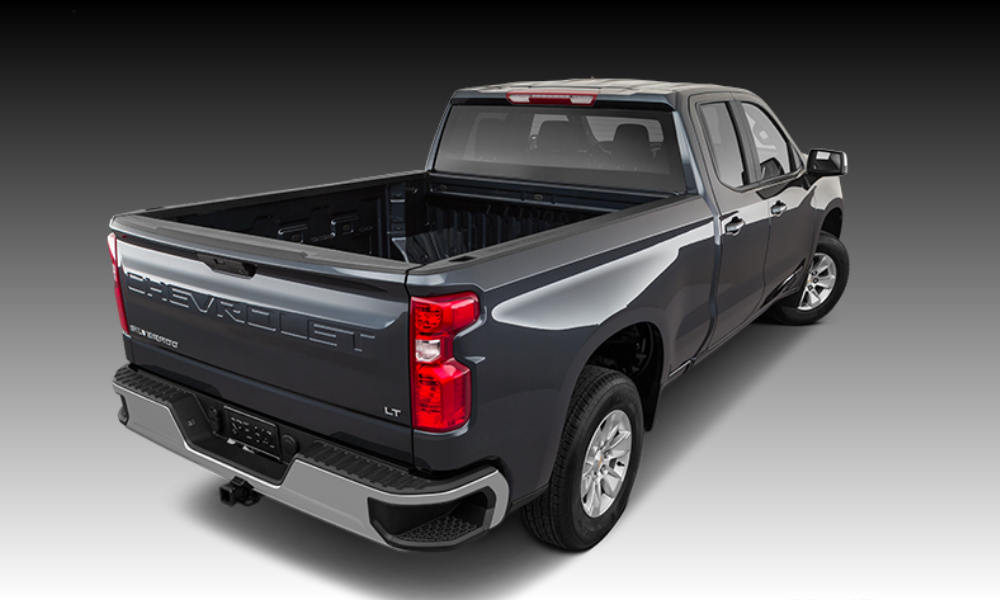
Bed features prove functional. Twelve tie-down cleats integrated into the bed provide genuine securing points rather than the afterthought approach competitors employ. The spray-in bedliner makes sense if you plan to haul rough materials. The powered rear window slides open for cab ventilation or easier bed access when the tailgate remains closed.
The Multi-Flex tailgate is clever engineering disguised as practical design. It drops conventionally, slides out fully to provide side-access loading, or swings open ninety degrees for bed-side work. Most owners never discover this functionality because Chevy’s marketing doesn’t amplify it. When the need arises, the design proves genuinely useful.
Under-seat crew cab storage accommodates smaller items adequately. Rear seat backs fold forward on double cabs, conceptually extending bed length. That’s more useful in marketing presentations than actual usage patterns.
Cabin storage includes a 4.7-gallon center console, front door pockets, and under-seat compartments on crew models. An overhead bin stores sunglasses and miscellaneous items. The storage philosophy is thoughtful without approaching obsessive.
Safety and Driver Assistance Systems
Chevy’s Safety Assist suite arrives standard on every Silverado 1500, a decision that reveals engineering priorities. The included features encompass Forward Collision Alert with Automatic Emergency Braking, Following Distance Indicator, Lane Keep Assist with Lane Departure Warning, Front Pedestrian Braking, and IntelliBeam automatic high-beam control. This baseline surpasses what some competitors offer as standard, which deserves explicit acknowledgment.
The automatic emergency braking function represents genuine safety technology. It can apply full braking force if imminent collision is detected. Real-world testing validates effectiveness at preventing low-speed accidents. This isn’t theoretical safety. It’s functional protection.
Blind spot monitoring, rear cross-traffic alert, and trailer side blind zone alert are available on higher trims. The trailer blind zone feature addresses a genuine limitation that trailers create. Trailers produce visibility challenges that mirrors and standard positioning can’t adequately address. This feature solves that problem.
Available safety technology includes 360-degree surround-view camera systems, head-up display capability on select configurations, and adaptive cruise control. The camera system provides a bird’s-eye view of the truck, genuinely aiding parking in confined situations. The head-up display projects critical information onto the windshield, keeping your visual focus on the road rather than the dashboard.
The truck’s structure includes ten airbags distributed across all seating positions. NHTSA testing results are respectable rather than exceptional. JD Power metrics rank the Silverado second in its segment for overall dependability, a position that indicates competence without superiority.
Worthy Competitors
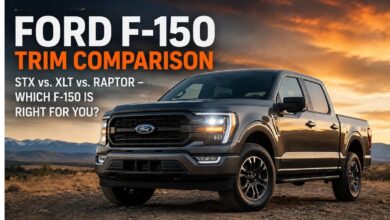
The Ford F-150 remains the segment benchmark, and for good reason. Better towing capacity ceiling (14,000 pounds with proper configuration). Better real-world fuel economy from EcoBoost engines. Newer design that reads more contemporary. Infotainment systems that feel more polished. The Silverado’s advantage? Superior interior space and a more comprehensive standard safety suite. The F-150 controls the narrative because it controls the market position. That matters regardless of spec sheets.
The Ram 1500 delivers the smoothest ride experience. The optional air suspension provides genuine comfort advantages on extended highway drives. The design registers as more sophisticated. The interior feels more upscale on comparable trim levels. The Silverado outperforms Ram on practicality and storage solutions. Ram outperforms Silverado on the subjective “feel” that brand positioning emphasizes.
The Toyota Tundra appeals to reliability-conscious buyers and those seeking alternative powertrains. The turbocharged engine architecture offers unique capability within the full-size truck segment. Toyota’s reliability reputation carries transcendent loyalty that objective performance data can’t replicate. The design has aged awkwardly visually, and interior technology significantly trails both Chevy and Ford. That reliability perception matters to many buyers regardless of actual ownership statistics.
The GMC Sierra is mechanically identical to the Silverado. It costs more. It adds luxury positioning. Unless you specifically value premium badging and upscale positioning, the Silverado delivers superior value for equivalent capability. The GMC serves a different buyer psychology, not a different truck.
Key Strengths and Key Weaknesses
The Silverado’s authentic strength is unwavering competence. The truck executes its mission with clarity. Interior space genuinely surpasses competitors’ offerings. Storage solutions address actual usage patterns rather than designer aspirations. The turbocharged diesel provides legitimate efficiency. The standard safety suite protects without requiring option purchases. For buyers evaluating trucks on utility rather than style, these strengths align perfectly with actual decision factors.
The critical weakness is aging design language. The body hasn’t fundamentally changed since 2019. The F-150 received a comprehensive generation update that reads modern. Ram redesigned the interior to feel more contemporary and upscale. The Tundra arrived with distinctive styling. The Silverado looks like competent engineering from an earlier cycle. That’s not a performance issue. It’s a market reality that affects resale value, subjective satisfaction, and the psychological calculus of truck shopping. Visual differentiation matters to many buyers, even if it shouldn’t influence purely rational purchasing decisions.
The secondary weakness is suspension tuning that many buyers will interpret as excessive firmness. This is a deliberate choice rather than a defect. Chevy prioritized work capability and towing stability. The cost is ride quality that won’t satisfy buyers seeking maximum highway comfort. You need to know which side of that equation you occupy before paper signatures become irreversible.
Which Category Does Cardrav Recommend?
The Silverado 1500 is engineered for practical buyers. If you need a reliable, genuinely capable pickup that prioritizes function, storage, and safety without demanding cutting-edge technology or premium materials, the Silverado delivers. Fleet managers evaluating total cost of ownership. Small business owners requiring straightforward capability. Families who actually use trucks as functional tools rather than lifestyle statements. The Silverado addresses these buyer categories effectively.
It’s less suitable for buyers prioritizing maximum highway comfort (Ram’s domain), cutting-edge technology and features (F-150’s domain), or distinctive styling that influences parking lot perceptions. The Silverado refuses to apologize for being a truck rather than a lifestyle vehicle. That clarity of purpose is its defining characteristic.
Conclusion: Is It Worth Buying?
Yes. The 2023 Chevrolet Silverado 1500 deserves serious consideration, provided you understand precisely what you’re acquiring. This is a truck engineered by people who build trucks for actual living, not designers attempting to reinvent the category through styling and technology theater. It provides class-competitive capability, excellent practical features, and genuine value across its entire trim range.
The $36,300 starting price for a 2WD Work Truck with the 2.7-liter turbo represents substantial value in the full-size pickup segment. Moving to the LT trim adds meaningful comfort features and the superior infotainment screen without budget destruction. The 5.3-liter V8 upgrade costs $3,000-4,000 and delivers proven reliability with abundant power.
The diesel justifies its premium if you’ll accumulate regular highway miles. The 6.2-liter V8 makes sense exclusively for buyers who’ve decided that performance genuinely outweighs operating economics.
The Silverado won’t dominate any single competitive category. It won’t ride better than a properly configured Ram 1500 with air suspension. It won’t match the F-150’s cutting-edge technology integration. It won’t carry Toyota’s reliability brand prestige. What it will do is execute its mission comprehensively. Interior space that actually accommodates people. Storage solutions that address real problems. Pricing that doesn’t require financial restructuring. For the majority of genuine truck buyers, that’s precisely sufficient.
Buy the Silverado if you’re purchasing a functional tool. Test drive the F-150 or Ram if you’re buying a lifestyle product. Twenty minutes of actual driving will clarify exactly which category defines your actual needs.
FAQs
How much can the 2023 Silverado 1500 tow?
The diesel reaches 13,300 pounds. The 6.2-liter V8 maxes at 13,000 pounds. The 5.3-liter V8 handles 11,500 pounds. The 2.7-liter turbo manages 9,500 pounds. These numbers assume proper hitch configuration, appropriate safety chains, and correct differential ratio. Verify your exact trim and configuration before financial commitment. These ratings represent genuine capacity, not marketing fantasy. Real-world towing success depends on proper trailer brake controller installation and calibration.
What are the fuel economy estimates for the 2023 Silverado 1500?
The 2.7-liter turbo achieves seventeen city/twenty-two highway/nineteen combined. The 5.3-liter V8 delivers sixteen city/twenty highway/eighteen combined. The 6.2-liter V8 manages fifteen city/nineteen highway/sixteen combined. The 3.0-liter diesel provides the best efficiency at twenty-two city/twenty-seven highway/twenty-four combined. EPA estimates represent reasonable real-world expectations. Actual results vary based on driving patterns, conditions, and driving habits.
Is the Silverado good for towing a travel trailer?
Absolutely, provided you stay within moderate trailer weights. Real owners regularly tow five-thousand to seven-thousand-pound trailers comfortably, even on mountain grades, using the 5.3-liter V8 or diesel. The firm suspension tuning actually benefits towing by maintaining platform level and preventing excessive sway. Proper trailer brake controller installation and calibration are essential prerequisites.
What’s the warranty coverage on the 2023 Silverado 1500?
Three years or 36,000 miles of basic coverage. Five years or 60,000 miles of powertrain warranty. The diesel engine receives an additional 100,000-mile extended powertrain warranty. These warranties are competitive with industry standards. No surprises. No required purchases to activate coverage.
Why choose a Silverado 1500 over an F-150 or Ram 1500?
Choose the Silverado if interior space matters to you. Choose it if practical storage solutions appeal to your actual usage patterns. Choose it if comprehensive standard safety features rank high in your priority weighting. Choose the F-150 if maximum towing capacity and cutting-edge technology are paramount. Choose the Ram if superior ride quality on extended highway driving represents your primary concern. The Silverado wins decisively on practical truck logic and interior accommodation.