The 2026 Nissan Rogue is not trying to reinvent the compact SUV. Instead, Nissan is sticking with the things that have made the Rogue a practical choice for families and everyday drivers: a comfortable ride, plenty of room inside, useful cargo space, and good fuel economy without the added cost or complexity of a hybrid powertrain. There is no major redesign for 2026, but the lineup does get a new Dark Armor trim, giving buyers another way to move up from the more basic versions.
The bigger question is whether that familiar approach is still enough. The compact SUV market has changed a lot, and the Rogue now faces strong alternatives such as the Honda CR-V, Toyota RAV4, Hyundai Tucson, Kia Sportage, and Subaru Forester. Some offer stronger hybrid powertrains, some provide more cargo room, and others put more emphasis on driving or standard all-wheel drive. The Rogue’s answer is a more relaxed approach, with a cabin designed around comfort and everyday use rather than sporty handling.
There is also a new choice within the Rogue family for 2026. Nissan has introduced a Plug-In Hybrid version with three rows and a very different powertrain, giving buyers another reason to look closely at which Rogue makes sense for them. The regular gasoline Rogue remains the simpler option for drivers who do not want to think about charging and who are happy with five seats.
That makes the 2026 Nissan Rogue a more interesting buy than its lack of a redesign might suggest. It is not the quickest or most engaging SUV in this class, and some rivals have clear advantages in areas such as hybrid efficiency and cargo space. But the Rogue does several important things well, especially when comfort, interior space, everyday practicality, and a reasonable price matter more than excitement. The question is whether those strengths are enough to make it the right compact SUV for you.
Pros and Cons
Pros
- Comfortable front seats with good lower back support on longer drives
- Competitive fuel economy for a non-hybrid compact SUV
- Flat, wide cargo floor that handles bulky items without much effort
- Rear seat legroom that comfortably fits adults on road trips
- Standard Safety Shield 360 driver assistance suite across the lineup
- Available Google built-in infotainment on upper trims that feels intuitive rather than gimmicky
Cons
- Three-cylinder engine sends some coarse vibration into the cabin under hard acceleration
- CVT keeps engine speed high during passing maneuvers
- Interior materials in lower trims feel noticeably plainer than in the SL and Platinum
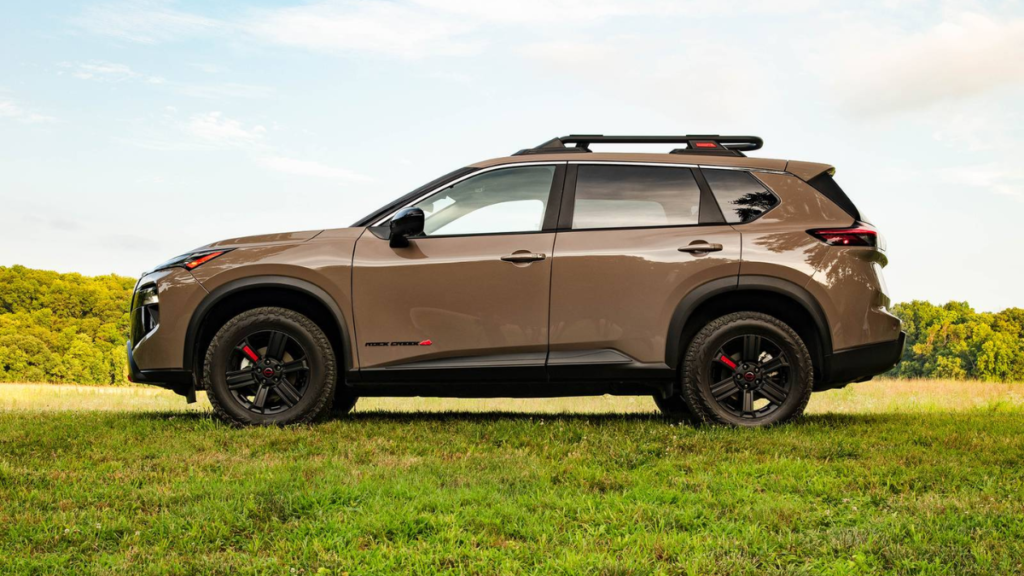
- Rock Creek’s off-road hardware helps on rough and unpaved roads but doesn’t turn the Rogue into a serious off-road SUV
- Some competitors, including the Honda CR-V, offer more outright cargo room
What’s New for the 2026 Nissan Rogue?
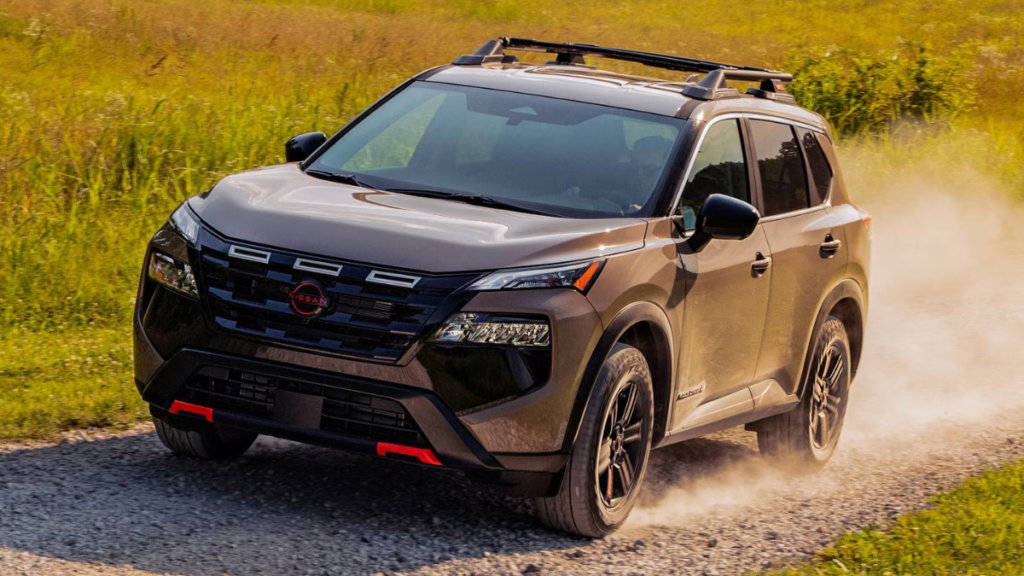
Nissan did not redesign the Rogue for 2026. This generation, which arrived for the 2021 model year, continues largely unchanged mechanically. The headline addition is the new Dark Armor trim, slotting in between the mainstream SV and the leather-appointed SL. Dark Armor builds on the SV with gloss black exterior accents on the mirrors, badges, pillar trim, grille bars and mirror caps, along with 19-inch gloss black wheels and satin black roof rails. It also bundles in real equipment, including an HD Intelligent Around View Monitor with moving object detection, a panoramic moonroof, heated front seats and a heated steering wheel.
Beyond the new trim, the rest of the gasoline Rogue lineup carries over its existing engine, transmission and feature structure, with Nissan issuing a mid-cycle “2026.5” pricing update that current inventory reflects. The bigger news for the Rogue nameplate is the arrival of the Rogue Plug-In Hybrid, a related but mechanically distinct model with three-row seating and its own price range. Nissan has also announced a future 2027 Rogue Hybrid e-POWER model using a different hybrid architecture, but that vehicle isn’t on sale yet and has no bearing on a 2026 purchase decision.
2026 Nissan Rogue Pricing and Trim Levels
Nissan sells the 2026 Rogue in six trim levels: S, SV, Dark Armor, Rock Creek, SL and Platinum. According to Nissan’s current official pricing, the S starts at $29,490, the SV starts at $30,490, Dark Armor starts at $33,340, Rock Creek starts at $34,390 with standard all-wheel drive, and the range-topping Platinum starts at $39,390, also with standard AWD. Nissan’s SL pricing wasn’t listed alongside the other trims on the manufacturer’s current build tool at the time of writing, but based on its position in the lineup, it starts in the mid-$30,000s, between Dark Armor and Platinum. All of these figures exclude a destination and handling charge, which Nissan currently lists at $1,545, along with tax, title, license and any dealer-installed options.
All-wheel drive is optional on the S, SV, Dark Armor and SL trims for an additional $1,400, and it comes standard on Rock Creek and Platinum. That structure matters for shoppers deciding where to spend their money, since a well-equipped SV with AWD can end up close in price to a base Dark Armor.
The S trim keeps things simple, with cloth seats, an 8-inch touchscreen and the core Safety Shield 360 suite, worth considering only if budget is the deciding factor. The SV adds real day-to-day value, including a power-adjustable driver’s seat, additional USB ports, dual-zone climate control and proximity keyless entry, and remains the volume seller for a reason. Dark Armor layers in style and comfort features without demanding SL money, while Rock Creek trades that style for a different look built around all-terrain hardware. SL steps into leather-appointed seating and more driver assistance content, and Platinum tops the range with semi-aniline leather, a 12.3-inch digital instrument display and Nissan’s most complete technology package.
| Trim | Drivetrain | Starting MSRP* |
|---|---|---|
| S | FWD | $29,490 |
| SV | FWD | $30,490 |
| Dark Armor | FWD | $33,340 |
| Rock Creek | AWD (standard) | $34,390 |
| SL | FWD | Mid-$30,000s (exact figure not listed) |
| Platinum | AWD (standard) | $39,390 |
*Excludes destination and handling charge, currently $1,545. AWD adds $1,400 where optional. Pricing subject to change and dealer adjustment.
How Does the Nissan Rogue Drive?
Independent testing from outlets including Edmunds and Car and Driver describes the Rogue as a vehicle built around comfort rather than engagement, and that description holds true for 2026. Steering is light and easy to manage at parking lot speeds, though it offers little feedback once the road starts to curve. Ride quality is the Rogue’s strongest dynamic trait, soaking up broken pavement and highway expansion joints with a settled, quiet demeanor that suits a daily commute.
Braking response is predictable and linear, without the grabby pedal feel of some competitors’ regenerative systems, since the standard Rogue has no hybrid hardware to manage. Cabin refinement is decent at highway speeds, but the three-cylinder engine can be heard, and occasionally felt, under harder acceleration. The Rogue is tuned more for relaxed daily driving than quick acceleration, and buyers cross-shopping something sportier, like a Mazda CX-50, will notice the difference. For shoppers who prioritize a calm, easy driving experience, the Rogue delivers what it promises.
Engine and Performance
Every 2026 Rogue trim uses the same powertrain: a 1.5-liter turbocharged three-cylinder engine rated at 201 horsepower and 225 lb-ft of torque, paired exclusively with a continuously variable transmission. This VC-Turbo engine uses variable compression technology to balance power against efficiency, and in everyday driving that shows up as adequate, unhurried acceleration rather than anything that feels quick.
City driving is where the Rogue feels most comfortable, with enough low-end torque from the turbocharger to keep pace with traffic without much drama. Highway passing requires more patience. The CVT holds engine speed higher than a traditional automatic would during full-throttle merges, and independent reviewers have noted the resulting engine drone, the most common driving complaint about this generation of Rogue. Nissan has tuned the transmission to prioritize fuel economy over responsiveness, a tradeoff that suits commuters more than anyone cross-shopping the Rogue against a turbocharged four-cylinder rival with a conventional automatic.
Fuel Economy and All-Wheel Drive
Fuel economy is one of the more competitive aspects of the Rogue compared with other non-hybrid compact SUVs. EPA estimates for the front-wheel-drive S, SV and Dark Armor trims come in at 29 mpg city, 36 mpg highway and 32 mpg combined. Adding all-wheel drive to those same trims, along with the Platinum, drops the estimate to 28 city, 35 highway and 31 combined. The Rock Creek, with its all-terrain tires, is rated at 27 city, 32 highway and 29 combined, the lowest figure in the lineup but reasonable for a vehicle with dedicated off-road hardware.
Deciding between FWD and AWD comes down to climate rather than performance. Front-wheel drive suits buyers in regions with mild winters and mostly dry pavement, saving both the $1,400 upfront cost and a modest amount of fuel economy. All-wheel drive earns its keep in snow, heavy rain and on loose or gravel surfaces, where the added traction reduces wheel slip and improves confidence pulling away from a stop. The Rogue’s AWD system, even in Rock Creek trim, is tuned for slippery roads rather than genuine off-road use, and buyers picturing rock crawling or deep mud should look elsewhere.
Interior, Comfort and Technology
The Rogue’s cabin is a strong selling point, particularly in the front seats. Nissan’s Zero Gravity seat design continues to earn praise from independent reviewers for reducing fatigue on longer drives, with supportive cushioning that avoids the flat, unshaped feel found in some competitors’ base seats. Rear seat space is generous for the class, with roughly 38.5 inches of rear legroom that comfortably fits adults rather than just children.
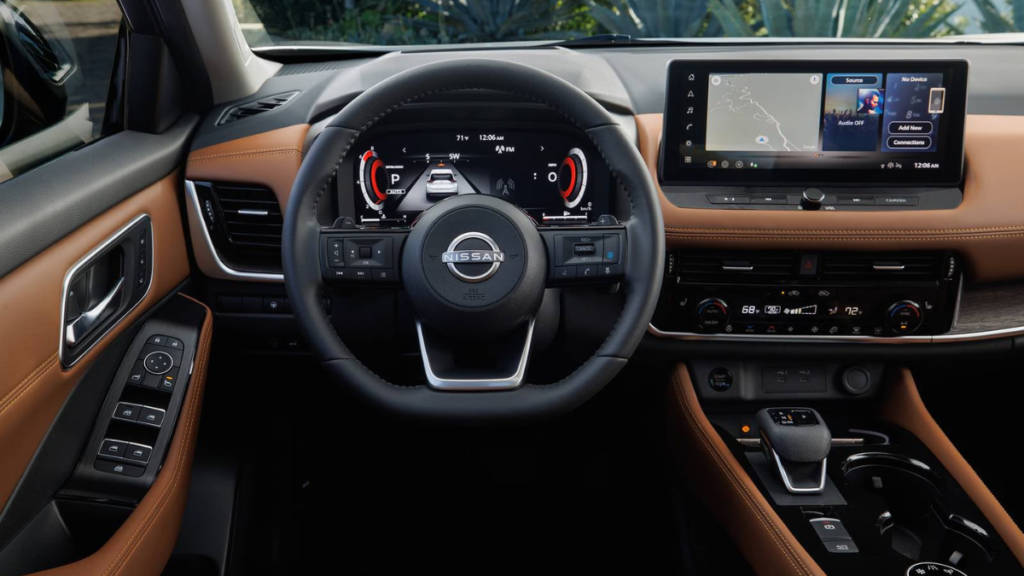
Standard technology on every trim includes a touchscreen with Apple CarPlay and Android Auto, a driver information display and the Safety Shield 360 suite. S, SV, Dark Armor and Rock Creek use an 8-inch touchscreen with wired CarPlay and Android Auto. Stepping up to SL or Platinum brings a larger 12.3-inch touchscreen with Google built-in, adding native Google Maps navigation and Google Assistant voice control along with wireless CarPlay and Android Auto. Wireless device charging isn’t available on S, SV or Dark Armor, is offered as an optional package on Rock Creek, and comes standard on Platinum.
The panoramic moonroof, standard on Dark Armor and Platinum, brightens the cabin and is one of the more popular options Nissan sells on this vehicle. The Platinum’s quilted semi-aniline leather-appointed seats, 12.3-inch digital instrument cluster and ten-speaker Bose audio system change the character of the interior, while the SL moves up from cloth to leather-appointed seating without going as far as the Platinum’s semi-aniline material. Materials on the S and SV are serviceable but cost-conscious, with harder plastics on the lower dash and door panels; Dark Armor and SL are where the cabin starts to match the Rogue’s exterior design.
Cargo Space and Practicality
Practicality remains one of the Rogue’s core strengths. Behind the rear seats, the gasoline Rogue offers roughly 36.3 to 36.5 cubic feet of cargo space depending on trim, expanding to 74.1 cubic feet with the 60/40-split rear seats folded flat. That’s enough room for a large grocery run, a stroller and a diaper bag, or a week’s worth of luggage, and the load floor is flat and wide enough to make loading bulky items straightforward.
Buyers should keep the gasoline Rogue’s practicality separate from the Rogue Plug-In Hybrid, which uses a different platform stretch to accommodate a third row and seating for up to seven. The gasoline Rogue reviewed here is strictly a five-seat, two-row SUV, and its cargo figures reflect that simpler layout. Families who need occasional third-row seating should look toward the PHEV variant or a larger three-row SUV instead.
Safety and Driver Assistance
Nissan includes its Safety Shield 360 suite of driver assistance features as standard equipment across every 2026 Rogue trim, bundling automatic emergency braking with pedestrian detection, blind-spot warning, rear cross-traffic alert, lane departure warning and high-beam assist. ProPILOT Assist, Nissan’s adaptive cruise and lane-centering system, is standard from the SV trim upward; Nissan’s specifications don’t list it as included on the base S.
The 2026 Rogue earned a 2025 IIHS TOP SAFETY PICK designation, based on Good ratings in the small overlap front and updated side crash tests, along with Good or Acceptable ratings for pedestrian front crash prevention and headlights. It fell short of the higher TOP SAFETY PICK+ distinction because it scored Acceptable, rather than Good, in the updated moderate overlap front test. NHTSA results specific to the 2026 model year hadn’t been finalized as of this writing, so buyers should check NHTSA’s website directly before purchase. Safety Shield 360 and ProPILOT Assist are designed to support an attentive driver, not replace one, and Nissan is explicit that these systems can’t prevent every collision.
2026 Nissan Rogue vs. the Plug-In Hybrid
Choosing between the gasoline Rogue and the 2026 Nissan Rogue Plug In Hybrid comes down to two different ownership styles rather than one being objectively better than the other. The standard gasoline Rogue reviewed here carries a lower purchase price, a simpler five-seat layout, the familiar 201-horsepower engine and no need to think about charging at any point. It is the easier vehicle to own for someone who parks on the street, doesn’t have home charging access, or simply wants to fill up and drive without adjusting a routine.
The Rogue Plug-In Hybrid takes a different approach. It pairs a hybrid powertrain with a plug-in battery for a combined output well above the gasoline engine’s 201 horsepower, comes standard with all-wheel drive, and adds a third row that brings seating capacity up to seven, something the gasoline Rogue cannot offer. Its main advantage, meaningful electric-only driving range for local trips, only pays off for buyers who plug in regularly. Skip the charging routine and the PHEV becomes a heavier, pricier Rogue that no longer delivers its core efficiency benefit.
Our dedicated 2026 Nissan Rogue Plug In Hybrid review covers electric range, charging and third-row packaging in depth. For shoppers who don’t need seven seats and won’t charge regularly, the gasoline Rogue remains the simpler choice.
How Does the Rogue Compare With Its Rivals?
The compact SUV segment is crowded, and the Rogue faces serious competition from the Toyota RAV4, Honda CR-V, Hyundai Tucson, Kia Sportage and Subaru Forester. Against the RAV4, the Rogue offers a quieter ride on rough pavement, while Toyota’s hybrid lineup is a major advantage for buyers who prioritize fuel economy above all else. The Honda CR-V edges out the Rogue on outright cargo capacity, and its available hybrid powertrain delivers smoother acceleration, making it a similarly comfortable and practical alternative worth cross-shopping.
The Hyundai Tucson and Kia Sportage counter with competitive hybrid options of their own, though their infotainment and interior ergonomics draw more mixed reviews than the Rogue’s straightforward layout. The Subaru Forester makes standard all-wheel drive a central part of its appeal, offering that traction across its entire lineup rather than as an option on most trims.
None of this makes the Rogue a clear winner or loser in the class. It competes well on ride comfort, front seat comfort and non-hybrid fuel economy, while giving up some ground on cargo room and the smoother powertrain feel hybrid rivals now offer. The right choice depends on which of those priorities matters most.
Which 2026 Rogue Trim Should You Buy?
For most buyers, the SV is the trim to choose. It adds meaningful daily-use equipment over the base S, including the power driver’s seat, dual-zone climate control and additional USB ports, for a modest price increase, and it avoids the base trim’s plainer cabin.
Buyers who want a more distinctive look without spending SL money should consider the Dark Armor, since it bundles real comfort features, including heated seats and a panoramic moonroof, alongside its blacked-out styling. Families who regularly drive in snow or on unpaved roads may find the Rock Creek’s standard AWD and all-terrain hardware worth the added cost, while buyers focused on interior luxury should look to the SL or Platinum, understanding they’re paying a real premium for leather, a larger display and Nissan’s most advanced infotainment hardware.
Is the 2026 Nissan Rogue Worth Buying?
For the right buyer, yes. Anyone who wants a comfortable, efficient, easy to live with compact SUV and doesn’t especially care about spirited handling will find a lot to like here. Ride quality, front seat comfort and cargo practicality all hold up well against the competition, and the standard Safety Shield 360 suite means every trim, even the base S, comes with a solid foundation of driver assistance technology. Pricing across the lineup is in line with rivals, particularly for buyers who settle on the SV or Dark Armor instead of paying for features they won’t use.
The calculation changes for a few buyers. Anyone who wants a more engaging drive or the maximum cargo capacity in the class should spend time in a Honda CR-V or a hybrid RAV4 first. Families who need a third row, or who plan to charge regularly for local fuel savings, should look closely at the Rogue Plug-In Hybrid instead. Outside of those needs, the 2026 Nissan Rogue is a reasonable, well-rounded choice.
Final Verdict
Strongest points: ride comfort, front seat support, a useful cargo hold and a 2025 IIHS TOP SAFETY PICK rating. Weakest points: a coarse three-cylinder engine under hard acceleration, a droning CVT during passing, and cabin materials on lower trims that lag behind the exterior design. The SV is the trim to buy for most shoppers, with Dark Armor as the pick for anyone who wants more style without SL-level spending. Buyers who need a third row or plan to charge regularly should look at the Rogue Plug-In Hybrid instead.
FAQ
Is the 2026 Nissan Rogue worth buying?
Yes, for buyers who prioritize comfort, efficiency and cargo space over performance. The Rogue offers a quiet, comfortable ride, competitive fuel economy for a non-hybrid compact SUV and a standard suite of driver assistance features across every trim. It isn’t the most engaging vehicle in its class to drive, and buyers who want more excitement or the smoothest possible powertrain should test drive hybrid rivals like the RAV4 or CR-V before deciding, but for everyday practicality it remains a solid choice.
How does the 2026 Nissan Rogue compare with the Plug-In Hybrid version?
The gasoline Rogue is less expensive, seats five and never requires charging, making it simpler to own for buyers without home charging access. The Rogue Plug-In Hybrid costs more, comes standard with all-wheel drive and a higher combined horsepower rating, and adds a third row seating up to seven, but its efficiency advantage only shows up for owners who plug in regularly. Buyers who don’t need seven seats and won’t charge consistently are usually better served by the standard gasoline Rogue.
Which Rogue trim offers the best value?
The SV trim offers the strongest overall value in the lineup. It adds a power-adjustable driver’s seat, dual-zone automatic climate control, additional USB ports and keyless entry over the base S for a relatively small price increase. It’s likely to appeal to buyers who want the Rogue’s core strengths without paying for the more expensive appearance and luxury features of the upper trims.
Is all-wheel drive worth paying for on the Rogue?
It depends on climate and driving conditions rather than performance. Buyers in regions with regular snow, heavy rain or gravel roads will notice a real improvement in traction and confidence with AWD, and the $1,400 upgrade is generally worth it for anyone dealing with genuine winter weather. Buyers in mild, dry climates can save that money and a small amount of fuel economy by sticking with the standard front-wheel-drive setup.
How does the Rogue compare with the RAV4, CR-V or Tucson?
The Rogue rides comfortably and posts competitive fuel economy for a non-hybrid, but the CR-V offers more cargo space and a smoother available hybrid powertrain, while the RAV4’s hybrid variants are a strong draw for buyers focused on fuel economy. The Tucson counters with a hybrid option of its own and different infotainment ergonomics that some buyers prefer and others don’t. No single vehicle wins outright, so the right choice depends on whether a buyer prioritizes ride comfort, cargo room, powertrain smoothness or a hybrid option.