2022 Toyota Corolla Cross Review: Toyota filled a gap in its lineup that arguably shouldn’t have existed. Between the cramped C-HR and the oversized RAV4 sat the Corolla Cross, arriving for 2021 to answer a question many buyers didn’t know they were asking. The older RAV4 was sleeker and more efficient than today’s bloated models, and demand persisted for something closer to that size. The Corolla Cross answers that call without pretense.
This is a Corolla sedan lifted 8.1 inches off the ground, not a pretend SUV wearing a crossover badge. Toyota took an existing platform and packaged it smartly for buyers who want height, cargo space, and all-weather capability without committing to a full-size utility vehicle. The positioning is deliberate. Competitors like the Honda HR-V and Subaru Crosstrek do similar work, but the Corolla Cross has something they don’t quite match: Toyota’s reputation for building cars that last without drama.
Starting at $22,445 for the base L trim with front-wheel drive, the Corolla Cross slots into the market’s hottest segment. Buyers are moving away from sedans faster than ever, and subcompact crossovers have become the entry point for families stepping into SUVs. The Corolla Cross makes sense for that customer. It’s affordable, practical, and won’t embarrass you with reliability problems. What it won’t do is excite you, and that’s intentional.
Our Opinion
The 2022 Toyota Corolla Cross delivers affordable, reliable transportation with excellent safety equipment and useful cargo space. The trade-off is modest performance and a dated infotainment interface. For buyers prioritizing dependability and value, that’s an acceptable compromise. For drivers wanting more excitement or cutting-edge technology, they’ll feel disappointed.
Toyota engineered the Corolla Cross as honest transportation. There’s no pretense here, no marketing hype about capability it doesn’t possess. The cabin is straightforward, the controls are logical, and the warranty is solid. The ride surprises you with how composed it feels for the price. What you get is a vehicle built for people who use cars rather than obsess over them, and that philosophy delivers real value.
Pros and Cons
Pros
- Excellent safety ratings, including IIHS Top Safety Pick+ and NHTSA five stars
- Spacious cargo area with 26.5 cubic feet behind the rear seats
- Smooth, comfortable ride with composed handling
- Toyota’s reputation for reliability and strong resale value
- Good fuel economy with EPA estimates of 31 city and 33 highway mpg (FWD)
- Standard Toyota Safety Sense 2.0 with full-speed adaptive cruise control
Cons
- Underpowered 169-horsepower engine feels sluggish, especially on the highway
- CVT transmission is loud and unresponsive under hard acceleration
- Rear legroom is tight at just 32 inches
- Infotainment system feels dated with sluggish response times
- Engine and road noise are intrusive at highway speeds
- Base L trim lacks keyless entry and alloy wheels
What’s New for 2022
The 2022 model year introduced the Corolla Cross to the North American market for the second model year after its debut in 2021. There were no significant changes from the 2021 model, as Toyota considered the vehicle fully developed from launch. The 2022 Corolla Cross carried over the same three trim levels, powertrain, and standard safety suite that had been established the year prior.
For 2023, Toyota added a hybrid variant with 194 horsepower, addressing the most persistent criticism of the conventional model. The 2022 remains gasoline-only with its single 2.0-liter engine option. This fact is worth considering when evaluating the 2022 used market. The hybrid was announced in mid-2022, meaning buyers purchasing new 2022 models knew something more powerful was coming. That context explains why the 2022 has depreciated as quickly as it has.
Exterior Design
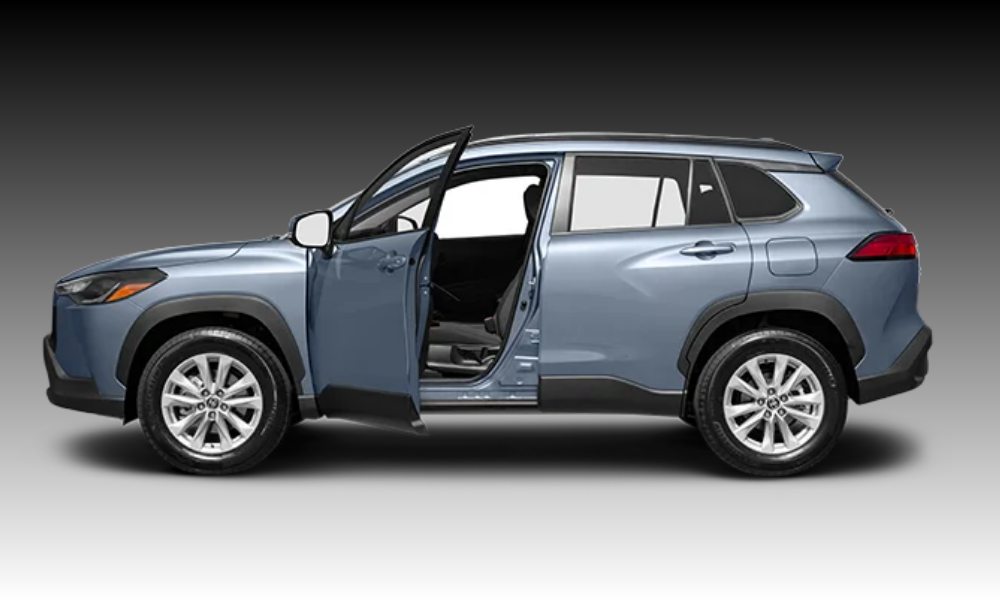
The Corolla Cross is not meant to turn heads. Toyota intentionally kept the design reserved and approachable rather than aggressive or futuristic. The result is a vehicle that looks competent without being memorable. You’d struggle to describe it to someone unfamiliar with the model without deferring to vague descriptors like “it looks like a regular crossover.”
The front end is straightforward: LED headlights with a simple trapezoidal grille, fog lights, and hood lines that suggest no particular design narrative. Thick black plastic cladding runs along the wheel arches, across the bumper lower sections, and down the side skirts. This cladding serves a practical purpose, protecting the lower body from rock damage and oxidation, and it gives the Corolla Cross slightly more visual aggression than the design language alone would suggest.
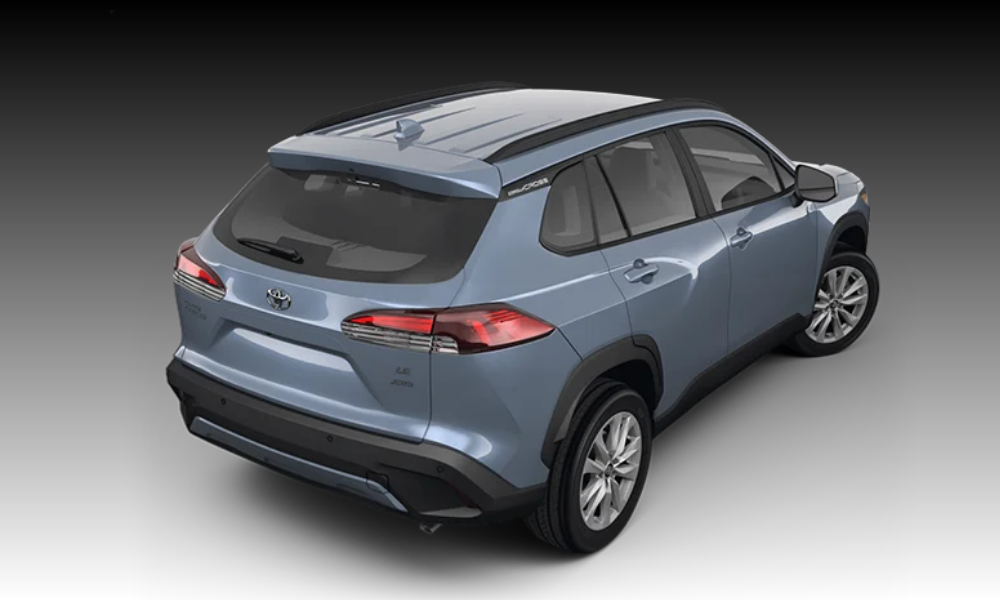
The rear is equally understated. Modest taillights, a simple tailgate, and minimal overhang complete the picture. Wheel options range from 17-inch steel on the L trim to 18-inch alloys on the XLE. The alloy wheels on higher trims visually improve the proportions, though even then the Corolla Cross doesn’t stop traffic.
Ground clearance is 8.1 inches, nearly identical to the current RAV4 and meaningful enough to clear most approach and departure obstacles you’ll encounter off-road or in rough driveways. The height gives the Corolla Cross the visual stance SUV buyers seek without the exaggeration of vehicles that sit unnecessarily tall.
Driving Experience
The most pleasant discovery about the Corolla Cross is how well it handles. The suspension is wound tighter than you’d expect from a vehicle at this price point. The ride is supple without being soft, and the body leans in corners without wallowing. On winding roads at moderate speeds, the car feels attentive and responsive. This is where the excitement begins, even if the engine disappoints.
The steering is direct. There’s meaningful weight in the wheel, and feedback from the front tires comes through clearly. The ratio is quick enough that parallel parking doesn’t require excessive hand movements, and the turning radius is respectable for a vehicle with a 103.9-inch wheelbase. The combination of quick steering and responsive suspension gives the Corolla Cross a nimbleness you wouldn’t expect from its exterior dimensions.
Where the driving experience falters is highway passing. Merging into heavy traffic requires planning and patience, as the 2.0-liter engine struggles noticeably when the vehicle is loaded. Passing slower vehicles on two-lane highways involves downshifting the CVT and accepting prolonged engine noise. The transmission seems designed to drag the RPM up and keep it there, as if volume might somehow compensate for insufficient low-end torque.
Around town, you forget these limitations. The Corolla Cross is a breeze to maneuver, visibility is excellent from the elevated seating position, and the tight turning radius makes parking in urban spaces simple. The ride absorbs most small bumps without transmitting harshness into the cabin. This is where the Corolla Cross earns its value proposition.
Performance and Acceleration
A single 2.0-liter naturally aspirated inline-four powers the 2022 Corolla Cross, producing 169 horsepower at 6,600 rpm and 150 pound-feet of torque at 4,400 rpm. Toyota shared this engine with the Corolla sedan, and the performance characteristics are identical. The problem is that what works reasonably in a lighter sedan feels inadequate in a taller, heavier crossover.
A continuously variable transmission is the only gearbox offered. It improves efficiency and provides smooth operation in normal driving, but it also holds the engine at high RPM during acceleration, producing a drone that persists even at highway speeds during gentle climbs. The shift feel is vague. Manual mode with shift levers allows you to lock the transmission in specific ratios, though most drivers won’t explore this option.
Toyota’s specification claims 0-60 acceleration in the mid-8 second range, but real-world testing by multiple publications consistently shows times closer to 9 seconds with a single occupant and even slower with additional weight. Highway passing requires downshifting and accepting audible strain from the engine for 5 to 8 seconds while you complete the maneuver.
Where the engine makes sense is in fuel economy. The narrow power band and modest output mean the Corolla Cross achieves the EPA ratings Toyota claims: 31 mpg city and 33 mpg highway with front-wheel drive, or 29 and 32 with all-wheel drive. That efficiency, combined with the modest $32 fill-up cost, keeps operating expenses low.
Ride Comfort and Cabin Refinement
The Corolla Cross rides well for a vehicle built on a compact platform. The suspension absorbs impacts from potholes and rough pavement without jarring the occupants. The ride is never harsh, though undamped movements from minor bumps can be felt if you’re paying attention. The engineers appear to have prioritized comfort over sporty handling, which was the correct choice for the intended buyer.
Road noise is minor despite the modest insulation budget. Tire noise, typical of smaller vehicles, is present at highway speeds but not excessive. Wind noise is almost nonexistent thanks to the aerodynamic proportions. The overall cabin ambiance is quiet and restful, which contributes to the sense that the Corolla Cross is a place to relax rather than a vehicle that demands your attention.
The front seats are spacious and accommodating. The upright driving position suits both tall and short drivers without excessive adjustment. The L and LE trims offer manually adjusted seats, which is disappointing at this price point, but the XLE includes a 10-way power driver seat with lumbar support that finally provides meaningful adjustment. Seat cushioning is firm rather than plush, but the support is adequate for all-day driving without fatigue.
The rear seat is where compromises become apparent. Headroom is adequate at 39 inches, but legroom is only 32 inches, which is noticeably tighter than the RAV4 despite the wheelbase being only 2 inches shorter. Adults over 6 feet tall will find the rear seat tight for long drives. Children and average-sized adults will find it perfectly acceptable.
Interior Design and Luxury
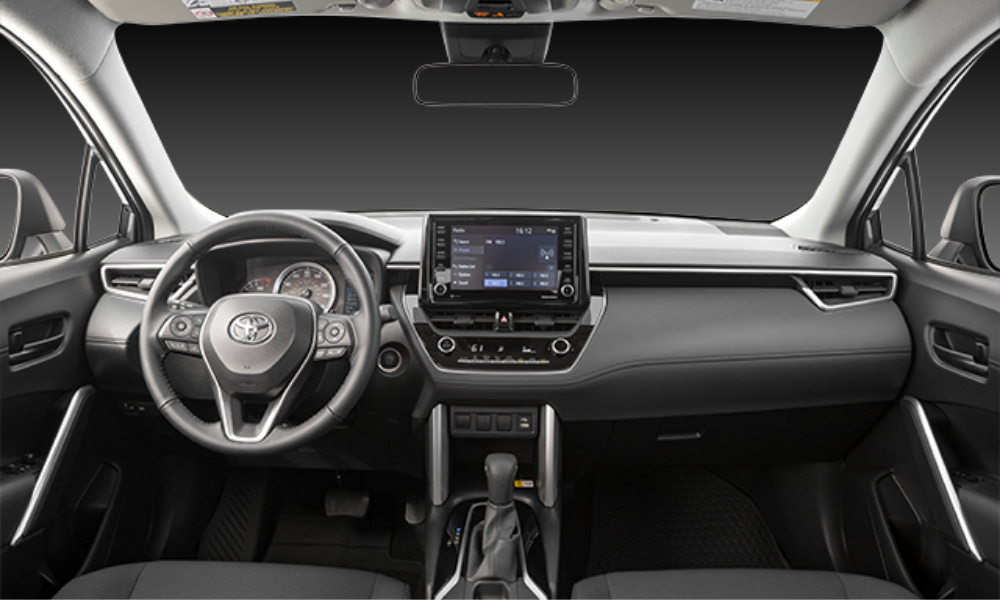
The Corolla Cross interior prioritizes function over form. The dashboard is straightforward and uncluttered. Switches are large and easy to identify. Button placement makes sense. Gauges and controls are logically organized. For buyers who have spent time in modern vehicles with overly complex interfaces, this simplicity is refreshing.
Material quality varies by trim. The base L trim uses hard plastic throughout the cabin, including large areas of the dashboard, door panels, and lower sidewalls. The plastic feels sturdy rather than cheap, but the overall effect is austere. The LE and XLE trim levels add soft-touch materials to the upper dashboard and door surfaces, improving the perceived quality considerably. The XLE includes synthetic leather seat trim with contrast stitching that distinguishes it from the base models.
Storage space throughout the cabin is thoughtful. Cup holders are plentiful. Door pockets are deep. There’s a center console bin with a soft-touch cover on higher trims. The interior feels designed by people who use cars rather than stylists first worried about appearances. The quality of switchgear is especially surprising at this price point. Buttons feel solid, and the rotary controls operate smoothly without rattle.
Passenger space up front is excellent. The driver and front passenger can sit comfortably side by side, and the console doesn’t intrude on either occupant’s space. Headroom is generous at 38.6 inches for front passengers, with the exception of sunroof-equipped models losing about an inch of headroom. The cabin width feels generous for a vehicle with a 71.9-inch exterior width, suggesting careful interior packaging.
The lack of distinctive design elements means the Corolla Cross interior won’t impress people who walk by while you’re showing someone around the vehicle. What it will do is feel right after spending hours inside. That’s a different measure of luxury than materials and aesthetics, and it’s one the Corolla Cross achieves.
Technology and Infotainment
The Corolla Cross infotainment system is functional but dated. All models come with either a 7-inch touchscreen on the L trim or an 8-inch screen on the LE and XLE trims. Both screens integrate Apple CarPlay and Android Auto, which means you’ll likely use your phone for navigation rather than the native mapping system. Amazon Alexa voice control is standard, though activation requires the correct phrase and takes longer than saying your request directly into your smartphone.
The 8-inch screen on the LE and XLE is the better choice if you’re configuring a new Corolla Cross. It’s easier to see and interact with while driving, and the menu hierarchy is slightly more intuitive. That said, Toyota’s infotainment interface has remained essentially unchanged since 2013, and it shows. The graphics look dated. The response time when scrolling through menus is sluggish. Audio quality from the standard six-speaker system is acceptable but unremarkable.
Wireless smartphone charging is available on the LE and XLE trims and actually works as advertised. It’s a simple feature that’s appreciated by anyone who uses wireless charging in other devices. The charging pad is positioned in a logical spot in the center console, though you’ll need to remove your phone case if it’s thicker than half an inch.
An available JBL audio system with nine speakers and a subwoofer is offered on the LE and XLE trims for an additional cost. The upgrade delivers noticeably better sound than the base system, with more depth and clarity across the frequency spectrum. For music lovers, it’s worth the investment. The backup camera on base models has lower resolution than you’d prefer, making identifying small obstacles or parking lines challenging at night. The XLE trim adds dynamic backup guidelines that display parking lines on the screen, making reversing easier in tight situations.
Fuel Consumption
The EPA rates the Corolla Cross at 31 mpg city and 33 mpg highway for front-wheel drive models, or 29 and 32 for all-wheel drive variants. These figures are respectable for a new vehicle and marginally better than segment competitors. Real-world fuel economy reported by owners varies between 25 and 30 mpg depending on driving patterns, terrain, and conditions.
What’s frustrating about the Corolla Cross fuel economy is that the much larger and more powerful RAV4 with a 2.5-liter engine achieves similar overall fuel economy. Buyers choosing the Corolla Cross for efficiency get a slower vehicle that isn’t demonstrably more economical. This reality calls into question whether the 2.0-liter engine was the right choice or if Toyota constrained themselves unnecessarily with the Corolla platform.
Highway fuel economy is where the CVT makes its case. At steady speeds, the transmission holds a consistent ratio without unnecessary shifts, and the engine operates efficiently. In city driving with constant acceleration and deceleration, the CVT’s advantage diminishes. The fuel tank holds 12.4 gallons, meaning highway range is roughly 384 to 409 miles on a full tank with front-wheel drive. That’s respectable range for weekend trips without frequent fill-ups.
Practicality and Storage
The Corolla Cross offers 26.5 cubic feet of cargo space behind the rear seats for front-wheel drive models, or 25.2 cubic feet with all-wheel drive. When the 60-40 split-folding rear seats are folded flat, that expands to 66.8 cubic feet. For context, those numbers outpace direct competitors like the Honda HR-V and Subaru Crosstrek. They’re not far behind the compact RAV4.
The cargo opening is tall and wide, making it easy to load bulky items like bicycles, strollers, or luggage without contortion. The cargo floor is low relative to the bumper height, reducing the lifting distance for heavy items. Interior tie-down points are thoughtfully placed for securing cargo, and the rear seats lock in place securely when folded.
Daily practicality is strong. There are four cup holders up front, with additional cup holders in the rear seat armrest on higher trims. The center console includes a sizable bin for phones, keys, or small items. Door pockets are deep and useful. The glove box is standard size and organized.
Seating five adults is theoretically possible but uncomfortable on long drives. Four adults or three adults plus two children is the practical capacity for comfortable travel. The rear center seat is narrower than the outboard seats, making it unsuitable for extended use during long trips. The towing capacity is 1,500 pounds, which is enough for small trailers but not heavy utility trailers.
Safety and Driver Assistance Systems
The 2022 Toyota Corolla Cross comes standard with Toyota Safety Sense 2.0, a comprehensive suite that includes forward-collision warning with pedestrian and cyclist detection, automatic emergency braking, lane departure alert with steering assist, lane tracing assist, road sign assist, full-speed range adaptive cruise control, and automatic high-beam headlights. This is an impressive standard equipment list at this price point.
The Insurance Institute for Highway Safety awarded the Corolla Cross its Top Safety Pick+ designation, the highest rating possible. The IIHS gave particular praise to the automatic emergency braking system, rating it Superior for preventing collisions with both vehicles and pedestrians. The National Highway Traffic Safety Administration assigned the Corolla Cross a five-star overall rating. Crashworthiness was rated five stars in all impact categories. Rollover resistance received a four-star rating, which is typical for crossovers due to their taller center of gravity.
The Corolla Cross includes nine airbags distributed throughout the cabin. Front airbags are dual-stage, meaning they adjust deployment intensity based on collision severity. Side curtain airbags extend the full length of the cabin, protecting both front and rear passengers in side impacts. The LATCH system for installing child safety seats received a Good+ rating from the IIHS, the highest possible rating.
Blind spot monitoring and rear cross-traffic alert are standard on LE and XLE trims. Optional front and rear parking sensors with automatic braking are available on the XLE, which detect obstacles and apply braking to prevent low-speed collisions.
Worthy Competitors
The Honda HR-V enters at a similar price point with a 1.8-liter engine and slightly less cargo space. The HR-V’s interior feels more upscale and the driving dynamics slightly sharper, but the Corolla Cross offers more cargo capacity and a quieter cabin.
The Subaru Crosstrek slots above the Corolla Cross in price but includes standard all-wheel drive with a sportier suspension tuning. The Crosstrek’s 2.0-liter engine is less powerful than the Corolla Cross, but Subaru’s symmetrical all-wheel drive system provides better traction than the Toyota’s conventional setup. The Crosstrek interior feels more deliberately designed, though material quality doesn’t exceed the Corolla Cross on a per-dollar basis.
The Hyundai Kona offers more aggressive styling and a more modern infotainment system, along with a 10-year powertrain warranty that exceeds Toyota’s 5-year coverage. The Kona is slightly smaller and lighter than the Corolla Cross, giving it a nimbler feel in tight spaces. Reliability data slightly favors Toyota. The Kia Seltos is essentially the Hyundai Kona with different styling. It offers identical mechanical specifications and warranty coverage to the Kona, plus additional interior refinement that appeals to buyers prioritizing materials over practicality. The Mazda CX-30 carries a price premium over the Corolla Cross but delivers a more engaging driving experience and a more distinctive interior. The CX-30 is lighter, which partially offsets its smaller engine. The CX-30 appeals to buyers willing to pay more for style and driving dynamics.
Key Strengths and Key Weaknesses
The Corolla Cross’s greatest strength is how well it rides despite its short wheelbase and modest suspension budget. Buyers expecting harshness from the abbreviated wheelbase are pleasantly surprised by the composed, quiet ride that absorbs impacts without noise or harshness. That accomplishment reflects genuine engineering skill and design priorities that prioritized the actual experience rather than specification sheets.
The second strength is cargo practicality. The space is not just adequate but genuinely useful for a vehicle this size. The opening is accessible, the floor is low, and the height allows bicycles and luggage to load without awkward angles.
The primary weakness is the engine. It’s not that the 2.0-liter is fundamentally flawed, but that it’s borderline underpowered for the vehicle’s weight and purpose. Most buyers will accept this limitation. Some will resent it. The hybrid that arrived for 2023 confirms Toyota understood the constraint. The secondary weakness is infotainment staleness. Buyers comparing the Corolla Cross directly to the Kona or Seltos will notice the infotainment system immediately looks and operates like it belongs in a vehicle from 2013. This is a perception issue more than a functionality issue, but perception matters in purchase decisions.
Recommended Category
The 2022 Toyota Corolla Cross is recommended for buyers prioritizing dependability, cargo space, and safety over performance and modern tech. It’s ideal for daily commuters, small families, and first-time SUV buyers who value long-term durability and low operating costs.
It is not recommended for drivers seeking turbocharged acceleration or a cutting-edge infotainment experience. For those needs, the Kona, Seltos, or CX-30 are better alternatives.
Is It Worth Buying?
Yes, if you find a 2022 at the right price. The Corolla Cross delivers honest, practical transportation without hype. It starts reliably, carries what you need, protects your family, and holds value well. The 2.0-liter engine is adequate for city driving but feels strained on the highway—a trade-off most buyers in this segment accept.
The real question is whether the 2023 hybrid makes the 2022 obsolete. With 194 horsepower in the hybrid, the 2022 loses its value advantage when purchased new. Buying a used 2022 at depreciated prices makes sense. Buying new, however, is harder to justify when the hybrid exists.
For buyers who accept the engine limitation and find a 2022 at a good price, it’s a solid choice. For those wanting better acceleration or a more modern interface, the Kona or Seltos are stronger options. For those willing to wait, the 2023 hybrid changes the game entirely.
FAQ
How does the Corolla Cross compare to the RAV4?
The RAV4 is larger and more powerful, with better highway acceleration. The Corolla Cross is smaller, more efficient to park, and more maneuverable in city driving. Choose the RAV4 if you frequently drive long distances or value more powerful performance. Choose the Corolla Cross if parking space and fuel economy matter more than outright power.
Should I wait for the 2023 Corolla Cross hybrid?
If you’re buying new, yes. The 194-horsepower hybrid addresses the primary weakness of the conventional model. If you’re buying used and finding a 2022 at a good price, the conventional model is acceptable if you accept the power limitations.
Is all-wheel drive necessary for the Corolla Cross?
No. Front-wheel drive is adequate for most buyers in most climates. All-wheel drive adds useful capability in heavy snow, but it costs $1,300 and reduces fuel economy. Budget-conscious buyers and those in mild climates don’t need it.
Which trim level is best value?
The LE trim offers the best balance of features and price. It includes the larger 8-inch infotainment screen, wireless charging, blind-spot monitoring, and keyless start for about $2,300 more than the base L. The XLE adds features that matter less (leather, power driver seat) for another $1,800.
How does the Corolla Cross’ fuel economy really compare to competitors?
Real-world fuel economy is competitive but not best-in-class. Expect 28-30 mpg combined in mixed driving. The Honda HR-V and Hyundai Kona achieve similar economy. The Subaru Crosstrek is typically 1-2 mpg worse. Wait for the 2023 hybrid if fuel economy is the priority.