Best Trailer Brake Controllers
Five top-rated options compared for smoother, safer, and more controlled towing.

A trailer can feel perfectly manageable on a flat, open highway. Then traffic compresses ahead, the road tips downhill, or the trailer is loaded heavier than usual, and the picture changes fast. That’s the moment a driver finds out whether the trailer’s brakes are actually helping the tow vehicle stop, or just riding along until something forces them to react. The difference between those two outcomes almost always comes down to one small box wired into the dash: the trailer brake controller.
A brake controller tells the trailer’s electric brakes when to engage and how hard, based on what the tow vehicle is doing. Without functioning trailer brakes, the tow vehicle’s braking system must provide the stopping force without assistance from the trailer’s electric brakes. With a good controller matched to the trailer, the load slows down with the truck instead of pushing against it, which matters most exactly when it’s needed most: sudden stops, mountain grades, and wet roads.
Picking the right one isn’t as simple as grabbing whatever’s cheapest at the parts counter. Controllers differ in how they sense braking force, how they mount in the cabin, how many axles they support, and how much daily interaction they ask of the driver. Some are built to disappear behind the dash with only a small knob showing. Others put a full display in front of the driver. A newer category skips the dashboard entirely and hands control to a smartphone.
This guide looks closely at five controllers worth considering in 2026: the REDARC Tow-Pro Elite, REDARC Tow-Pro Liberty, CURT 51170 Spectrum, Tekonsha 90195 Prodigy P3, and CURT 51180 Echo Mobile. Each takes a genuinely different approach to the same job, and the right pick depends less on brand loyalty and more on how someone tows, what vehicle they’re installing it in, and how much control they want at their fingertips. What follows breaks down where each one earns its place, where it falls short, and which type of towing setup it actually suits.
Want to compare all five recommended trailer brake controllers in one place?
View our curated selection on Amazon.
Quick Comparison
| Controller | Control Type | Braking Style | Axle Capability | Best For | Main Advantage |
|---|---|---|---|---|---|
| REDARC Tow-Pro Elite | Dash knob, hidden main unit | Proportional + user-controlled off-road mode | 1–3 axles | Mixed on-road and off-road towing | Dual braking modes in one unit |
| REDARC Tow-Pro Liberty | Dash knob, hidden main unit | Proportional (inertia-based) | 1–2 axles | Everyday highway towing | Clean factory-style install with proportional braking |
| CURT 51170 Spectrum | Separate rotary knob, hidden module | Proportional (triple-axis accelerometer) | 1–4 axles | Buyers who want a discreet dash footprint | Fully concealed main module |
| Tekonsha 90195 Prodigy P3 | Dash-mounted LCD unit | Proportional with manual boost levels | 1–4 axles | Drivers who want a traditional display and manual controls | Detailed diagnostics and Boost control |
| CURT 51180 Echo Mobile | Smartphone app (Bluetooth) | Proportional (triple-axis) | 1–2 axles | Multi-vehicle or occasional towing setups | No dash installation required |
What Is a Trailer Brake Controller?
Most trailers heavy enough to need brakes at all use electric drum brakes, which work through magnets rather than hydraulic pressure. Those magnets need an electrical signal telling them when to activate and how strongly, and that’s the entire job of a brake controller.
The chain runs like this: the driver presses the tow vehicle’s brake pedal, and depending on the controller and tow vehicle, the system receives a braking input while an inertia-based controller also measures the tow vehicle’s deceleration to determine how much trailer braking to apply. It then sends a proportional electrical current down the trailer wiring harness to the brake magnets. The trailer’s wheels then brake alongside the tow vehicle’s wheels instead of coasting freely behind them.
Without that signal, a trailer’s electric brakes simply don’t do anything, no matter how well-built they are. The tow vehicle is left trying to stop its own weight plus the trailer’s weight, using brakes that were never designed to carry a second vehicle’s worth of momentum. That’s why panic stops with an unbraked trailer tend to feel long, unstable, and unpredictable. A properly configured controller removes most of that burden by letting the trailer contribute its own stopping power at the right moment.
Proportional vs. Time-Delayed Brake Controllers
Older and lower-cost brake controllers use time-delayed activation. When the brake pedal is pressed, the controller applies trailer braking according to a preset output or ramp rate rather than directly matching the tow vehicle’s actual deceleration. It’s a simple system, but because the output doesn’t scale with how hard the vehicle is actually braking, it can produce a jerky, disconnected feel at the trailer end, particularly during light stops or sudden hard braking.
Proportional controllers, which is the mode all five products in this guide use for normal driving, take a different approach. They use an internal accelerometer to measure how quickly the tow vehicle is decelerating, then apply trailer braking force that matches it in real time. Light pedal pressure produces light trailer braking; a hard stop produces a hard trailer response. The result is a combination that slows down as one unit instead of two vehicles fighting each other’s momentum.
That said, proportional systems aren’t automatically flawless for every situation. They rely on accurate calibration and correct mounting orientation, and in genuinely rough off-road conditions where the accelerometer is reading bumps and articulation rather than clean deceleration, a manual or user-controlled mode can actually be more predictable. That’s the reasoning behind features like the Tow-Pro Elite’s off-road mode, which lets the driver override proportional sensing entirely when the terrain calls for it. All five controllers here offer proportional braking in their normal operating mode; the REDARC Tow-Pro Elite additionally provides a User-Controlled Mode for off-road use, a feature the other four do not include.
How We Chose These Trailer Brake Controllers
This list isn’t built around lab numbers or manufacturer marketing copy. It’s built around how each controller is actually designed to behave: how it senses braking force, how adjustable it is, how it mounts in a vehicle, what kind of display or interface the driver interacts with, and what range of trailers and tow vehicles it’s built to support.
We also weighed how each product fits into a realistic ownership experience. A controller that’s technically capable but frustrating to calibrate isn’t a practical daily-use recommendation, and a controller that’s simple to use but limited in adjustability isn’t the right fit for someone hauling a heavy multi-axle trailer. Reputation, documented feature sets, and how each manufacturer positions its own product line all factored into where each of these five landed. Cardrav has not physically tested these controllers on a dyno or a closed course, and this guide does not claim measured stopping distances or lab results. The comparisons here are based on published specifications and documented feature sets rather than in-house testing.
The Five Best Trailer Brake Controllers
1. REDARC Tow-Pro Elite
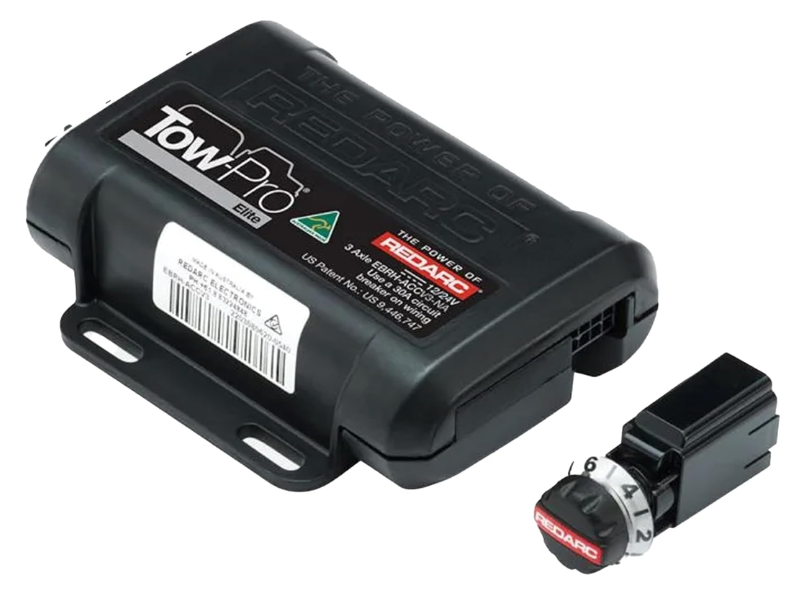
The Tow-Pro Elite sits at the top of REDARC’s lineup, and it’s built for towing that doesn’t stay on pavement the whole time. It’s the option worth considering for anyone who splits their towing between highway miles and rougher terrain, like a camper trailer that ends up on gravel access roads or a boat launch with a loose incline.
What separates it from most proportional controllers is that it isn’t limited to one braking philosophy. In Proportional Mode, it behaves like a conventional inertia-sensing controller, matching trailer braking to the tow vehicle’s deceleration for smooth, predictable highway stops. Switch it to User-Controlled Mode, and the driver sets a fixed braking output independent of the vehicle’s own braking, which REDARC positions as useful for off-road conditions such as sand, mud, or steep grades where a driver-set brake level can be adjusted for the terrain at hand.
Physically, the Elite hides its main unit behind the dash and leaves only a small control knob visible, so it doesn’t clutter the cabin. Its three-axis accelerometer offers flexible mounting, allowing the main unit to be installed in a range of orientations while maintaining accurate brake sensing, which gives installers more flexibility than controllers that require a specific mounting angle.
Important features:
- Two selectable braking modes: Proportional and User-Controlled
- Three-axis accelerometer with flexible mounting orientation
- Active Calibration
- 12V and 24V vehicle compatibility
- Supports trailers with 1 to 3 axles
- Compatible with electric and electric-over-hydraulic brakes (with some system-specific exceptions)
- Includes Universal Bare Cable Harness and TPSI-001 Universal Switch Insert
Pros:
- Genuinely useful off-road/manual mode alongside standard proportional braking
- Compact, hidden installation with minimal dash footprint
- Flexible mounting orientation
- Works on both 12V and 24V electrical systems
Cons:
- Higher price point than simpler proportional-only controllers
- The added mode-switching functionality is unnecessary for drivers who only ever tow on paved roads
- Limited to 3 axles, which rules out the largest multi-axle trailers
Best for: Owners who regularly tow in mixed conditions, including gravel, dirt, or steep grades, and want the option to override proportional braking when road conditions call for it.
2. REDARC Tow-Pro Liberty
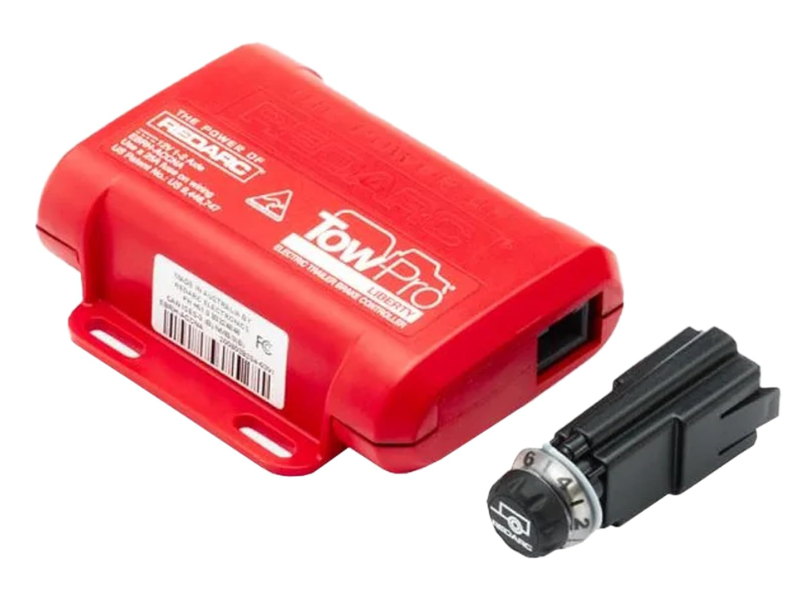
The Tow-Pro Liberty is REDARC’s answer for buyers who want the same clean, factory-style installation as the Elite but don’t need the off-road-specific manual mode. REDARC positions it specifically for everyday highway driving, and that framing fits: it’s a proportional-only controller aimed at drivers whose towing stays mostly on paved roads.
Where the Elite gives the driver a choice between two braking philosophies, the Liberty keeps things simpler with a single proportional system, called Everyday Mode, built around the same three-axis accelerometer technology found in the Elite. It measures the tow vehicle’s braking force and applies matching power to the trailer brakes, aiming for smooth stops without the push-pull sensation that comes from mismatched braking. A manual override button on the remote head lets the driver apply the trailer brakes independently if trailer sway develops, without needing a separate mode switch.
The physical footprint is similar to the Elite: a small dash-mounted knob, with the main computing unit tucked out of sight behind the dash. For someone who wants a factory-integrated look without a bulky aftermarket box on the dashboard, that’s a meaningful selling point. Unlike the Elite, the Liberty does not include the Universal Bare Cable Harness or TPSI-001 switch insert as standard; a vehicle-specific harness and/or switch insert is typically needed and, depending on the vehicle, purchased separately.
Important features:
- Proportional braking via three-axis accelerometer (Everyday Mode)
- Active Calibration
- Manual override button for immediate trailer brake application
- Supports trailers with 1 to 2 axles
- 12V vehicle compatibility
- Compatible with electric and electric-over-hydraulic brakes
Pros:
- Clean, minimal dash presence
- Simple, single-mode operation with fewer settings to manage
- Flexible mounting orientation thanks to the accelerometer design
- Straightforward manual override for sway situations
Cons:
- Limited to 1–2 axles, which excludes larger trailers
- No off-road or user-controlled mode if towing conditions get rougher
- 12V only, unlike the Elite’s 12V/24V compatibility
Best for: Buyers who tow small to mid-size trailers primarily on the highway and want proportional braking with a factory-look install, without paying for off-road-specific functionality they won’t use.
3. CURT 51170 Spectrum
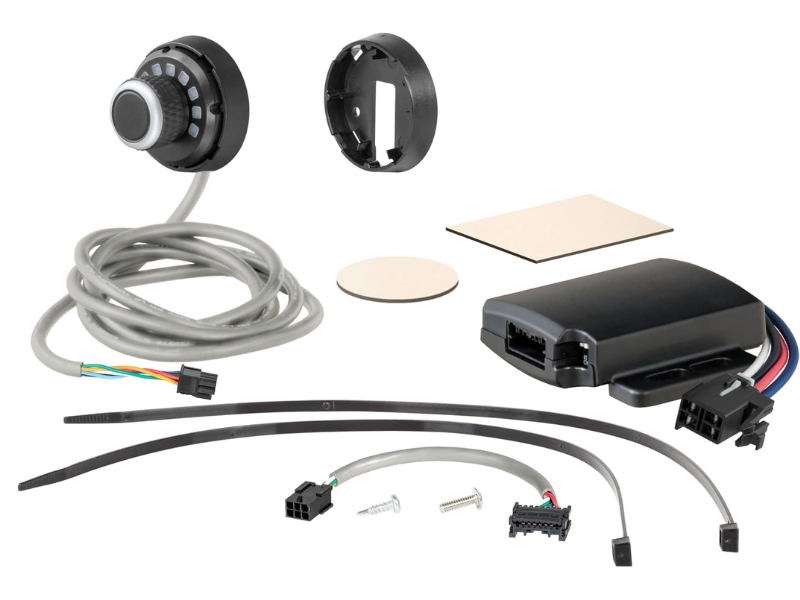
The Spectrum takes the concealed-installation concept and pushes it further. Rather than a single knob-and-body unit, it splits into two separate pieces: a compact rotary knob with a push-button center that mounts in a single hole on the dash, and a completely separate main module with the actual accelerometer, which can be tucked away behind the dash out of sight entirely, using either a drill mount or a surface adhesive mount depending on the installation.
For someone who cares about keeping their interior looking as close to stock as possible, that separation matters. Instead of finding space for a full brake controller body somewhere reachable, only a small knob needs a mounting spot, and it can be placed in a convenient dash location using the supported mounting options rather than wherever the electronics happen to fit. The knob itself uses ten tri-color LEDs to indicate braking activity and power level, giving the driver feedback without a full digital display.
Functionally, the Spectrum relies on a triple-axis accelerometer to measure vehicle and trailer motion and apply proportional braking accordingly, and it’s rated to operate up to eight trailer brakes across 1 to 4 axles, giving it more headroom than either REDARC controller for larger trailers. It’s also compatible with vehicles running ABS and cruise control, and works with both low-voltage and PWM (pulse-width modulation) brake systems, which matters for compatibility with certain modern trucks.
Important features:
- Triple-axis accelerometer for proportional braking
- Separated knob and main module design
- Supports 1 to 4 axles and up to 8 brakes
- Ten tri-color LED indicator on the control knob
- Automatic leveling and calibration
- Compatible with ABS, cruise control, low-voltage, and PWM systems
- Push-button manual override on the knob itself
Pros:
- Genuinely minimal dash footprint thanks to the separated design
- Higher axle and brake capacity than either REDARC controller
- Broad electrical system compatibility (PWM and low-voltage)
- Simple, single-knob operation
Cons:
- LED indicator system provides less detailed feedback than a full display
- Requires a vehicle-specific quick-plug harness, sold separately
- No off-road or user-controlled braking mode
Best for: Buyers with larger trailers who still want a nearly invisible dash presence, and who prioritize a clean cabin over a full-featured display.
4. Tekonsha 90195 Prodigy P3
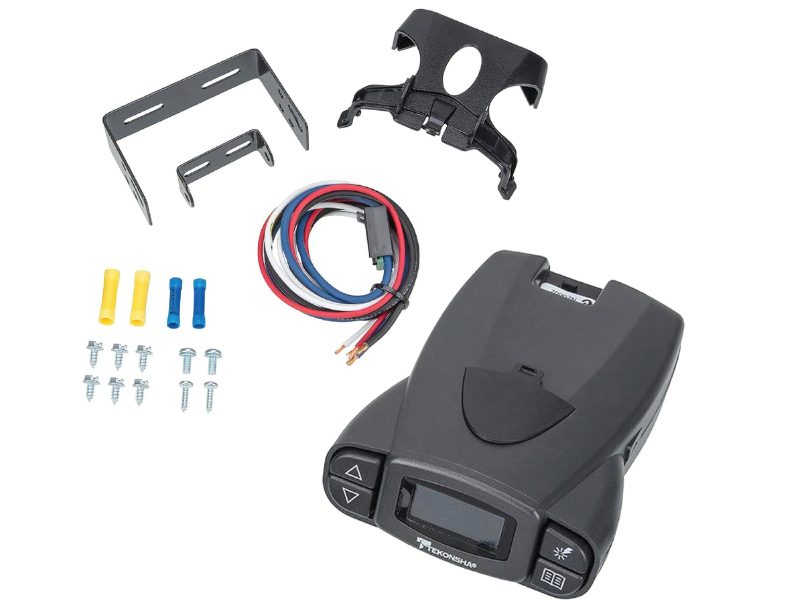
The Prodigy P3 is the traditionalist of this group, and that’s not a knock. It keeps the layout that most people picture when they think of a trailer brake controller: a single dash-mounted unit with a multi-color LCD display, physical buttons, and a manual lever, all visible and reachable from the driver’s seat.
That visibility is the point. Rather than hiding the interface behind a small knob, the Prodigy P3 puts diagnostic information front and center, showing output current, battery status, brake voltage, and trailer connection warnings directly on the display. For drivers who want to glance down and immediately understand what the system is doing rather than interpreting LED colors, that’s a real advantage. The display also supports English, French, and Spanish.
Where the P3 particularly stands out is its Boost feature, which allows the driver to add up to three levels of extra braking power at the touch of a button, useful when hauling a heavier load than usual without needing to fully recalibrate the base settings. Manual override is also available through a physical control lever, giving the driver direct control over trailer braking when needed.
Important features:
- Multi-color LCD display with diagnostics (output current, battery, brake voltage)
- Boost feature with up to three additional power levels
- Manual control lever for direct brake application
- Proportional braking
- Supports 1 to 4 axles, 2 to 8 brakes
- Compatible with electric and electric-over-hydraulic brakes
- Snap-in mounting clip for removable storage
Pros:
- Full diagnostic display, easier to read at a glance than LED-only interfaces
- Boost feature adds flexibility for varying trailer loads
- Detailed diagnostics make it easy to spot a trailer wiring issue at a glance
- Can be removed and stored when not towing
Cons:
- Visible dash unit takes up more space than concealed designs like the Spectrum or Tow-Pro line
- Traditional button-and-display interface is a matter of preference next to app-based or fully hidden alternatives
- Requires a vehicle-specific plug, sold separately
Best for: Drivers who prefer a conventional, visible brake controller with a full diagnostic display, Boost power, and manual controls.
5. CURT 51180 Echo Mobile
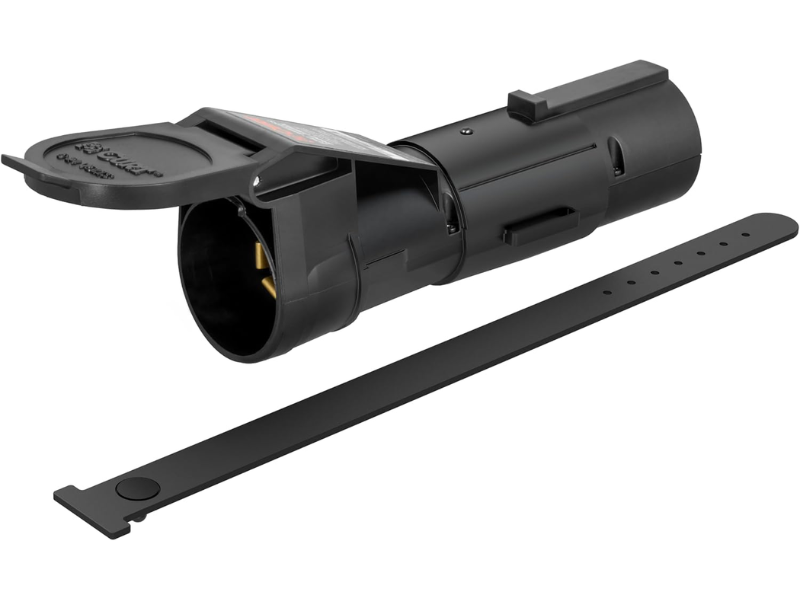
The Echo Mobile skips the dashboard altogether. Instead of a knob or a display mounted inside the cabin, it physically connects between the vehicle’s 7-way RV blade connector and the trailer’s plug at the rear, and it uses Bluetooth to communicate with a smartphone running CURT’s app. There’s no wiring to run through the firewall, no hole to drill, and nothing permanently mounted inside the cab. The trailer brakes themselves are still activated through that physical 7-way connection; Bluetooth is used only between the Echo unit and the phone, not between the vehicle and the trailer.
That approach makes the most sense for a specific kind of towing situation: someone who tows occasionally rather than constantly, or someone who moves between multiple vehicles and doesn’t want to install (or reinstall) a hardwired controller in each one. Because the Echo Mobile connects at the 7-way plug rather than through the dash, it can be unplugged and moved to a different truck in minutes, provided that vehicle also has a 7-way connector.
Inside, it uses the same kind of triple-axis motion sensing as the other proportional controllers here, and the companion app lets the driver adjust maximum brake output and sensitivity, monitor brake activity, and manually apply the trailer brakes from the phone screen. Adjustments should only be made while the vehicle is stationary, not while driving. If the Bluetooth connection drops mid-drive, the unit continues operating on its most recently saved settings rather than losing braking function. It’s also compatible with vehicles running low-voltage, PWM, ABS, and cruise-control systems. The Echo Mobile is not compatible with Apple CarPlay or Android Auto, though it doesn’t interfere with either system. CURT states that, due to legal requirements, the Echo Mobile is only available for the North America and Australia markets.
Important features:
- Bluetooth connection to a dedicated smartphone app (iOS and Android)
- Physically connects between the vehicle’s 7-way RV blade connector and trailer plug, no dash wiring
- Triple-axis motion sensing for proportional braking
- Portable design for use across multiple vehicles, with stored vehicle-trailer profiles
- Automatic calibration
- Compatible with low-voltage, PWM, ABS, and cruise-control systems
- Continues operating on last saved settings if Bluetooth disconnects
- Supports 1 to 2 axles, 2 to 4 brakes
- Available only in North America and Australia, per CURT
Pros:
- No dash installation or drilling required
- Genuinely portable between vehicles with a compatible 7-way connector
- The app provides convenient access to brake settings and monitoring, but adjustments should only be made while the vehicle is stationary
- Weather-resistant, potted construction helps protect the unit from the elements
Cons:
- Limited to 1–2 axles, not suited to larger multi-axle trailers
- Requires a paired smartphone to adjust settings, which isn’t ideal for every driver
- Not compatible with Apple CarPlay or Android Auto
- Mounting at the rear 7-way connector means it’s more exposed to the elements than a cabin-mounted unit, despite its weather-resistant build
Best for: Owners who tow occasionally, share a controller across more than one vehicle, or simply prefer managing settings through a phone rather than a physical dash interface.
What to Consider Before Buying
Proportional braking
All five controllers here use proportional braking, and for good reason. It’s the technology that keeps the trailer’s stopping force matched to the tow vehicle’s, rather than applying a flat, fixed amount of braking regardless of how hard the driver is stopping. If a controller under consideration isn’t proportional, that alone is worth questioning before buying it.
Trailer size and axle count
Not every controller supports the same number of axles or brake magnets. The REDARC Liberty and CURT Echo Mobile top out at two axles, which is fine for a single-axle utility trailer or a smaller travel trailer, but not enough for a large fifth-wheel or a multi-axle enclosed trailer. The Spectrum and Prodigy P3 both extend up to four axles and eight brakes, giving more room to grow if the towing setup changes down the line. Never use a brake controller beyond its specified axle or brake capacity. Before buying, verify the trailer’s axle count, the number of braked wheels or brake magnets, whether the system is electric or electric-over-hydraulic, the tow vehicle’s wiring, and that the controller under consideration is actually rated for that combination.
Wiring harness requirements
Not every controller ships with everything needed for installation. The REDARC Tow-Pro Elite includes a universal bare cable harness and universal switch insert as standard. The REDARC Tow-Pro Liberty may need a vehicle-specific harness or switch insert purchased separately depending on the configuration. The CURT 51170 Spectrum requires a vehicle-specific quick-plug harness sold separately, as does the Tekonsha 90195 Prodigy P3. The CURT 51180 Echo Mobile is the exception: it connects through the vehicle’s existing 7-way RV blade connection rather than a permanent dash wiring installation, so no separate harness is typically needed. Checking exactly what’s included, and what still needs to be ordered, before checkout avoids a stalled installation.
Tow vehicle compatibility
Most controllers require a vehicle-specific wiring harness or plug, sold separately, to connect with a truck or SUV’s factory wiring. Some newer vehicles use pulse-width modulation (PWM) brake signaling rather than a simple voltage signal, and not every controller handles that correctly out of the box. Confirming both the correct harness and the correct signal compatibility before ordering saves a returned or unusable part later.
Installation
Installation difficulty depends heavily on the tow vehicle and whether a factory brake-controller connector or a compatible vehicle-specific harness already exists for it; it isn’t equally easy to self-install across every vehicle. Two general approaches show up in this group. REDARC’s controllers and the CURT Spectrum use a hidden main module wired into the vehicle, with only a small knob visible on the dash. The Prodigy P3 mounts the full unit somewhere accessible, typically under the dash. The CURT Echo Mobile skips a wired dash installation entirely, connecting through the 7-way connector at the rear of the vehicle instead.
Installation complexity varies by vehicle and wiring configuration. In some cases, particularly on trucks with a factory brake-controller plug already in place, installation is a fairly quick plug-in job. In others, it involves locating and connecting to a wiring harness without that factory plug, which takes more time and care. Because this work happens near a vehicle’s brake and battery circuits, anyone uncomfortable working with vehicle electrical systems should use a qualified installer rather than guessing.
Gain and braking adjustment
Gain refers to how much braking force the controller sends to the trailer at a given level of vehicle braking. Set too low, the trailer under-brakes and leans on the tow vehicle to do most of the stopping work, which increases stopping distance and wears down the tow vehicle’s own brakes faster than necessary. If gain is set too high, the trailer brakes may engage too aggressively, potentially causing harsh braking or premature wheel lock on some trailers and surfaces. The right gain setting depends on trailer weight, brake condition, brake type, road surface, and the specific controller’s design, and it’s something that should be checked and adjusted for the trailer actually being towed rather than left at a factory default. There isn’t one universal gain number that’s correct for every setup.
Dashboard visibility and control
How a controller communicates with the driver matters more than it might seem while shopping. A full display like the Prodigy P3’s shows detailed diagnostic information at a glance, while a knob-based system like the Spectrum or either REDARC controller relies on color-coded LEDs for quicker but less detailed feedback. The Echo Mobile’s app-based approach offers the most detailed real-time information of all, but only when a phone is mounted, unlocked, and connected, which isn’t always practical mid-drive.
Budget vs. long-term value
The cheapest controller on a shelf isn’t automatically the best value once axle capacity, harness compatibility, and daily usability are factored in. A controller that doesn’t support the trailer’s full axle count, or that requires constant recalibration because it wasn’t designed for the towing conditions it’s actually used in, ends up costing more in frustration and wasted setup time than the money saved upfront. Matching the controller to the actual trailer and towing pattern first, then comparing price within that shortlist, tends to produce a better long-term outcome than shopping by price alone.
Common Mistakes to Avoid
Buying based only on price, without checking whether the controller supports the trailer’s actual axle and brake count, is one of the most common and easily avoidable mistakes. A controller rated for two axles simply won’t manage a four-axle trailer safely, no matter how good its reviews are.
Ignoring trailer brake configuration is another. Not every trailer uses standard electric drum brakes; some use electric-over-hydraulic systems, and not every controller supports both the same way.
Failing to verify tow vehicle compatibility, particularly around PWM brake signaling on newer trucks, can lead to a controller that installs but doesn’t function correctly.
Setting gain incorrectly, and then never revisiting it, is a mistake that shows up gradually rather than immediately. A gain setting that felt fine towing an empty trailer may be dangerously low once that trailer is loaded near capacity.
Assuming all controllers work identically leads buyers to skip the manual for their specific unit, missing features like boost modes, manual override behavior, or stored profiles that could make towing easier. Mounting the controller somewhere difficult to reach while driving also defeats the purpose of quick access to manual override or sway control. And picking a proportional-only highway controller for a trailer that regularly sees gravel roads or steep unpaved descents can leave a driver without the manual control that rougher terrain sometimes calls for.
Final Verdict
There isn’t a single best trailer brake controller for every towing situation, but there is a clear best fit for different priorities.
For buyers who split their towing between highway and rougher terrain, the REDARC Tow-Pro Elite is the strongest overall pick among these five, largely because its dual braking modes cover situations the other four controllers simply can’t handle as well. It’s the premium choice here too, reflecting both its added functionality and its price.
For a clean, integrated installation, the CURT 51170 Spectrum stands out by hiding nearly its entire footprint behind the dash while still supporting up to four axles, making it the strongest option for buyers who want their cabin to look as close to stock as possible without sacrificing capacity.
For drivers who want a traditional, full-display controller with manual boost and detailed diagnostics, the Tekonsha 90195 Prodigy P3 remains the most practical traditional choice.
For convenience and portability, the CURT 51180 Echo Mobile is the clear pick, particularly for anyone who tows only occasionally or moves a controller between more than one vehicle.
And for buyers who simply want proportional braking with a clean, factory-style install and don’t need the extra complexity of off-road modes or app pairing, the REDARC Tow-Pro Liberty offers the simplest path to smoother, more consistent towing.
Whichever controller ends up matching a specific trailer and towing routine, the underlying goal is the same: a trailer that slows down with the tow vehicle instead of against it, especially in the moments when that difference matters most
FAQ
Do I really need a trailer brake controller, and when does it become important?
If your trailer has electric brakes, a controller is what tells them when to engage and how hard. Without one, the tow vehicle provides essentially all of the stopping force, a gap that becomes far more noticeable as trailer weight increases, on downhill grades, in emergency stops, or on low-traction roads. Legal requirements vary by jurisdiction, so confirm the rules for your specific tow vehicle and trailer.
Is a proportional brake controller better than a time-delayed controller?
For most on-road towing, yes. A proportional controller matches trailer braking to the tow vehicle’s actual deceleration rather than following a preset time-based ramp, so it responds naturally to both light and hard stops. Time-delayed controllers still work for simpler, budget-conscious setups, but proportional braking is the more refined choice, and proper calibration matters either way.
How do I choose the right brake controller for my trailer and tow vehicle?
Start with the trailer: confirm its axle and brake count, whether it uses electric or electric-over-hydraulic brakes, and its loaded weight, then match a controller rated for that setup. Next, check the tow vehicle’s wiring, connector, and any ABS or PWM compatibility needs. Installation style matters too: concealed units like the REDARC Tow-Pro or CURT Spectrum keep the dash clean, while the Tekonsha Prodigy P3 puts more information and manual control in view.
Can I install a trailer brake controller myself, or should I have it professionally installed?
A competent DIYer can often handle it when the vehicle already has a factory brake-controller connector and the correct harness. It gets more involved without that plug, or on vehicles with more complex electrical systems, since incorrect wiring or calibration can cause poor or inconsistent braking. If you’re unsure about identifying brake signal, power, ground, and trailer-brake wiring, professional installation is the safer route, and the controller should still be calibrated and tested afterward.
Which type of brake controller is best if I tow different trailers or use more than one tow vehicle?
Portability and installation flexibility matter more here than having the most feature-packed permanent controller. Hardwired options like the REDARC Tow-Pro Elite or CURT Spectrum give a clean, integrated install but stay tied to one vehicle. The CURT Echo Mobile connects through a compatible 7-way RV connector and uses a smartphone app instead, making it easier to move between vehicles. Portability shouldn’t come at the expense of compatibility, though: each vehicle and trailer still needs to meet the controller’s electrical, axle, brake, and connector requirements.