There’s something quietly defiant about the 2023 Mitsubishi Pajero Sport. While most mid-size SUVs have evolved into lifted wagons with leather seats and touchscreens, the Pajero Sport sticks to its roots: body-on-frame, rear-wheel drive biased, with proper four-wheel drive hardware. In a world where the Toyota 4Runner is one of the few remaining dinosaurs in this segment, the Pajero Sport feels like a distant cousin that never left the farm.
This isn’t a car for everyone. If you’re cross-shopping this with a Kia Sorento or a Hyundai Palisade, you’re probably in the wrong showroom. The Pajero Sport appeals to a specific buyer: someone who actually needs off-road capability, who tows occasionally, and who doesn’t mind trading some on-road refinement for genuine ruggedness.
The Pajero Sport sits in a strange spot in the American market, mostly because it’s not officially sold here. But in markets like Australia, Southeast Asia, and the Middle East, it’s a real alternative to the Fortuner, the Everest, and yes, even the 4Runner. It’s cheaper than most of them, and genuinely capable off-roadو more so than anything wearing a Honda or Nissan badge in this class.
Quick Verdict
The 2023 Mitsubishi Pajero Sport remains one of the best body-on-frame SUVs for buyers who value durability, towing, and off-road ability over ride comfort and cabin refinement. It isn’t the most modern SUV in its class, but it’s still one of the most honest.
Our Opinion
The Pajero Sport is honest. It doesn’t pretend to be a luxury vehicle or a high-tech rolling smartphone. It’s a workhorse SUV that happens to have three rows of seats and enough creature comforts to make daily driving tolerable. If you need something that can tow a trailer, handle bad roads without complaint, and seat seven people when necessary, this is a solid choice.
The flaws are real: stiff ride, dated interior materials, and a basic infotainment system. On highways, it’s noisier than a Highlander or a Pilot. The third row is tight, even by mid-size SUV standards. The diesel engine, while efficient, isn’t particularly smooth or quiet.
But here’s the thing: none of that matters if you’re using this vehicle the way it’s intended. On dirt roads, on trails, towing a boat, the Pajero Sport makes sense. It’s one of the last mid-size SUVs that still prioritizes capability over comfort.
Pros and Cons
Pros:
- Genuine off-road capability with body-on-frame construction
- Decent towing capacity for the class
- More affordable than most competitors
- Reliable diesel engine with good fuel economy
- Simple, durable design that’s easy to maintain
Cons:
- Interior materials feel cheap compared to modern competitors
- Stiff ride on paved roads
- Infotainment system is outdated
- Third row is cramped
- Not officially available in the U.S. market
What’s New?
The 2023 Pajero Sport gets a light refresh. The front fascia has been tweaked with a new grille design and updated LED headlights on higher trims. The taillights get a similar LED treatment, modernizing the rear end without changing the overall shape.
Inside, there’s a larger 8-inch touchscreen on upper trims, replacing the previous 7-inch unit. Apple CarPlay and Android Auto are now standard across the range, which should’ve happened years ago.
Safety features have been upgraded slightly, with lane departure warning, adaptive cruise control, and automatic emergency braking now available on top trims, though they’re not as refined as what you’d find in a Honda or Toyota.
The suspension has been retuned for slightly better on-road comfort, but this is still a truck-based SUV. Don’t expect it to ride like a crossover. Mechanically, it’s mostly carryover: same engines, same transmission, same four-wheel-drive system.
Exterior Design
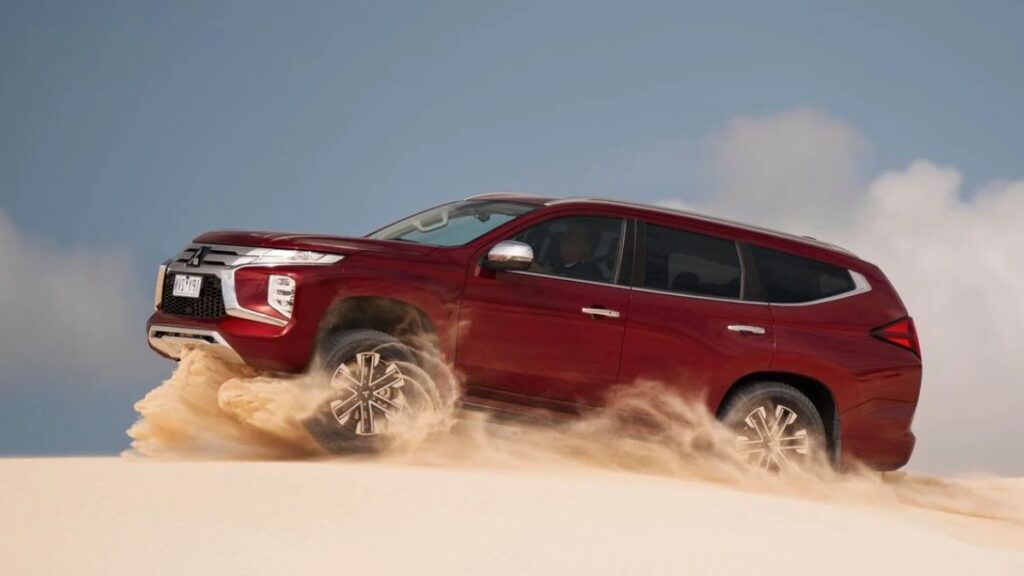
The Pajero Sport looks tough without trying too hard. It’s not as aggressive as a 4Runner, not as sleek as a Highlander. The front end has Mitsubishi’s Dynamic Shield design language,lots of black plastic and chrome in a geometric pattern. It’s not ugly, but it’s not particularly distinctive either.
The proportions are right for a body-on-frame SUV. It sits high, with good ground clearance and a squared-off roofline that prioritizes interior space over aerodynamics. The wheel arches are pronounced, giving it a planted stance, and the standard 18-inch wheels fill them out decently.
One thing I appreciate is the lack of fake vents and unnecessary styling gimmicks. No chrome exhaust tips that aren’t real or faux skid plates that wouldn’t protect anything. It’s functional design, which is refreshing.
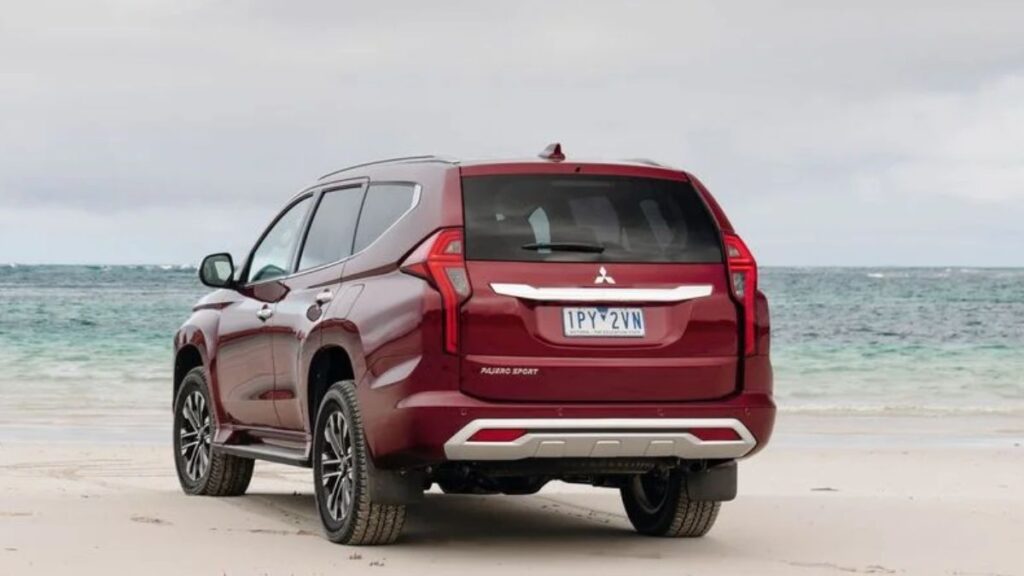
The rear end is upright and boxy, good for cargo space but nothing special aesthetically. The spare tire is mounted underneath instead of on the tailgate, keeping the rear profile clean.
Driving Experience
On smooth pavement, the Pajero Sport is competent but uninspiring. The steering is light but vague, body roll is noticeable in corners, and the suspension feels tuned more for durability than comfort. Highway driving exposes the compromises: wind noise around the mirrors and A-pillars, and the diesel engine drones at cruising speeds.
But take this thing off pavement, and suddenly everything makes sense. The suspension soaks up rocks and ruts without complaint. The ground clearance tackles obstacles that would scrape a crossover. The four-wheel-drive system, with a proper low-range gearbox, delivers the torque multiplication needed for steep climbs and loose surfaces.
The Super Select 4WD system is brilliant. Run in rear-wheel drive on dry pavement for better fuel economy, shift into four-wheel drive high for slippery conditions, and drop into four-low when things get serious. The center differential locks for maximum traction, and the rear differential has a limited-slip function to keep power where it’s needed.
On dirt roads, the Pajero Sport feels planted and confident. The long wheelbase helps stability, and the relatively short overhangs give you decent approach and departure angles. It’s not a Wrangler or a Land Cruiser, but it’s more capable than most people will ever need.
Towing is another strength. With a rated capacity around 6,800 pounds depending on the market, it handles decent-sized trailers without struggling. The diesel’s torque makes pulling grades easier, and the body-on-frame construction handles the weight better than a unibody crossover.
Performance and Acceleration
In most markets, the Pajero Sport comes with a 2.4-liter turbodiesel four-cylinder making around 181 horsepower and 317 lb-ft of torque. That’s not a lot of power, but the broad, flat torque curve makes it feel stronger than the numbers suggest.
Zero to 60 mph takes somewhere around 10 to 11 seconds,slow by modern standards but fine for a vehicle this size. The diesel’s power delivery is smooth, with minimal turbo lag once you’re rolling.
The eight-speed automatic does a decent job managing the engine’s narrow power band. It’s not the quickest-shifting gearbox, and it hunts for gears in stop-and-go traffic, but it’s smooth most of the time.
Some markets offer a gasoline 3.0-liter V6 making around 218 horsepower. It feels more refined but doesn’t offer the diesel’s low-end torque, which is what you really want in a vehicle like this.
The diesel’s real strength is efficiency. Depending on driving conditions, you can see fuel economy in the mid-to-high 20s on the highway, impressive for a vehicle this size and weight. Performance isn’t the Pajero Sport’s strong suit, and it doesn’t pretend to be. This is a vehicle built for torque and durability, not speed.
Ride Comfort and Cabin Luxury
Ride comfort is a mixed bag. On smooth roads, the Pajero Sport is fine,the suspension absorbs small bumps, and the seats are supportive enough for long drives. Hit a pothole or rough patch, and you’ll feel it. The body-on-frame construction and stiff suspension mean impacts transmit into the cabin more than they would in a unibody crossover.
The front seats are comfortable, with decent bolstering and enough adjustability. They’re heated and power-adjustable on higher trims, but not ventilated, which is a miss in hot climates.
The second row is spacious, with good legroom and headroom for adults. The seats slide and recline, and there are air vents and USB ports for rear passengers.
The third row is tight. Fine for kids or short trips, but adults will find it cramped. Legroom is minimal, the floor is raised, and entry and exit are awkward. This is typical for mid-size three-row SUVs, but worth noting if you plan to use that third row regularly.
Cabin noise is higher than you’d find in a modern crossover. The diesel engine is audible at idle and under acceleration, wind noise picks up at highway speeds, and road noise is noticeable on coarse pavement. It’s not terrible, but it detracts from refinement.
Interior Design and Luxury
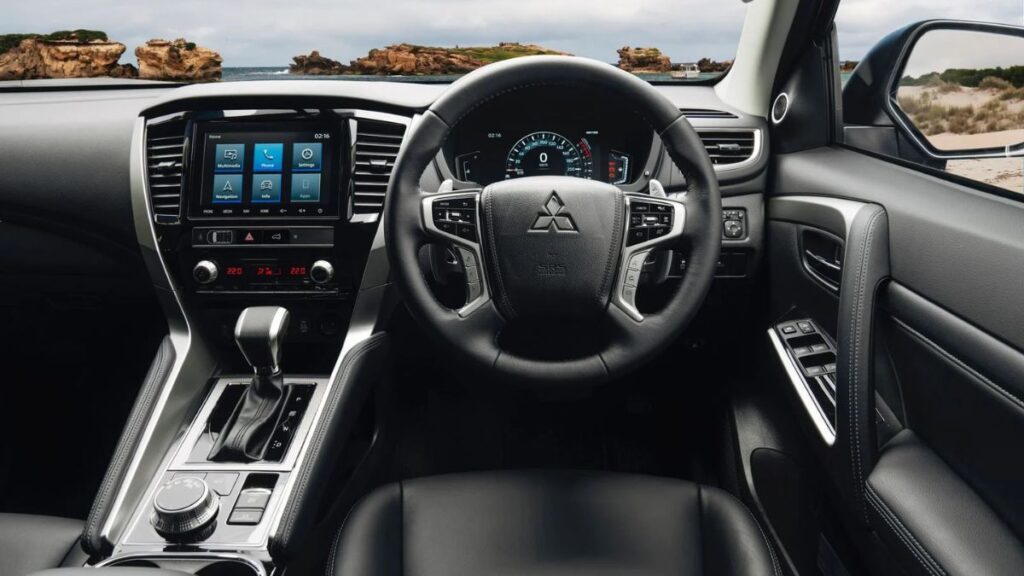
The Pajero Sport’s interior is functional, not fancy. Materials are mostly hard plastics, with some soft-touch surfaces on the dashboard and door panels. Everything feels durable and easy to clean, which matters more in a vehicle like this than premium materials.
The dashboard layout is straightforward, with clearly labeled buttons and controls. No fancy digital instrument cluster or touch-sensitive controlsو just traditional gauges, physical buttons, and a simple design that prioritizes usability. Some will find it refreshingly simple; others will think it looks dated.
Build quality is solid. Panels fit together well, and there are no creaks or rattles, even on rough roads. Mitsubishi has a reputation for durability, and the Pajero Sport’s interior feels like it will hold up to hard use.
One area where the interior falls short is ambient lighting and overall ambiance. No mood lighting, no premium touches, no sense of occasion. It’s a place to sit and drive, nothing more.
Technology and Infotainment
The infotainment system is basic. The 8-inch touchscreen is responsive enough, but the graphics are dated and the interface is clunky. Menus are buried in submenus, and simple tasks take more steps than they should.
Apple CarPlay and Android Auto are standard, which is the saving grace. Most people will plug in their phone and bypass Mitsubishi’s native system entirely. The sound system on base models is acceptable; higher trims get an upgraded system with more speakers, improving clarity and bass.
Navigation is available, but the maps are outdated and the routing isn’t as smart as what you’d get from Google Maps. Unless you’re off-grid without cell service, there’s no reason to use it.
Driver assistance features are present but not particularly advanced. Adaptive cruise control works, but it’s not as smooth as Honda or Toyota systems. Lane-keeping assist is more of a lane-departure warning. Automatic emergency braking is available but not as sensitive as the best systems in the class.
There’s no wireless charging, no Wi-Fi hotspot, no fancy digital displays. It’s a basic setup that gets the job done but doesn’t impress.
Fuel Consumption
Fuel economy is one of the Pajero Sport’s strengths, at least with the diesel engine. In mixed driving, expect around 22 to 24 mpg, competitive for a body-on-frame SUV. On the highway, that climbs to the mid-to-high 20s, impressive given the vehicle’s size and weight.
Around town, fuel economy drops to the high teens or low 20s. The diesel’s torque means you don’t have to work the engine hard, which helps keep consumption down.
The gasoline V6, where available, is less efficient, expect high teens combined, with low 20s on the highway.
The fuel tank holds around 18 gallons, giving you a decent range. With the diesel, you can easily cover 400 to 450 miles on a tank in highway driving.
Practicality and Storage
Cargo space is generous with the third row folded, around 45 cubic feet, enough for groceries, luggage, or camping gear. Fold down the second row, and that expands to over 80 cubic feet. With the third row up, cargo space shrinks to around 8 cubic feet, barely enough for a couple of backpacks.
The tailgate opens upward and is heavy, there’s no power liftgate option, which is disappointing at this price point. The load floor is relatively high, making lifting heavy items in and out a chore.
Towing capacity is around 6,800 pounds with the diesel, strong for the class. The truck-based chassis and robust suspension make it well-suited for towing trailers, boats, or campers. Integrated trailer sway control adds confidence when hauling heavy loads.
Roof rails are standard on most trims and are functional, not just decorative,they can support roof boxes or kayak racks.
Safety and Driver Assistance Systems
The Pajero Sport comes with a decent array of safety features, though it’s not class-leading. Standard equipment includes multiple airbags, stability control, traction control, and a rearview camera. Higher trims add blind-spot monitoring, rear cross-traffic alert, and parking sensors.
Crash test ratings vary by market, but the Pajero Sport generally scores well in frontal and side impacts. The body-on-frame construction provides a strong structure, though it’s not as crumple-zone optimized as modern unibody vehicles.
Advanced driver assistance systems are available but not particularly refined. Adaptive cruise control maintains a set distance from the car ahead but isn’t smooth in stop-and-go traffic. Lane-keeping assist provides steering inputs but is more reactive than proactive.
Hill descent control is useful for off-road driving, allowing you to crawl down steep slopes without touching the brake pedal. It’s not something you’ll use every day, but it’s reassuring when you need it.
Worthy Competitors
Toyota Fortuner: The most direct competitor. Similar construction, diesel options, and three-row seating. Better reliability reputation and stronger resale value, but more expensive.
Ford Everest: More refined interior and better tech. More comfortable on-road but not necessarily better off-road. Also pricier.
Isuzu MU-X: Even more utilitarian, with a focus on durability over comfort. Cheaper and just as capable, but the interior feels a step down.
Toyota 4Runner: The American equivalent, though larger and more expensive. Stronger off-road reputation but thirstier and less efficient.
Jeep Grand Cherokee: More refined on-road experience and wider range of engines. Less rugged than the Pajero Sport but more luxurious.
Key Strengths and Key Weaknesses
Biggest Strengths:
The Pajero Sport’s core strength is off-road capability. The Super Select 4WD system, body-on-frame construction, and robust suspension make it genuinely capable in tough conditions. The diesel engine’s efficiency and torque are standout features, making it practical for daily use and long-distance towing.
Biggest Weaknesses:
The interior feels dated. Materials are functional but cheap, the infotainment system is clunky, and the overall ambiance lacks polish. On-road refinement is also a weakness: stiff ride, noticeable noise, and vague steering. The third row is cramped, and the lack of a power liftgate is disappointing.
Conclusion: Is It Worth Buying?
The 2023 Mitsubishi Pajero Sport is worth buying if you need what it offers. It’s a capable, durable, and efficient body-on-frame SUV that doesn’t pretend to be something it’s not. If you tow regularly, drive on dirt roads, or want something that will last 200,000 miles without complaint, this is a solid choice.
But if you’re looking for a comfortable, refined, tech-forward family hauler, there are better options. The Pajero Sport’s strengths are very specific, and they won’t matter to most buyers in the mid-size SUV segment.
For the right buyer, this is one of the best values in the segment. For everyone else, it’s easy to overlook. The question is which category you fall into.
FAQ
Is the Mitsubishi Pajero Sport available in the United States?
No, the Pajero Sport is not officially sold in the U.S. market. It’s primarily available in Australia, Southeast Asia, the Middle East, and some parts of South America.
What kind of fuel economy does the Pajero Sport get?
With the 2.4-liter turbodiesel, expect around 22 to 24 mpg combined, with mid-to-high 20s on the highway. The gasoline V6 is less efficient, averaging high teens combined.
How capable is the Pajero Sport off-road?
Very capable. The Super Select 4WD system, body-on-frame construction, and good ground clearance make it one of the more competent off-road vehicles in the mid-size SUV class.
Is the third row usable for adults?
Not really. It’s fine for kids or short trips, but adults will find it cramped. Legroom and entry/exit are both challenging.
How does the Pajero Sport compare to the Toyota Fortuner?
They’re very similar in capability and layout. The Fortuner has a stronger reputation for reliability and better resale value, but the Pajero Sport is often cheaper and just as capable off-road.