The 2023 Mazda MX-30 EV represents one of the most ambitious and controversial vehicles Mazda has produced in recent years. As the brand’s first fully electric vehicle in the United States, the MX-30 arrived with a mission that differed dramatically from almost every rival in the growing EV market. Instead of pursuing the longest range or the biggest battery, Mazda focused on delivering something it believed had become increasingly rare: a compact crossover that prioritized design, craftsmanship, driving enjoyment, and sustainability.
At first glance, that philosophy makes a great deal of sense. The MX-30 looks fantastic. Its proportions are clean, its styling remains elegant years after launch, and it avoids the exaggerated futuristic themes that quickly date many electric vehicles. Even today, it feels more mature and sophisticated than numerous competitors that rely heavily on aggressive lighting signatures and oversized displays to create visual impact.
The same philosophy continues inside the cabin. Mazda approached the interior as a living space rather than a technology showcase. Recycled materials, cork accents, thoughtful ergonomics, and impressive build quality create an environment that immediately feels more premium than its price tag suggests. Few compact electric crossovers offer the same level of warmth and character.
Unfortunately, great design alone is rarely enough to succeed in the electric vehicle segment. Buyers expect an EV to fit seamlessly into their daily lives, whether that means commuting, road trips, family duties, or weekend travel. This is where the MX-30 begins to face challenges. While it succeeds in delivering the refinement and driving character that Mazda enthusiasts appreciate, it asks owners to accept compromises that many competing EVs simply do not require.
That reality makes the 2023 Mazda MX-30 EV one of the most fascinating vehicles to evaluate. It is neither a complete failure nor a hidden gem. Instead, it is a well-engineered crossover built around a philosophy that many buyers may admire but few are ultimately willing to embrace. Understanding whether that philosophy works is what truly defines the MX-30 ownership experience.
Our Take
The 2023 Mazda MX-30 EV feels like a vehicle created by engineers and designers who genuinely cared about how a car should feel rather than how it should look on a specification sheet.
There is a level of craftsmanship here that immediately stands out. The cabin materials feel richer than expected, the controls operate with precision, and the overall driving experience reflects Mazda’s long-standing commitment to refinement. Unlike many affordable EVs that prioritize efficiency above all else, the MX-30 delivers a sense of polish that makes everyday driving more enjoyable.
However, the automotive market ultimately judges electric vehicles differently than conventional crossovers. Buyers may appreciate beautiful design and premium materials, but they also expect flexibility and convenience. The MX-30’s biggest challenge is that its strengths appeal primarily to the heart while its limitations affect daily ownership.
As a result, the MX-30 becomes a difficult vehicle to recommend broadly. Some drivers will appreciate its uniqueness and character, while others will struggle to justify its compromises when alternative EVs offer greater practicality. It remains one of the most distinctive electric crossovers of its generation, but also one of the most polarizing.
Pros & Cons
Pros
- Elegant exterior styling that still looks fresh today
- Premium cabin quality with sustainable materials
- Comfortable and refined everyday driving experience
- Precise steering and balanced handling
- Quiet cabin with excellent overall refinement
- Strong list of standard safety features
- Distinctive character compared with many mainstream EVs
Cons
- Limited driving range compared with rivals
- Rear-seat space is tighter than expected
- Rear-hinged doors reduce everyday practicality
- Cargo space trails several competitors
- Modest acceleration for an electric vehicle
- Restricted market availability when new
- Difficult value proposition against competing EVs
What’s New for 2023?
Mazda carried the MX-30 EV into the 2023 model year with very few significant changes. The overall formula remained intact, including the same electric powertrain, battery configuration, distinctive freestyle rear doors, and premium-focused cabin design.
The most notable update was a slight increase in pricing across the lineup. Buyers could still choose between the standard MX-30 EV and the more feature-rich Premium Plus trim, both of which remained generously equipped with advanced driver-assistance technologies and premium comfort features.
While many competitors spent this period improving battery capacity, charging performance, and overall range, Mazda chose to leave the MX-30 largely unchanged. That decision helped preserve the vehicle’s original identity but also meant that it entered 2023 facing even stronger competition from newer and more capable electric crossovers.
Exterior Design
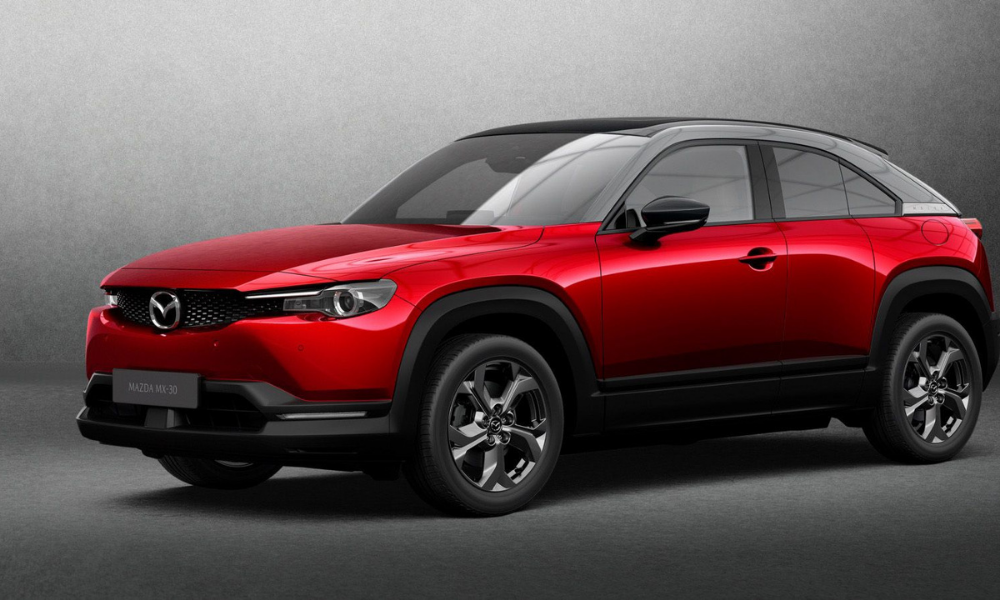
The 2023 Mazda MX-30 EV proves that an electric vehicle does not need exaggerated styling to attract attention. While many manufacturers used sharp edges, oversized light signatures, and futuristic details to emphasize their transition toward electrification, Mazda followed a far more restrained approach. The MX-30 looks modern without feeling experimental, and that decision has allowed its design to age remarkably well.
Viewed from the front, the MX-30 immediately feels familiar to anyone who appreciates Mazda’s design language. The slim headlights, clean surfaces, and carefully sculpted bodywork create a sense of sophistication that many competitors struggle to achieve. Rather than announcing itself as an electric vehicle from every angle, the MX-30 simply presents itself as an attractive crossover that happens to be powered by electricity.
The most distinctive feature is undoubtedly the rear-hinged freestyle doors. Inspired by the RX-8 sports car, these doors give the MX-30 a unique visual identity and create a dramatic first impression whenever they are opened. They help separate the vehicle from an increasingly crowded EV segment where many crossovers are beginning to look interchangeable.
However, good design is not always synonymous with practicality. The same rear doors that make the MX-30 memorable can become inconvenient in everyday situations. Rear passengers depend on the front doors being opened first, which can complicate entry and exit in tight parking spaces. It is a solution that prioritizes character over convenience.
Even so, the overall design succeeds because it feels authentic. Nothing about the MX-30 appears forced or artificial. It remains one of the few affordable electric crossovers that looks elegant rather than trendy, and that distinction gives it lasting appeal long after many competitors have begun to feel dated.
Driving Experience
The driving experience is where the MX-30 most clearly demonstrates Mazda’s priorities. While many electric vehicles focus on straight-line acceleration and instant power delivery, the MX-30 concentrates on balance, predictability, and driver confidence. It feels engineered by people who value how a vehicle behaves on a winding road rather than how quickly it reaches highway speeds.
Around town, the MX-30 feels light, responsive, and exceptionally easy to place on the road. Visibility is generally good, steering inputs are precise, and the vehicle responds naturally to driver commands. The compact dimensions make navigating crowded urban environments surprisingly stress-free, which aligns perfectly with Mazda’s intended mission for the vehicle.
What stands out most is the consistency of its behavior. The MX-30 never feels nervous or unsettled. Weight transfers are controlled, body movements remain composed, and the chassis communicates clearly without becoming harsh. Drivers familiar with Mazda’s reputation for engaging handling will immediately recognize the brand’s influence in the way the MX-30 approaches corners and changes direction.
Unlike some electric vehicles that isolate drivers from the road entirely, the MX-30 maintains a degree of connection that makes daily driving more enjoyable. It may not deliver breathtaking acceleration, but it offers something many competitors overlook: a sense of involvement. The result is a vehicle that feels natural from the first mile rather than one that relies solely on impressive performance figures.
For drivers who appreciate refinement and control more than outright speed, the MX-30 remains one of the more rewarding compact EVs to drive. Its dynamic character feels intentional, mature, and distinctly Mazda.
Performance & Acceleration
The 2023 Mazda MX-30 EV approaches performance from a fundamentally different perspective than many electric vehicles. Rather than overwhelming drivers with instant acceleration, Mazda focused on creating smooth and predictable power delivery that complements the vehicle’s urban-focused mission.
The electric motor delivers power in a progressive manner that feels easy to manage in everyday driving. Pulling away from traffic lights is effortless, merging into traffic rarely requires drama, and the MX-30 maintains enough responsiveness to feel confident during normal commuting situations. The powertrain operates quietly and smoothly, reinforcing the premium character of the vehicle.
Drivers expecting the explosive acceleration often associated with EVs may find the MX-30 somewhat conservative. It does not deliver the sudden surge of torque that has become common among modern electric crossovers. Instead, acceleration builds gradually, prioritizing refinement over excitement. Some buyers may view this as a weakness, while others will appreciate the calmer and more predictable driving experience.
Interestingly, this approach fits the MX-30’s overall personality. The vehicle never attempts to portray itself as a performance-oriented EV. Every aspect of its engineering suggests a focus on comfort, balance, and ease of use rather than outright speed. In that context, the powertrain feels appropriately matched to the vehicle’s character.
Ultimately, performance is adequate rather than thrilling. The MX-30 will not impress buyers searching for rapid acceleration, but it provides enough capability to handle daily driving comfortably while maintaining the refined demeanor that defines the rest of the vehicle.
Ride Comfort & Cabin Refinement
If there is one area where the 2023 Mazda MX-30 EV consistently exceeds expectations, it is ride quality and overall refinement. From the moment the vehicle begins moving, it becomes clear that Mazda invested significant effort into creating a calm and comfortable environment for both driver and passengers.
Road imperfections are absorbed with impressive composure. The suspension strikes an effective balance between comfort and control, allowing the MX-30 to remain comfortable on rough pavement without feeling disconnected from the road. Smaller bumps are filtered out smoothly, while larger impacts are handled with a level of sophistication that feels closer to a premium vehicle than an entry-level EV.
The cabin itself contributes significantly to this sense of refinement. Wind noise is well managed at highway speeds, road noise remains reasonably subdued, and the electric powertrain operates with minimal intrusion. Together, these qualities create a relaxed atmosphere that encourages longer journeys, even if the vehicle’s range limitations may discourage them.
Seat comfort is another strength. The front seats provide excellent support for everyday driving and maintain their comfort during extended periods behind the wheel. Mazda’s attention to ergonomics is evident throughout the cabin, from the driving position to the placement of controls and storage areas. Everything feels thoughtfully designed rather than simply assembled.
Perhaps most importantly, the MX-30 possesses a sense of maturity that many rivals lack. Instead of impressing occupants with oversized screens or flashy technology demonstrations, it creates a feeling of quality through craftsmanship, material selection, and careful engineering. That approach may not generate headlines, but it contributes significantly to the vehicle’s appeal and helps justify its premium positioning.
Interior & Luxury Feel
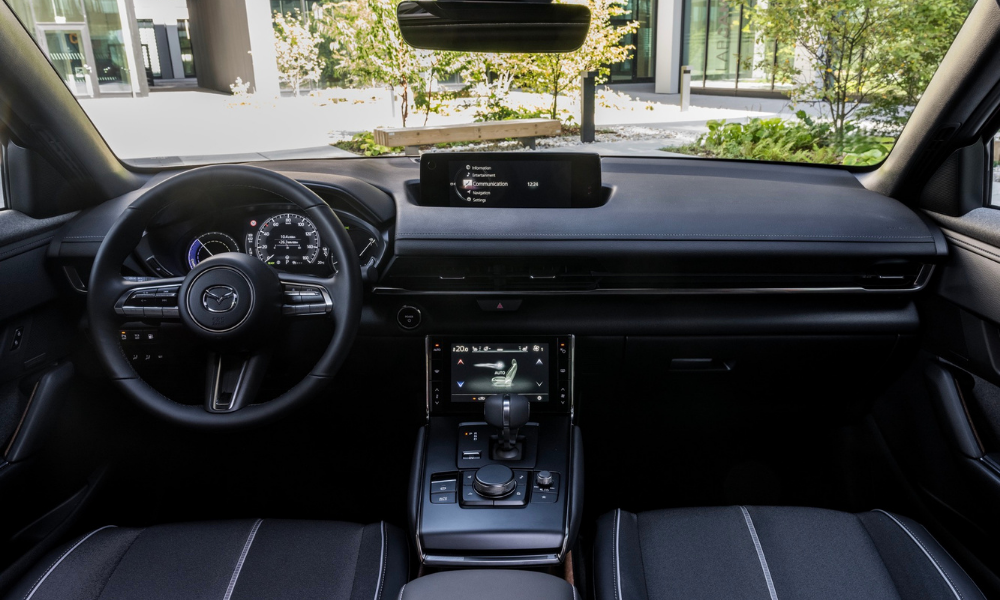
The 2023 Mazda MX-30 EV delivers one of the most distinctive interiors in the compact EV segment. Rather than following the increasingly common formula of replacing every physical control with a large screen, Mazda focused on creating an environment that feels inviting, tactile, and genuinely premium. The result is a cabin that feels more expensive than its price suggests.
The first thing most drivers notice is the quality of the materials. Soft-touch surfaces appear throughout the cabin, while the unique cork trim immediately gives the MX-30 a personality of its own. The cork is not simply a styling gimmick. It serves as a subtle reminder of Mazda’s history while helping create an atmosphere that feels warmer and more natural than many technology-focused competitors.
The floating center console further enhances the feeling of openness. Combined with the clean dashboard design, it gives the cabin a modern appearance without becoming visually overwhelming. Unlike some EVs that prioritize minimalism at the expense of usability, the MX-30 manages to feel contemporary while remaining practical.
Rear-seat accommodations are less impressive. While the front occupants enjoy a comfortable and premium environment, passengers in the second row may find space somewhat limited. This is especially noticeable during longer trips where competing crossovers provide a more accommodating rear cabin.
Even with those limitations, the MX-30 remains one of the most interesting interiors in its class. Its focus on craftsmanship and thoughtful design creates a stronger emotional connection than many rivals that rely solely on technology to impress buyers.
Technology & Infotainment
Mazda has always approached infotainment differently than many competitors, and the MX-30 continues that philosophy. Instead of placing every function behind a touchscreen, Mazda combines a central display with a rotary controller and physical shortcut buttons. While this approach may initially require an adjustment period, it often becomes easier to use over time.
The infotainment display is positioned high on the dashboard, allowing drivers to access information without significantly taking their eyes off the road. Navigation through menus is logical, and the system avoids unnecessary visual clutter. It may not appear as flashy as some newer EV interfaces, but it generally succeeds in delivering a straightforward user experience.
A second screen dedicated to climate controls adds a modern touch without eliminating important physical interactions. This layout helps separate driving functions from entertainment features, reducing distractions while maintaining a clean interior design.
Apple CarPlay and Android Auto integration ensure compatibility with modern smartphones, allowing owners to access navigation, music, and communication features through familiar interfaces. For many drivers, these integrations will become the primary technology features used on a daily basis.
While the MX-30 may not offer the most advanced infotainment system in the EV market, it reflects Mazda’s broader philosophy of prioritizing usability over spectacle. The technology feels designed to support the driving experience rather than dominate it.
Fuel Economy, Charging & Electric Range
The 2023 Mazda MX-30 EV occupies a unique position in the electric vehicle landscape because it challenges conventional expectations regarding battery size and driving range. Mazda intentionally selected a smaller battery pack than many competitors, arguing that most daily driving needs can be satisfied without carrying hundreds of miles of unused range.
In practice, this philosophy creates both advantages and disadvantages. A smaller battery contributes to reduced weight, improved efficiency, and shorter charging sessions. Drivers who primarily operate within urban environments may find that the MX-30 comfortably handles their daily routines without requiring frequent charging stops.
However, the reality of EV ownership extends beyond routine commuting. Flexibility matters, and this is where the MX-30 faces its greatest challenge. Competing electric crossovers often provide significantly more freedom for spontaneous travel, weekend trips, and longer commutes. Buyers must carefully evaluate whether the MX-30’s range aligns with their lifestyle before making a purchase decision.
Charging performance is generally straightforward, and the relatively modest battery capacity allows replenishment times that compare favorably with some larger EVs. Home charging remains the most convenient solution and will likely satisfy the needs of most owners.
Ultimately, the MX-30 asks buyers to embrace a different philosophy of electric mobility. Some drivers will appreciate that approach, while others may prefer the greater flexibility offered by longer-range alternatives.
Practicality & Cargo Space
Practicality is an area where the MX-30 delivers mixed results. As a compact crossover, it provides many of the everyday benefits buyers expect from the segment, including an elevated seating position, useful cargo access, and manageable exterior dimensions.
The cargo area is well designed and easy to access thanks to the wide rear hatch opening. Loading groceries, luggage, and everyday items is generally straightforward, and the low lift-over height helps reduce effort when handling heavier objects. For daily errands and urban use, the cargo space proves perfectly adequate.
The challenge appears when compared with some of the segment’s most practical competitors. Several rival electric crossovers offer larger cargo areas, more rear-seat space, and greater overall flexibility. Families with growing storage needs may find themselves wishing for additional room.
The rear-hinged freestyle doors create another practical compromise. They add visual character and help distinguish the MX-30 from competitors, but they can become less convenient when loading passengers in tight parking spaces or crowded environments.
For singles, couples, and urban drivers, the MX-30’s practicality will likely prove sufficient. For larger families or buyers prioritizing maximum utility, several competitors provide more accommodating packaging solutions without significantly increasing vehicle size.
Safety & Driver Assistance
The 2023 Mazda MX-30 EV reflects Mazda’s long-standing commitment to safety by offering a comprehensive suite of driver-assistance technologies as standard equipment. Rather than reserving important safety features for expensive option packages, Mazda equipped the MX-30 with many of the systems modern buyers expect from a premium crossover.
On the road, these technologies operate in a manner consistent with the vehicle’s overall character. The various assistance systems work quietly in the background, providing support without becoming intrusive. Lane-keeping assistance, adaptive cruise control, blind-spot monitoring, and automatic emergency braking all contribute to a more confident driving experience while preserving the driver’s sense of control.
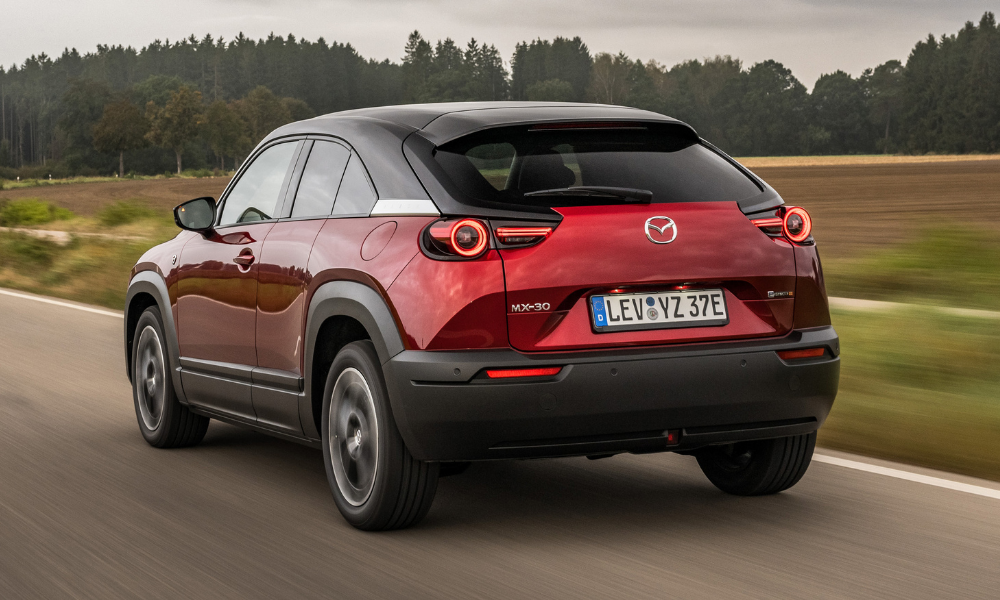
Visibility is generally good from the driver’s seat, although the thick rear pillars required by the freestyle door design can create some limitations when looking over the shoulder. Fortunately, modern driver-assistance technologies help compensate for these blind spots and improve overall awareness in traffic.
What stands out most is that the MX-30 feels engineered around accident prevention rather than simply achieving strong test scores. The safety systems are well integrated into the driving experience and rarely feel overly aggressive. That refinement helps reduce fatigue during daily commuting and reinforces the premium character found throughout the vehicle.
For buyers prioritizing safety, the MX-30 remains competitive despite its age. It may not introduce groundbreaking new technology, but it delivers the core safety features most drivers use every day while maintaining the balanced driving experience Mazda is known for.
Competitors Worth Considering
The electric vehicle market evolved rapidly during the MX-30’s lifespan, which means buyers have several strong alternatives worth considering. The most direct competitor is the Nissan Leaf, a long-standing EV that offers practical transportation, proven reliability, and broader availability. While the Leaf’s interior lacks some of the MX-30’s premium touches, it remains one of the most accessible electric vehicles on the market.
The Hyundai Kona Electric presents another compelling alternative. It combines impressive efficiency, everyday practicality, and a significantly more versatile ownership experience. Buyers focused on maximizing electric range will likely find the Kona Electric easier to live with over the long term.
The Chevrolet Bolt EV and Bolt EUV also deserve serious consideration. Both vehicles built strong reputations by delivering excellent electric range, practical packaging, and competitive pricing. Even years after launch, they remain benchmarks for value in the affordable EV segment.
For buyers who appreciate Mazda’s design philosophy but are not fully committed to an electric vehicle, several models from the brand’s own lineup deserve attention. The Mazda3 offers a more engaging driving experience in a compact package, while the CX-30 provides crossover practicality with familiar Mazda refinement. Buyers needing additional passenger and cargo space may also want to explore the CX-5 or the larger CX-50.
Those seeking a more premium family-focused Mazda can look toward the CX-90, which delivers significantly greater versatility and performance. While none of these vehicles directly replace the MX-30‘s electric powertrain, they represent alternatives for shoppers who value Mazda’s approach to design and driving dynamics but require fewer compromises in everyday use.
Which Trim Does Cardrav Recommend?
The base 2023 Mazda MX-30 EV represents the strongest value within the lineup.
Mazda equipped even the standard model with an impressive collection of comfort, convenience, and safety features, making it feel far from entry-level. Buyers still receive the premium cabin materials, distinctive design, advanced driver-assistance technologies, and the same overall driving experience that defines the MX-30.
The Premium Plus trim adds several desirable luxury touches, including additional convenience features and upgraded technology. While these enhancements certainly improve the ownership experience, they do not fundamentally change the vehicle’s capabilities. The MX-30’s strengths and limitations remain largely the same regardless of trim level.
Because of that reality, spending additional money on the higher trim becomes difficult to justify for many buyers. The standard model already delivers the qualities that make the MX-30 appealing in the first place. For shoppers determined to own an MX-30 EV, the base trim offers the best balance between equipment, value, and overall ownership satisfaction.
Final Verdict: Should You Buy It?
The 2023 Mazda MX-30 EV is one of the most unusual electric vehicles of the modern era. It succeeds brilliantly in some areas while struggling significantly in others. Its elegant design, premium cabin, refined ride quality, and thoughtful attention to detail make it feel more sophisticated than many similarly priced competitors.
At the same time, purchasing an electric vehicle involves practical considerations that cannot be ignored. Buyers expect flexibility, convenience, and confidence in a wide range of driving situations. The MX-30’s philosophy asks owners to accept limitations in exchange for style, craftsmanship, and a uniquely Mazda driving experience.
For a specific type of buyer, that trade-off may be perfectly acceptable. Drivers with predictable daily routines, reliable home charging, and an appreciation for Mazda’s design philosophy may find the MX-30 genuinely enjoyable to own. Few electric crossovers possess the same personality or sense of craftsmanship.
For most shoppers, however, the market offers stronger overall choices. Several competitors provide greater practicality, broader usability, and better long-term value without sacrificing comfort or technology. The MX-30 remains a fascinating experiment and an important chapter in Mazda’s electrification journey, but it is ultimately easier to admire than it is to recommend.
The 2023 Mazda MX-30 EV is a good Mazda and an interesting EV. Unfortunately, it never quite becomes a great electric crossover.
FAQ
Is the 2023 Mazda MX-30 EV a good first electric vehicle?
That depends entirely on how you plan to use it. The MX-30 works best for drivers with predictable daily routines, access to home charging, and relatively short commutes. If your driving habits rarely change and you value design, comfort, and refinement more than outright range, the MX-30 can be an enjoyable introduction to EV ownership. However, buyers who frequently travel long distances may find other electric crossovers easier to live with.
Why did Mazda give the MX-30 a smaller battery than most competitors?
Mazda’s engineers followed a different philosophy than many EV manufacturers. Instead of maximizing battery size, they focused on reducing weight, improving efficiency, preserving driving dynamics, and lowering the environmental impact associated with battery production. While that approach helped create a lighter and more engaging vehicle, it also resulted in one of the shortest driving ranges in the segment.
Are the MX-30’s freestyle rear doors practical in everyday use?
The answer depends on your lifestyle. The rear-hinged doors certainly make the MX-30 stand out visually and help create a unique ownership experience. However, they require the front doors to be opened first, which can become inconvenient in tight parking spaces or busy urban environments. Families with young children may find traditional rear doors easier to use on a daily basis.
How does the 2023 Mazda MX-30 EV compare with the Hyundai Kona Electric and Nissan Leaf?
The MX-30 focuses more heavily on premium design, cabin quality, and driving refinement. The Hyundai Kona Electric and Nissan Leaf generally offer greater practicality and broader usability, particularly for buyers who prioritize electric range and flexibility. The Mazda feels more upscale inside, while its rivals often provide stronger value from a purely functional standpoint.
Is the 2023 Mazda MX-30 EV likely to age well?
From a design perspective, absolutely. The MX-30’s styling avoids many of the trendy elements that quickly make vehicles feel outdated. Its interior materials, elegant proportions, and minimalist approach should remain attractive for years. The larger question concerns technology and range expectations, as the EV market continues to advance rapidly and newer competitors offer increasingly greater capabilities.
What is the biggest strength of the 2023 Mazda MX-30 EV?
Its character. Many affordable EVs focus almost entirely on specifications, while the MX-30 prioritizes craftsmanship, comfort, design, and driving feel. The result is a vehicle that feels more personal and distinctive than many competitors. Even buyers who ultimately choose another EV often come away impressed by how thoughtfully the MX-30 has been designed.
What is the biggest weakness of the 2023 Mazda MX-30 EV?
The vehicle’s overall flexibility. The MX-30 performs well when used within the specific role Mazda envisioned, but ownership becomes more challenging when drivers expect it to handle every scenario. That limitation narrows its audience considerably compared with more versatile electric crossovers.