A crossover SUV with five seats, the 2023 Jaguar F-Pace has a 113.1-inch wheelbase. There are four possible trim options and three different engines. A 2.0-liter, 16-valve inline four-cylinder with 246 horsepower powers the P 250 and P 250 S. A mild hybrid 3.0-liter, 24-valve inline-six with 395 horsepower is available for the R-Dynamic S 400. A high-performance model called the SVR is also available. It has a twin-supercharged, 5.0-litre, 32-valve V8 engine that produces 550 horsepower. All variants of the F-Pace have all-wheel drive.
The F-Pace P 250 has a base price of $53,550 (destination included). It is increasingly commonplace to use satellite navigation with What3Words software. Perforated leather seats, a motorized liftgate in the back, the Pivi Pro infotainment system, traffic sign recognition technology, and an adaptive speed limiter are all included in the P 250 S ($57,150).
The 149 more horsepower and the sport-tuned suspension account for a large portion of the R Dynamic S 400’s higher cost ($65,950). It sports unusual 19-inch wheels as well. From there, the F-Pace SVR ($90,650) represents a massive increase in both power and cost. It boasts 155 more horsepower than the R Dynamic S, 304 more than the P 250 and P 250 S, and unique 20-inch wheels. The inside is a mix of leather, suede, and fabric, and the front performance seats are heated and chilled.
Direct rivals of the Jaguar F-Pace among luxury crossover SUVs in this size range are the Audi Q5, BMW X3, and Porsche Macan. The introductory price of the Audi Q5 is $46,695, and the base price of the BMW i3 is $46,395, much cheaper than the $53,550 base Jaguar F-Pace P 250. This price difference persists through all trim levels. Except for the hot-rod GTS, which costs roughly $5,000 less than the F-Pace SVR, the Porsche Macan is more expensive than the Jaguar in every model. However, the Jaguar outperforms the Porsche by 116 horsepower.
We drove an F-Pace SVR for a week and found it significant, cozy, and quiet, until you stepped on the gas, delightful growl results from doing that. There is an option that allows you to increase the exhaust’s volume, although doing so can attract the notice of the local authorities. The SVR has improved handling and braking to match the available power. The SVR seems to be a top-tier luxury SUV when driven, usually lightly.
The F-Pace SVR’s split personality could be its best quality. The driver chooses whether to engage in exuberant bursts of speed and handling or be pampered by a luxury vehicle. What distinguishes it from the most popular versions of the X3 and Macan, which often focus only on sport?
Pros & Cons
Pros
- Distinctive styling compared with German rivals
- Spacious cargo area
- Strong engine lineup including the SVR V8
- Comfortable ride quality
- Premium interior materials
Cons
- Base engine feels slower than competitors
- Higher ownership and insurance costs
- Limited crash-test data available
- Infotainment system still trails some rivals
- SVR pricing is difficult to justify
| Specification | 2023 Jaguar F-Pace |
|---|---|
| Engine | 2.0L Turbo I4 / 3.0L Mild-Hybrid I6 / 5.0L Supercharged V8 |
| Horsepower | 246–550 hp |
| Torque | Up to 516 lb-ft |
| Drivetrain | AWD |
| Transmission | 8-Speed Automatic |
| Fuel Economy | 17–24 MPG Combined |
| Seating | 5 Passengers |
| Cargo Capacity | Up to 65 cu ft |
| Starting MSRP (2023) | $53,550 |
Our Take
The 2023 Jaguar F-Pace remains one of the most distinctive luxury compact SUVs on the market. While competitors such as the BMW X3, Audi Q5, and Porsche Macan dominate sales charts, the F-Pace offers something increasingly rare: character.
Its styling still feels fresh, the interior delivers genuine luxury, and the available six-cylinder and SVR V8 engines provide impressive performance. The downside is that the entry-level four-cylinder model struggles to match the pace set by German rivals, and ownership costs remain higher than average.
For buyers seeking a luxury SUV that stands out from the crowd rather than blending into it, the F-Pace remains a compelling alternative.
Performance:
The basic F-Pace seems to be a good match for the Audi Q5, BMW X3, and Porsche Macan models. However, the Jaguar is hefty and loses more than a second to the Audi and almost a second to the BMW and Porsche in 0-60 times. The horsepower figures for the 6-cylinder variants of each car are equally comparable, yet the Jag accelerates to 60 mph at least half a second more slowly than any of them. Only when paying for the SVR can the F-Pace beat the BMW X3 M, which costs about $17,000 less, in the dash to 60 mph, clocking in at 3.8 seconds. The steering accurately reacts to inputs, but there is more of a sensation of heaviness than any actual connection to the road. Given the size and weight of the Jag, the brakes are more than sufficient.
Fuel efficiency:
With an average of 23 miles per gallon across its entire lineup, Audi beats Jaguar, BMW, and Porsche for the honors in fuel efficiency. The Porsche Macan GTS achieves 19 miles per gallon in its high-performance trims, while the BMW X3 M and Jaguar F-Pace SVR average 17 miles per gallon.
The four-cylinder F-Pace gets 24 mpg combined, 22 in the city and 27 on the interstate. The P340 and P400 versions, which use 3.0-liter mild hybrid engines, get 22 mpg combined, 20 mpg in the city, and 22 mpg on the highway (1 mpg less for the P400 city and highway). Last but not least, the EPA rates the F-Pace SVR at 17 mpg combined, 15 towns and 21 streets.
Safety and driver support technology:
Neither the National Highway Traffic Safety Administration nor the Insurance Institute for Highway Safety have given the Jaguar F-Pace a crash test grade. Additionally, neither the Australian ANCAP nor the Euro NCAP has rated it. Despite this, it has a comprehensive set of driver-assistance safety technologies and would presumably crash well based only on mass. For a vehicle of its size, it offers excellent visibility as well. No accident data, however, lowers its overall rating. Porsche lacks crash test information for the Macan as well. Still, the NHTSA has given the Audi Q5 and BMW X3 5-star ratings, and the Insurance Institute for Highway Safety has given both vehicles an excellent overall grade.
Forward collision warning, automated emergency braking, blind-spot detection, rear cross-traffic alert, lane departure warning, lane-keeping assistance, and automatic high lights are all included in the standard safety technology. The options include parking assistance, a head-up display, traffic sign recognition, and adaptive cruise control.
Comfort and Space
The Q5’s back seat has eight-tenths of an inch more legroom than the F-Pace’s, the second roomiest of the rivals. On the other hand, the Jag boasts more excellent back legroom than the X3 by eight-tenths of an inch and more than an inch and a half more than the Macan. Front seat comfort is outstanding, even with the bolsters in the SVR variant we tried, indicating the F-Pace would be a decent option for extended road trips.
Infotainment: Jaguar F-Pace
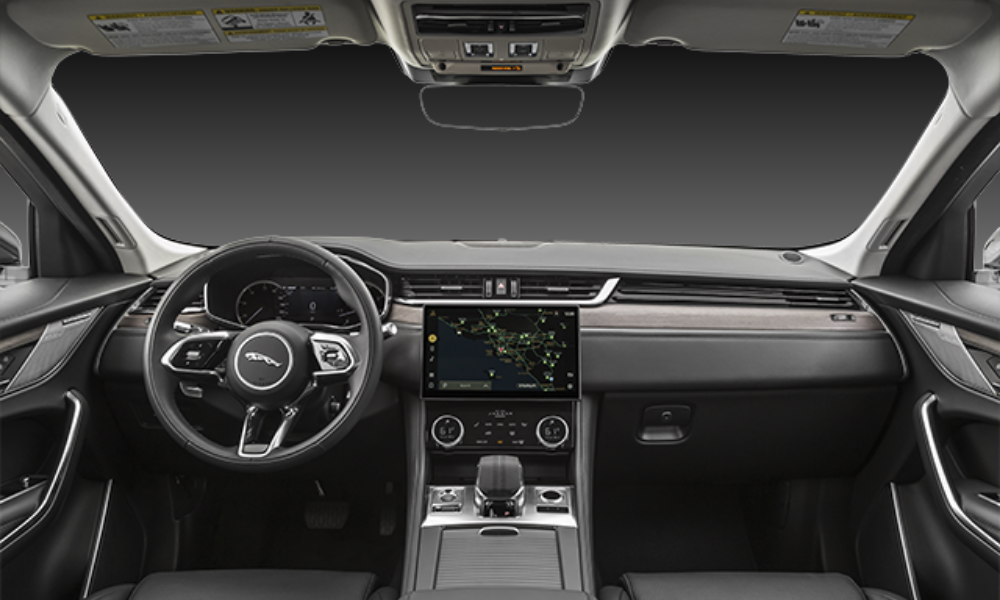
Jaguar made a 14-speaker, 380-watt Meridian audio system with a twin subwoofer standard in all grades when it updated the F-Pace in 2021. It has an 11.4-inch touchscreen for operation and is Apple CarPlay and Android Auto compatible. Devices may now be charged wirelessly. We had no connectivity troubles, and inputs were rewarded with prompt answers.
Storage & Cargo Space:
The Jaguar F-Pace has 65 cubic feet of cargo space when the second row of seats is folded flat, outpacing the competition. The Audi Q5 and Porsche Macan are much behind, coming in at 54.1 and 53.0, respectively, while the BMW X3 comes in second with 62.7. The Audi has a tiny edge over the Jaguar with the second row in place (38.0 to 37.2 cubic feet), while the BMW and Porsche each have 36.4 and 35.6 cubic feet, respectively.
Design: Jaguar F-Pace
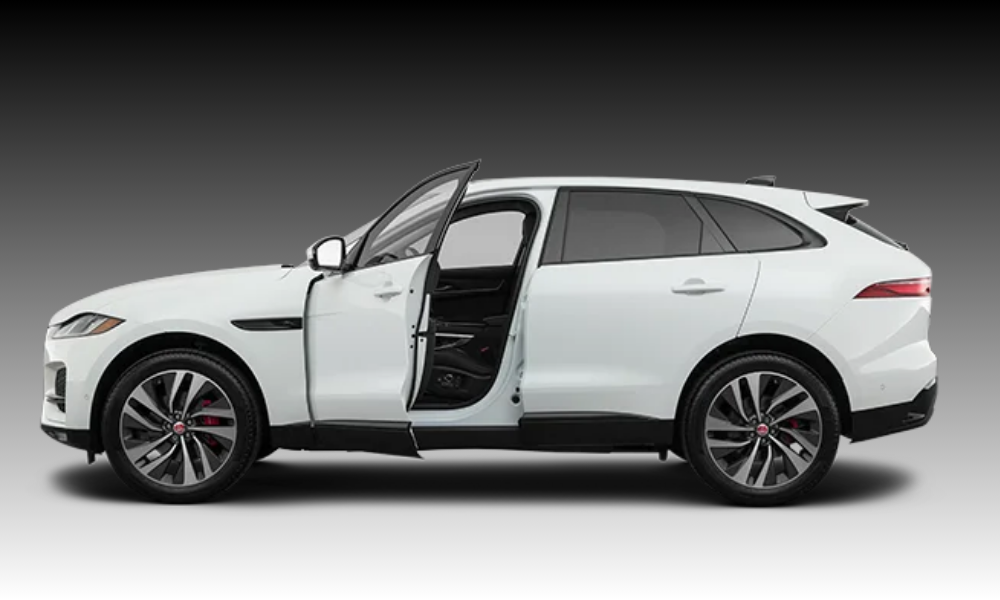
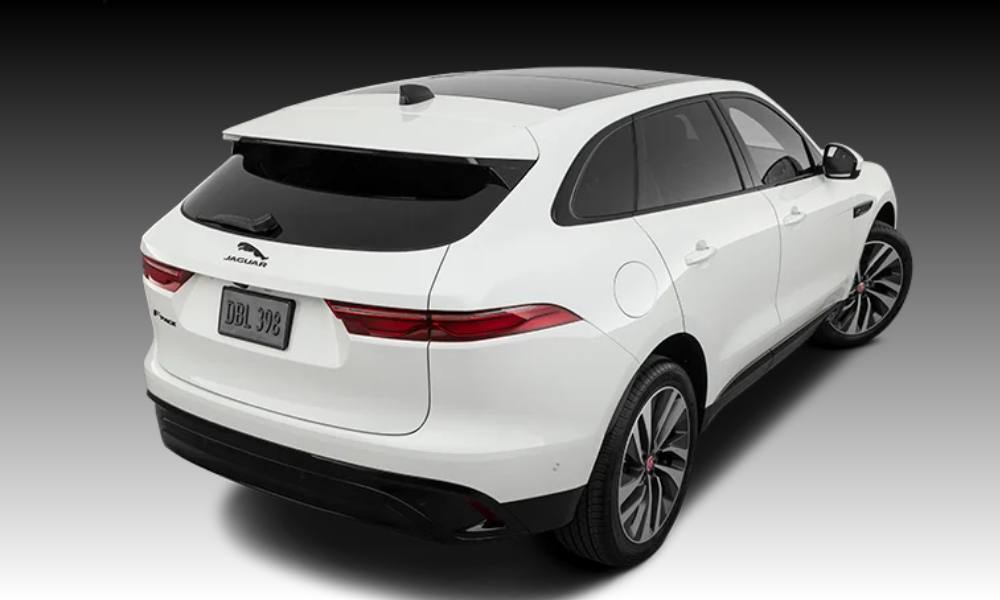
With minor creases around the lower body, cat-like LED headlights, and a prominent, aggressive grille with tiny air intakes on each side, the F-Pace stands apart from the standard design of a crossover SUV. The F-Pace also has a threatening appearance from behind, thanks to prominent twin exhausts. The F-Pace looks like a performance car, even in more affordable variants. The uniqueness of the F-Pace, which is less popular than the Audi and BMW in many areas, contributes to its appeal.
Which Trim Does CarDrav Recommend?
If value is your priority, the P250 S offers the best balance of luxury features and pricing. However, our choice would be the R-Dynamic S 400.
The mild-hybrid six-cylinder engine transforms the driving experience, delivering substantially stronger acceleration without reaching the SVR’s steep price point. It also adds a sportier suspension setup and a more premium overall feel.
The SVR remains an exciting performance SUV, but for most buyers the R-Dynamic S 400 provides the sweet spot between performance, luxury, and everyday usability..
How Much Does the Jaguar F-Pace Cost to Insure?
Insurance costs for the 2023 Jaguar F-Pace are generally higher than many of its key luxury SUV rivals. Our findings indicate that a 30-year-old driver with a clean driving record may pay approximately $2,869 annually to insure an F-Pace P340S, while the high-performance SVR can push annual premiums to around $4,550 depending on location and coverage levels.
For comparison, insurance costs for competing luxury SUVs tend to be lower. The Audi Q5 averages around $2,550 per year, while the BMW X3 30i comes in at approximately $2,293. Performance-focused alternatives such as the BMW X3 M average roughly $2,943 annually, while the Porsche Macan remains competitive at around $2,549.
If insurance costs are a major factor in your purchase decision, it’s worth comparing the F-Pace against alternatives such as the Audi Q5, BMW X3, Porsche Macan, Lexus RX, and Cadillac XT5. While the Jaguar delivers distinctive styling and strong performance, ownership costs can be noticeably higher than some of its most popular rivals..
FAQ
Is the 2023 Jaguar F-Pace a good luxury SUV?
Yes. The 2023 Jaguar F-Pace offers a blend of luxury, distinctive styling, strong engine options, and impressive cargo space. It stands out from rivals like the BMW X3 and Audi Q5 thanks to its unique character and premium cabin design.
Which 2023 Jaguar F-Pace trim is the best choice?
The R-Dynamic S 400 is the trim we recommend most. Its mild-hybrid six-cylinder engine delivers significantly stronger performance than the base model while remaining far more affordable than the high-performance SVR.
How fast is the 2023 Jaguar F-Pace SVR?
The F-Pace SVR can accelerate from 0 to 60 mph in approximately 3.8 seconds. Its supercharged 5.0-liter V8 produces 550 horsepower, making it the quickest and most powerful model in the lineup.
Does the 2023 Jaguar F-Pace come with all-wheel drive?
Yes. Every 2023 Jaguar F-Pace model comes standard with all-wheel drive, providing improved traction and stability in various driving conditions.
How much cargo space does the 2023 Jaguar F-Pace offer?
The Jaguar F-Pace provides up to 65 cubic feet of cargo capacity with the rear seats folded flat. This gives it one of the largest cargo areas in the luxury compact SUV segment.
Is the 2023 Jaguar F-Pace fuel efficient?
Fuel economy depends on the engine. The four-cylinder models achieve up to 24 MPG combined, while the six-cylinder mild-hybrid versions return around 22 MPG combined. The high-performance SVR is rated at 17 MPG combined.
Does the 2023 Jaguar F-Pace support Apple CarPlay and Android Auto?
Yes. All 2023 F-Pace models include Jaguar’s Pivi Pro infotainment system with standard Apple CarPlay and Android Auto compatibility, along with an 11.4-inch touchscreen display.
How much does it cost to insure a 2023 Jaguar F-Pace?
Insurance costs are generally higher than many competitors. Annual premiums vary by trim, driving history, and location, but performance-oriented models like the SVR typically cost significantly more to insure than the base versions.