The affordable performance segment has become increasingly difficult to define. At the top end, manufacturers are building six-figure performance crossovers capable of humiliating supercars in a straight line. Impressive, certainly, but hardly attainable for the average enthusiast searching for genuine driver engagement without destroying their bank account.
That is exactly where the 2023 Hyundai Kona N enters the conversation.
With the beloved Hyundai Veloster N now retired, this compact crossover carries the N badge forward as Hyundai’s most accessible performance machine. It looks aggressive, sounds properly unruly, and delivers the kind of unfiltered character many modern performance cars have quietly abandoned in pursuit of refinement.
The ride is firm, the cabin reminds you that price matters, and subtlety is nowhere to be found. Yet that is precisely what makes the Kona N so compelling. In an era where performance vehicles often feel over-engineered and emotionally distant, Hyundai’s smallest N product still feels mechanical, mischievous, and genuinely eager to entertain every time the road begins to twist.
Pros
- Lightning-fast 8-speed dual-clutch transmission with crisp, immediate shifts
- A genuinely entertaining exhaust soundtrack, complete with aggressive crackles and pops
- Exceptional front-end grip, thanks to the electronically controlled limited-slip differential
- Deeply supportive sport seats that feel purpose-built for spirited driving
Cons
- Firm suspension tuning can feel harsh on rough urban pavement
- Cabin materials lean heavily on hard plastics, limiting premium appeal
- No manual transmission option for purists seeking maximum engagement
What’s New
For 2023, the Hyundai Kona N returns largely unchanged, reinforcing its role as one of the most distinctive performance crossovers on sale today. With the discontinuation of the Hyundai Veloster N, the Kona N now stands as Hyundai’s sole compact N-badged performance machine, carrying the brand’s enthusiast-focused philosophy into a segment few expected to take seriously.ndai shifts its N division focus toward high-performance EVs like the Ioniq 5 N.
Overview
The 2023 Hyundai Kona N draws its character from a turbocharged 2.0-liter four-cylinder engine producing 276 horsepower and 289 lb-ft of torque, figures that place it among the most potent options in the compact performance crossover segment. The power delivery feels immediate and energetic, with strong mid-range thrust that makes the Kona N feel quicker than its modest dimensions might suggest.
A standout feature is Hyundai’s N Grin Shift system, activated through the bright red steering-wheel-mounted button. Once engaged, the system temporarily increases output by 10 horsepower for a 20-second overboost window, sharpening throttle response and giving the Kona N an extra layer of urgency when quick acceleration matters most. It is a theatrical feature, certainly, but one that adds genuine excitement when used on an open road.
Power is sent exclusively to the front wheels through Hyundai’s eight-speed wet dual-clutch automatic transmission, a gearbox that responds with impressive precision whether left to its own logic or controlled manually through the paddle shifters. Shifts arrive quickly and decisively, helping the Kona N reach 60 mph in just 5.2 seconds when launch control is engaged.
That level of performance is seriously impressive for a front-wheel-drive crossover, though physics inevitably makes its presence known. Under hard acceleration, noticeable torque steer requires a firm grip at the wheel, particularly when the turbocharger reaches peak boost. Rather than feeling like a flaw, however, it adds a welcome layer of rawness that reminds you this is still an enthusiast-focused machine, not an overly polished performance appliance.
Competitors to Consider
The 2023 Hyundai Kona N occupies a surprisingly niche corner of the market, blending crossover practicality with genuine hot-hatch aggression. Still, a few compelling alternatives deserve consideration.
The Volkswagen Golf GTI remains the benchmark for buyers seeking a more polished everyday performance car. Its cabin quality is noticeably more upscale, overall refinement is superior, and the availability of a manual transmission gives enthusiasts an added layer of engagement. What it lacks, however, is the Kona N’s mischievous sense of drama and unapologetically aggressive personality.
For drivers prioritizing outright capability, the Toyota GR Corolla raises the bar significantly. Its rally-inspired all-wheel-drive system delivers exceptional traction and composure, while its turbocharged three-cylinder engine feels every bit as energetic as its reputation suggests. The downside is cost. Dealer markups and limited availability often push pricing well beyond what many shoppers would consider reasonable.
Meanwhile, the Mazda CX-30 Turbo appeals to buyers who value premium design and everyday comfort. Its interior feels substantially more luxurious than Hyundai’s, and standard all-wheel drive adds year-round confidence. It is quick enough to satisfy casual enthusiasts, but its chassis tuning prioritizes refinement over excitement, making it far less playful when the road begins to twist.
the Kona N stands apart because it refuses to compromise its enthusiast-first attitude. Where its rivals often lean toward balance, sophistication, or practicality, Hyundai’s hot crossover remains laser-focused on delivering raw, accessible fun.
Driving Experience
Behind the wheel, the 2023 Hyundai Kona N reveals a split personality that becomes more apparent the longer you spend with it. In its calmer drive modes, it behaves like a reasonably practical daily commuter, though the firm suspension tuning never lets you forget this is a performance-focused machine. Road imperfections are transmitted directly into the cabin, and there is little attempt to soften the experience for comfort’s sake.
Switch into the more aggressive N settings, however, and the Kona N takes on an entirely different character. The active exhaust opens up, the throttle sharpens, and the dual-clutch transmission becomes far more assertive with its shifts. Downshifts are punctuated by crisp crackles from the exhaust, while full-throttle acceleration produces a soundtrack far more dramatic than anyone would expect from a subcompact Hyundai crossover.
What makes the experience genuinely impressive is the chassis calibration. Hyundai’s electronically controlled limited-slip differential works exceptionally well, helping the front end bite hard into corners while managing power delivery with surprising composure. Push the car through a series of tight bends and it feels eager to rotate, resisting the front-heavy reluctance that often defines performance-oriented front-wheel-drive crossovers.
There is still some torque steer under hard acceleration, particularly when the turbocharged engine delivers its strongest surge of boost, but it never feels unruly or uncontrolled. Instead, it adds a layer of mechanical honesty that reinforces the Kona N’s enthusiast appeal.
Despite its taller stance, body control remains disciplined, and the steering delivers enough accuracy to place the car confidently through technical sections of road. It does not feel like a traditional crossover at speed. Instead, it behaves much more like an oversized hot hatch, one engineered to prioritize driver engagement over broad-market comfort.
Comfort
Comfort is not the primary mission of the 2023 Hyundai Kona N, and Hyundai makes little effort to disguise that fact. Buyers expecting the relaxed ride quality typically associated with small crossovers may find the Kona N surprisingly uncompromising in daily use.
Its electronically controlled suspension is firmly calibrated even in its softer settings, and when combined with the short wheelbase and low-profile Pirelli P Zero summer tires, the result is a ride that communicates nearly every surface imperfection directly into the cabin.
On smooth pavement, that setup gives the Kona N an impressively planted and confidence-inspiring feel. The body remains tightly controlled through sweeping corners, and there is very little of the float or softness commonly found in crossover-based platforms.
The trade-off becomes obvious the moment road quality deteriorates. Broken pavement, expansion joints, and sharp-edged impacts are transmitted with little filtering, often creating a restless ride that can become tiring over longer highway drives. Occupants are constantly reminded that comfort was secondary to handling precision during development.
The deeply bolstered sport seats help offset some of that harshness by providing excellent support during spirited driving, though their aggressive shaping may feel restrictive for broader occupants during extended trips.
For enthusiastic drivers, the firmness feels purposeful and consistent with the vehicle’s character. For commuters seeking everyday refinement, however, the Kona N’s ride quality may prove difficult to live with over time.
Interior
Step inside the 2023 Hyundai Kona N, and it becomes immediately clear where Hyundai prioritized its budget. Material quality is functional rather than luxurious, with hard black plastics dominating much of the dashboard and door panels. There is little here designed to impress buyers searching for premium ambiance, and the overall presentation lacks the visual sophistication offered by some rivals at similar price points.
That said, Hyundai’s N division focused its attention where it matters most for enthusiastic driving.
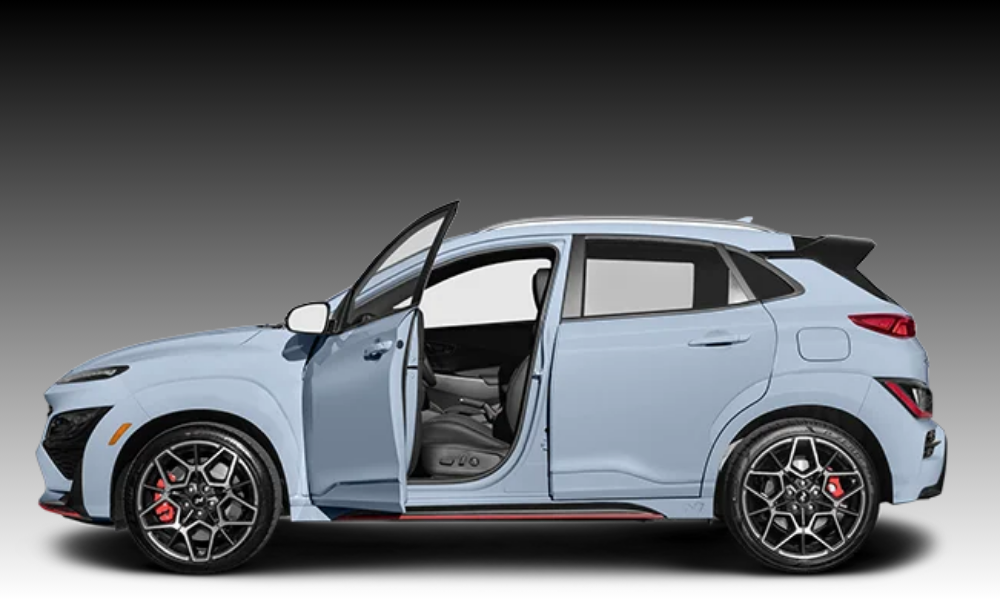
The heavily bolstered sport seats immediately stand out, combining supportive sculpting with suede inserts that help keep occupants securely in place during aggressive cornering. They feel purpose-built for spirited driving and reinforce the Kona N’s performance-first identity the moment you settle behind the wheel.
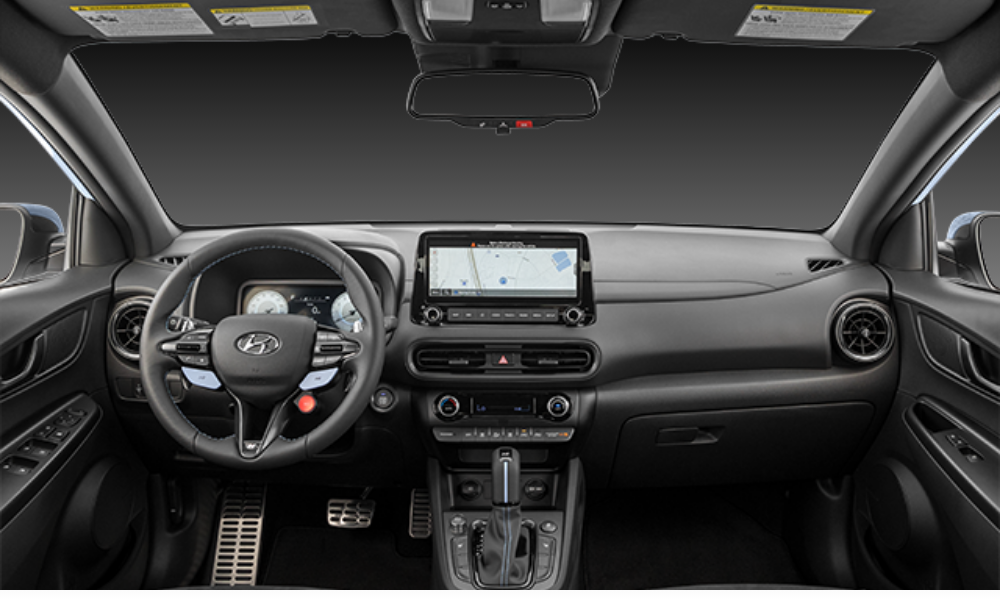
The leather-wrapped steering wheel is another highlight, offering a thick, confidence-inspiring grip along with Hyundai’s signature Performance Blue drive-mode controls placed within easy reach. These dedicated buttons make switching between drive settings feel intuitive and reinforce the car’s motorsport-inspired character.
Large aluminum paddle shifters mounted behind the wheel further elevate the experience. Their size and tactile response make manual gear changes feel deliberate and satisfying, adding a level of driver interaction often missing from affordable performance vehicles.
While the broader cabin design may not deliver the upscale polish found in alternatives like the Volkswagen Golf GTI or the more premium-feeling Mazda CX-30 Turbo, the Kona N succeeds in creating an environment that feels focused and engaging from the driver’s seat. It may not feel expensive, but it feels purpose-built, and that distinction matters.
In-Cabin Tech
The technology package in the 2023 Hyundai Kona N is straightforward in layout but impressively comprehensive in function. It features a dual 10.25-inch display setup, pairing a fully digital instrument cluster with a matching infotainment screen at the center of the dashboard.
The driver display is where the Kona N’s performance identity becomes most visible. Alongside standard driving information, it offers N-specific data readouts including G-force monitoring, oil temperature, turbo boost pressure, and configurable performance layouts designed for spirited driving or track use. The interface adapts depending on the selected drive mode, with the graphics shifting to a more performance-oriented layout when N mode is activated.
The infotainment system itself is responsive and logically structured, prioritizing usability over visual experimentation. While it may not feel as visually advanced as some newer systems from rivals like the Volkswagen Golf GTI, it compensates with clarity and consistency in daily use.
What stands out most is how Hyundai integrates performance data into the driving experience without overwhelming the driver. The information is accessible, well-organized, and clearly designed with track-oriented enthusiasts in mind, reinforcing the Kona N’s identity as more than just a styling exercise.
Storage
Despite its performance-first focus, the 2023 Hyundai Kona N still retains the practical advantages expected from a compact crossover. Rear-seat space is usable for daily needs, and the rear hatch opens to a cargo area that is flexible enough to handle luggage, groceries, or weekend travel gear without difficulty. Folding the rear seats expands the load space further, making the Kona N more versatile than a traditional hot hatch in everyday scenarios.
That said, practicality here is clearly secondary to performance intent. The cargo area is not class-leading in size, and the high load lip reminds you that this is still a performance-oriented setup rather than a utility-focused design.
Where the Kona N does stand out is in its usability for enthusiasts who still need a single car for mixed purposes. It can handle routine commuting and longer trips during the week, then switch roles for spirited weekend driving without requiring compromise on ownership flexibility.
Unlike some rivals that prioritize soft-road image or premium comfort, the Kona N’s interior layout remains straightforward and functional, focusing on space efficiency rather than luxury detailing.
MPG
Efficiency is not a priority in the 2023 Hyundai Kona N, and the official figures reflect that clearly. The EPA rates it at 20 mpg in the city, 27 mpg on the highway, and 23 mpg combined.
Those numbers are reasonable for a performance-focused compact crossover, but they tell only part of the story. In everyday commuting, the Kona N can stay relatively close to its rated efficiency if driven conservatively and kept in its calmer drive modes.
However, fuel consumption rises quickly once the car is driven with enthusiasm. Frequent use of higher engine revs, aggressive acceleration, and extended use of performance modes will noticeably reduce real-world economy. In practice, the Kona N rewards spirited driving, but that enjoyment comes with a clear trade-off at the fuel pump.
Value
With a starting price of around $36,285, the 2023 Hyundai Kona N makes a strong case for itself in the affordable performance segment. In terms of outright performance per dollar, very few rivals offer a similar combination of power, chassis tuning, and enthusiast-focused hardware at this price point.
Standard equipment includes performance-oriented upgrades such as upgraded brakes, an electronically controlled limited-slip differential, and an active exhaust system that significantly enhances the driving experience. Combined with nearly 280 horsepower from its turbocharged engine, the Kona N delivers a level of capability that would have been difficult to imagine in this price bracket just a few years ago.
Where it stands out most is not in luxury or refinement, but in how much driving character Hyundai has managed to package into a relatively accessible crossover. It feels purpose-built for enthusiasts on a budget, even if that focus comes at the expense of premium materials and ride comfort.
Wildcard
The defining trait of the 2023 Hyundai Kona N is not just its performance, but the way it delivers it with very little restraint. This is not a polished interpretation of a fast crossover; it is a deliberately unrefined one in the best possible sense.
Under hard acceleration, torque steer is present, traction can feel stretched at the limit, and the chassis occasionally reminds you that it is based on a compact crossover platform. Yet instead of diluting the experience, these traits add to its character. The car feels mechanical, reactive, and constantly involved with the driver’s inputs.
There is also a strong sense of theatricality baked into the driving experience. The exhaust note is intentionally exaggerated, gearshifts are loud and deliberate, and the overall calibration prioritizes sensation over subtlety. It is a car that communicates everything it is doing, whether you asked for it or not.
What makes the Kona N stand out is that none of this feels accidental. It is engineered personality rather than unintended roughness, designed to appeal to drivers who value engagement over refinement.
In a segment increasingly dominated by polished, balanced performance crossovers, the Kona N remains deliberately off-center. That imbalance is exactly what gives it its identity.
Trim Level Differences
Unlike the standard Kona lineup, the 2023 Hyundai Kona N is offered in a single, fully equipped configuration. There are no incremental trim steps or option-heavy packages designed to gradually build up performance or features.
Instead, Hyundai delivers the Kona N as a complete performance package from the outset. The mechanical setup, chassis upgrades, braking system, and electronically controlled limited-slip differential are all included as standard, alongside the full N-specific interior and infotainment features.
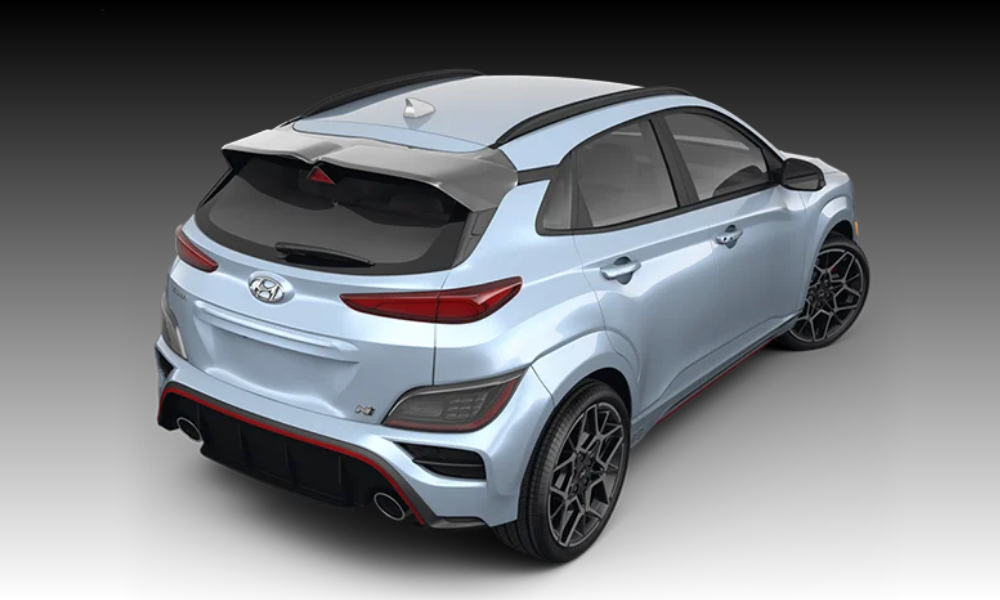
Personalization is limited primarily to exterior paint choices, including signature performance-oriented colors such as Sonic Blue and Racing Red, depending on market availability. Beyond that, there are no meaningful factory add-ons that alter the specification or performance character of the car.
This simplified structure reinforces the Kona N’s positioning. Rather than offering a hierarchy of trims, Hyundai focuses on a single, purpose-built configuration aimed squarely at enthusiasts who want the full experience without navigating option lists or upgrade tiers.
The result is a straightforward ownership proposition: every Kona N leaves the factory with the same performance intent, equipment level, and driving character.
Which Trim Does CarDrav Recommend?
Since the 2023 Hyundai Kona N is offered in a single, fully loaded configuration, there is no traditional trim hierarchy to navigate. Every car leaves the factory with the same performance hardware, chassis tuning, and N-specific features.
For that reason, the recommendation is straightforward: there is only one correct choice.
Buy the Kona N as it is.
Select your preferred exterior color, accept the firm ride as part of the experience, and commit to what the car is fundamentally designed to be. There is no “better version” waiting in a higher trim level, and no downgraded variant to avoid. The formula is fixed from the outset.
This simplicity is part of its appeal. It removes the usual hesitation of option packages and forces a clear decision: you either want a compact performance crossover with this level of character, or you don’t.
For enthusiasts, that clarity is exactly the point.
FAQ
Is the 2023 Hyundai Kona N available with an all-wheel-drive (AWD) system?
No. The Kona N is offered exclusively with front-wheel drive. While AWD could improve traction and reduce torque steer under hard launches, Hyundai deliberately kept the layout FWD to preserve its hot-hatch character, control weight, and maintain a more accessible price point. The result is a more traditional, driver-focused setup, even if it comes with some compromises in traction at the limit.
What is the 0–60 mph time, and what does the “NGS” button do?
With launch control engaged and optimal conditions, the Kona N accelerates from 0 to 60 mph in around 5.2 seconds. The N Grin Shift (NGS) function provides a temporary overboost, increasing output by up to 10 horsepower for approximately 20 seconds. The system also sharpens throttle response and transmission behavior, delivering a more aggressive acceleration profile when activated.
How practical is the cargo space and seating compared to a standard Kona?
Cargo capacity is broadly comparable to the standard Kona, offering roughly 19.2 cubic feet behind the rear seats, expanding further with the 60/40 split-folding configuration. The main trade-off appears in rear passenger comfort, where the sport-oriented front seat design and overall packaging make it less accommodating for taller occupants over long distances. It remains usable, but clearly secondary to its performance mission.
Can you get the Kona N with a manual transmission?
No. The 2023 Hyundai Kona N is only available with Hyundai’s 8-speed wet dual-clutch transmission (N DCT). While this removes the option of a manual gearbox, the DCT is engineered for rapid, consistent shifts and plays a central role in the car’s performance identity.
Is the ride comfortable enough for daily use?
Comfort depends heavily on expectations. The suspension is firmly tuned even in its softer settings, and rough road surfaces can feel particularly harsh. While it can be used as a daily driver, especially in well-maintained cities or highways, it clearly prioritizes handling precision and performance feedback over ride comfort.ng engagement.