
Look, let’s get one thing straight about the 2023 Chevrolet Blazer: it’s wearing a name it hasn’t earned. The original Blazer? That was a truck. A proper one. Body-on-frame, four-wheel drive, the kind of vehicle people bought because they actually needed it to do something. haul gear, tow boats, handle terrain that would make a Honda CR-V weep.
When Chevrolet brought the Blazer name back in 2019, they made a completely different calculation. The new Blazer is a car-based crossover with a sloping roofline and Camaro-inspired styling, built for buyers who want their SUV to look good in a parking lot rather than crawl through one.
And honestly? That’s not necessarily a criticism. Most SUV buyers never leave the pavement, and Chevrolet knows it. What the 2023 Blazer is really selling is attitude, sharp lines, aggressive stance, and a driving experience that feels more car-like than most of its competitors. Whether that’s enough depends entirely on what you’re actually asking it to do.
Here’s where things get complicated. The problems surface the moment practicality enters the conversation. The cargo area is smaller than almost everything it competes against. The rear headroom is genuinely compromised by that swoopy roofline. And at highway speeds, the cabin is noisier than you’d expect at this price point. These aren’t minor footnotes. they’re real tradeoffs.
So who is this thing for? If you park in city garages, commute on highways, and genuinely care how your car looks from the outside, the Blazer makes a lot of sense. But if you’re loading strollers every morning and road-tripping with three kids, the Honda Passport and Hyundai Santa Fe will serve you better without making you feel like you’re settling.
Our Take
The 2023 Chevrolet Blazer is a stylish, well-handling midsize SUV that delivers a refined ride and strong optional V6 performance. The new 10-inch touchscreen is a genuine improvement over what came before, and the Blazer’s composure through corners makes it one of the more engaging SUVs in this segment.
But the strengths come with real costs. The sloping roofline kills rear headroom. The cargo area is smaller than almost every direct competitor. The interior materials don’t justify the price on higher trims. And the cabin noise at highway speeds is hard to ignore once you notice it.
If style and driving dynamics are your priorities, the Blazer is worth a serious look. If you’re buying an SUV primarily because you need the space and practicality that come with one, the Blazer will frustrate you within the first month.
Pros
- Refined ride quality with well-controlled body roll
- Agile handling for an SUV
- Attractive, easy-to-use infotainment system with standard 10-inch touchscreen
- Strong optional V6 engine (308 hp, 6.6 sec 0-60)
- Distinctive Camaro-inspired exterior styling
Cons
- Compromised rear headroom due to sloping roofline
- Below-average cargo capacity (64 cu ft with seats folded)
- Cabin noise from wind, road, and tires at highway speeds
- Interior materials don’t feel premium enough for the price
- Slow-heating climate control and seat heaters
What’s New for 2023
The 2023 Blazer gets a mid-cycle refresh with changes inside and out. Up front, the fascia has been reworked with a leaner nose, a more windswept grille, and slimmer headlights that push the aggressive look further. New wheel designs and additional color options round out the exterior updates.
The bigger news is inside. The standard touchscreen grows to 10 inches, replacing the previous 8-inch unit, with noticeably crisper graphics and a more modern layout. Interior trim materials have also been revised. The price is up $1,400 over the 2022 model, which reflects the added equipment reasonably enough.
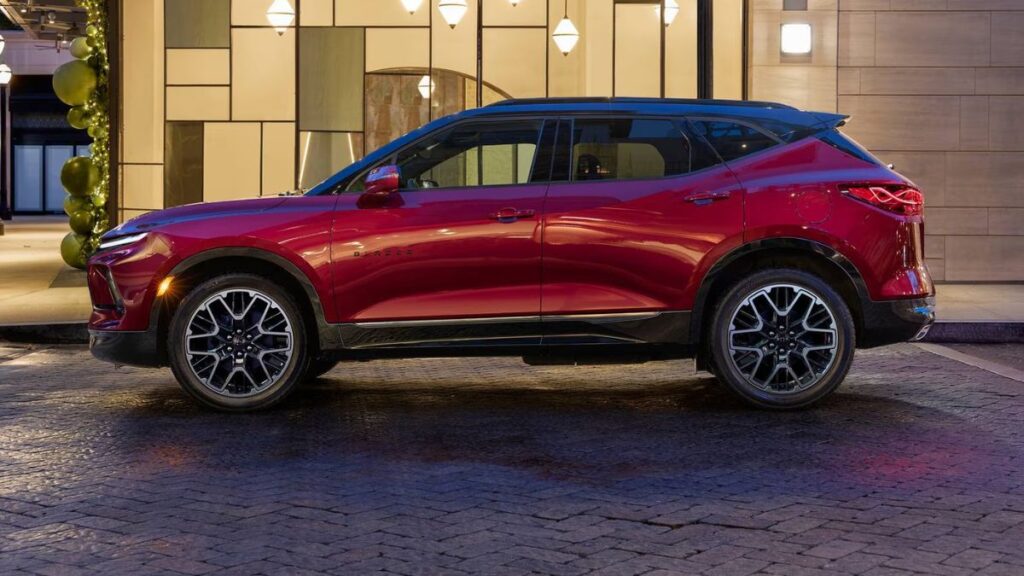
Exterior Design: Camaro-Inspired and Proud of It
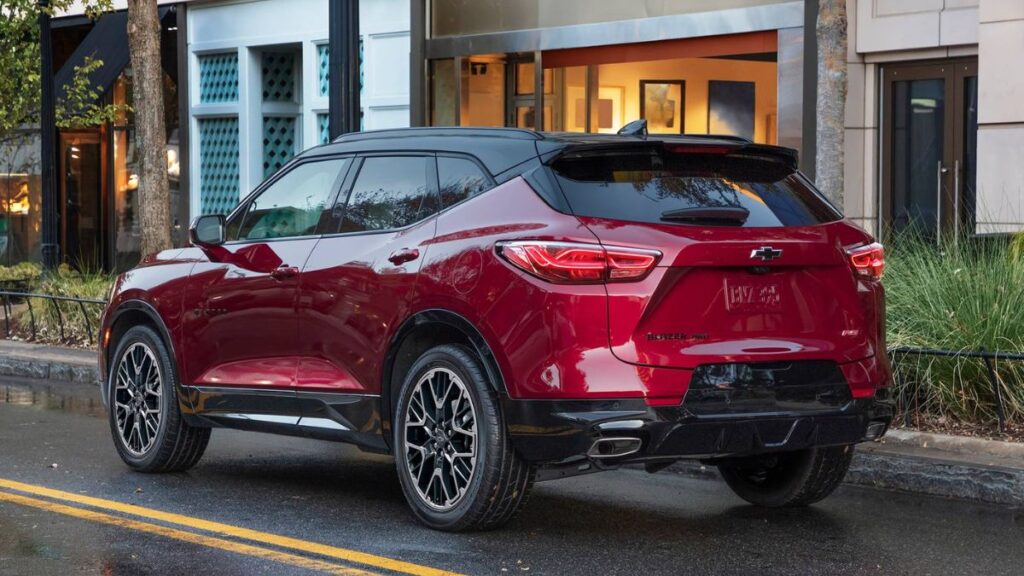
The Blazer looks like nothing else in this segment, and that’s entirely intentional. The sharp creases, the aggressive front end, the roofline that swoops toward the rear rather than standing tall for cargo space. Chevrolet looked at a segment full of sensible, upright crossovers and decided to build something that looked like it belonged on a different kind of road.
The revised front end for 2023 sharpens things further, with a more windswept grille and slimmer LED headlights that give the Blazer a focused, almost squinting expression. The rear is equally deliberate, with sculpted bodywork and taillights that tie the whole design together.
It’s polarizing, and it’s supposed to be. Some buyers will walk past it in a parking lot and immediately want one. Others will look at the compromised rear space and wonder what the point was. Both reactions are reasonable.
2023 Chevrolet Blazer Driving Experience: Agile but Flawed
The Blazer drives better than most SUVs at this price, and that’s not a small thing. The chassis is genuinely well-sorted, body roll is kept in check, and the steering responds with enough sharpness that you actually feel engaged behind the wheel rather than just pointed in a direction.
The V6 model reaches 60 mph in 6.6 seconds, which is quick for a midsize crossover. The ride absorbs road imperfections without transmitting them harshly into the cabin, striking a balance that works for both daily commuting and longer highway stretches.
That said, there are real flaws in the driving experience. The steering feels heavy and slow in tighter situations, which undercuts the agility the suspension promises. V6 models produce noticeable torque steer under hard acceleration, a pulling sensation in the wheel that you learn to anticipate. The all-wheel drive system is designed for wet pavement, not actual off-road use. And at highway speeds, the wind and road noise levels are high enough that you’ll raise your voice talking to rear passengers. That last one is a persistent annoyance rather than an occasional one.
2023 Chevrolet Blazer Performance: V6 Power, Four-Cylinder Economy
The Blazer comes with two engine options, and the choice between them matters more than the spec sheet suggests.
The base engine is a 2.0-liter turbocharged four-cylinder producing 228 horsepower and 258 lb-ft of torque, paired with a nine-speed automatic and available all-wheel drive. It gets you to 60 mph in around 7.5 seconds, which is adequate for merging and highway driving without ever feeling urgent. Fuel economy sits at around 22 mpg combined, which is the engine’s clearest advantage. It’s a practical choice for buyers who mostly need the Blazer to commute and run errands without spending too much at the pump.
The 3.6-liter V6 is a different conversation. At 308 horsepower and 270 lb-ft of torque, it drops the 0-60 time to 6.6 seconds in real-world testing and gives the Blazer a character the four-cylinder simply can’t replicate. The exhaust note is satisfying, the acceleration feels genuinely strong rather than just adequate, and the nine-speed automatic keeps up without hunting for gears. Fuel economy lands at 19 to 22 mpg combined depending on configuration, which is a reasonable tradeoff for what you’re getting. Towing capacity with the V6 and proper equipment reaches 4,500 pounds, giving the Blazer at least some utility credentials.
The V6 is the engine most buyers cross-shopping the RS trim will end up with, and it’s the right call if performance is part of why you’re considering the Blazer in the first place. The four-cylinder is a sensible default, but it doesn’t give the Blazer anything to brag about.
Ride Comfort: Smooth but Noisy
The Blazer’s ride is one of its genuine strengths. It absorbs bumps and surface changes without transmitting them harshly into the cabin, and the front seats offer good support and bolstering for longer drives. The rear seats sit at a comfortable angle and height, which helps on longer trips even if the headroom situation limits who can actually use them comfortably.
The noise is the persistent problem. Wind, road, and tire noise all make themselves known at highway speeds in a way that feels out of place at this price point. It’s not unbearable, but it’s present enough to notice regularly, and it makes the cabin feel less refined than the exterior styling suggests. The climate control system also takes longer than expected to warm the cabin, and the seat heaters are slow to reach a useful temperature.
Interior: Style Over Function
The Blazer’s interior reflects the same priorities as its exterior: looks first, practicality when there’s room for it. The dashboard is clean and well-organized up front, the seat adjustments accommodate a wide range of driver sizes, and the 10-inch touchscreen is genuinely easy to use.
The rear seat is where the compromises become unavoidable. The sloping roofline cuts into headroom enough that taller passengers will feel it on any trip longer than a few minutes. Two adults fit comfortably across, but three is a real squeeze. The outward visibility suffers from the same roofline, with thick pillars creating blind spots that make a blind-spot monitoring system less of an option and more of a necessity.
Control placement is another weak point. Some buttons and knobs are placed awkwardly and labeled in ways that require a learning period. These aren’t catastrophic problems, but they add friction to the daily experience in a car that costs close to $45,000 in higher trims.
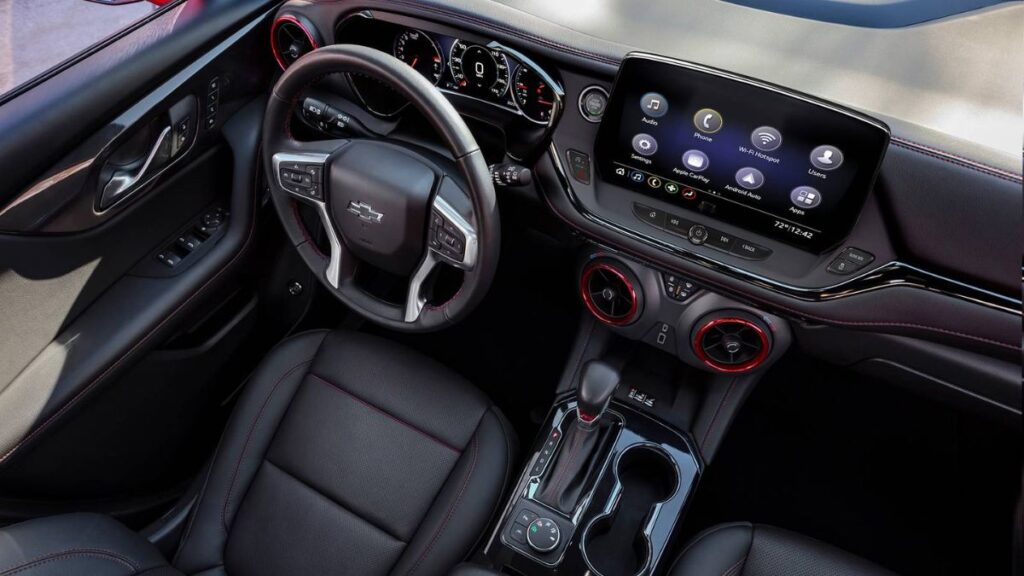
Technology: A Significant Upgrade
The jump to a standard 10-inch touchscreen for 2023 makes a real difference. The interface is crisp, responsive, and logically organized, and Apple CarPlay and Android Auto integration works without the lag or hesitation that plagued some earlier GM systems. The native interface holds up well on its own if you prefer not to mirror your phone.
The available Bose audio system is decent but shows its limits at higher volumes, where distortion starts to creep in. The voice command system works, but it prefers specific phrasing over conversational speech, which means you’ll occasionally find yourself repeating requests.
Driver assistance features including adaptive cruise control, blind-spot monitoring, and rear cross-traffic alert are available on higher trims and work competently without being intrusive in normal driving.
Storage: Below Average for the Class
The cargo numbers are the Blazer’s most glaring weakness on paper, and they hold up in daily use. With the rear seats folded, the Blazer offers 64 cubic feet of cargo space. The Honda Passport manages 77.9 cubic feet. The Hyundai Santa Fe gives you 72.1. The gap isn’t a rounding error. It’s the direct cost of the sloping roofline, and it means the Blazer will require a second trip or creative loading on days when competitors would handle everything in one go.
The liftover height is also on the higher side, which adds effort when loading heavier items. Inside the cabin, door pockets are shallow and storage options for smaller items are limited. The center console is wide and usable, but it doesn’t compensate for the lack of space elsewhere. Towing capacity reaches 4,500 pounds with the properly equipped V6, which is at least competitive for the class.
Fuel Economy: Meeting Expectations
The V6 is EPA-rated at 19 city and 27 highway with front-wheel drive, landing at 22 mpg combined. In real-world testing over roughly 1,245 miles, the front-wheel-drive V6 returned 19.5 mpg, slightly below the EPA estimate but within normal range. On a controlled evaluation route, it hit 21.1 mpg. The four-cylinder model improves slightly on those figures, with around 22 mpg combined in most configurations.
Neither result is exceptional for the segment, but neither is embarrassing. The Blazer sits roughly in the middle of the class for fuel economy, which matches its positioning everywhere else.
Biggest Strength and Weakness
The Blazer’s strongest card is the one you see before you open a door. In a segment where most SUVs are designed to offend no one, the Camaro-inspired styling does something genuinely rare: it makes people look twice. The sharp lines, the aggressive front end, the roofline that prioritizes proportion over headroom. It’s a deliberate design with a point of view, and the handling backs it up. The Blazer corners with more confidence than most buyers will ever need, and the V6 gives it real urgency when the road opens up.
The weakness lives in the same design decisions. That roofline that looks so good from the outside takes rear headroom with it. The 64 cubic feet of cargo space with seats folded is not a minor gap behind the Passport and Santa Fe. It’s a meaningful one that shows up regularly in real life, on grocery runs and airport pickups and weekends away. The high liftover height adds effort every time you load something heavy. And for families who bought an SUV specifically because they needed the room, none of the styling advantages will make up for those moments.
The Blazer is a vehicle that made a specific set of choices and committed to them. The styling and driving dynamics are genuinely good. The practicality is genuinely limited. Whether that trade works for you is the whole question.
Competitors Worth Considering
The Honda Passport is the most direct alternative for buyers who find the Blazer appealing in concept but need more space. It offers 77.9 cubic feet of cargo room, better rear headroom, and a more practical interior without giving up much in terms of road manners.
The Hyundai Santa Fe brings a more premium-feeling interior, stronger warranty coverage, and 72.1 cubic feet of cargo space. It’s a more complete daily package for families.
The Volkswagen Atlas steps up to three rows of seating if passenger capacity is the priority, with class-leading cargo room to match.
The Ford Edge offers a more refined and quieter interior, with a comfortable ride that makes highway commuting noticeably more relaxing than the Blazer.
Trim Comparison
2LT (from ~$36,400): 228-hp 2.0L turbo four-cylinder, 18-inch wheels, 10-inch touchscreen, Apple CarPlay, Android Auto, LED headlights, Chevy Safety Assist. The starting point for buyers who want the Blazer’s looks without stretching the budget.
3LT (from ~$39,600): Adds 19-inch wheels, heated front seats, power liftgate, remote start, and driver-seat memory. The most balanced trim in the lineup for most buyers.
RS (from ~$42,600): V6 engine standard, 20-inch wheels, sport-tuned suspension, black exterior accents, and unique styling details. The performance and style pick.
Premier (from ~$44,000): Adds leather seats, ventilated front seats, heated rear seats, and premium audio. The comfort-focused choice for buyers who want a more upscale interior.
Which Trim Does Cardrav Recommend?
The 3LT is the right choice for most buyers. It adds the features that actually improve daily life, heated front seats, a power liftgate, remote start, without the significant price jump to the RS or Premier. Add the Convenience package for adaptive cruise control, wireless charging, and a power liftgate if those aren’t already included. The RS makes sense specifically for buyers who want the V6 and the sport-tuned suspension as part of the package.
Should You Buy the 2023 Chevrolet Blazer?
Buy it if styling and driving dynamics matter to you and your life doesn’t require hauling large amounts of cargo regularly. The Blazer looks distinctive, handles well for the segment, and the V6 gives it genuine performance credentials. The updated infotainment system makes daily use genuinely pleasant.
Don’t buy it if rear passenger space, cargo capacity, or a quiet highway cabin are near the top of your list. The Blazer’s compromises in those areas are real and consistent, and competitors like the Honda Passport and Hyundai Santa Fe address them better without sacrificing the things that actually matter to most SUV buyers.
Final Verdict
The 2023 Chevrolet Blazer is a vehicle that chose to be interesting over being practical, and it mostly succeeds on its own terms. The styling stands out. The V6 is genuinely quick. The chassis is more sorted than the segment average. The 10-inch touchscreen is a real improvement.
But the cargo numbers don’t lie, and neither does the rear headroom. The cabin noise at highway speeds is a persistent reminder that the Blazer’s priorities were set before comfort was considered. And at prices approaching $45,000, the interior materials leave you wanting more.
The 2023 Chevrolet Blazer is the right SUV for a specific buyer: someone who wants their crossover to have a personality, drives mostly alone or with one other person, and doesn’t regularly need to move large amounts of stuff. For that buyer, it delivers something genuinely different in a segment that desperately needs it. For everyone else, the spreadsheet points elsewhere.
FAQ
Is the 2023 Chevy Blazer a good family car?
It depends on the family. The sloping roofline cuts into rear headroom enough that taller passengers will feel it on longer trips, and the 64 cubic feet of cargo space with seats folded trails most competitors by a meaningful margin. Two adults fit comfortably in the rear, but three is a squeeze. For smaller families or couples who don’t need maximum cargo room, the Blazer works well. For families with multiple kids and the gear that comes with them, the Honda Passport or Hyundai Santa Fe are more practical choices that won’t require constant compromise.
Is the 2023 Chevrolet Blazer V6 engine worth the extra cost?
For most buyers who are cross-shopping the RS trim, yes. The V6 produces 308 horsepower against the four-cylinder’s 228, and the difference in real-world driving is noticeable. The 6.6-second 0-60 time feels genuinely quick for a midsize SUV, and the exhaust note adds character the turbo four simply doesn’t have. Towing capacity also jumps to 4,500 pounds with the V6. The four-cylinder is a reasonable default for buyers focused on fuel economy and daily commuting, but if performance is part of why you’re considering the Blazer, the V6 is worth the upgrade.
How does the Blazer compare to the Honda Passport?
The Passport gives you significantly more cargo space, 77.9 cubic feet against the Blazer’s 64, better rear headroom, and a more practical interior layout. The Blazer counters with sharper styling, more engaging handling, and a more distinctive road presence. If your primary reason for buying an SUV is the utility it provides, the Passport is the more sensible choice. If you want your SUV to have personality and spend most of your time on-road without heavy cargo needs, the Blazer makes its own case.
Is the 2023 Chevrolet Blazer good for off-roading?
No. The Blazer is a car-based crossover built for on-road performance, not trail use. The ride height is lower than traditional SUVs, and the all-wheel-drive system is calibrated for wet-weather traction rather than serious off-road situations. It will handle light gravel and dirt roads without drama, but anything more demanding will quickly expose its limits. If off-road capability is a genuine requirement, the Jeep Cherokee or Subaru Outback are far more appropriate choices.
What is the Blazer’s fuel economy in real-world driving?
The V6 with front-wheel drive is EPA-rated at 19 city and 27 highway, landing at 22 mpg combined. In real-world testing over about 1,245 miles, the V6 returned 19.5 mpg, slightly below the EPA estimate but within normal variation. The four-cylinder model improves modestly on those numbers, averaging around 22 mpg combined in most configurations. Neither result stands out in the segment, but both are reasonable for the performance level on offer.

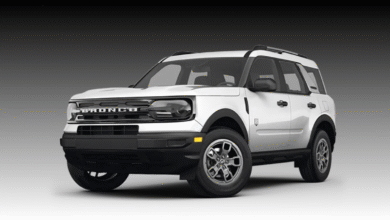
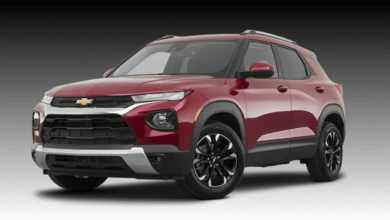
At a time when Ford really stepped up with the new Bronco, Chevy missed a great chance to bring back the Blazer as a tough off road vehicle. Instead, they turned the Blazer into a soccer mom vehicle. Really sad!
I’m also sad about this, unfortunately