Home EV Charging Stations for Five Distinct Needs
Five chargers from five brands show how output cable length connector type and installation format change the right answer for different drivers.


Disclosure: CarDrav may earn a commission from qualifying purchases made through links in this article. Learn more in our Affiliate Disclosure.
The evening routine of an electric vehicle owner looks simple on paper. You pull into the garage after a long day and plug in. By morning the car is ready. That routine only works when the equipment on the wall matches the car and the electrical system behind it. A charger with an impressive amperage number can sit half idle if the vehicle accepts less power than the unit can offer. A powerful unit can also become an expensive surprise when the home panel needs work before it can run safely.
Charging stations deserve a closer look than a quick glance at a spec sheet allows. Daily distance matters first. A driver who covers thirty miles on most days replaces that energy easily overnight on modest power. A driver who runs a delivery route or shares one garage between two cars needs more headroom. Electrical capacity comes next because every charging rate depends on a circuit that can carry it for hours at a time. Connector compatibility matters too because the industry is moving from J1772 toward NACS and some households now own both kinds of vehicles. Cable reach and mounting position finish the list because a cord that stops short of the port becomes a daily irritation.
This article compares five home EV charging stations from five different brands. They range from a compact 16 amp portable unit to a 48 amp hardwired wall connector. The article compares product capabilities and practical trade offs and CardRav has not physically tested the units. One view runs through every section. A good home charging decision starts with the real circumstances of the driver and the house. The specification sheet comes second.
What Matters When Choosing Home Charging Equipment
Level 1 and Level 2 Charging
Level 1 charging uses a standard 120 volt AC household outlet and tops out near 1.4 kilowatts. Level 2 charging uses 208 or 240 volt AC power and a dedicated circuit. Both deliver alternating current to the car and the vehicle converts it to the direct current its battery needs. This is different from DC fast charging at public stations which bypasses the car’s converter entirely and is not something any product in this article does.
Output in kilowatts equals volts multiplied by amps and divided by 1000. At 240 volts a 16 amp charger delivers about 3.8 kilowatts. A 32 amp unit delivers about 7.7 and a 40 amp unit about 9.6. A 48 amp unit reaches about 11.5. When voltage stays comparable output rises in direct proportion to current.
The Vehicle Sets the Ceiling
Every EV has an onboard charger that converts AC power. If that converter accepts 7.2 kilowatts then a 48 amp station will still deliver no more than 7.2 to that car. Buyers should check the owner’s manual for the maximum AC charging rate before paying for amperage the vehicle cannot use.
A rough example shows what output means in practice. Suppose a car has 60 kilowatt hours of usable battery and the driver wants to move from 20 percent to 80 percent. That is 36 kilowatt hours. At 9.6 kilowatts the ideal time is near 3.8 hours. At 7.7 kilowatts it is near 4.7 hours. At 3.8 kilowatts it is near 9.4 hours. A real session runs somewhat longer because of conversion losses and the car’s own charging curve.
Plug In Versus Hardwired
A plug in station uses a cord and plug that fit a matching outlet. Most units in this article use a NEMA 14-50 plug. That does not make installation optional. The outlet still needs the right rating and a dedicated circuit with the correct breaker and wire gauge. A 14-50 receptacle on an undersized circuit cannot safely deliver 40 amps. A hardwired unit connects directly to the circuit and removes the outlet from the chain.
Connectors
The old claim that every EV in North America shares one connector is no longer accurate. Most non Tesla vehicles built for several years use J1772. Tesla vehicles use NACS and a growing number of newer models from other brands now ship with NACS ports. Adapters exist in both directions but they add cost and a point of wear. Buyers should confirm the model year and charging port on their own car before choosing a connector.
Cable Length Smart Features and Weather Protection
Measure the distance from the planned mounting spot to the charging port with the car parked where it normally sits. Add slack. A cable pulled tight is a tripping hazard and a strain on the connector. Smart features such as scheduling and current limits help drivers on time based electricity rates or households with tight panels. They matter less for someone who plugs in and leaves. Weather protection deserves scrutiny. Marketing language like weatherproof says little. Look for a stated enclosure rating such as NEMA Type 3R or Type 4 or an IP rating and confirm it for the exact model.
Circuit Sizing and the Electrician
Continuous loads generally call for a breaker rated above the charging current. In common practice a 40 amp charging load needs a 50 amp branch circuit and a 48 amp load needs a 60 amp circuit. A 32 amp load typically calls for 40 amps and a 16 amp load for 20. Local electrical codes decide the final design so a licensed electrician should assess the panel and wiring before purchase. Nobody should attempt high voltage electrical work without the training to do it safely.
Every EV also carries a separate 12 volt auxiliary battery that runs lights locks and computers. It is distinct from the high voltage traction battery that moves the car. Home charging stations feed the traction battery. An ordinary automotive battery charger cannot charge it. Readers who want background on how vehicle batteries differ can start with our look at the best batteries for trucks and cars.
Five Home Charging Stations in Detail
EVIQO Level 2 EV Charger 40A for Plug In Home Charging

- WORKS WITH EVERY NON-TESLA EV: Standard J1772 connector plugs straight into Ford, Chevrolet, Hyundai, Kia, Nissan, BMW, …
- PLUG IN, NO HARDWIRING: Level 2 charger delivers up to 40A to fully charge most EVs overnight. Plugs into a 240V, 4-pron…
- CONTROL & SAVE FROM YOUR PHONE: A stronger built-in antenna keeps the charger online even in a garage or basement. Use t…
- SAFETY-CERTIFIED & WEATHERPROOF: Independently tested and certified (UL, ETL, FCC, Energy Star). A fully sealed IP66 / N…
The EVIQO charger targets drivers who already have a suitable 240 volt outlet or plan to add one. It is rated for 40 amps at 240 volts which equals 9.6 kilowatts. It ships with a NEMA 14-50 plug and a J1772 connector and a 25 foot cable. Charging current is adjustable from 6 to 40 amps. The unit connects over 2.4 GHz WiFi and the app handles scheduling and shows energy usage and cost. It also receives automatic software updates and includes a reset button and a glow in the dark connector holster. The enclosure is rated IP66 and NEMA 4. The product is described as UL and ETL certified and carries a three year manufacturer warranty.
The cable length is the quiet strength here. Twenty five feet reaches ports on the far side of a car or into a driveway without stretching. Smart scheduling suits owners on time of use rates. The ability to turn current down helps if the circuit or panel is marginal.
The limits are practical. It needs a dedicated 50 amp circuit to deliver its full output. This is the plug in J1772 model so a vehicle with a NACS port needs an appropriate adapter. WiFi support on 2.4 GHz only can frustrate owners with weak signal in a detached garage.
Compared with the Lectron below it offers a longer cable and a similar output. This makes it a balanced option for someone with a suitable outlet who wants fast charging without a hardwired install. Households that plan to hardwire for 48 amps should look elsewhere.
Tesla Universal Wall Connector for Mixed Connector Households

- UNIVERSAL COMPATIBILITY: Seamlessly transitions between NACS and J1772 connectors, accommodating all major North America…
- CHARGING SPEED: Up to 44 miles of range per hour of charge, with up to 11.5 kW / 48 amp output, depending on Tesla model…
- CONVENIENCE: Indoor or outdoor installation (by your own electrician or one of the 1,400+ Tesla Certified Electricians) …
The Universal Wall Connector is the only hardwired unit here and the only one built around the idea that one home may hold cars with different ports. It delivers up to 48 amps which at 240 volts equals about 11.5 kilowatts depending on the vehicle and the circuit. The cable is about 24 feet long and the output is adjustable.
The connector design is the reason to pay attention. One unit serves vehicles with NACS ports and vehicles with J1772 ports through its integrated arrangement. A household that owns a Tesla and a car from another brand can share a single wall unit instead of managing loose adapters. Other Tesla wall connectors are NACS only so nobody should assume the whole family shares this arrangement.
The Tesla app handles charging schedule management and energy consumption monitoring. The unit is described as suitable for indoor and outdoor installation.
The honest limits begin with installation. This is not a swap for a plug in unit. An electrician must wire it to a suitable circuit and a 48 amp setting needs a 60 amp breaker. And 48 amps only helps if the vehicle can accept it.
Next to the EVIQO and Lectron it costs more in money and planning but removes the outlet and adds connector flexibility. It suits a household with a Tesla and a J1772 car or anyone building a long term wall installation. Renters and drivers who want portability would be better served by a plug in unit.
AIMILER Level 2 EV Charger 32A for Flexible Portable Use

- ❤ [Equipped with Nema 14-50 plug 240V, Compatible with 110-120V Nema 5-15p to 14-50r EV Adapter(Not packaged) or the oth…
- ❤ [Features a J1772 Connector for All North America J1772 EVs/PHEVs. For Tesla EVs/Nacs Connector Cars, This will Requir…
- ❤ [Up to 7.68kWh High Speed Charging, Adjustable Amperage from 16A to 32A & Requires a 20A to 40A circuit]: Maximum curr…
The AIMILER charger sits one step below the 40 amp units on output. It is rated at 32 amps which equals about 7.7 kilowatts on a 220 to 240 volt supply. It uses a NEMA 14-50 plug and a J1772 connector and a 25 foot cable. Charging current can be set from 16 to 32 amps through the display controls or the app. The display shows information such as the charging amperage and the input voltage. The WiFi app also offers charging schedule and delay settings. The listing describes the unit as ETL and FCC listed.
The trade off against a 40 amp unit is straightforward. A 32 amp load typically needs only a 40 amp circuit while a 40 amp load needs 50. Charging is about 20 percent slower. For a driver who adds sixty or seventy miles a day that gap rarely shows up overnight. It matters more for someone who often returns with a nearly empty battery and leaves again within hours. That makes 32 amps a practical middle ground for drivers who do not need maximum speed.
Compared with the EVIQO it offers a lower rated output and the same cable length. It fits a buyer who wants a portable plug in charger and does not need maximum speed. Anyone with a long daily commute or a plan to upgrade to a larger battery should consider a 40 amp unit.
EVDANCE Level 1 and Level 2 Portable Charger 16A for Occasional Charging

- Flex Level 1 EV Charger – The EVDANCE Level 1 electric car charger is compatible with J1772 electric vehicles and plug-i…
- Convenient to Use – This charger has both NEMA 6-20 plug for 16A 240V charging (3.68kW, 10-12 mi/h) and a NEMA 6-20 to 5…
- Check Your Outlet Type -This charger works with standard 120V NEMA 5-15/5-20 outlets (2-5 mph charging speed) and 240V N…
The EVDANCE is a different kind of product and it should not be mistaken for a smaller version of the others. It carries a single NEMA 6-20 plug for 240 volt outlets and includes an adapter that converts that plug to a NEMA 5-15 for an ordinary 120 volt outlet. It is one cable with one adapter and not two separate chargers. The charger uses a J1772 connector and a 25 foot cable. It also includes a carrying bag and Velcro straps. LED lights show status and errors. The enclosure is rated IP66 and the product carries a one year warranty. It is described as ETL listed.
The gap between the two outlets is the whole story. On 120 volts the charger is limited to 12 amps which is about 1.44 kilowatts and roughly 2 to 5 miles of range per hour. On a 240 volt NEMA 6-20 circuit it reaches 16 amps which is about 3.7 kilowatts and roughly 10 to 12 miles per hour. It is nowhere near the speed of a 32 or 40 or 48 amp unit.
A NEMA 6-20 outlet is not standard in most homes. Adding one requires a 20 amp 240 volt circuit and that work can narrow the savings versus a 14-50 setup.
It makes sense for plug in hybrid owners or for drivers with low daily mileage who can use time overnight. It also works as a backup charger that fits in a trunk bag. Compared with the AIMILER it gives up half the output in return for plug flexibility. Drivers who depend on fast turnaround should skip it.
Lectron Level 2 J1772 Charger WiFi Version 40A for Connected Portable Charging
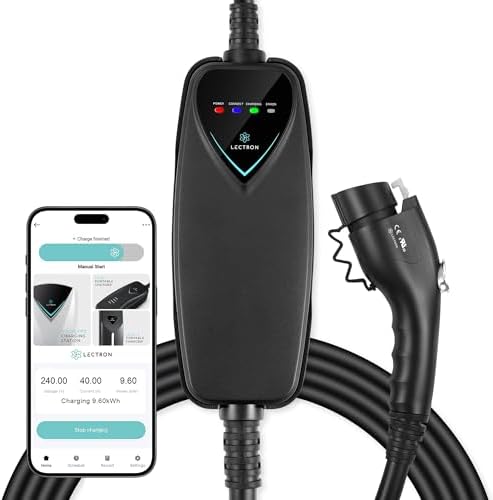
- SMART WIFI & APP CONTROL – This portable WiFi-enabled EV charger lets you monitor your charging status in real-time, sch…
- J1772 COMPATIBILITY – The Lectron Level 2 J1772 EV charger is compatible with all electric vehicles that use the J1772 s…
- OVERNIGHT CHARGING – This portable charging station provides up to 240V and 9.6 kW of input power and a 40A charging rat…
The Lectron charger is rated at 40 amps on a 240 volt supply for about 9.6 kilowatts. It uses a NEMA 14-50 plug and a J1772 connector and a 16 foot cable. The WiFi connection lets the app show charging status and schedule sessions and set energy limits. A carrying case is included. The charger handle is described as UL 2251 certified and the charger itself is described as Energy Star and ETL and FCC certified.
The shorter cable is the main practical difference from the EVIQO and AIMILER. Sixteen feet works when the outlet is close to the port. It will not reach the far side of a wide driveway without moving the car. Like the EVIQO it needs a dedicated 50 amp circuit to deliver full output.
The trade off is reach against smart charging and portability. The app and carrying case suit someone who wants connected portable charging while the short cable favors a parking spot close to the outlet.
Compared with the EVIQO it offers a similar output and a shorter cable. It suits buyers who want portable Level 2 charging with scheduling and whose parking spot sits near the outlet. Someone who needs more reach or NACS compatibility will be happier elsewhere.
Practical Ownership and Installation Considerations
Installation can change the real cost of a charging station more than the sticker price. A driver with a working 14-50 outlet on a properly sized circuit can plug in a portable unit and start charging. A driver without one needs a new circuit or a hardwired installation. The distance between the panel and the garage affects wire length and labor. Panel capacity affects whether the home can carry the added load or needs an upgrade. These factors vary widely so this article offers no universal installation price. Request a written quote from a licensed electrician based on your own panel and layout.
Scheduled charging can help if the utility offers time based pricing. Off peak electricity rates may lower the cost per kilowatt hour but savings depend entirely on the local tariff and the charging window. Check the rate plan before assuming any benefit.
Cables and connectors need care. Inspect them regularly for cracks and heat damage. Coil the cable loosely and keep it off the ground when not in use. Do not drive over it. Follow the manufacturer’s instructions and stop using any unit that shows damage. Do not use an ordinary extension cord with an EV charger.
One more point on readiness. A portable jump starter may help revive a compatible 12 volt auxiliary battery in suitable circumstances. Owners should follow the vehicle manual. It will not charge the high voltage traction battery. Drivers who want to understand those tools can browse our look at portable jump starters.
A Meaningful Comparison of the Five Options
These five charging stations serve different needs rather than competing on output alone. The EVDANCE delivers up to 16 amps and offers basic charging flexibility through its included outlet adapter. The AIMILER steps up to 32 amps and approximately 7.7 kilowatts at 240 volts. The EVIQO and Lectron both reach 40 amps and approximately 9.6 kilowatts through a NEMA 14 50 plug. Their main practical difference is cable reach. EVIQO provides 25 feet while Lectron provides 16 feet. The Tesla Universal Wall Connector sits at the top of the group with up to 48 amps and approximately 11.5 kilowatts. It also uses a hardwired installation and offers an integrated arrangement for NACS and J1772 vehicles.
The difference between these charging rates matters most when a driver needs to recover a large amount of battery range in a limited period. A 16 amp unit can handle modest daily driving when the car remains parked overnight. A 32 amp charger gives drivers more flexibility without requiring the higher output of a 40 amp or 48 amp installation. A 40 amp charger offers a useful balance for many households while the Tesla can make sense for drivers who need its additional output and connector flexibility. Even then a vehicle with a 7.2 kilowatt onboard charger will not charge faster on an 11.5 kilowatt station than on a charger capable of supplying the vehicle’s full accepted rate.
Installation also changes the decision. EVIQO and Lectron are portable plug in units that use a suitable NEMA 14 50 outlet. AIMILER uses the same general plug format but offers a lower maximum current. EVDANCE uses a NEMA 6 20 plug with an adapter for a standard 120 volt outlet. The Tesla requires a permanent hardwired installation. Buyers should therefore consider the existing electrical setup before comparing charging speeds. A plug in charger still needs a properly rated circuit and a hardwired unit requires an electrician to confirm that the home’s electrical system can support it.
Compatibility can matter more than maximum output. A household with both a Tesla and a J1772 vehicle may value the Tesla Universal Wall Connector because of its integrated connector arrangement. Drivers with a single J1772 vehicle and a suitable outlet may find that EVIQO or Lectron meets their needs without a permanent installation. AIMILER suits drivers who want a middle ground in charging output while EVDANCE is better suited to occasional charging or lower daily mileage. The right choice depends on how much energy the vehicle needs each day and how much time it spends parked at home.
Choosing the Right Home EV Charging Station
Choosing among charging stations begins with the car and the household rather than the biggest amperage number. Before buying a unit check the vehicle’s maximum AC charging rate and confirm that the connector matches its charging port. A 40 amp charger is sufficient for many drivers who charge overnight. A 48 amp unit is more useful when the vehicle can accept the additional power and the home’s electrical system can support the required circuit. A driver who covers modest daily distances may find that a lower output charger meets the same routine without paying for capacity that rarely gets used.
The installation deserves equal attention. A suitable existing outlet can make a plug in unit more convenient while a hardwired wall connector suits a permanent setup. Either choice requires the correct electrical circuit and a careful assessment of the home’s capacity. A qualified electrician should confirm the installation requirements before work begins. Cable length matters too. Measure the distance between the planned charging location and the vehicle’s charging port so the cable reaches comfortably without being stretched across a walkway or driveway.
Charging speed is only part of the decision. A portable 16 amp charger can work well for modest daily mileage but it may struggle to replenish a large amount of energy in a short window. A 32 amp or 40 amp charger provides more flexibility for drivers with longer commutes. The Tesla Universal Wall Connector may suit a household with different connector types or plans for long term home charging. Smart features such as scheduled charging can also help when the local utility offers lower electricity rates at certain times. The value depends on the rate plan and the driver’s routine rather than the presence of an app alone.
Safety should remain part of the decision after the charger has been installed. Inspect the cable and connectors for signs of damage and follow the manufacturer’s instructions. Do not use an ordinary extension cord to reach a vehicle. If the outlet cannot reach the parked car safely then ask a qualified electrician about a better location.
In the end the right charging station is the one that matches the vehicle’s accepted charging rate and the home’s electrical capacity while fitting the way the car is used every day. Confirm the connector. Measure the cable reach. Understand the installation requirements. Then choose the level of output that serves the household rather than paying for the largest number on the specification sheet. A well matched charger should make home charging feel like an ordinary part of the daily routine.



Where is the Juicebox?
It exists, my friend, thank you