Best Ceramic Coatings for Cars 5 Popular Picks
Compare five ceramic coatings by durability, ease of use, preparation, and real-world protection.

Best ceramic coatings for cars share one job: they put a thin, slick, chemically resistant layer on top of your clear coat so that water, grime, bird droppings, and UV exposure have a harder time doing their usual damage. That is the honest core of it. A ceramic layer does not make paint bulletproof, and it does not turn a car into something that never needs washing. What it does is change how the surface behaves. Water balls up and rolls away, dirt releases more easily, and the paint tends to hold its depth and gloss longer than bare clear coat would.
That is why ceramic car paint protection has moved from professional detail shops into ordinary driveways. Drivers want a car that stays cleaner between washes and looks sharper without a monthly waxing session. But the shelf is crowded, and the word “ceramic” now appears on products that behave very differently. A fourteen-ounce spray you buff off in ten minutes belongs to a different category than a 30 ml bottle of SiO2 liquid that demands a decontaminated, polished panel and a steady hand. Claims like 9H, 10H, graphene, and “years of protection” make it easy to compare things that were never meant to be compared.
So the choice comes down to a few practical questions. How much time will you spend on prep? How long do you realistically need the protection to last? How often will the car be washed and where does it live? This guide sorts five popular products into the categories they actually belong to. It explains what each is good at and points out where each one asks for a trade-off.
Our Take
Start with the distinction that matters most. A true wipe-on ceramic coating is a concentrated liquid, typically SiO2-based, that you apply by hand to a prepared panel. It cures into a thin layer that bonds to the paint and is meant to last in the range of years when conditions are right. A ceramic spray, sealant, or ceramic wax is a diluted, easier-to-use formula with ceramic technology blended into a more forgiving carrier. You spray it, wipe or buff it, and you are done. The protection is real, but it is shorter-lived and designed to be reapplied. Neither is “fake.” They solve different problems for different people.
Application difficulty is where the buying decision usually turns. Spray products are generally more forgiving and easier to correct, but poor technique can still cause streaking or uneven coverage. A true coating is less forgiving. Apply too much, wipe at the wrong moment, or leave high spots, and you can end up with smears that are annoying to fix once the layer has begun to cure. That is not a reason to avoid them, but it is a reason to be honest about your garage, your lighting, and your patience.
Preparation affects the result more than most buyers expect. Any ceramic layer is only as good as the surface it sits on. Paint that still carries embedded contamination, old wax, or swirl marks will lock those flaws in underneath the coating. For a spray product, a thorough wash and a quick wipe-down may be enough. For a long-life coating, expect a full wash and chemical and mechanical decontamination. That often means claying and some level of polishing, followed by a panel wipe to remove oils so the coating can bond. Skipping steps is the most common reason people feel disappointed.
Durability claims deserve a calm reading. A manufacturer’s number is a ceiling reached under favorable conditions, not a promise. A car parked outside in a hot, high-UV climate, washed with harsh soaps, and driven daily on salted roads will not behave like a garage-kept weekend car washed with a pH-neutral shampoo. Treat any figure as a comparison tool between products rather than a guarantee for yours.
It also helps to separate two ideas that get blurred constantly. Hydrophobic behavior is about how water interacts with the surface. It is useful because it helps keep dirt from sticking and makes washing easier. It is not impact protection. A ceramic layer will not stop rock chips, prevent scratches from careless wiping, or shield a door edge from a shopping cart. Its benefits are chemical and environmental: contamination resistance, UV protection, easier cleaning, and gloss. Rust is another example of a problem a coating cannot solve. If a car already has corrosion, a dedicated rust treatment such as rust converters and inhibitors addresses the metal in a way no paint-level ceramic product can.
So who should choose what? Drivers who want quick results, regular reapplication, and low risk should lean toward the spray products. They suit daily drivers, family vehicles, and anyone who would rather spend twenty minutes after a wash than a full weekend on prep. Drivers who enjoy the process, are willing to polish and decontaminate, and want protection measured in years should consider a proper DIY coating. Those two groups are not competing. They are simply buying different things.
1. CERAKOTE Platinum Rapid Ceramic Paint Sealant Spray (14 oz)
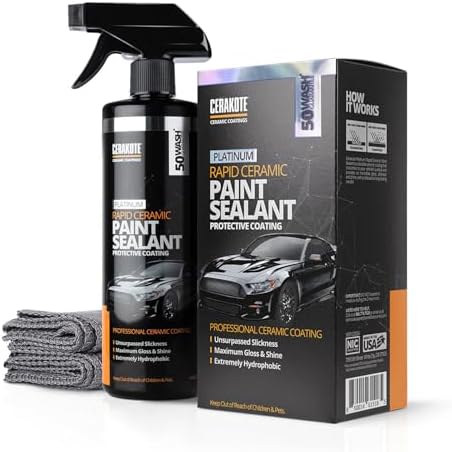
- CERAMIC COATING FOR CARS: Delivers an extremely glossy, mirror-like finish on clean paint. Use as a standalone paint sea…
- 50-WASH CERAMIC PROTECTION: A true ceramic paint sealant, tested to a 50-wash durability rating for months of protection…
- CERAMIC SPRAY WAX ALTERNATIVE, QUICK AND EASY: Wash and dry first, then spray a thin, even coat onto one panel at a time…
The first thing to understand about this product is its category. It is a ceramic paint sealant in spray form, not a traditional professional coating, and it should be judged accordingly. You mist it onto a clean panel and buff it off, then let it cure for about two hours while keeping the surface away from moisture. The manufacturer also advises working one panel before moving to the next. That keeps the learning curve shallow. Nothing about the process requires special technique beyond clean towels and even coverage.
CERAKOTE markets the formula around a 50-wash durability rating, along with strong water repellency and resistance to road grime, mud, and dirt. That is a manufacturer claim. The useful way to read it is as an indication of a maintenance-style product that is meant to survive repeated routine washing rather than a one-time, multi-year treatment. How many washes you actually get depends on the soap you use, the climate, and how dirty the car gets between rinses.
Where the product earns its attention is in the feel it leaves behind. The emphasis is on slickness and a glossy finish, and sealants in this class tend to give paint a noticeably smooth, sharp look with quick water sheeting.
The trade-off is longevity and bond strength. A spray sealant will not match the layered, cured protection of a true coating, and it is designed to be reapplied. Prep still matters, even though it is lighter, since a sealant applied over dirty paint will not perform well. For someone who wants a fast, repeatable way to keep a daily driver glossy and easy to wash, it is a sensible entry point. For someone chasing multi-year protection, it is the wrong tool.
2. Turtle Wax 53409 Hybrid Solutions Ceramic Spray Coating (16 oz)
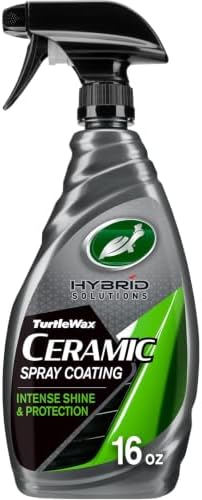
- LONG-LASTING PROTECTION: Ceramic wax polymers form a durable shield for your paint, protecting against UV rays, dirt and…
- ULTIMATE SHINE: Enhances the appearance of your car’s paint, boosting color depth and clarity while delivering a high-gl…
- EXTREME WATER REPELLENCY: This spray wax creates a slick surface that repels water instantly, allowing it to bead and ro…
Turtle Wax approaches ceramic from the accessible end. This is a spray-on, wipe-off product built around SiO2-infused polymers, and it is an accessible ceramic spray coating rather than a conventional wipe-on coating. That distinction does not make it a lesser product, only a different one. Its entire design philosophy is that protection should fit into a normal wash routine.
The listing describes strong water beading, a high-gloss finish, and protection that can last up to 12 months with the recommended application. Read that last part carefully. Twelve months is a best-case figure tied to following the directions, and most owners who wash frequently or park outside will reasonably expect to reapply more often. Used that way, it works well as a seasonal refresh before summer sun or winter weather.
Where it separates itself from the others is breadth and simplicity. It is meant for paint and other exterior surfaces, and the application is about as straightforward as detailing gets: spray a section, wipe, and finish with a clean towel. Compared with the stricter prep that true coatings demand, this is forgiving, which makes it appealing for people trying ceramic protection for the first time.
The limitation is the same one that applies to the category. You are trading depth and lifespan for convenience. It will give paint a glossy, water-repelling surface and make washing easier, but it will not behave like a cured coating, and it should not be expected to. At a size of 16 oz, though, it offers a lot of repeat applications for routine maintenance. For commuters and families who want visible results without a project, it is a practical pick.
3. Griot’s Garage Ceramic 3-in-1 Wax (22 oz)

- CERAMIC PROTECTION: Made in the USA, our ceramic spray wax for cars forms an SiO2-infused shield that defends against ox…
- EASY SPRAY-ON APPLICATION: Get long-lasting protection in minutes with this SiO2 car wax spray; simply spray-on the hybr…
- HYDROPHOBIC AND SELF-CLEANING: Our SiO2 ceramic spray wax creates an ultra-slick, water-resistant layer that reduces dir…
Griot’s Garage names its product honestly: this is a wax. More precisely, it is a water-based blend of hydrophobic polymers, SiO2, and carnauba wax that you spray on and wipe off. That combination is the whole story. You get the warm, deep gloss people associate with carnauba, paired with the water behavior of a ceramic additive, in a format that takes minutes.
Because it is a hybrid, it should be evaluated on the strengths that suit it. Gloss is a highlight. Versatility is another, since the listing says it can be used on paint, plastic, rubber trim, wheels, and chrome. That makes it unusually handy as one bottle for a whole-car wipe-down, rather than a product reserved only for painted panels. The protection is described as lasting for months, which is a modest and believable claim for this style of formula.
It is not meant to replace a true high-solids coating, and the article is better served by saying so plainly. If your priority is the longest possible protection window, this is not it. If your priority is a quick, enjoyable maintenance step that leaves the car looking rich and shedding water, it fits well.
The sensible way to use it is as a top-up product. For a lightly driven car, one to two applications per year may be enough to refresh gloss and water behavior. Owners who wash frequently or park outside may prefer to reapply every few weeks or after a few washes. Treat the paint’s long-term protection as a separate matter. At 22 oz, there is plenty of product for that kind of regular use.
4. Adam’s Polishes Advanced Graphene Ceramic Coating (60 ml)

- ✅ THE NEXT GENERATION OF PROTECTION FOR YOUR ENTIRE VEHICLE! Adam’s UV Graphene Ceramic Coating is a clear, nanocrystall…
- ✅ PATENT PENDING UV TRACING TECHNOLOGY! Infused with patent-pending Ceramic Glow Technology. This feature acts as an app…
- ✅ ULTRA HIGH GLOSS, DEPTH OF COLOR! Now with 50% more coating resin and additional silicate resin for added durability a…
Here the conversation changes. This is a true DIY wipe-on ceramic coating, positioned as a professional-grade product that home users can apply. The “graphene” in the name refers to graphene-infused chemistry, and it is worth treating that term as a marketing label with some technical basis rather than proof that it is dramatically superior to a well-made SiO2 coating. Graphene ceramic coatings are not automatically better. They are another formulation choice.
The listing makes bold claims. It states 9+ years of protection with proper preparation and maintenance, and it references 10H hardness testing by SGS Labs. These are manufacturer statements. They should stay that way in your head. A long durability figure like this assumes ideal conditions, careful washing, and regular maintenance. Hardness ratings also describe a test condition, not a promise that the paint will resist scratches or impacts in daily driving. Expect a strong, long-lasting layer, but plan for real-world variation.
What helps is the practical design. UV tracing technology lets you see where the coating has been applied. This reduces missed spots and uneven coverage, a genuine advantage for first-time coaters. That kind of aid matters because the biggest risk with any wipe-on coating is application error rather than the chemistry itself.
The cost of that performance is effort. The listing calls for proper washing, decontamination, claying, and polishing for best results. That is not optional if you want the coating to bond well and look clean. At 60 ml, it is enough to cover a typical vehicle, though you should plan your workspace and timing carefully. This is for the owner who treats a coating as a weekend project and is willing to be methodical. For everyone else, the spray options above will feel like a better fit.
5. GYEON MOHS EVO Ceramic Coating (30 ml)

- PROFESSIONAL RESULTS – DIY APPLICATION: GYEON MOHS delivers real ceramic performance without the need for a professional…
- LONG-LASTING GLOSS & EASY MAINTENANCE: Enhances water beading and surface slickness to help maintain a glossy finish bet…
- INCREDIBLE GLOSS & DEPTH: Instantly boosts the clarity and reflectivity of your paint for a slick, glass-like finish tha…
GYEON MOHS EVO is a genuine SiO2 coating designed for DIY application, and it belongs in the same conversation as the Adam’s product rather than the three sprays. It is a single-layer coating, which simplifies the process compared with systems that require multiple coats or topper layers. The goal is a deep gloss and strong slickness with a cured layer that handles contamination and chemicals.
The listing says up to 36 months of hydrophobic UV protection for a single layer, with up to 48 months possible for two layers. Because this article is discussing it as a single-layer DIY coating, 36 months is the primary figure to plan around. That is a more measured claim than the nine-plus-year figure on the Adam’s listing. In practice, that smaller number may be the more useful one for planning. A 36-month window is easy to reason about. If your car stays outdoors, gets washed regularly, and sees normal weather, a few good years is a realistic frame of mind. Remember that this is also a manufacturer claim. Results depend on prep and maintenance.
Where it differs from the others is the combination of a professional reputation with a manageable, single-layer approach. It is not the simplest choice, and the 30 ml size rewards careful product control and even application. Plan your process and work methodically rather than rushing.
Like Adam’s, it demands real preparation. Decontamination, polishing, and a clean surface before application are what let it bond properly. If you are willing to do that, it offers a more durable, more cured form of protection than any of the spray products. If you are not, you will likely be happier with a simpler product.
Which Ceramic Protection Fits You
The five products split into two clear camps. CERAKOTE, Turtle Wax, and Griot’s Garage are easy-to-apply spray products and maintenance products built for routine upkeep. They give you gloss, hydrophobic behavior, and simpler washing with little risk and little time. Adam’s Polishes and GYEON are true DIY coatings, which ask for preparation and care in exchange for longer protection. Spray products generally trade some longevity for convenience, while true wipe-on coatings demand more preparation and application discipline in exchange for longer-lasting protection. Choosing between them is less about which is “best” and more about which kind of effort you are prepared to put in.
For most drivers who want improvement without a project, a spray is the rational pick. Among those three, CERAKOTE leans toward durability and slickness, Turtle Wax toward simplicity, and Griot’s Garage toward gloss and versatility across trim and wheels. For drivers who care about long-term paint protection and enjoy the work, either coating makes sense. Adam’s offers application aids and a longer claimed lifespan, while GYEON offers a more conservative claim and a single-layer process. The deciding factors are practical: how much time you have, whether you are willing to decontaminate and polish, how long you want the protection to last, how often the car is washed, and whether the vehicle is a daily driver or more of a detailing project.
For daily drivers, ceramic sprays are usually worth using because they add gloss, help water bead and sheet away, and make routine washing easier without demanding a full weekend of prep. A true coating, on the other hand, should not be applied over wax or old sealants. Those layers can interfere with bonding, so the paint needs to be washed, decontaminated, and wiped down with a panel prep product first. It also helps to keep expectations honest. Ceramic protection is not meaningful impact or scratch protection. It will not stop rock chips, keys, branches, or shopping carts, and it does not remove the need to wash the car. A coated car still collects contamination, and regular washing with a pH-neutral soap is what keeps the hydrophobic effect working and helps the protection last.
Spray protection generally needs refreshing when water stops beading and sheeting the way it did, or after weeks to months depending on the product, climate, and washing habits. That is normal. These products are designed to be reapplied. The best approach is to match the product to your actual habits. Choose a spray if you want quick, repeatable maintenance. Choose a true coating if you are willing to prepare the paint properly and want a longer protection window. Preparation and maintenance matter as much as the product in the bottle, and a modest product applied well on clean paint will outperform an expensive one applied carelessly.
If you also want to cut cabin heat, remember that paint protection and glass are separate problems. IR ceramic window tint handles the glass side in a way no paint coating can, and windshield sun shades can reduce heat buildup while parked. If the vehicle already has corrosion, a dedicated rust treatment is a better solution than relying on ceramic protection. Pick the product that matches the time you actually have, not the one with the biggest number on the label. Do the prep, wash with a gentle method, and the results will take care of themselves.