Backup Cameras for Cars Trucks and RVs
Compare mirror, wired, wireless, and RV backup cameras to find the right fit for your vehicle.
Anyone who has reversed a loaded SUV out of a tight parking bay knows the moment. The rear window is half filled with luggage, the mirror shows the headrests, and the area directly behind the bumper is a guess. A backup camera exists to close that gap. It shows the low, close-in patch of ground that mirrors cannot reach, where bollards, kerbs, bicycles and small children tend to be.
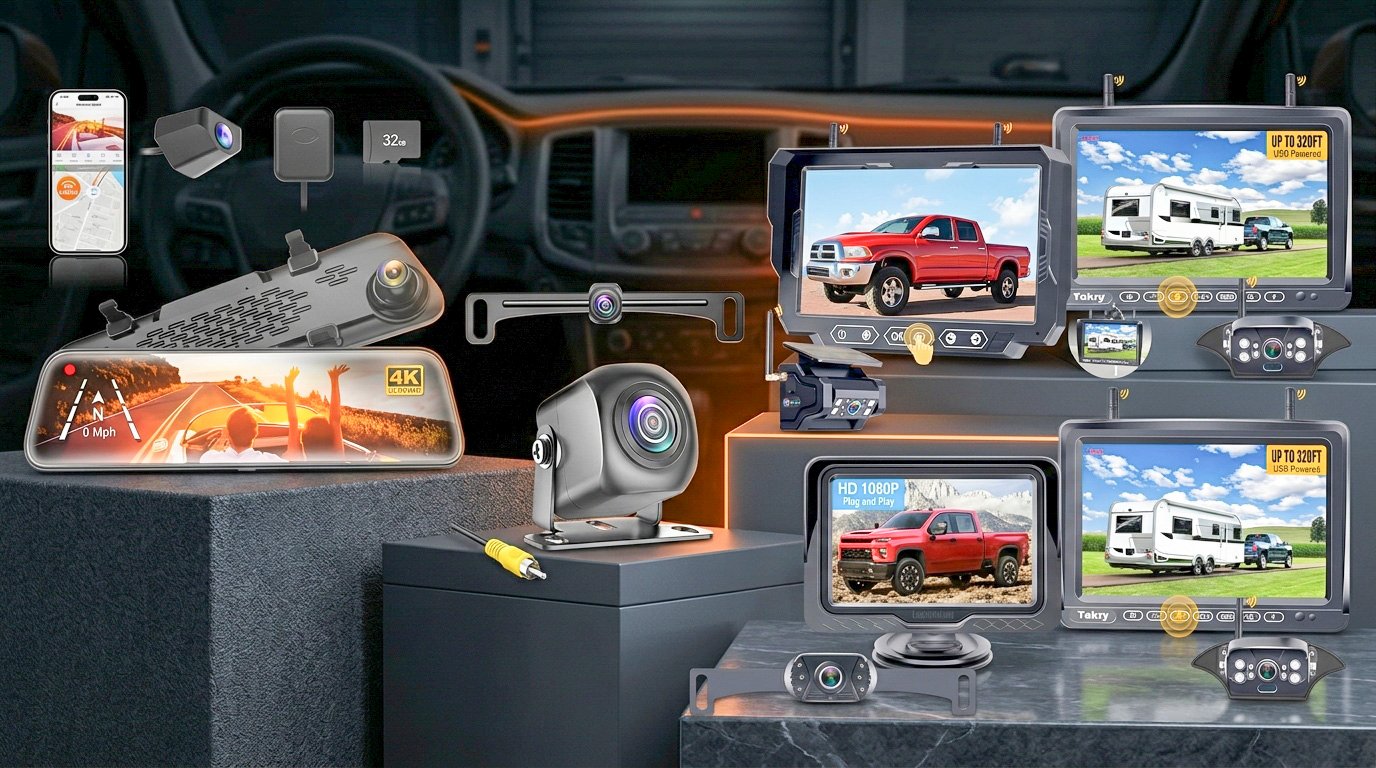
The trouble starts when you begin shopping. A single camera on a short cable is a backup camera. So is a boxed kit with its own monitor, a digital mirror that also records the road, a wireless unit for a pickup and trailer, and a system built for a 30-foot motorhome. They share a purpose and almost nothing else. The right one depends on the length of your vehicle, the screen you already have, and how much of your weekend you are willing to spend behind trim panels.
That is the lens for this comparison. We have set five products side by side, not to crown a winner but to show which kind of driver and which kind of vehicle each one suits. Along the way, we will point out where the marketing language needs a careful reading.
Our Take
We chose these five because each solves the rear-visibility problem in a different way. One is a mirror that doubles as a recorder. One is a bare wired camera for people who already own a display. One is a wireless, magnetic setup with a monitor. One is a complete camera-and-screen kit. One is a wireless system aimed at RVs and trailers. If we had picked five similar kits, the article would have been easier to write and far less useful.
This is also why a single best-to-worst ranking would mislead. Judged on a spec sheet, a 4K mirror and a basic wired kit look like a mismatch, yet the cheaper-looking option may be the correct purchase for a compact hatchback. The reverse holds for a camper van. What matters is the fit between product and situation, and the main variables are fairly few.
Compatibility comes first, and it often counts for more than headline resolution. A 1080P sensor feeding a screen that cannot interpret its signal gives you an expensive blank display or a degraded picture. Installation comes next. A wired camera is usually the steadiest, but the cable has to travel from the back of the vehicle to the dash, and on a long vehicle that is real work. Vehicle length compounds the problem: the farther the camera sits from the driver, the more the installation method decides everything.
Display type is the third variable. Some buyers want a dedicated monitor, some want the picture in the mirror, and some already have a head unit. It also pays to understand what “wireless” means. It describes the video link between camera and screen. The camera still needs power, the monitor still needs power, and any claim of solar assistance should be read as a supplement to that arrangement and not a replacement for it.
Getting this right pays off in ordinary ways: fewer scuffed bumpers, calmer parking, safer hitching and less guesswork when you reverse. The limitations are worth stating plainly too. No camera removes the need to look around you, picture quality in the dark depends on lighting and mounting position, and specifications can differ between listings, so confirm the details on the current product page before you order. If you are also planning other upgrades, our roundup of smart car accessories worth buying can help you decide what else deserves a place in the same installation session.
The Five Backup Camera Options
WOLFBOX G840S 12″ 4K Mirror Dash Cam

- UPGRADED 4K UHD CLARITY – Experience stunning detail with the front camera’s upgrade to 4K UHD (2160p) resolution, paire…
- 5.8GHz WiFi&GPS TRACKING – The included external GPS antenna enables real-time GPS data display directly on the dash cam…
- LARGER SCREEN & WIDER VIEW – The WOLFBOX G840S mirror camera features a 170° front lens and a 140° rear lens, offering a…
Think of the G840S as a replacement for your rearview mirror and not an addition to it. It is a 12-inch digital mirror with front and rear recording, so the same installation gives you a live rear view and a dash cam.
The case for this format is strongest when the rear view is obstructed. Tall cargo, rear passengers, large headrests, a small rear window or heavily darkened rear glass can all turn a glass mirror into a poor instrument. A camera-fed mirror sees past those obstacles. If rear glass darkness is part of your problem, our explainer on IR ceramic window tint and visibility shows why a screen-based view can make up for what tint takes away.
The compromise is commitment. You are routing a front unit and a rear camera, and sorting out power, which is a bigger job than fitting a single reversing camera. Some drivers also dislike shifting focus between a mirror image and a display. Because the system combines mirror, recorder and reversing view, a fault affects all three. It makes the most sense if you want to rebuild how you see behind the car and are willing to give the installation a proper afternoon. If you simply want to see the ground behind the bumper, a simpler product will do the job with less fuss.
PixelMan PMD2A-S AHD 1080P Backup Camera

- 【Continuous Upgraded 1080P AHD Backup Camera】After launching three car backup cameras, PixelMan further upgrade and laun…
- 【Support HD and AHD switching】This upgraded back up camera even supports HD and AHD switching. Each optimization improve…
- 【1/2.7in AHD 1080P Large Chip Adopted in This Reverse Cam】The chip size determines the amount of reversing camera output…
Compatibility is the whole story with the PMD2A-S. It is a standalone wired camera, and its 1080P operation relies on an AHD-capable output. Whether it works well for you depends on whether your monitor, head unit or mirror display accepts that signal. It is not a universal fit, and treating it as one is the quickest route to a return.
When the match is right, this is an economical and tidy upgrade. You are not paying for a second screen you will never use, and a wired link avoids the radio variables that wireless systems bring. If your car already has an aftermarket head unit with a spare camera input, or you have a compatible dash monitor, adding a dedicated camera can be the most elegant solution of the five.
The limitations are the mirror image of those strengths. You supply the display, and you take on the task of checking connectors, power trigger and input settings. You also still have to run the cable the length of the vehicle, which is easy on a hatchback and tedious on anything long. Choose it if you know your screen supports the signal. If you are not sure, a boxed kit saves you the research.
pemacom P15 1080P Wireless Magnetic Backup Camera

- 1 MINUTE MAGNETIC QUICK INSTALL: This backup camera for truck features a base with 6 powerful magnets made from “3rd gen…
- SCREEN RESOLUTION & HD NIGHT VISION: Pemacom’s self-developed algorithm can improve the clarity of the backup camera pic…
- POWERFUL DIGITAL SIGNAL: The back up camera systems for truck features a more powerful digital signal receiver with freq…
The thing that stands out about the P15 is what it lets you skip: a long cable run from the tailgate to the cab. It pairs a 1080P camera with a monitor, sends the picture wirelessly and attaches magnetically, so setup is quick and the camera can move between surfaces. For a pickup that sometimes tows, a camper that changes configuration, or a trailer you attach and detach, that flexibility has real value.
Precision about the word “wireless” helps here. The video travels without a cable, which removes the hardest part of many installations. Power is still part of the picture, however. The camera needs an energy source, and the solar assistance on this model is best seen as a helpful supplement and not a reason to assume you will never think about power again. The monitor needs power in the cab too, so read the power arrangement before you decide it suits your use.
The large monitor is a practical advantage when you are watching a hitch or a long load. The trade-off is permanence. A magnetic mount is about convenience and speed, not the vibration-proof, hidden finish of a fixed installation. It rewards owners who value flexibility and punishes those who want a factory look. If a clean, permanent wired install matters more to you, look elsewhere on this list.
LeeKooLuu LK3 HD 1080P Backup Camera Kit

- Easy to Install: The backup camera for car takes only 25 minutes from start to finish installation, just 2 steps: ① Firs…
- Stable Signal Transmission: The LeeKooLuu backup camera is superior in signal stability compared to other backup camera …
- All-Weather Defender: The backup camera for truck housing is made of ABS-TC material and utilizes the latest nano-coatin…
Some buyers do not want to research input standards at all. They want a camera and a screen in the same box, and the LK3 gives them that. Camera and monitor arrive together, which removes the compatibility question that hangs over a standalone unit.
This listing has also been around for a long time and has gathered a large body of buyer feedback. That does not prove it outperforms newer rivals, but a long-running product gives you more real-world evidence about its behavior than a new listing can. Before buying, read recent feedback for patterns about installation difficulty, screen visibility and low-light performance, since those vary by vehicle. Night visibility is part of its appeal, but any camera in the dark depends on lighting and mounting height, so keep expectations sensible.
Do not mistake it for the wireless products. It is a wired kit, so you still route a cable from rear to front, and the farther the camera is from the dash, the more that matters. For a typical car, SUV or pickup, the straightforward design is a strength: fit, power, see. On a long trailer or an RV, the cable run may tip you toward one of the wireless systems.
Yakry Y27-N Wireless RV Backup Camera System

- Dual Antennas Design with Enhanced Stability: Y27 RV backup camera features 2026 unique dual-antenna design and chip, of…
- Easy DIY Installation in Just 30 Minutes: Y27 wireless backup camera comes with a Furrion bracket and pigtail wire for e…
- Expandable with 4 Channels: Add up to 4 cameras to the HD 1080P monitor with Y27 RV camera system wireless item, and swi…
Large vehicles create their own category of problem. On a travel trailer or motorhome, the camera can sit many meters from the driver, and in that setting the length of cable and the effort of routing it become the central question. The Y27-N is designed for that situation, and that focus is why it earns a place here.
A wireless link spares you the longest and most awkward wiring. It also helps with trailers that are unhitched and reconnected, since there is no video cable to plug and unplug each time. If your RV or trailer already has pre-wiring for a rear camera, that existing infrastructure may affect how neatly the system integrates, so check what your vehicle provides before ordering. Mismatched connectors are exactly the kind of detail that stalls an installation. Since an RV is also a place where preparedness matters, our guide to portable jump starters for roadside emergencies is a sensible companion read.
It is not the obvious pick for a passenger car, and it should not be presented as one. On a compact vehicle the added complexity buys you nothing, and a simpler kit will serve better. For occasional light towing, the pemacom’s portability may be the better fit. The Y27-N is most convincing when the vehicle is long, the camera is far away, and reversing is a routine part of using it.
Final Conclusion
There is no universally right backup camera, only the right one for a given vehicle. A product that suits a compact hatchback can frustrate the owner of a long trailer, and the reverse is just as true. The more useful question is not “which camera is best” but “which installation will I actually be happy living with.”
Start with the vehicle. If it is a car, SUV or small pickup and you simply want a rear view without a research project, the LeeKooLuu LK3 is the natural choice, since the camera and monitor come together and you avoid compatibility guesswork. If you already have a compatible screen or head unit, the PixelMan PMD2A-S is the efficient standalone solution, provided you confirm AHD support first. If your rear view is regularly blocked by cargo, passengers or tinted glass, and you also want recording, the WOLFBOX G840S is the more ambitious path, with the extra installation effort that comes with it.
If a long cable is the thing you are trying to avoid, the choice turns on how you use the vehicle. The pemacom P15 suits pickups, trailers and setups you move around, trading permanence for speed. The Yakry Y27-N suits RVs, campers and long trailers, where distance and existing pre-wiring shape everything.
So which one makes the most sense for you? Measure how far the camera must sit from the driver, check what display you already own, and decide whether you want a fixed installation or something flexible. Those answers narrow the field faster than any resolution figure. The specification sheet tells you what a camera can do, but your vehicle tells you what it will do.