Volkswagen T-Roc 2023: The compact SUV segment is unforgiving, and every manufacturer is fighting for a category that essentially prints money. Volkswagen knows this better than most. The T-Roc arrived in 2018 asking a simple question: what if a Golf became an SUV without losing its personality?
Five years on, the 2023 T-Roc carries a meaningful facelift, updated technology, and a largely earned reputation. But the competition has sharpened considerably. The Ford Puma is more engaging to drive. The Mazda CX-30 feels genuinely premium inside. The Toyota C-HR has undergone its own transformation. And yet the T-Roc keeps selling, and there’s a clear reason for that beyond badge loyalty.
Our Opinion
The T-Roc is built for buyers who want the Golf experience with a higher seating position and stronger visual presence, without sacrificing driving quality. If you commute regularly, live in or near a city, and want something composed and well-built, it works extremely well.
It is not the right choice for buyers chasing maximum practicality. A Skoda Karoq or Volkswagen Tiguan offers substantially more space for comparable money in certain configurations. The T-Roc prioritizes style and driving character over raw utility, and that’s either exactly what you need or entirely the wrong call.
Pros and Cons
Pros:
- Composed and planted on motorways with well-weighted steering
- Meaningful post-facelift tech upgrades, particularly the infotainment
- Premium-feeling materials in mid and upper trims
- Strong engine lineup, especially the 1.5 TSI with cylinder deactivation
- Competitive real-world fuel economy for a petrol compact SUV
- Five-star Euro NCAP rating with useful driver assistance features
- Extensive trim and color customization options
- Respectable residual values against mainstream rivals
Cons:
- 392-liter boot trails several direct competitors
- Haptic climate controls are frustrating to use while driving
- Rear legroom is tight for taller adults on longer journeys
- Entry trims feel underspecified for their asking price
- No hybrid powertrain in the mainstream 2023 lineup
- 1.0 TSI feels strained under load at motorway speeds
- Some driver assistance systems default to intrusive settings
What’s New?
The 2023 T-Roc builds on the substantial mid-cycle facelift introduced for 2022. The front end received a redesigned bumper, revised LED lighting signatures, and standard LED headlights across more trim levels. Inside, the shift to Volkswagen’s MIB3 infotainment platform was the bigger story, replacing a system that was aging against newer rivals. The digital instrument cluster became more accessible lower down the trim range, and adaptive cruise control with stop-and-go functionality was improved and extended to more affordable specifications.
For 2023, changes are incremental. Trim structures were adjusted in several markets, the color palette received minor updates, and optional packages were consolidated. It’s a refined version of the 2022 facelift rather than a ground-up rethink, but that facelift was significant enough that the car still reads as current.
Exterior Design
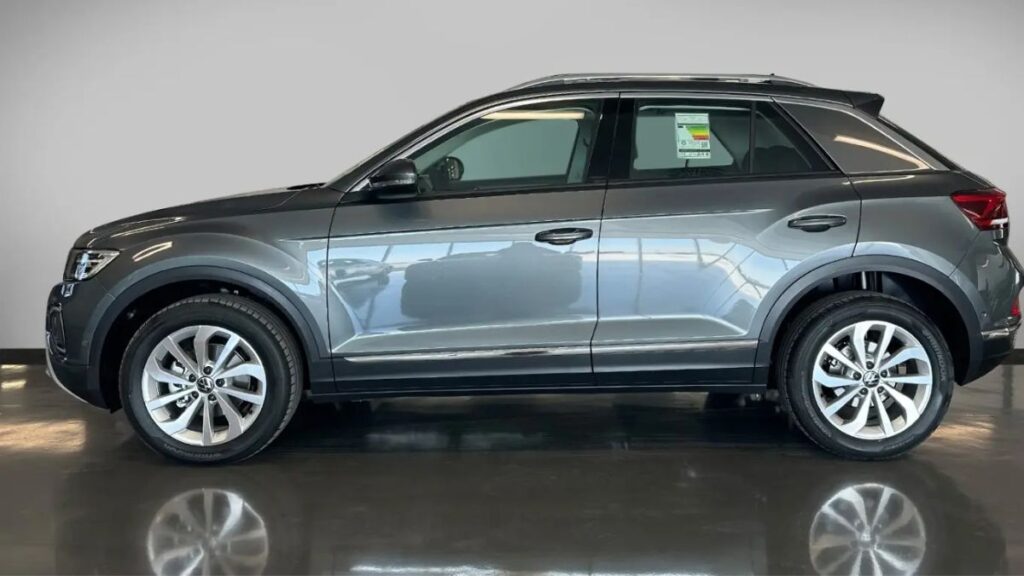
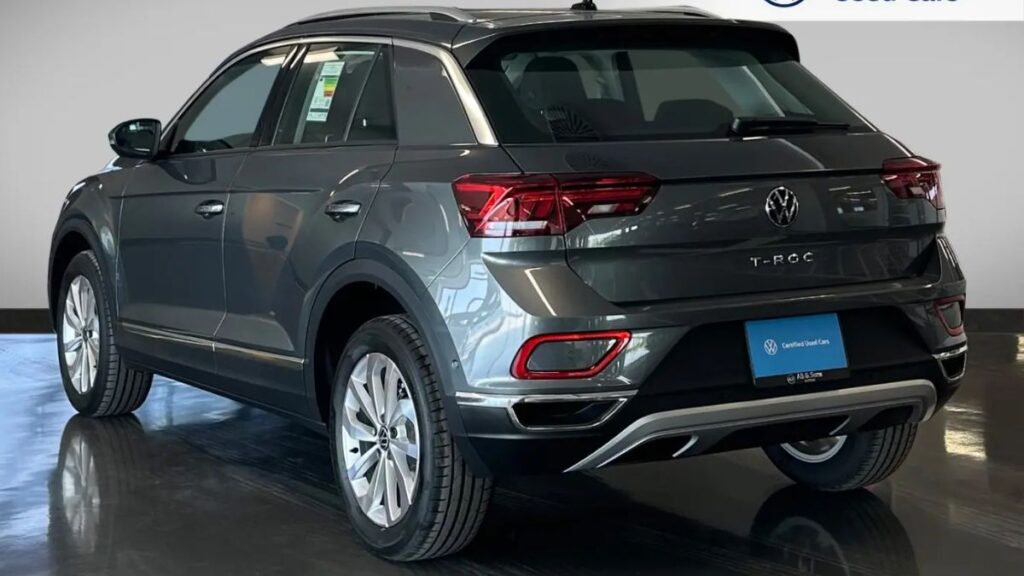
The facelifted T-Roc looks more assertive than its predecessor. The wider lower bumper, crisper LED daytime running light signatures, and a more confidently positioned grille give the front end genuine presence. In person, the proportions hold up well. It maintains its character in a parking lot full of anonymous crossover shapes.
The sloping roofline favors style over rear headroom, and the high beltline limits rearward visibility slightly. The two-tone roof configurations and broad color palette offer a level of personalization that few rivals match at this price. R-Line trim, which accounts for a significant share of sales, adds sportier bumpers, side skirts, and larger alloys that improve the car’s visual proportion rather than just adding visual noise. Confident without being loud, which is a balance Volkswagen typically gets right.
Driving Experience
On the road, the T-Roc is one of the more rewarding compact SUVs to spend time in. Steering weight is well-calibrated, and there’s enough feedback through the wheel to keep you connected to the front axle. Body roll is controlled without tipping into harshness. The DSG automatic, particularly with the 1.5 TSI, reads traffic confidently and makes motorway driving genuinely relaxed. Sport mode sharpens throttle response in a useful rather than theatrical way.
Around town, the elevated seating position delivers the visibility advantage crossover buyers want. What the T-Roc doesn’t do is excite. The chassis is tuned to absorb rather than engage, and there’s no real eagerness through a sequence of corners. That’s not a failure for a family crossover, but buyers expecting anything close to a performance experience should look at the T-Roc R, a different machine entirely.
Performance and Acceleration
The entry-level 1.0-liter three-cylinder TSI produces 110 horsepower and is frugal in urban conditions, but under motorway load with a full complement of passengers, it shows its limits. Overtaking requires more planning than most buyers will find comfortable over time.
The 1.5-liter TSI four-cylinder at 150 horsepower is the engine that best suits the car. It pulls cleanly, pairs well with the DSG, and uses cylinder deactivation under light load for a genuine real-world efficiency benefit. The 0-62 mph sprint takes approximately 8.4 seconds, which feels brisk enough in everyday driving without being a headline figure.
A 2.0-liter turbocharged diesel at 150 horsepower remains available in select European markets, offering strong long-run economy for high-mileage buyers. The T-Roc R and its 300-horsepower 2.0-liter TSI is a separate performance conversation altogether.
Ride Comfort and Cabin Refinement
Volkswagen tunes for composure over suppleness, and the T-Roc follows that formula. Standard suspension handles urban imperfections reasonably well, though sharp potholes register clearly through the seat. Optional adaptive dampers, available on higher trims in certain markets, add genuine flexibility without sacrificing motorway stability.
NVH management is a quiet strength. Wind intrusion at speed is well-controlled, and engines are effectively isolated from the cabin at cruising RPM. The 1.0 TSI becomes more audible under hard acceleration. The 1.5 TSI is noticeably more refined at pace.
Front seat comfort is a consistent highlight, with good lateral support and adequate lumbar adjustment for longer drives. The rear bench accommodates two adults comfortably. Three across is a stretch, and taller passengers will notice the limited legroom on extended journeys.
Interior Design and Quality
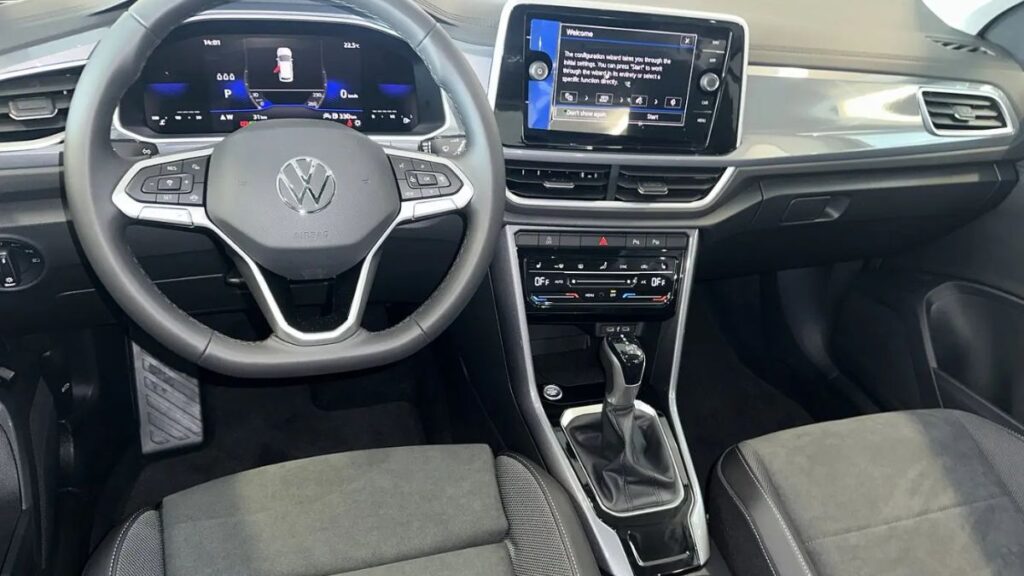
The T-Roc largely upholds Volkswagen’s reputation for thoughtful assembly. Hard plastics appear on lower door panels in entry-level trims, but the surfaces you interact with most feel appropriately premium for the price. The facelift produced a cleaner dashboard layout, with the high-mounted touchscreen readable without significant head movement.
The haptic climate control panel deserves direct criticism. Physical temperature and fan speed controls have been replaced by touch sliders that require you to look at what you’re pressing while driving. It’s a genuine daily frustration rather than a minor inconvenience, and worth experiencing in person before committing. Volkswagen has acknowledged this direction hasn’t landed universally well, and newer group models are returning to physical controls. The 2023 T-Roc, however, remains in the haptic era.
Ambient lighting, quality upholstery choices, and solid overall construction make the cabin feel above its price class in well-specified configurations.
Technology and Infotainment
The MIB3 system on the 9.2-inch touchscreen is a genuine step forward. Response is faster, menu logic is more intuitive, and wireless Apple CarPlay and Android Auto connect reliably. Built-in navigation is usable without defaulting to your phone. The optional digital cockpit cluster places navigation directly in the driver’s eyeline across configurable layouts.
Volkswagen’s We Connect platform covers remote access, selected over-the-air updates, and real-time traffic data. The app works without significant frustration, though buyers should clarify which features are permanent inclusions and which are time-limited trial subscriptions before signing. The optional Beats audio upgrade is worth adding if sound quality matters to you.
Fuel Consumption
Volkswagen quotes the 1.5 TSI DSG at 44 to 47 mpg on the WLTP combined cycle. Real-world figures are more grounded. Urban driving typically returns 35 to 38 mpg. Mixed driving delivers 40 to 44 mpg without particular effort, and sustained motorway cruising can reach 45 mpg where cylinder deactivation is most effective. The 1.0 TSI sits in a similar range but without the same open-road efficiency benefit.
Where the 2.0 TDI diesel is available in European markets, real-world motorway consumption in the high 40s to low 50s mpg is realistic, making a strong long-term financial case for high-mileage users. Against full hybrid rivals like the Toyota C-HR or Honda HR-V e:HEV, the T-Roc’s petrol options trail in urban efficiency specifically.
Practicality and Storage
The T-Roc offers 392 liters of boot space, expanding to 1,237 liters with the rear seats folded. Those numbers are workable but lag behind rivals. The Skoda Karoq offers 521 liters as standard, and the Ford Puma adds underfloor MegaBox storage that punches above its external dimensions. The T-Roc’s boot is at least a clean rectangle, making efficient packing straightforward despite the limited volume.
Cabin storage is sensible. Door pockets, a usable center console bin, and front and rear USB-C ports cover daily needs adequately. The rear doors provide acceptable access, though the sloping roofline compromises headroom for taller adults. As a four-seat car primarily used by front occupants, it’s comfortable. As a regular five-seat family solution, it warrants a test sit before purchase.
Safety and Driver Assistance Systems
Euro NCAP awarded the facelifted T-Roc five stars, with strong results across adult and child occupant protection and safety assist. Standard equipment across most trims includes AEB, lane keeping assist, adaptive cruise control with stop-and-go, traffic sign recognition, and fatigue monitoring.
Lane keeping assist defaults to assertive intervention and can feel intrusive on roads with worn lane markings. Adjusting the sensitivity early in ownership makes a noticeable difference. Blind spot monitoring and rear cross traffic alert are available on higher trims and perform reliably. Overall, the safety package is competitive for the class and a clear improvement over the pre-facelift car.
Worthy Competitors
Ford Puma: More engaging to drive with clever underfloor storage. Interior quality trails the T-Roc slightly, and the ride is busier on poor surfaces, but it’s a strong all-around alternative.
Mazda CX-30: The interior quality benchmark in this segment. Ride comfort is excellent, though the infotainment experience and naturally aspirated engine option are less convincing.
Toyota C-HR: Full hybrid as the primary powertrain delivers a real efficiency advantage, particularly in urban use. Less driver-focused than the T-Roc but a rational choice for efficiency-first buyers.
Honda HR-V: More practical interior and the e:HEV hybrid system impresses in city conditions. Lacks the T-Roc’s chassis precision and the styling divides opinion, but it’s a practical, efficient option.
Key Strengths and Key Weaknesses
The T-Roc’s strengths are anchored in how complete it feels dynamically for a compact crossover. It remains one of the more composed and confident options in its class, with driving dynamics that stand out against most mainstream rivals. The post-facelift infotainment system and digital cockpit also make a noticeable difference in everyday use, giving the cabin a more modern and cohesive feel.
Volkswagen’s strong residual values and wide service network further reinforce its appeal as a long-term ownership choice. Add to that a high level of personalization, especially in exterior styling and trim combinations, and the T-Roc manages to feel more tailored than many competitors. Cabin quality is also solid in mid and upper specifications, where materials and finish elevate the overall perception. The 1.5 TSI engine, particularly with cylinder deactivation, delivers measurable efficiency in real-world driving, adding another layer of balance to the package.
However, the compromises are just as clear. Boot space is below average for the segment, which limits outright practicality compared to rivals like the Skoda Karoq. The haptic climate controls remain one of the most consistent daily frustrations, requiring more attention than physical controls in real-world use. Rear passenger space is also tight for taller adults on longer journeys, which reinforces its positioning as more of a four-seat crossover than a full family hauler.
The absence of a mainstream hybrid option is another gap, especially when competitors are moving toward electrified efficiency in this segment. Entry-level trims also feel relatively sparse in equipment for the price, making mid-spec versions the more logical starting point. And finally, while the T-Roc is strong in many areas, some rivals simply offer either more character or more practicality for similar money, depending on what a buyer values most
Which Category Does CarDrav Recommend?
The T-Roc belongs in the style-led compact crossover category alongside the Cupra Formentor and MINI Countryman, not the utility-first group occupied by the Karoq or Qashqai. CarDrav recommends the 1.5 TSI DSG in R-Line trim as the optimal configuration. It pairs the right engine and transmission with a specification level that justifies the cabin’s premium feel.
This is the car for urban and suburban buyers who commute regularly, want something composed and well-presented, and prioritize driving quality over maximum practicality.
Conclusion: Is It Worth Buying?
Yes, with clear expectations. The 2023 T-Roc is a well-built, well-driving compact crossover that rewards buyers who value refinement and character. The facelift meaningfully improved it, the 1.5 TSI is the obvious engine choice, and cabin quality in upper trims is hard to fault at the price.
The compromises are real. Boot space will become relevant on family trips. Rear passengers feel the legroom limits on longer journeys. The lack of a hybrid option stings against efficient rivals, and the haptic climate controls will frustrate every single day.
If those trade-offs fall outside your priorities, the T-Roc earns a confident recommendation. If practicality or running efficiency drive your decision, the Skoda Karoq, Toyota C-HR, or Mazda CX-30 will serve you better. The T-Roc knows exactly what it is, executes it well, and makes no apology for the rest.
FAQs
Is the 2023 Volkswagen T-Roc reliable?
Generally yes. The 1.5 TSI and DSG gearbox are well-proven across VW Group products. Some owners report occasional infotainment and touch-control niggles. Following service intervals carefully matters given the turbocharged engine’s demands on oil quality.
How does the T-Roc compare to the Ford Puma?
The Puma drives with more engagement and offers cleverer storage. The T-Roc counters with stronger interior quality and better motorway refinement. The choice comes down to driving enjoyment and packaging versus cabin quality and long-distance composure.
What is the real-world fuel economy of the 1.5 TSI?
Expect 35 to 38 mpg in urban conditions, 40 to 44 mpg in mixed driving, and up to 45 mpg on sustained motorway runs. These fall below WLTP figures, as expected, but remain competitive for a petrol compact SUV with genuine performance.
Is the T-Roc practical enough for a family?
For small families, yes. Two adults and children in the rear works comfortably for regular use. For consistent rear adult passenger comfort or maximum boot capacity, a Skoda Karoq or Volkswagen Tiguan offers considerably more without leaving the VW Group lineup.
Does the 2023 T-Roc hold its value well?
Better than most mainstream rivals. Consistent used market demand and strong brand recognition support residuals. R-Line and higher specifications hold value more strongly than entry trims. Checking current used pricing before negotiating new is always worthwhile.