2026 Honda Odyssey Review Space, Comfort, and V6 Power
A familiar V6 minivan with the best second-row seating in the segment, and a gas-only powertrain in a hybrid-minded market


This 2026 Honda Odyssey review starts with a plain observation: the minivan has become the family hauler that fewer shoppers bother to cross-shop, yet it still does the job better than most three-row SUVs. The Odyssey is an eight-passenger, front-wheel-drive van with a naturally aspirated V6, a cabin built around real family routines, and a second-row seating system that no rival copies exactly. What it does not have is a hybrid powertrain or all-wheel drive, and that matters more every year as competitors add both. The central question is whether the Odyssey is still a smart choice when its rivals are more efficient and more technologically ambitious. If you want the background on how this generation started, our 2023 Honda Odyssey review covers the van as it stood several years into its run.
Our Take
The 2026 Odyssey is a very good family minivan that is no longer the most modern one. Its case rests on four things: seating that rearranges itself around your children, a V6 that never sounds or feels strained, a cabin that treats every row like it matters, and a cargo area that swallows whatever a busy household throws at it. These strengths are not marketing language. They show up on the first school run, the first airport trip, and the first time you try to load a stroller, two car seats, and a week of groceries in a crowded parking lot.
The weaknesses are just as clear. The Odyssey burns regular gasoline at a rate that hybrid rivals simply do not, and it offers no way around that. The infotainment screen is serviceable rather than impressive, the parking aids stop short of a surround-view camera, and the crash-test record includes one result that deserves a serious conversation rather than a footnote.
It is fair to ask why a van from the fifth generation, first sold for the 2018 model year, still deserves attention. Honda gave it a meaningful refresh for 2025, which brought revised styling, a larger central touchscreen, an updated instrument display, and wireless smartphone integration. The 2026 model carries all of that over without a redesign or significant mechanical changes. That lack of news is worth discussing because it tells you what you are buying: a mature, well-sorted vehicle with few surprises, rather than a rolling experiment. For buyers who value predictability, that is an advantage. For buyers who want the newest powertrain or the biggest screen, it is a reason to keep shopping.
Our verdict is that the Odyssey suits families who put space, comfort, and daily usability ahead of fuel economy. Households that cover lots of miles and care most about the monthly fuel bill will be happier elsewhere, and we will explain why as we go.

Exterior Design and Dimensions
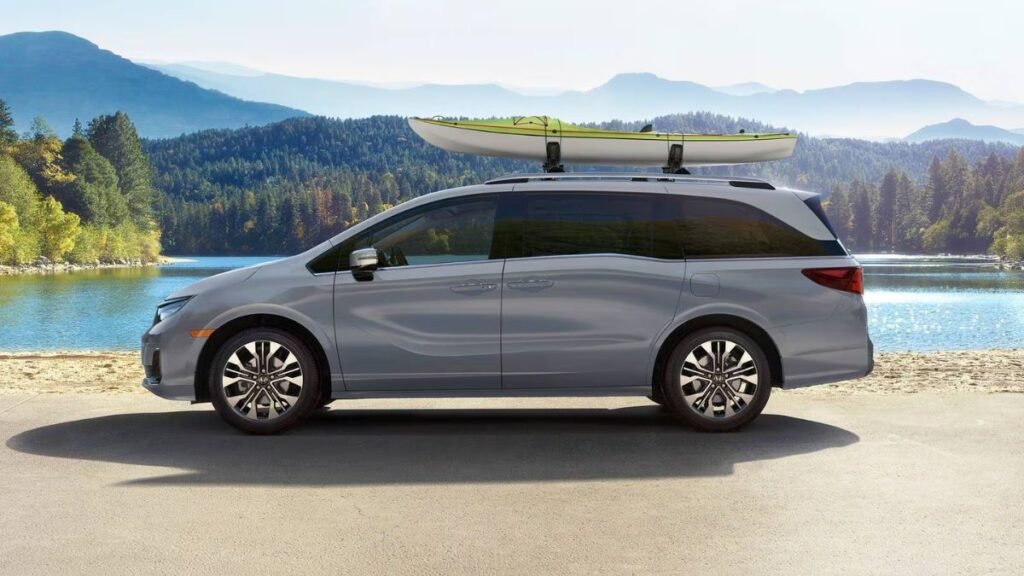
Nobody buys a minivan for its drama, and the Odyssey does not pretend otherwise. The profile is a conventional, practical one, with a tall greenhouse, large side glass, and a body shaped around passengers rather than fashion. The 2025 refresh tidied the front end and brought more modern detailing, which helps the van look current without disguising what it is. We think that honesty is a virtue here.
The real design story is the pair of sliding rear doors. They open wide without swinging into the car parked beside you, which is a quiet benefit in tight supermarket lots and school pickup lines. They also make it far easier to reach a child seat without contorting your back, something any parent of a toddler learns quickly.
The Odyssey measures 205.2 inches long, 78.5 inches wide, and 69.6 inches tall, riding on a 118.1-inch wheelbase. That long wheelbase is the foundation of the interior, because it gives designers room to place three rows without squeezing anyone into the corners, and it also helps the ride feel settled on the highway. The wide body adds shoulder room and lets the second row spread out in a way narrower vehicles cannot manage. At the same time, the van is not so large that it feels unmanageable in town, and its tall glass areas make it easier to place on the road than the styling suggests.
V6 Engine, 10-Speed Automatic, and Towing
Every 2026 Odyssey uses the same powertrain, and there are no engine choices to weigh. Under the hood is a naturally aspirated 3.5-liter V6 displacing 3,471 cc, producing 280 horsepower at 6,000 rpm and 262 lb-ft of torque at 4,700 rpm. It is a 24-valve SOHC i-VTEC design with Variable Cylinder Management as standard, which lets the engine run on fewer cylinders when the load is light. Power goes to the front wheels through a 10-speed automatic transmission with shift-by-wire control and paddle shifters. The fuel tank holds 19.5 gallons, and the engine runs on regular unleaded.
The practical difference between this engine and the smaller turbocharged or hybrid alternatives is worth spelling out. A turbocharged four-cylinder tends to make its torque low in the rev range, which feels punchy around town but can sound busy when the car is loaded and working hard. A hybrid adds electric torque that fills in smoothly from a stop, and it saves fuel by using that assistance. The Odyssey’s V6 does neither of those things. It builds power in a linear, predictable way, with no turbo lag and no dependence on battery charge. That simplicity is why it feels so unflappable with a full cabin and why it never seems to be straining to merge onto a fast highway.
The 10-speed automatic spreads its ratios finely, which keeps the engine in a useful part of its range and makes shifts easy to miss in ordinary driving. The paddle shifters are present, but they are more of a courtesy than a reason to choose the van. Nobody is going to carve canyon roads in an Odyssey, and the transmission’s real strength is how quietly it does its job.
The Odyssey can tow up to 3,500 pounds, but only when equipped with Honda’s dealer-installed accessory towing package, which includes a Class II hitch, a towing kit, and a wiring harness. That figure is not an unconditional standard feature. It suits a small camping trailer, a utility trailer, or a pair of bikes and a light load, but anyone with a heavy boat or a large travel trailer needs a different vehicle.
Fuel Economy
The EPA rates every 2026 Odyssey at 19 mpg in the city, 28 mpg on the highway, and 22 mpg combined, and the numbers are identical across all four trims. For a traditional V6 minivan, that is a reasonable result. The highway figure in particular is respectable for a vehicle this large, and the cylinder-management system likely helps on long, steady stretches.
The weak spot is the city number. Families who spend most of their time in stop-and-go traffic will feel the 19 mpg rating, and no amount of gentle driving will turn this van into a hybrid. For some extra real-world context, an independent highway evaluation of the mechanically similar 2025 Odyssey recorded about 28 mpg at a steady 75 mph. That was a 2025 test, not a new 2026 one, and it is useful mainly as a sign that the highway rating is achievable under the right conditions. Real-world fuel economy depends on speed, load, terrain, weather, and driving style, so we would not promise any buyer that they will match the EPA figures.

Driving Experience and Ride Quality
The Odyssey is not a sports minivan, and Honda has not tried to make it one. What it does offer is a driving experience that is easy, predictable, and relaxed. The V6 provides straightforward power delivery, so acceleration feels steady when the van is empty and only slightly less so with a full cabin of passengers. There is no turbocharged surge to get used to, just a progressive build of speed that makes merging and passing uncomplicated.
The steering is light and accurate enough that the van feels smaller than it is, which helps in parking lots and on narrow streets. Braking is stable and confidence-inspiring, an important quality when the cabin is loaded with children. Visibility is good thanks to the upright seating position and large glass areas, though the lack of a 360-degree camera means you rely on mirrors, the rearview camera, and the sensors on trims that have them.
On the highway, the Odyssey settles into a quiet, comfortable cruise, and the long wheelbase helps it track steadily. Road noise and wind noise are generally well controlled for a van of this shape, and the Elite trim adds sound-insulating glass for those who want an even calmer cabin. The suspension favors comfort over sharpness. The 19-inch wheels on the higher trims may feel slightly firmer over small road imperfections than the 18-inch wheels on the EX-L, so buyers who prize a softer ride may prefer the smaller wheels. Drivers who dislike engine restarts at stoplights should also be aware of the stop-start system, since it is the kind of feature people either accept or learn to dislike.
Interior Space, Seating, and Comfort
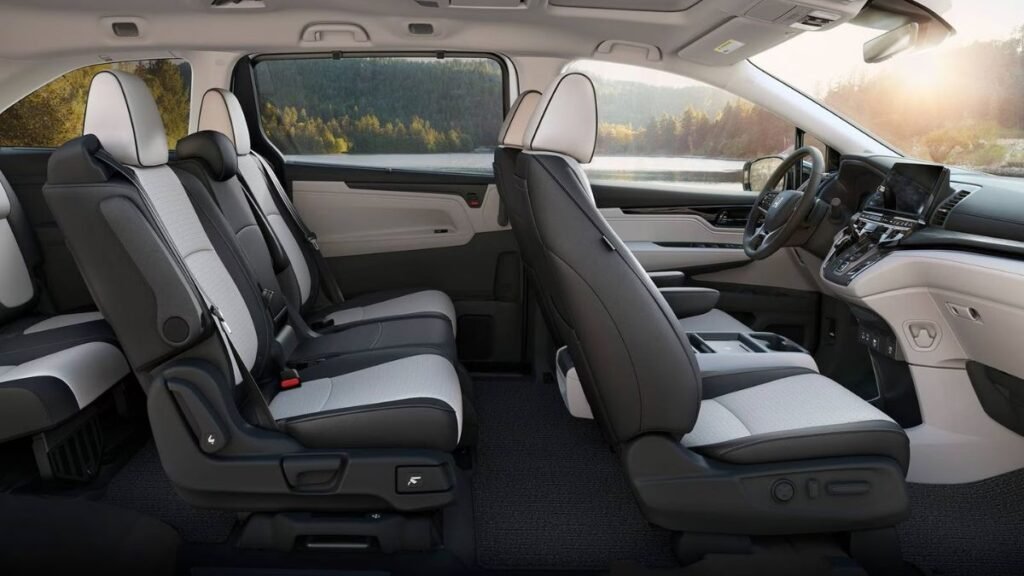
This is where the Odyssey earns its reputation. The cabin seats eight passengers and offers 160.1 cubic feet of EPA passenger volume. Legroom measures 40.9 inches in the first row, 40.9 inches in the second row, and 38.1 inches in the third row, while headroom is 38.7, 39.2, and 38.3 inches from front to rear. Those numbers tell a useful story, because the third row is not far behind the others in headroom and gives up only a few inches of legroom.
The front seats are supportive, with plenty of adjustment, and they suit long drives without much fuss. The second row is where families spend the most time, and it is generous in both legroom and positioning. The third row can carry adults for short and moderate trips, although it does not match the first two rows for space, and anyone planning long journeys with adults in the back should sit in it first. Cupholders, small storage areas, and sensible cabin cubbies keep the day-to-day clutter under control, and the wide-opening sliding doors make getting in and out easy for both children and adults.
Magic Slide Second-Row Seating
If one feature defines the Odyssey, it is Honda’s Magic Slide second-row seating system, which is available on all four trims. The second-row seats slide both laterally and longitudinally, and that flexibility creates a surprising number of arrangements. You can shift the seats to make it easier to climb into the third row, move a child closer to a parent in the front row, create more space between the outboard seats, or open up a clear path to a child seat. The removable center seat adds yet another layer, because taking it out changes the cabin arrangement and lets the outboard seats move closer together or farther apart.
The practical benefit is especially clear for parents with several young children. The Odyssey provides three LATCH positions in the second row and two more in the outboard third-row seats, for five child-seat installation positions in total. A parent can place one seat where a child can be reached from the front, keep a sibling within arm’s length, and still have space to get to the third row. Few other vehicles make these daily juggling acts so painless.
The system does have limits that buyers should understand. The second-row seats are removable, but they are not fold-flat seats that vanish into the floor, and they are relatively heavy, so taking them out takes manual effort and some space to store them. This is a real compromise, and it is one of the reasons some shoppers prefer rivals that hide their seats away.
Third-Row Magic Seat
The third-row seats are a 60/40 split-folding Magic Seat arrangement that folds into the rear cargo well using designated pull straps. The folding is manual, not powered, but it is quick and easy to learn, and it changes the van from a people carrier to a cargo hauler in a few seconds. That simplicity means fewer parts to fail and no waiting on a motor, although some buyers will wish for a power option at this price.
Cargo Capacity
Cargo figures in a minivan depend entirely on how the seats are arranged, so each number must be read with its configuration in mind. Behind the third row, the Odyssey offers 32.8 cubic feet of standard space and up to 38.6 cubic feet at maximum. Behind the second row, with the third row folded, the standard figure is 86.6 cubic feet and the maximum is 91.0 cubic feet. Behind the first row, the standard figure is 140.7 cubic feet, and the maximum reaches 155.7 to 155.8 cubic feet depending on trim. That largest figure requires removing the second-row seats and folding the third row, so it is not available while all eight seats are installed.
The deep well behind the third row is the most useful everyday feature here. It swallows groceries, luggage, sports equipment, and strollers without making you fold anything, and it is far deeper than the shallow cargo area of most three-row SUVs. When the seats are reconfigured, the Odyssey can carry large items, including 4-by-8-foot sheet material, when set up appropriately.
This is the core difference between a minivan and a conventional SUV. An SUV may look rugged, but its cargo space is usually shorter, higher, and less flexible once all three rows are in use. A minivan like the Odyssey is built around the box, and that box is large, square, and low to the ground, which makes loading much easier.
Technology and Infotainment
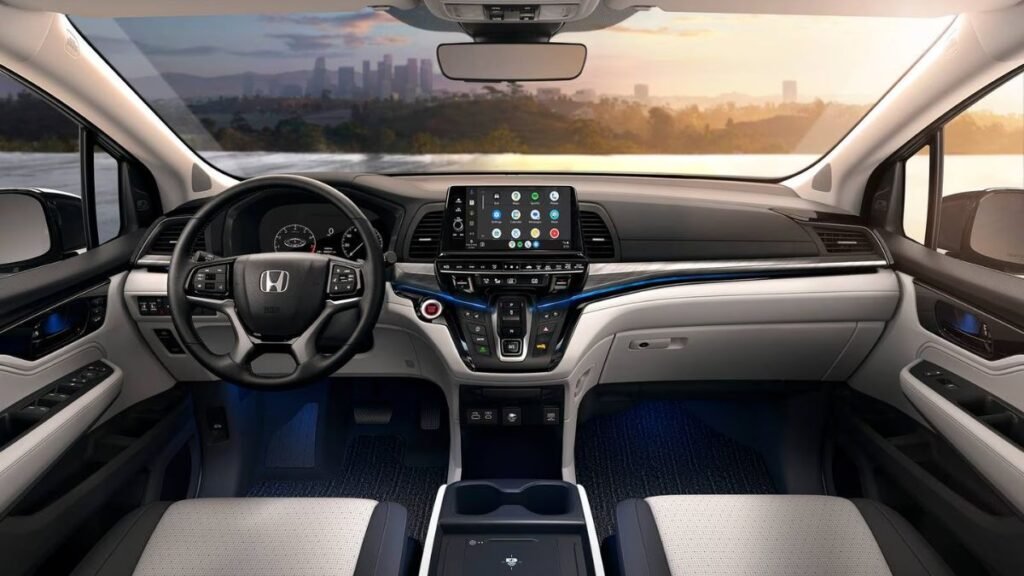
Every Odyssey comes with a 9-inch central touchscreen and a 7-inch driver information display. Wireless Apple CarPlay and wireless Android Auto are standard, as are wireless phone charging and USB-C charging connections. For most families, that is a solid foundation, since the phone does most of the heavy lifting for maps, music, and calls.
The 9-inch screen is functional, but it is smaller than the displays in some newer competing family vehicles, and the system does not use the newer Google-based interface found in certain newer Honda models. The practical difference should not be exaggerated. The menus are straightforward, the physical controls that remain are easy to find, and most owners will spend their time in CarPlay or Android Auto anyway. Still, shoppers who want the largest screen and the most advanced software will find the Odyssey a little dated.
CabinTalk is the standout feature. It lets the driver or front passenger speak to people in the rear seats through the vehicle’s speakers or through compatible rear entertainment headphones. Anyone who has shouted over a wailing toddler or a loud movie knows why this matters, because it saves you from turning around or raising your voice.
Touring and Elite trims add CabinWatch, a rear-seat camera system that lets the driver observe passengers in the back without twisting around. They also offer an available rear entertainment system with a 12.8-inch high-resolution screen. For families who take long road trips with children, that large display can be a lifesaver, but it is not standard on every trim and should not be assumed on the cheaper models.
Trim Levels and Pricing
The 2026 Odyssey comes in four trims: EX-L, Sport-L, Touring, and Elite. A quick note on naming is in order. Honda’s original pricing announcement called the middle trim Sport, while later specification documents call it Sport-L, and we use the current Sport-L name for the equipment package. The prices below are published manufacturer MSRP figures, not guaranteed dealer transaction prices, and actual costs will vary with dealer pricing, taxes, registration, options, and regional availability. Honda announced a destination charge of $1,495.
EX-L
The EX-L starts at $42,795, or $44,290 with destination, and it is far from a bare-bones entry trim. It includes leather-trimmed seating, heated and power-adjustable front seats, power sliding rear doors, a power moonroof, a power tailgate, the 9-inch touchscreen, wireless smartphone integration, the Magic Slide second row, and Honda Sensing safety technology. In other words, it delivers the essential Odyssey experience without forcing you to pay for more expensive trims, and for many families it is the sensible choice.
Sport-L
The Sport-L costs $43,895, or $45,390 with destination. It focuses on appearance, with 19-inch gloss-black alloy wheels, black exterior accents, a leather-trimmed interior with red stitching, and rear USB-C charging connections. It is primarily an appearance and equipment upgrade, not a more powerful version of the van, since the engine and drivetrain are identical. At about $1,100 over the EX-L before destination, it is a modest step up, and its value depends on whether you like the styling and want the extra charging ports.
Touring
The Touring, at $47,495 or $48,990 with destination, is the technology-focused trim. It adds the 12.8-inch rear entertainment display, Honda navigation, the CabinWatch camera, front and rear parking sensors, Wi-Fi hotspot capability, and rear window sunshades. That is a meaningful list for families who spend hours on the road, and the parking sensors help make up for the missing surround-view camera. The jump from Sport-L is about $3,600, and for road-trip households it is the point at which the equipment list starts to feel worth the money.
Elite
The Elite tops the range at $51,695, or $53,190 with destination. It adds ventilated and heated front seats, a heated steering wheel, a premium 500-watt, 11-speaker audio system, a hands-free power tailgate, rain-sensing wipers, and additional sound-insulating glass. It does not offer a different engine or drivetrain. Whether it justifies the roughly $4,200 premium over the Touring depends on how much you value those comfort details, and for many buyers the Touring is the better balance. The Elite is for those who want the quietest, most comfortable Odyssey and are willing to pay for it.
Safety and Driver Assistance
Every 2026 Odyssey comes with Honda Sensing, which includes the Collision Mitigation Braking System and Forward Collision Warning to help avoid or lessen frontal impacts. Road Departure Mitigation, Lane Departure Warning, and the Lane Keeping Assist System help keep the van in its lane, while Adaptive Cruise Control eases long highway drives and Traffic Sign Recognition keeps speed limits in view. Rounding out the list are a Blind Spot Information System, Cross Traffic Monitor, Auto High-Beam Headlights, and a rearview camera. Front and rear parking sensors are limited to the Touring and Elite trims, so buyers of cheaper models should not assume they are included.
There is no surround-view 360-degree camera, and the parking assistance is less comprehensive than that of some newer competitors. In a large van, that omission is noticeable, especially in tight urban spaces.
IIHS Crash Test Results
The Insurance Institute for Highway Safety (IIHS) results for the Odyssey are mixed, and they need careful explanation. The van earned Good ratings in the small overlap front test and the updated side impact test, and Good in the seat belt reminder evaluation. It received Good+ for LATCH ease of use, Acceptable for headlights, and Acceptable for pedestrian front crash prevention. The updated moderate overlap front test, however, produced a Poor rating.
These results come from different test vehicles of the same fifth-generation Odyssey, so they are not all fresh crash tests performed on a 2026 vehicle. The updated moderate overlap test was performed on a 2023 Odyssey EX-L, and the rating applies to 2023 through 2027 models. The small overlap and side impact results also apply across the fifth-generation model years, as the evaluation indicates.
The Poor moderate overlap result centers on the protection offered to rear passengers, with concerns about head and neck injury risk. That matters in a vehicle whose purpose is carrying children and adults in the back, and we do not think it should be brushed aside. It is also not the whole story, because several other tests produced Good ratings, and the Odyssey did not fail across the board. Families should weigh this result carefully and decide how much it affects their choice.
Buyers should also be aware of NHTSA recall 26V332, which covers certain Honda and Acura vehicles from multiple model lines, including certain 2018 through 2026 Honda Odyssey vehicles. The potential Odyssey population is approximately 9,408 vehicles, out of a total recall population of 98,892 across all included Honda and Acura models, and that larger number should not be attributed to the Odyssey. The issue concerns the front passenger seat weight sensor, which may crack and develop a short circuit, potentially affecting airbag deployment in a crash. The remedy is replacement of the affected sensor at no charge, and NHTSA’s filing listed July 6, 2026, as the scheduled start date for owner notifications. Not every 2026 Odyssey is necessarily affected, so owners and shoppers should check the vehicle identification number through the official NHTSA recall lookup and confirm whether any required repair has been completed. This is a specific component issue, not a sign that the entire model line is unsafe.
Warranty and Ownership
In the United States, the Odyssey carries a basic limited warranty of 3 years or 36,000 miles and a powertrain limited warranty of 5 years or 60,000 miles. Honda also includes a maintenance program for 1 year or 12,000 miles, and roadside assistance runs for the duration of the basic warranty under the applicable terms. This coverage is typical for the mainstream American market, so it is neither a weakness nor a major advantage over every competitor.
Long-term value comes down to the full picture. Fuel costs will be higher than in a hybrid rival, particularly in city driving, and a three-row van needs sizable tires that are not cheap to replace. Routine maintenance, insurance, and the original purchase price all belong in the calculation as well. We will not promise a specific long-term reliability rating without verified evidence, but we do think families should price out several years of ownership, not just the monthly payment.
How the Odyssey Compares With Its Rivals
The Toyota Sienna is the most obvious alternative. It uses a hybrid powertrain with a combined system output of approximately 245 horsepower, and its fuel economy can reach about 36 mpg combined in certain front-wheel-drive configurations. All-wheel drive is also available on selected trims. For shoppers who put fuel efficiency first, or who live where winter weather makes AWD attractive, the Sienna is the stronger choice. That said, it is not automatically better in every respect, since the Odyssey’s V6 feels more traditional and its Magic Slide seating offers a different kind of flexibility.
The 2026 Kia Carnival Hybrid has a combined EPA rating of approximately 32 mpg, with published estimates of about 34 mpg in the city and 31 mpg on the highway. That makes it a far more efficient alternative to the Odyssey, and it brings distinctive interior technology and styling as well. The hybrid powertrain changes the comparison considerably, because it shifts the argument from space and seating to fuel savings and design. Honda has shown elsewhere in its lineup how seriously it takes hybrid technology, as we discuss in our 2026 Honda Accord review, which makes the Odyssey’s gasoline-only approach stand out even more.
The Chrysler Pacifica is the third major rival. Its Stow ‘n Go seating system, available in applicable gasoline models, lets the seats fold into the floor, which is a different and in some ways more convenient solution than removing heavy seats from the Odyssey. The Pacifica also offers available all-wheel drive. Honda’s Magic Slide system is better at rearranging the second row around children and car seats, while the Pacifica is better at making the cabin disappear into a flat cargo floor. Which you prefer depends on whether you reconfigure your seats for people or for cargo more often.
Verdict: Who Should Buy the 2026 Honda Odyssey
The 2026 Honda Odyssey is still one of the best ways to move a family, and its strengths are the ones that count most day to day. The V6 is smooth and unstrained, the 10-speed automatic stays out of the way, the cabin is spacious across all three rows, and the Magic Slide second row solves problems that other vans only manage around. Add a large, deep cargo area and a comfortable long-distance ride, and you have a vehicle that makes family life easier.
Its limits are real. There is no hybrid powertrain and no all-wheel drive, fuel economy trails the hybrid minivans, and there is no 360-degree camera. The third row folds by hand, the second-row seats are heavy to remove, and some of the technology feels behind the curve. The Poor moderate overlap result deserves honest consideration, too, particularly for families who regularly carry passengers in the back.
Put together, those points describe a van for buyers who value space, seating flexibility, and a refined V6 over efficiency. If you drive moderate miles, have young children in car seats, and want the most usable cabin you can buy, the EX-L or Touring is a convincing choice. If your priority is fuel savings, or you need AWD, a hybrid rival such as the Sienna or Carnival Hybrid will probably make you happier. The Odyssey may not be the newest idea in the segment, but it remains one of the best answers to the question of how a family actually lives in a vehicle.