2024 Toyota Sienna Review: Is It Still the Best Family Minivan?
A closer look at the Sienna’s hybrid powertrain, fuel economy, comfort, technology, safety, and how it compares with today’s toughest minivan rivals.

Buy a 2024 Toyota Sienna and you’re making a trade before you ever back out of the driveway. You give up the effortless V6 shove of a Honda Odyssey or Chrysler Pacifica, and in exchange you get a minivan that can realistically go further between fill ups than almost anything else built to carry a family of seven or eight. For a household doing school runs, errands, and the occasional road trip rather than racing to merge onto the interstate, that’s usually an easy trade to accept.
The Sienna has been hybrid only since this generation launched for 2021, and the 2024 version doesn’t change that formula. It adds a new package for the sportier XSE trim, a few darker exterior details, and not much else. That’s not a criticism. Four years into a generation, a minivan that was already well sorted doesn’t need reinventing every fall.
Our Take
The Sienna’s entire personality comes from one decision: Toyota made the Sienna hybrid-only for this generation. That single choice explains almost everything else about how this van drives, what it costs to fuel, and where it falls short against its rivals.
Around town, the hybrid system is smooth and quiet, and the interior does a genuinely good job of solving the specific, unglamorous problems that come with hauling kids and gear. The cabin is comfortable on long trips, the cargo area handles strollers and luggage without drama, and the Woodland Edition gives outdoorsy families a version of the Sienna built around towing small trailers and reaching gravel campsites with more confidence.
Where it asks for patience is acceleration. The four cylinder engine works audibly hard when you ask for real power, and the second row seats, while excellent, don’t fold flat into the floor the way the Pacifica’s do. If maximum straight line performance or maximum cargo flexibility ranks above efficiency on your list, it’s worth cross shopping before committing.
Strengths and Weaknesses
What it does well
- Fuel economy that no gas powered rival gets anywhere close to
- One of only two minivans offered with all-wheel drive for the 2024 model year
- A comfortable, thoughtfully organized interior built for real family use
- The Woodland Edition adds genuine capability, not just badges
Where it comes up short
- Noticeably slower and louder under hard acceleration than V6 competitors
- Second row seats don’t fold flat, unlike the Pacifica’s Stow ‘n Go setup
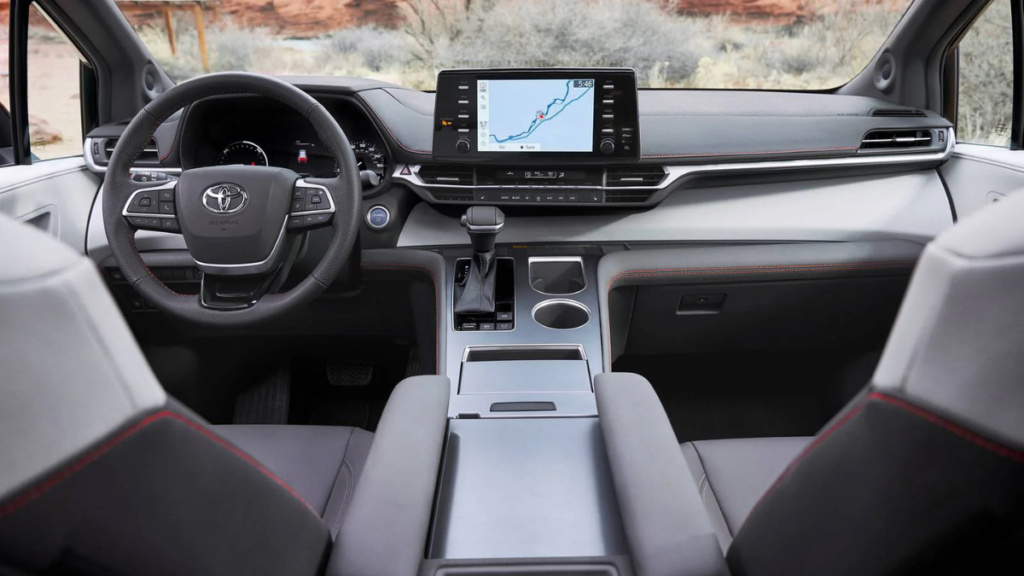
- The 9 inch touchscreen and wired phone connections feel dated next to newer rivals
- A newer IIHS crash test exposed a limitation in rear-seat protection (more on that below)
What’s New for 2024
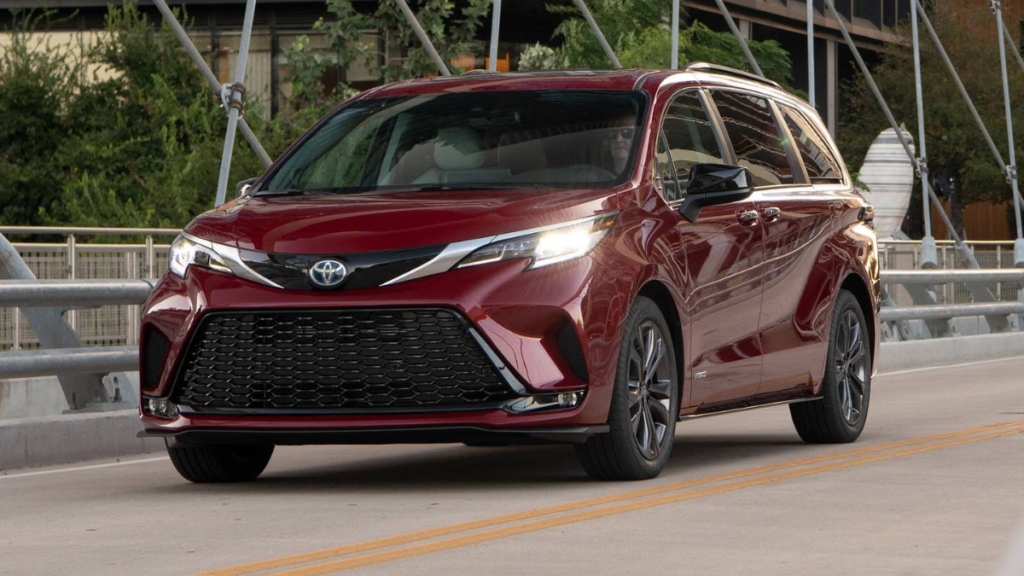
Not much, and Toyota isn’t pretending otherwise. This is the fourth model year of the current generation, which was completely redesigned for 2021, so the 2024 changes are refinements rather than anything close to a redesign.
The one addition worth knowing about is a new XSE Premium Package, which brings leather trimmed seating, heated and ventilated front seats, driver seat memory, a power tilt and telescoping steering column with memory, a larger driver information display, orange interior stitching, and upgraded exterior mirrors to the sportier XSE trim. The package brings several features that previously required moving higher in the lineup. Beyond that package, the LE and XLE trims get darkened, chrome accented headlight housings, and the XSE AWD and Woodland Edition wheels shift to a darker finish. The powertrain, the trim lineup, and the cargo and seating layout carry over unchanged from 2023.
For context on how the Sienna got here: Toyota added the Woodland Edition, its adventure oriented AWD trim, back in 2022. The following year brought a 25th Anniversary Edition package specific to that model year, celebrating a quarter century of Sienna sales in the United States. That anniversary trim did not carry over to 2024. If you’re weighing a used 2022 or 2023 against a new 2024, 2023 Toyota Sienna review and 2022 Toyota Sienna review cover those specific model years in more depth.
Exterior and Design
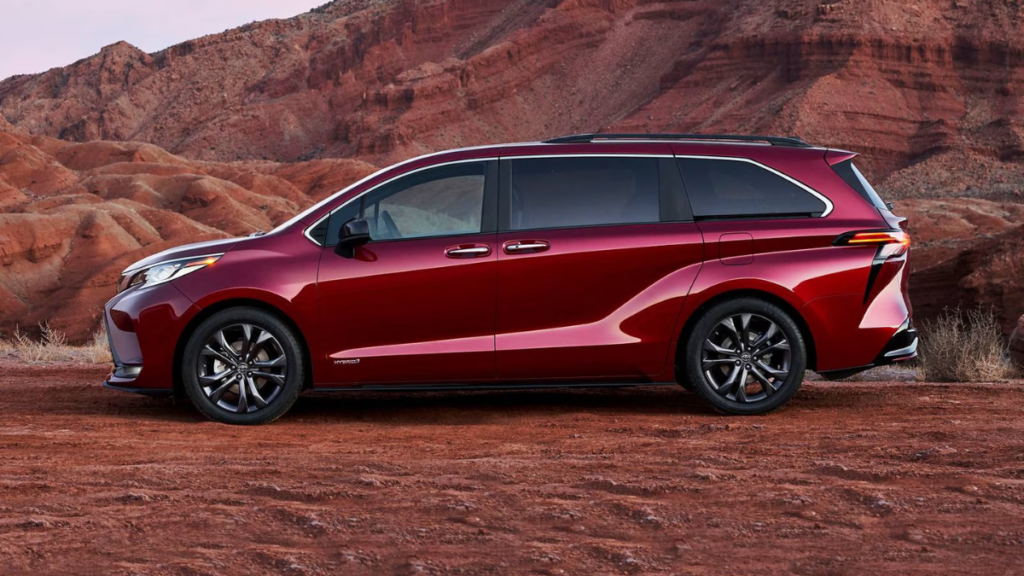
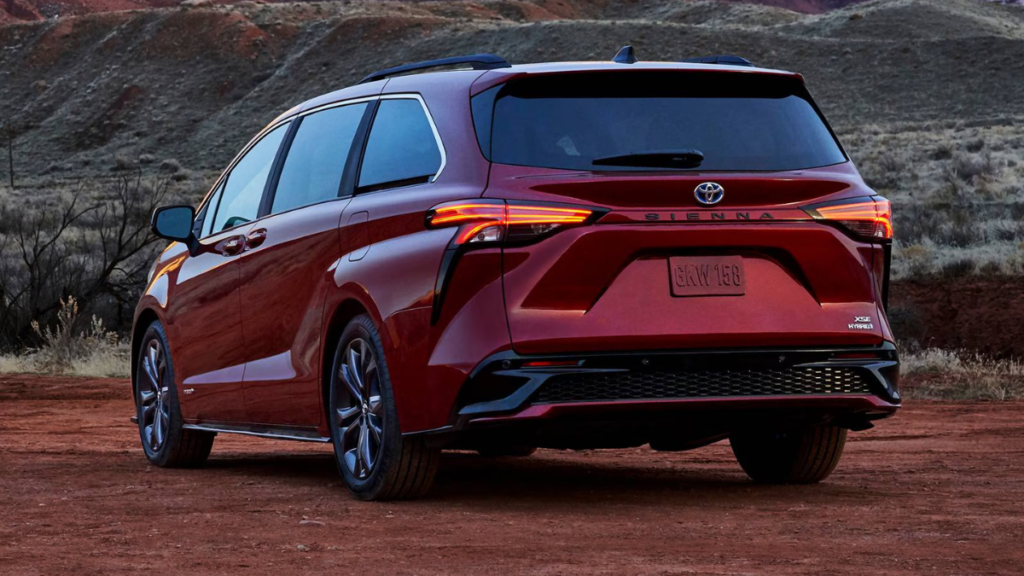
The Sienna’s shape hasn’t changed since the 2021 redesign, and it still doesn’t look like a traditional minivan. The sweptback nose, creased body sides, and low, wide stance give it more of a crossover silhouette than the boxier Odyssey or Carnival. That’s largely a styling choice, but it also helps the aerodynamics that support the hybrid’s fuel economy numbers.
Visibility is good for a vehicle this size, thanks to a relatively low beltline and generous glass area, though the thick D pillars do create a blind spot over the driver’s shoulder that the standard blind spot tech helps compensate for. Trim level changes the look meaningfully: the XSE wears a darker mesh grille and black exterior trim for a sportier appearance, while the Woodland Edition’s exclusive paint colors and slightly taller stance give it a distinct identity within the lineup. That taller stance comes from extra ground clearance built into unique springs and shocks rather than bigger tires, and it’s the clearest visual signal that this particular Sienna is meant for rougher roads than the rest of the family.
Driving Experience and the Hybrid Powertrain
Every 2024 Sienna uses the same mechanical layout: a 2.5 liter four cylinder gasoline engine paired with Toyota’s Hybrid System II, sending power to the front wheels (or all four, with AWD) through an electronic continuously variable transmission. Combined system output is 245 horsepower, drawn from a nickel metal hydride hybrid battery rather than the lithium ion packs found in some newer hybrids. That’s an older battery chemistry, heavier for its capacity than lithium ion, but it’s the same technology that has underpinned Toyota’s hybrids for decades with a strong track record for durability.
Off the line, the electric motors provide immediate response, so the van never feels sluggish pulling away from a stoplight. Around town is genuinely where this powertrain shines: quiet, composed, and happy to run on electric power alone at low speeds and light throttle. Merge onto a fast moving highway or try to pass on a two lane road, though, and the story changes. The four cylinder engine makes itself heard under hard acceleration, and the CVT holds engine speed high during those bursts in a way that broadcasts effort rather than hiding it. This isn’t a flaw so much as an honest consequence of how Toyota tuned the system: efficiency first, acceleration second.
Ride quality is one of the Sienna’s genuine strengths. It soaks up broken pavement and expansion joints well, and body control stays composed over rough roads even with a full load of passengers, which matters more than how it rides empty. Steering is light and easy in parking lots without going vague at highway speed. The brake pedal is a smaller weak point worth naming directly: stopping performance itself is fine, but the pedal feel can be grabby or inconsistent, which makes it harder than it should be to bring the van to a perfectly smooth stop. Road noise is well controlled at a cruise, but the cabin gets noticeably louder whenever the powertrain is working hard, merging onto a highway, climbing a grade, or accelerating with a full load of people and cargo. None of this makes the Sienna exciting to drive. It makes it relaxing under normal conditions, which is the trade Toyota clearly chose to prioritize.
Fuel Economy
The EPA rates the front wheel drive 2024 Sienna at 36 mpg in the city, 36 mpg on the highway, and 36 mpg combined. The all wheel drive version drops slightly to 35 mpg city, 36 mpg highway, and 35 mpg combined. Those numbers put a substantial gap between the Sienna and the V6-powered rivals in the segment, which generally return fuel economy in the low twenties combined.
Edmunds’ own real world fuel economy testing has actually come in above the EPA sticker, in the low 40s combined for the Sienna in its testing. That’s worth noting as an independent data point rather than something every owner should expect; EPA figures remain the standard everyone can rely on for comparison shopping, and real world results vary with driving style, terrain, and temperature. The hybrid system is at its best in exactly the kind of driving most families do a lot of: stop and go traffic and lower speed city streets, where the electric motors carry more of the load. Sustained highway cruising narrows the advantage somewhat, since aerodynamic drag and constant engine load matter more there. Cold weather also tends to knock down real world efficiency, since the gas engine works harder to generate cabin heat and the battery doesn’t charge or discharge as efficiently when cold. None of that is unique to the Sienna. It’s true of hybrids generally.
All Wheel Drive
For the 2024 model year, the Sienna was one of only two minivans offered with all-wheel drive, alongside the Chrysler Pacifica. Toyota’s system doesn’t work like a traditional mechanical AWD setup with a driveshaft running to a rear differential. Instead, the Sienna’s Electronic On Demand AWD uses a separate electric motor mounted at the rear axle, powered independently of the front hybrid system.
Toyota says that rear motor can preemptively send up to 80 percent of available torque to the rear wheels during off the line starts, specifically to help prevent the front tires from slipping. That’s worth being precise about: it’s a launch focused, proactive behavior, not a system that continuously runs an 80/20 rear biased split under normal driving. Most of the time, especially cruising on dry pavement, the front wheel drive hybrid system does the bulk of the work, and the rear motor steps in as conditions call for it.
In practice, that makes the AWD Sienna meaningfully more secure on wet roads, light snow, and loose gravel than the front drive version, which matters for anyone in a real winter climate or anyone who regularly drives unpaved roads to a cabin or campsite. It isn’t an off road system in any serious sense, and Toyota doesn’t market it that way. For drivers who never see snow or dirt roads, the FWD model’s mpg advantage may matter more than the extra traction. For anyone dealing with poor weather or rough roads on a regular basis, it’s a genuinely useful option to have.
2024 Toyota Sienna Interior and Family Practicality
This is the Sienna’s strongest area, and it’s worth spending real time on. Depending on trim, the Sienna seats seven or eight. Eight passenger configurations use a second row bench, while seven passenger configurations swap in second row captain’s chairs, including Toyota’s Super Long Slide seats on upper trims, which travel much farther fore and aft than a typical minivan seat. That extra range matters on road trips: parents can slide the second row far back to let kids stretch out, or far forward to make third row access easier, without removing anything.
Some captain’s chair configurations on higher trims add ottoman style leg rests, which sounds like a gimmick until you’ve watched a kid put one to use on a three hour drive. Entry and exit benefit from power sliding doors on both sides, wide openings, and a step in height that kids can manage on their own. Materials feel appropriately upscale as you climb the trim ladder, with SofTex synthetic leather giving way to genuine leather on Limited and Platinum, and even the base LE is put together solidly rather than feeling like an afterthought. Storage is thoughtful throughout: deep door pockets, a generous center console, and seven USB ports distributed throughout the cabin, plus tri zone or quad zone climate control depending on trim, so the third row isn’t left arguing about the air conditioning.
Cargo Space and Everyday Practicality
The 2024 Toyota Sienna offers 33.5 cubic feet of cargo space behind the third row, 75.2 cubic feet behind the second row, and up to 101.0 cubic feet with the rear seats folded down. The smaller figure behind the third row is enough for a real grocery run or a stroller and diaper bag without folding anything. The maximum figure comfortably swallows luggage for a multi day family trip.
There’s a genuine limitation worth flagging clearly. The third row folds into the floor, but the second row captain’s chairs and bench are not designed to fold flat. That’s where the Chrysler Pacifica has a real edge with its Stow ‘n Go system, which lets both the second and third rows disappear into the floor without removing anything. For a family occasionally hauling flat pack furniture or bulky gear all the way up to the front seats, that difference matters. For typical duty, sports equipment, strollers, weekend luggage, it rarely comes up.
Towing capacity tops out at 3,500 pounds when properly equipped, which is enough for a small camping trailer or a couple of personal watercraft, and it’s on par with what the class offers. It’s not intended for anything close to heavy duty towing, and Toyota doesn’t market it that way.
Technology and Infotainment
The standard setup centers on a 9 inch touchscreen. Move up to the XSE, Woodland, Limited, or Platinum trims and it comes bundled with a three year Dynamic Navigation trial, eight speakers, and both Apple CarPlay and Android Auto. XLE buyers aren’t left out entirely: that same navigation and premium audio setup is available on the XLE through the XLE Plus Package, rather than being reserved exclusively for the trims above it. A 12 speaker JBL Premium Audio system is standard on Woodland, Limited, and Platinum, and available on XLE and XSE.
Here’s an honest weak point. For 2024, Apple CarPlay and Android Auto connect through a wired USB connection, not wirelessly. Toyota didn’t add wireless smartphone integration to the Sienna until the following model year, so anyone coming from a newer vehicle may find plugging in every trip a step backward. The screen itself is also smaller than what some rivals now offer, though it remains clear and responsive. Higher trims add a rear seat entertainment system, a 360 degree surround view camera, an available digital rearview mirror, wireless device charging, and Toyota’s Driver Easy Speak intercom, which pipes the driver’s voice through the rear speakers, genuinely useful for anyone tired of shouting over road noise to be heard in the third row.
Safety and Driver Assistance
Toyota Safety Sense 2.0 comes standard across the lineup, bundling automatic emergency braking with pedestrian detection, full speed range adaptive cruise control, lane departure alert with steering assist, automatic high beams, and road sign assist. Blind spot monitoring with rear cross traffic alert is standard as well, not an upcharge reserved for upper trims.
The 2024-25 Sienna earned the IIHS’s Top Safety Pick award (not the higher Top Safety Pick+ tier), with good ratings in the small overlap front test, the original moderate overlap front test, and the updated side test, along with acceptable or good standard headlights. That’s a strong overall safety package, though it isn’t a perfect record. IIHS’s newer, tougher moderate overlap front test, which uses an updated rear seat dummy to better evaluate protection for smaller passengers, gave the Sienna a marginal rating rather than good. That test doesn’t currently factor into the Top Safety Pick criteria, which is why the award and the marginal result coexist. It’s a real result worth knowing about, not a sign that the vehicle is unsafe overall.
Trim Lineup and Pricing
| Trim | Base MSRP* | Notes |
|---|---|---|
| LE | $37,685 | AWD available |
| XLE | $42,995 | AWD available |
| XSE | $45,245 | Available with new Premium Package |
| Woodland | $48,625 | AWD standard |
| Limited | $49,945 | |
| Platinum | $53,145 |
Manufacturer’s suggested retail price, does not include the destination charge. Figures reflect published 2024 model year base pricing and can vary somewhat by region and equipment.
The LE covers the basics without skimping: power sliding doors, the 9 inch touchscreen, tri zone climate control, and eight passenger seating, all with the same hybrid efficiency as every other trim. The XLE adds a power moonroof, hands free dual power sliding doors, SofTex seating, and an extra climate zone, and it’s the trim most likely to represent the best overall value in the lineup. The XSE trades some of that softer styling for black exterior trim and a mesh grille, along with standard navigation, and now the option of that new Premium Package for buyers who want the sportier look with more comfort features than the standard XSE offers.
Limited drops the XSE’s sport styling in favor of chrome accents, standard wireless charging, ottoman equipped second row seats, and a 360 degree camera. Platinum sits at the top, bundling nearly everything as standard for buyers who would rather not deal with an options list.
The Woodland Edition deserves its own explanation, because it changes the Sienna’s purpose more than any other trim. Standard equipment includes the Electronic On Demand AWD system, added ground clearance, roof rails, a tow hitch rated for the Sienna’s full 3,500 pound capacity, and a 1,500 watt inverter that provides household style 120 volt outlets, genuinely useful for camping gear or job site tools rather than just a bullet point on a window sticker. It’s important to be precise about what this trim actually is: an adventure oriented family minivan, not an off roader. The ground clearance bump is real but modest, and the long wheelbase means it doesn’t have the breakover angle of an actual off road vehicle. Rutted gravel roads and light unpaved trails, yes. Rock crawling, no.
How the 2024 Sienna Compares to 2023 and 2022
The gap between the 2024 and 2023 models is small enough that it shouldn’t be the deciding factor for most shoppers. The hybrid powertrain, trim structure, and cargo layout are identical. The 2024’s real additions are the XSE Premium Package and the darker exterior trim details covered earlier, while the 2023’s standout was its 25th Anniversary Edition, a package not available on the 2024. A well equipped leftover 2023 at a real discount remains fully competitive; see 2023 Toyota Sienna review for the details of that model year specifically.
The gap widens a bit against a 2022, mainly because that was the year the Woodland Edition debuted. A used 2022 Woodland offers essentially the same core capability as the 2024 version, standard AWD, the added ground clearance, the tow hitch and inverter, usually at a meaningful used market discount. Buyers going that route give up two years of minor refinement and won’t find the XSE Premium content that far back, but they keep the same fundamental powertrain, cargo figures, and safety tech 2022 Toyota Sienna review covers that model year in more depth.
The Competition
Honda Odyssey sticks with a 3.5 liter V6 making 280 horsepower and front wheel drive only. It’s noticeably quicker than the Sienna, and most reviewers, Edmunds included, rate it as the more engaging van to actually drive. It also offers a different approach to second row flexibility, with a removable middle seat that lets the outer two slide closer together. Fuel economy lands around 22 mpg combined, well behind the Sienna, and there’s no AWD option at all.
Chrysler Pacifica offers the most power in the group, with its 3.6 liter V6 making 287 horsepower, and it’s the only other minivan besides the Sienna available with AWD, though AWD and the Pacifica Hybrid aren’t offered together. Its biggest practical advantage is Stow ‘n Go seating, letting both the second and third rows fold flat into the floor, something the Sienna can’t match. The Pacifica Hybrid adds a plug in option that can cover a limited distance on electric power alone before switching to hybrid operation, a genuinely different value proposition than the Sienna’s standard hybrid setup for buyers who can charge at home.
Kia Carnival leans into SUV-like styling and offers up to 145.1 cubic feet of cargo space, well above the Sienna’s 101.0 cubic feet, along with a strong value proposition and Kia’s long powertrain warranty. For 2024 it’s gas only, with a roughly 290 horsepower V6 and combined fuel economy in the low twenties, similar to the Odyssey and well short of the Sienna. It doesn’t offer AWD.
The pattern holds across all three: more power, but meaningfully worse fuel economy, and in two of three cases, no AWD option at all. Among 2024 minivans, the Sienna’s combination of a conventional hybrid powertrain and available AWD is its clearest point of differentiation.
Which Trim Should You Buy
For most shoppers, the XLE remains the trim to beat. It adds the features people actually use daily, the moonroof, the hands free doors, the extra climate zone, without pushing into Limited or Platinum pricing. Families who tow, camp, or regularly drive unpaved roads should look hard at the Woodland Edition instead, since it’s the one trim built around a genuinely different use case rather than simply layering on luxury content. Buyers who want near top comfort without Platinum money should consider the Limited, and anyone who would rather not think about options at all can go straight to the Platinum. The XSE, especially with the new Premium Package, suits buyers who want sportier styling paired with real comfort features, though it doesn’t offer a clear value edge over a well equipped XLE for anyone who doesn’t care about the look.
Who Should Buy the 2024 Sienna, and Who Shouldn’t
It makes the most sense for households where fuel economy is a real priority rather than an afterthought, where AWD availability matters for weather or unpaved roads, and where family practicality, seating range, cargo space, USB ports in every row, outweighs raw acceleration. It’s also a strong choice for anyone planning a lot of long trips with kids in the back, since the ride quality and seat comfort hold up over hours in the car.
It makes less sense for buyers who need strong passing power or quick highway merging with a full load, who consider wireless phone connectivity a must have today rather than next year, who need maximum second row cargo flexibility for hauling large items, or whose priorities line up more closely with what the Pacifica, Carnival, or Odyssey specifically does better.
Final Verdict
The 2024 Toyota Sienna isn’t the quickest minivan on sale, and it isn’t the most entertaining one to drive. Its second row seats can’t be removed the way some competitors’ can, and the brake pedal feel isn’t as polished as it could be. Those are real, honest limitations, not minor asterisks.
Set against that: excellent fuel economy that no gas powered rival gets close to, an AWD option shared with only one other 2024 minivan, comfortable and versatile three row seating, solid technology, and a strong overall safety record. That combination adds up to a genuinely compelling package rather than an unquestioned category winner. Whether it’s still the best family minivan depends on what a given household needs most. For anyone who values efficiency, available all weather traction, and everyday usability over driving excitement or maximum cargo flexibility, the 2024 Sienna remains one of the most complete family minivans on sale. A discounted leftover 2023 is worth a look too, since almost nothing meaningful separates the two years. Anyone who prioritizes acceleration, removable second row seating, or the newest infotainment tech owes it to themselves to spend time in an Odyssey, Pacifica, or Carnival before deciding.
FAQ
Is the 2024 Toyota Sienna worth buying over a gas-powered minivan?
For many families, yes. The Sienna’s hybrid system delivers 36 mpg combined with front-wheel drive, a substantial advantage over the V6-powered Odyssey, Pacifica, and Carnival. Available AWD adds another reason to consider it. The tradeoff is performance, since the Sienna isn’t as quick or effortless under hard acceleration. If lower fuel consumption matters more to you than outright power, the Sienna makes a strong case.
Is the 2024 Toyota Sienna quick enough for highway driving?
Yes, but don’t expect sports-car acceleration. The electric motors make it responsive from a stop, but passing and highway merging take more effort, especially with a full load of passengers and luggage. The four-cylinder engine also gets noticeably louder when pushed hard. For normal family driving, there’s enough power. Buyers who frequently travel fully loaded may prefer the stronger acceleration of a V6 rival.
Is AWD worth choosing on the 2024 Toyota Sienna?
If you regularly deal with snow, heavy rain, or unpaved roads, it can be worth it. The Sienna’s electric rear motor provides additional traction without the complexity of a conventional mechanical AWD system. It won’t turn the van into an off-roader, but it can make poor-weather driving more reassuring. If you live somewhere with mild weather and spend almost all your time on pavement, the FWD model’s slightly better fuel economy may be the better choice.
Which 2024 Toyota Sienna trim is the best value?
The XLE is the sweet spot for most buyers. It adds SofTex seating, a power moonroof, hands-free sliding doors, and four-zone climate control without jumping to Limited or Platinum pricing. The Woodland makes more sense for buyers who actually tow, camp, or drive unpaved roads, while the Limited is the better choice for those prioritizing comfort. The XSE is mainly for buyers who want sportier styling and the option of the new Premium Package.
What is the biggest drawback of the 2024 Toyota Sienna?
The Sienna’s biggest compromises are its acceleration and second-row flexibility. The hybrid powertrain is smooth around town, but the four-cylinder engine becomes noisy under hard acceleration. The second-row seats also don’t fold flat into the floor, giving the Chrysler Pacifica a clear advantage when carrying bulky cargo. Add the dated 9-inch screen and wired smartphone connections, and the Sienna has a few areas where newer rivals feel more modern.
How does the 2024 Toyota Sienna compare with the Honda Odyssey and Chrysler Pacifica?
The Sienna prioritizes efficiency, while the Odyssey and Pacifica put more emphasis on power and driving performance. The Sienna gets dramatically better fuel economy and offers AWD, while the Odyssey is front-wheel drive only. The Pacifica counters with its Stow ‘n Go seating and greater cargo flexibility. There isn’t a single winner. The Sienna is the strongest choice for efficiency and available all-weather traction, while its rivals have advantages in performance or cargo versatility.
Should you buy a new 2024 Sienna or save money with a 2023 model?
A discounted 2023 can be an excellent alternative because the two model years share the same fundamental hybrid powertrain, seating layout, and cargo capacity. The 2024 adds the XSE Premium Package and a few exterior changes, but it isn’t a major mechanical update. If the 2023 is substantially cheaper, the older model may offer better value. If the price difference is small or you specifically want the XSE Premium Package, the 2024 is easier to justify.