Best Car Remote Starters: Top Picks for Every Driver
A practical buyer's guide to choosing a remote start system that actually fits your vehicle, your climate, and how you drive.u drive.

Best car remote starters can make a surprisingly big difference when the weather turns uncomfortable. Picture two scenarios. It’s 15 degrees outside and your windshield is a solid sheet of frost, and you’d rather not stand there scraping ice while the engine slowly warms up. Or it’s July, your car has been baking in a parking lot all day, and the steering wheel is too hot to touch. A remote starter lets you start your engine before you ever open the door, and on compatible vehicles, it can also give the climate control time to warm or cool the cabin.
That convenience matters beyond weather extremes, too. Commuters use remote start to shave a few uncomfortable minutes off their morning routine, and anyone parking in a garage, driveway, or apartment lot likes being able to start their car from inside their home.
Remote starters, though, are not interchangeable. They differ in advertised range, whether they give two-way confirmation (a signal back to your remote that a command actually worked), the security features bundled in, whether you get smartphone control, how complex the installation is, and, most importantly, whether the system was actually designed to work with your vehicle’s factory key fob and immobilizer. Choosing based on price or an impressive-looking remote is how people end up with a system that doesn’t fit their car, or one that does far more, or far less, than they need.
This guide walks through five remote starters worth knowing about for 2026, explains how they differ, and lays out what to check before buying any remote start system.A remote starter is only one way to make everyday driving more convenient. If you’re looking at other practical upgrades for your vehicle, our guide to the best car accessories covers several useful additions worth considering.
Best Car Remote Starters Compared
| Product | Type | Advertised Range | Main Strength |
|---|---|---|---|
| Compustar CS7900-AS | 2-way remote start + security/alarm | Up to 3,000 ft (manufacturer-advertised maximum) | Strong all-around security and confirmation features |
| Avital 5305L | 2-way remote start + security | Up to 1,500 ft (advertised figures vary somewhat by listing) | Established, traditional two-way system |
| Start-X Remote Start Kit | Vehicle-specific plug-and-play kit | Not rated the same way as other systems; practical range follows your factory key fob and the specific application | Simple installation for compatible Ford models |
| Viper 5706V | 2-way remote start + security | Up to 1 mile (manufacturer-advertised maximum) | Long advertised range with a detailed LCD status display |
| Compustar CSX4900-S | 2-way remote start + LTE smartphone module | Up to 3,000 ft on the physical remote; extended reach through cellular connection when service is active | Smartphone and GPS control through DroneMobile (subscription required for connected features) |
These are the figures each manufacturer advertises, not numbers Cardrav has independently measured. Real-world range depends heavily on your surroundings, which we get into further down.
What Is a Car Remote Starter?
At its simplest, a remote car starter is a small control module wired into your vehicle that lets you start the engine with a handheld remote or a smartphone app, without a key in the ignition. Press a button, and the module simulates the steps your car normally expects, such as confirming the vehicle is in park and the doors are closed, before it cranks the engine.
That used to be fairly straightforward, and on older vehicles it still is. Modern cars complicate the picture. Most vehicles built over the last decade or so use immobilizers, encrypted key fobs, and increasingly sophisticated factory security systems specifically designed to stop an engine from starting unless the correct key is present. Push-button start vehicles add another wrinkle, since there’s no traditional ignition cylinder to interface with at all.
Because of this, many aftermarket remote starters need some kind of bypass module to communicate with a vehicle’s factory electronics without tripping its security system. What’s actually required varies by the vehicle’s immobilizer type, ignition system, model year, trim, and how the installer configures things, so it isn’t accurate to say every car needs the same hardware. Some manufacturers build kits designed to plug into a car’s existing wiring and use the factory key fob directly. Others rely on more universal control modules that a professional wires and programs by hand. Neither approach is inherently better; the right one depends on your vehicle and how comfortable you are with the installation.
How We Chose the Best Car Remote Starters
Cardrav has not physically installed or independently tested all five of these systems on a vehicle for this guide. A true side-by-side install-and-drive comparison across five different remote starters, on five compatible vehicles, isn’t something we’ve done here.
Instead, this guide was built by comparing what each manufacturer publishes: advertised range, included hardware, security features, smartphone connectivity, the number and type of remotes included, general installation approach, and stated vehicle compatibility. We also looked at how each product is positioned relative to its competitors, for example whether it’s marketed as broadly compatible or built specifically for one make and model.
A few practical questions shaped the recommendations below. Does the system give real confirmation that a command was received, or does it just hope for the best? Does it fit your vehicle outright, or does it require checking compatibility closely first? Is installation something a reasonably handy owner could do, or does it call for a professional? And are there ongoing costs, like an app subscription, that aren’t obvious at checkout? If you want a system verified against your exact car, check the manufacturer’s compatibility tool or ask an installer before you buy.
Product Reviews
1. Compustar CS7900-AS
Best Overall
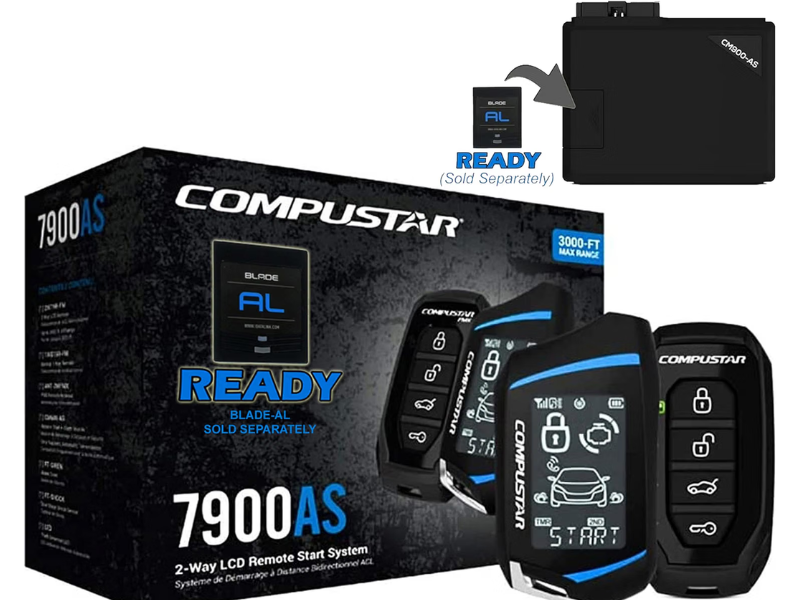
The CS7900-AS is aimed at buyers who want a full remote start and security package in one bundle, rather than stitching together separate alarm and starter systems. It pairs a two-way LCD remote with genuine security functionality, which is the main reason it stands out here. Instead of just hoping a lock command went through, the remote gives visual and audible confirmation that it did.
Compustar’s published specifications list a maximum advertised range of up to 3,000 feet under favorable conditions, along with the ability to add door, hood, trunk, and impact sensors around the vehicle. If someone tampers with the car while the alarm is armed, the two-way remote is designed to alert the owner rather than leave them to find out later.
Installation is worth addressing honestly. This is not a plug-and-play kit. Manufacturer listings note that it doesn’t include wiring diagrams or full installation instructions, and professional installation is generally recommended, with some retailers stating it’s required. The system is also built for automatic transmissions rather than manual ones. A confident DIYer comfortable with automotive wiring and bypass modules could still attempt it, but most owners will want a professional handling the job.
Pros:
- Combines remote start and a genuine security system in one bundle
- Two-way confirmation cuts down on guesswork compared with one-way systems
- Expandable sensor setup for owners who want more thorough monitoring
- Backed by an established name in the remote-start space
Cons:
- Not a plug-and-play system; professional installation is generally recommended
- Documentation from the manufacturer is reportedly limited, according to some buyer feedback
- Not designed for manual-transmission vehicles
- Smartphone or app control requires a separate add-on module
Best for: Drivers who want a full-featured remote start and security system in one purchase and are willing to have it professionally installed.
2. Avital 5305L
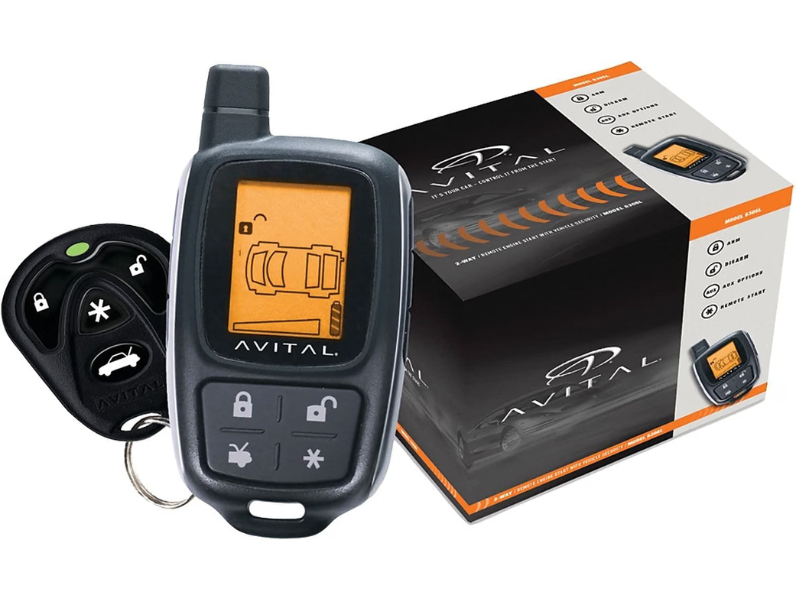
The Avital 5305L is a long-running two-way remote start and security system, and it’s worth saying upfront that this is an older model in Avital’s lineup rather than the brand’s newest release. Avital has since introduced additional models with different remotes and specifications. That doesn’t make the 5305L a poor choice; it’s a well-documented system that remains available through many retailers. But if having the newest available hardware matters to you, compare it against Avital’s current catalog before buying.
At the core of the system is a backlit two-way LCD remote paired with a one-way companion remote, giving owners a mix of full confirmation and a simpler backup option. Published range figures vary a bit by retailer. Some list a maximum of roughly 1,500 feet, while others describe it as a quarter-mile system, which is common with remote starters as listings get updated inconsistently over time. It’s worth checking the specific listing you’re buying from rather than assuming one number applies everywhere.
On the security side, the 5305L includes a dual-zone impact sensor, a fault-proof starter interrupt intended to prevent hot-wiring, and Avital’s Nuisance Prevention circuitry meant to cut down on false alarms. It’s also compatible with Directed’s SmartStart module if you want smartphone control later, though that’s a separate purchase rather than something included out of the box.
Pros:
- Long-running two-way system with documented, widely available specifications
- Solid core security features for the price point
- Includes both a full LCD remote and a simpler backup remote
- Can be expanded with smartphone control later if desired
Cons:
- An older model in Avital’s current lineup, not its newest remote starter
- Advertised range is shorter than some competitors on this list
- Professional installation is strongly recommended given the complexity of integrating with vehicle electronics
- Smartphone control isn’t included out of the box
Best for: Buyers who want a dependable, budget-conscious two-way system and don’t need the longest possible range or the newest hardware available.
3. Start-X Remote Start Kit
Best for Compatible Ford Vehicles
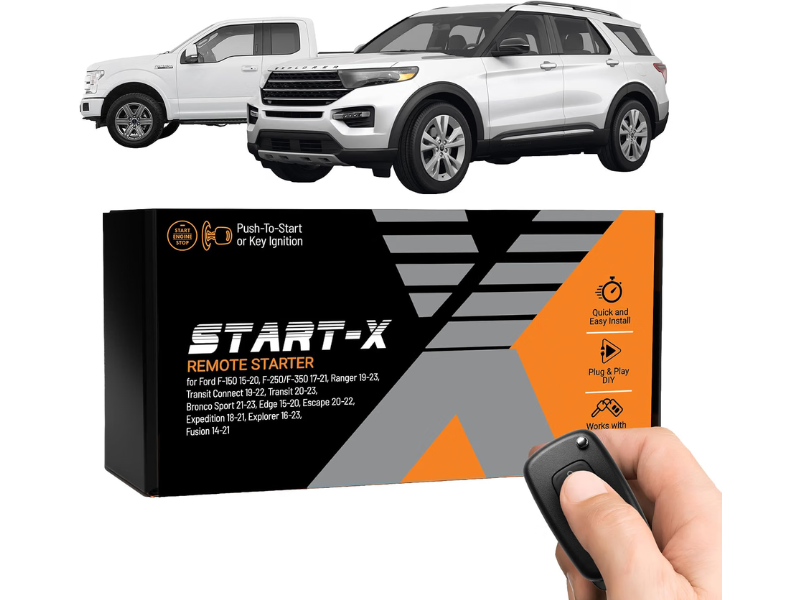
The Start-X kit takes a completely different approach from the other systems on this list, and that’s exactly why it earns its own category. Rather than a universal control module wired in by a professional, Start-X builds vehicle-specific kits designed to plug directly into a particular Ford model’s existing wiring harness, with no wire splicing on most versions. Owners keep using their actual factory key fob to remote start the car; the kit essentially teaches the existing fob a new trick rather than replacing it with an aftermarket remote. On kits built for supported vehicles, this often means pressing the lock button in a specific sequence, though the exact steps and any extra requirements, such as a hood pin sensor, depend entirely on the particular kit and application.
This factory-fob approach is a meaningful selling point for anyone who wants to keep their normal key experience intact, and it’s also why installation is marketed as approachable for owners rather than requiring a shop visit. Some listings describe installs taking under an hour with the included harness, though that will vary by vehicle.
Here’s the part that deserves real emphasis: this is not one universal remote starter that fits every Ford. Start-X sells separate kits for different Ford models, model years, and even ignition types, meaning push-to-start versus traditional key-blade ignition, and a kit built for one model or year range will not necessarily work on another. Some kits are further limited to automatic transmissions, gas engines, or vehicles with specific factory options. Before ordering, check your exact model year, model, engine, transmission type, and ignition configuration against the specific kit’s listed compatibility, and confirm any additional requirements for that application.
Pros:
- Straightforward installation for supported vehicles, without professional labor costs
- Keeps the factory key fob as the primary control method
- No wire splicing required on most kits
- Generally more affordable than a full professionally installed system
Cons:
- Compatibility is strictly limited to specific Ford models, years, and configurations
- Not a universal kit; buying the wrong version for your exact vehicle simply won’t work
- Application-specific requirements, such as automatic-only compatibility or a needed hood pin, vary by kit
- Feature set is more limited than full security-oriented systems like the Compustar or Viper options above
Best for: Ford owners whose exact model, year, and configuration are confirmed compatible with a specific Start-X kit and who want a simpler installation built around their factory key fob.
4. Viper 5706V
Best for Long-Range Two-Way Control
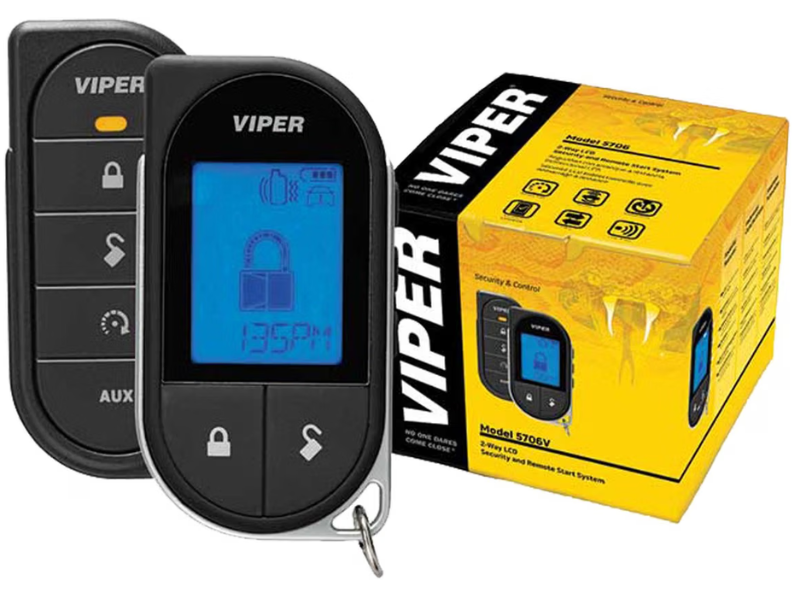
The Viper 5706V is built around its Responder LC3 remote, and range is the headline feature. Viper advertises a maximum of up to one mile, noticeably longer than the other two-way options here. As with any advertised range figure, this is a manufacturer-claimed maximum under favorable conditions, not a number to expect from inside a parking garage or a dense city block.
Beyond distance, the appeal of the 5706V is how much information the LCD remote can display. It’s designed to show vehicle status at a glance, and depending on configuration, it can show cabin temperature and count down remaining runtime so owners aren’t left guessing when a remote start session is about to end. The system includes both the two-way LCD remote and a one-way companion remote for backup use.
On the security side, it comes with the features you’d expect from an alarm-and-remote-start combination: a shock sensor, failsafe starter kill, a security siren, and optional keyless entry depending on how it’s configured for a given vehicle. Like the Compustar and Avital systems above, this is not a plug-and-play kit; it’s a professionally configured system, and pricing from some installers includes basic installation, though additional parts and labor are often needed depending on the specific make and model.
Pros:
- Longest advertised range of the two-way systems in this comparison
- Detailed status information on the remote, not just a simple confirmation beep
- Well-rounded security feature set for an alarm-and-starter combo
- Backed by an established security and remote-start brand
Cons:
- Advertised one-mile range is a best-case figure, not a guaranteed real-world distance
- Requires professional installation, and additional parts or labor are common depending on the vehicle
- No built-in smartphone or app control without additional hardware
- Pricing and included installation can vary significantly by installer and vehicle
Best for: Drivers who regularly want to start their car from farther away, such as a large parking lot or a distant office building, and who want detailed status feedback on the remote itself.
5. Compustar CSX4900-S
Best for Smartphone Control
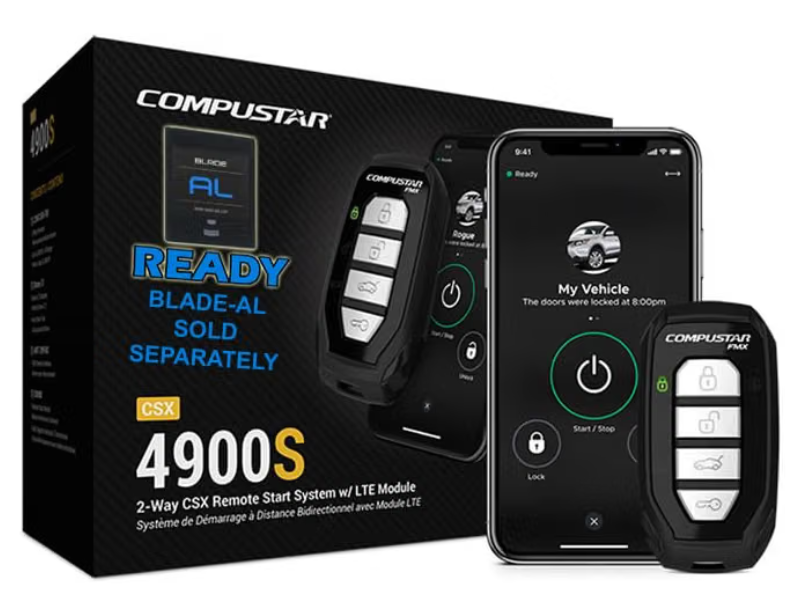
The CSX4900-S is built for buyers who want their phone to be the primary way they interact with a remote starter, not just a nice-to-have add-on. The bundle includes a traditional two-way LED remote with a manufacturer-advertised range of up to 3,000 feet, plus a Drone X1 LTE module that adds smartphone control and GPS tracking through the DroneMobile app.
It helps to keep these two layers of functionality separate. The physical two-way remote operates over standard RF range, that same 3,000-foot figure, the same way the other remotes on this list do. The DroneMobile app, by contrast, works over cellular data. That’s why Compustar describes it as reaching well beyond normal remote range: as long as both the vehicle’s module and your phone have active cellular and app service, distance from the car stops being the limiting factor in the way it is with a standard RF remote. That isn’t a literal, unconditional unlimited range; it depends on maintaining a working data connection and an active plan.
The catch, and it’s a significant one, is that smartphone functionality requires an active service plan. Compustar is explicit that using the physical remote or a factory remote does not require a subscription, but the app-based features, including remote start from a distance, GPS tracking, curfew alerts, and family sharing, depend on that ongoing LTE connection and plan. Many listings include a free trial, commonly 30 days, after which continued app access means paying for service. Anyone considering this system mainly for the smartphone features should budget for that ongoing cost.
Pros:
- Genuine smartphone and GPS functionality, not just a marketing bullet point
- Physical remote still works independently of the app or a subscription
- Family sharing feature is useful for households with multiple drivers
- Long advertised range on the physical remote, with extended cellular reach when service is active
Cons:
- Full smartphone features require an ongoing paid subscription after the trial period
- App-based control depends on active LTE and app service, not a literal unlimited range
- Not a plug-and-play system; professional installation and a bypass module are typically needed
- Built for automatic transmissions only
Best for: Buyers who specifically want app-based remote start, GPS tracking, and the ability to share vehicle access with family members, and who are comfortable with a recurring subscription cost.
How to Choose the Best Car Remote Starter
What to Consider Before Buying a Remote Starter
Remote Range
Every remote starter here lists an advertised maximum range, and it’s tempting to treat that number as the deciding factor. It shouldn’t be. Advertised range is measured under close-to-ideal conditions, usually open, flat terrain with minimal interference. In everyday use, buildings, parking structures, hills, and other radio signals can cut that distance down substantially. A system advertised at one mile might perform closer to a few hundred feet from inside a concrete office building. A more useful approach is to think honestly about your own situation, whether you typically start your car from just inside your house or from several floors up in an apartment building, and treat the advertised figure as a ceiling rather than a promise.
One-Way vs. Two-Way
A one-way remote sends a command to your car and hopes it arrives. You press lock, and you have to trust it worked. A two-way remote sends that same command but also receives a signal back, typically shown as a light, sound, or message on an LCD screen, confirming the command was received. That confirmation matters for remote start specifically, since nobody wants to walk out to a cold car only to discover the command never reached the vehicle. All five products here are marketed as two-way systems, or in Start-X’s case use the two-way capability already built into a factory fob.
Smartphone Control
App-based control, like what the Compustar CSX4900-S offers through DroneMobile, is genuinely useful if you frequently need to start your car from well beyond typical remote range, say from work or while traveling. It’s less necessary if you mainly start your car from your driveway or a nearby parking spot, where a standard RF remote already covers the distance. Cellular-based smartphone features usually come with an ongoing subscription cost after any trial period, which is easy to overlook when comparing the sticker price of different systems.
If you’re already upgrading your vehicle’s technology with smartphone-based features, you may also want to see our guide to the best wireless CarPlay adapters and AI boxes for other ways to modernize an older infotainment system.
Vehicle Compatibility
This is arguably the single most important thing to check before buying any remote starter, more than range or feature count. Compatibility can depend on a vehicle’s year, make, model, engine, transmission type, ignition system, factory immobilizer, and broader factory electronics and security setup. A system that works well on one model year of a car may not be compatible with the next year’s version if the manufacturer changed the electronics underneath. This matters most for vehicle-specific kits like Start-X, but it also applies to more broadly compatible systems from Compustar, Viper, and Avital, since those often still need a bypass module matched to the exact vehicle to work properly with its factory security system.
Installation
Broadly, remote starters fall into two installation categories. Vehicle-specific plug-and-play kits, like Start-X, are designed to connect to a car’s existing wiring harness without cutting or splicing wires, and many owners install these themselves with basic tools and some patience. More complex aftermarket systems, like the Compustar and Viper options covered here, typically involve wiring into multiple points in a vehicle’s electrical system, often alongside a separate bypass module for the immobilizer, and most manufacturers recommend professional installation for that reason. Still, professional installation isn’t automatically mandatory for every product; check what the specific manufacturer states before assuming you’ll need to hire someone.
Common Mistakes to Avoid
Buying Based Only on Range
The longest advertised range doesn’t automatically mean the best system for your situation. If you’re starting your car from inside your own house 50 feet away, an extra half-mile of theoretical range isn’t doing much for you, while other features, like security sensors or app control, might matter more in practice.A remote starter can improve convenience, but it should not replace basic emergency and safety equipment. If you’re building a more complete emergency setup for your vehicle, see our guide to the best car safety and daily-life essentials.
Ignoring Compatibility
It’s easy to fall for a strong feature list and skip the compatibility check. That’s a mistake worth avoiding. Confirm your exact year, make, model, and configuration against the manufacturer’s stated requirements before ordering anything, especially with vehicle-specific kits like Start-X.
Assuming Every Remote Starter Includes Security
Some remote starters are pure convenience devices with no meaningful alarm or intrusion detection built in. If shock sensors, door and trunk monitoring, or a siren matter to you, confirm the specific system actually includes those features rather than assuming any remote starter doubles as a security system.
Forgetting Smartphone Subscription Costs
An LTE-based smartphone feature, like DroneMobile on the CSX4900-S, usually comes with a free trial followed by a recurring cost. Factor that into the total cost of ownership rather than judging a purchase on its sticker price alone.
Assuming Plug-and-Play Means Universal
Plug-and-play describes how a kit connects to a car’s wiring, not how many cars it fits. Start-X’s kits are plug-and-play for the specific Ford models and configurations they’re built for; they are not universal, and using the wrong kit for your vehicle simply won’t work.
Choosing a Complicated System When You Only Need Basic Remote Start
If all you want is to warm up or cool down your car before you get in, a full security-and-remote-start bundle with sensors, sirens, and app connectivity may be more system, and more installation cost, than you actually need. Match the product to your use case rather than the longest feature list.
Final Verdict
There’s no single best remote starter here, just a best fit depending on what you drive and what you actually need day to day. The Compustar CS7900-AS earns its place as the overall pick because it balances two-way confirmation, expandable security, and a strong advertised range in one bundle, without requiring an app subscription to get core functionality working. The Avital 5305L remains a reasonable, budget-conscious two-way option, though it’s an older model in Avital’s lineup, so it’s worth comparing against the brand’s current catalog if having the newest hardware matters to you. The Start-X kit sits in a category of its own: it’s the right call specifically for owners of a compatible Ford model who want to keep using their factory key fob and prefer a simpler installation, but it is not a fit for anyone outside its supported vehicle list. The Viper 5706V is the pick if a long advertised range and a detailed status display are your priorities. And the Compustar CSX4900-S makes the most sense if smartphone-based control and GPS tracking are what you’re actually after, as long as you’re comfortable paying for a subscription to keep those features active.
The practical takeaway is simple: choose the vehicle-compatible system first, then choose the features you actually need. A remote starter with every feature imaginable is worthless if it can’t be properly wired into your car, or worse, if it’s installed incorrectly because it wasn’t designed for your model. Start with compatibility, then layer in range, security, and smartphone features based on how you actually park and drive.
FAQ
Is a remote car starter worth it?
For most drivers who deal with cold winters, hot summers, or inconvenient parking situations, a remote starter can be a genuine quality-of-life upgrade. The real question is not whether remote start is useful, but whether you need a basic system or want extras such as two-way confirmation, security, long-range control, or smartphone access. A simpler system can be enough for everyday convenience, while a system such as the Compustar CS7900-AS or CSX4900-S makes more sense if you want additional features.
Will a remote starter work with my car?
Not necessarily. Compatibility depends on the vehicle’s year, make, model, ignition system, transmission, and factory security setup. Vehicle-specific kits such as Start-X are designed for particular applications, while more advanced aftermarket systems may require a vehicle-specific interface or bypass solution. Always check compatibility for your exact vehicle before buying, especially if you have a newer car with a factory immobilizer or push-button start.
Is two-way remote start better than one-way remote start?
For many drivers, yes. A two-way system can send confirmation back to the remote, so you have a better indication that the vehicle received the command and responded. That becomes especially useful when the car is parked out of sight. However, two-way capability is not the only factor that matters. A simpler vehicle-specific system such as Start-X may be the better choice if your priority is straightforward remote starting through the factory key fob rather than additional security or long-range features.
Do remote starters require professional installation or a subscription?
It depends on the system. Vehicle-specific plug-and-play kits may be designed for owner installation on supported applications, while systems with more extensive wiring, security features, or vehicle interfaces are often better suited to professional installation. Smartphone-enabled systems are different again. The Compustar CSX4900-S, for example, uses an LTE module for app-based control and requires an active service plan for its smartphone features after any applicable trial period. Its physical remote can still be used without that subscription.
What should I look for when choosing a remote car starter?
Start with compatibility, then decide which features you will actually use. If you want the best overall balance of remote start, two-way confirmation, and security, the Compustar CS7900-AS is the strongest all-around choice in this guide. If you prefer a traditional two-way system, the Avital 5305L is worth considering. For a compatible Ford and a simpler factory-fob approach, Start-X is the more focused option. The Viper 5706V stands out for its advertised long range and two-way status information, while the Compustar CSX4900-S is the better fit if smartphone control and GPS tracking are priorities.