Best Dash Cams for 2026: Tested for Real-World Driving

Best Dash Cams 2026 : Every drive begins with a sense of control, but that control is never complete. Roads evolve in real time, drivers make unpredictable decisions, and even the most routine trip can shift into something unexpected within seconds. In this environment, relying on memory alone is no longer realistic. A dash cam steps into that gap, not as a decorative gadget, but as a silent observer that records what actually happens when human perception is not enough to retain every detail accurately.
Over the past few years, dash cameras have evolved far beyond simple recording tools. They are now closer to compact documentation systems that combine imaging precision, motion detection, parking surveillance, and in some cases, automated incident logging. But despite this evolution, their real-world effectiveness still varies significantly depending on how well they handle stress conditions like heat, darkness, and sudden impact scenarios.
This breakdown focuses on five widely used dash cams, evaluated not by marketing claims, but by how they behave in actual driving environments where reliability matters more than specifications.
| Dash Cam | Best For | Resolution | Key Strength |
|---|---|---|---|
| VIOFO A129 Pro Duo | Best Overall | 4K Front + 1080p Rear | Excellent video clarity and reliable dual-channel protection |
| VIOFO A119 V3 | Best Budget Option | 2K Quad HD | Reliable long-term performance with excellent heat resistance |
| ROVE R2-4K Dual | Best Value | 4K Front + Rear Camera | Balanced features and user-friendly setup |
| Garmin Dash Cam Mini 3 | Best Compact Dash Cam | 1080p | Extremely small and discreet design |
| REDTIGER F7NP | Best for Night Driving | 4K Front + Rear Camera | Strong low-light and nighttime recording performance |
1. VIOFO A129 Pro Duo 4K: Maximum Clarity for Critical Evidence
The VIOFO A129 Pro Duo is built for drivers who view their dash cam as a serious layer of protection rather than a passive recording device. In real-world driving, especially on highways or congested urban roads, the difference between usable and unusable footage often comes down to whether small visual details remain readable after motion, glare, and distance compression take effect.
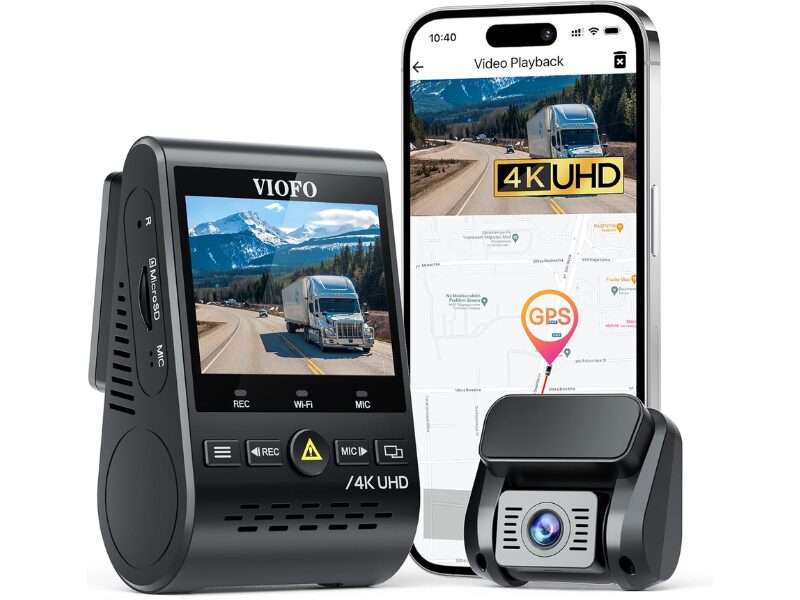
This system approaches that problem with a dual-camera architecture that separates responsibilities between front and rear coverage. The front unit handles the most critical task, which is capturing high-detail forward motion in 4K Ultra HD, while the rear camera provides consistent secondary awareness at 1080p. What matters here is not just resolution, but stability of detail under pressure, especially when vehicles are moving at different speeds in multi-lane environments.
In practical driving conditions, the system proves most valuable during sudden incidents where context matters as much as impact. Its buffered recording system does not simply react to collisions. Instead, it continuously stores short rolling segments, allowing the device to preserve what happened before and after an event. This becomes especially relevant in hit-and-run situations where the actual moment of impact is often less important than the events leading up to it.
Installation, however, is not minimal. The dual-channel setup requires proper cable routing through the cabin, which means the system behaves more like a permanent vehicle installation than a removable accessory. Once installed correctly, it tends to operate continuously without requiring further attention, which is where its reliability becomes noticeable over time.
2. VIOFO A119 V3 2K: Stability Over Complexity
The A119 V3 takes a completely different direction compared to feature-heavy systems. Instead of expanding functionality, it focuses on doing one thing consistently well over long periods of use. This makes it especially suitable for drivers who prefer reliability without technical involvement or frequent adjustments.
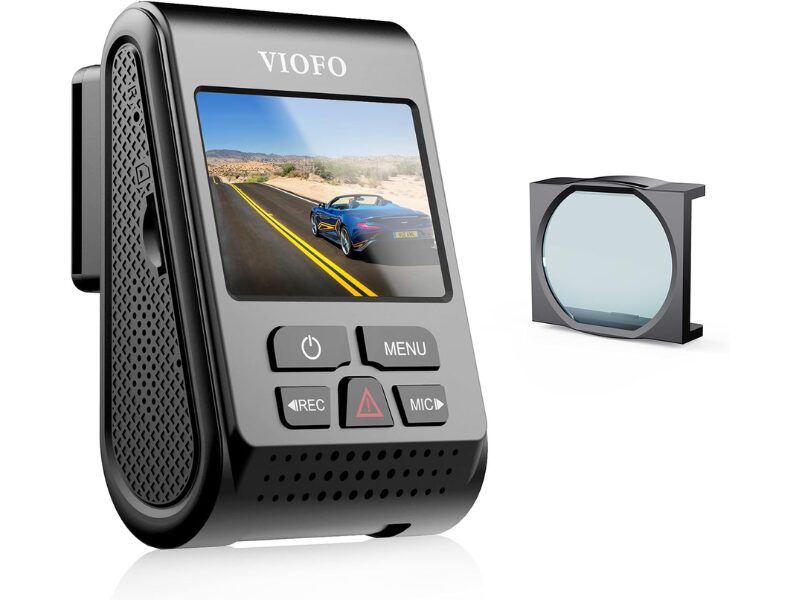
It operates as a single front-facing unit recording in 2K Quad HD with a wide 140-degree field of view. This balance between coverage and simplicity allows it to maintain stable performance without overloading processing systems or requiring complex configuration. The design philosophy here is clear: reduce variables, increase consistency.
In real-world use, the camera shows strong resilience in unpredictable lighting environments. Driving conditions often shift abruptly, such as moving from shaded roads into direct sunlight or exiting underground parking into bright outdoor environments. In these transitions, many cameras struggle to maintain clarity, but this model handles exposure adjustments in a controlled manner that preserves usable detail.
Another important element is its use of a supercapacitor instead of a traditional battery. This choice is not about performance on paper, but about durability under heat exposure. Vehicles parked under direct sunlight can experience extreme cabin temperatures, and in those conditions, conventional batteries degrade quickly. The supercapacitor design reduces this risk significantly, making it more suitable for long-term daily use.
The main limitation is structural rather than technical. Being a front-only system, it does not cover rear incidents, which may be a deciding factor for drivers looking for complete vehicle monitoring.
3. ROVE R2-4K Dual Dash Cam: Balanced Everyday Protection
The ROVE R2-4K Dual system sits in a practical middle space between simplicity and full-featured surveillance. It is designed for drivers who want complete front and rear coverage but without dealing with overly technical systems or complicated configuration steps.
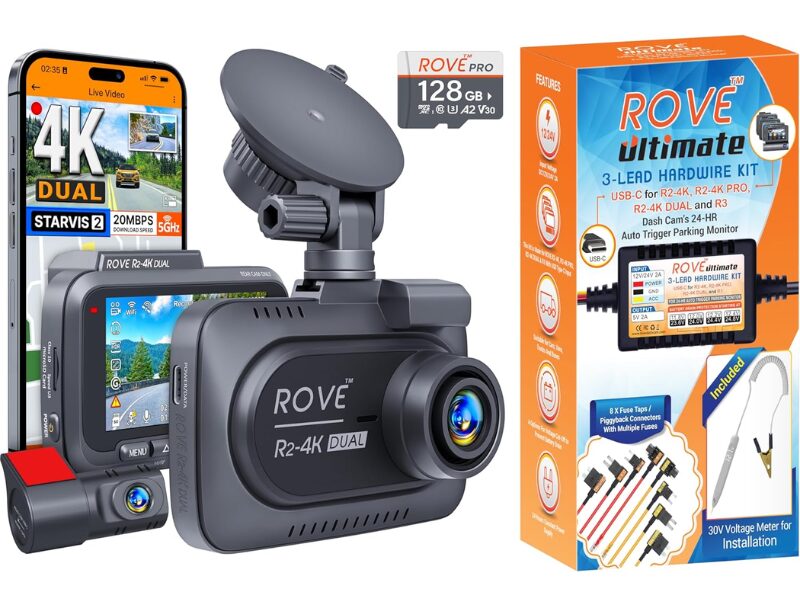
Instead of focusing on specialized features, the system prioritizes usability. Its interface is structured in a way that allows drivers to access recording functions, lock important clips, and adjust basic settings without needing technical knowledge. This makes it particularly useful in real-world scenarios where quick interaction matters more than advanced customization.
On the road, its performance is most noticeable during nighttime driving. Urban environments often create conflicting lighting conditions where bright headlights, reflective surfaces, and dark road edges overlap. The camera manages these transitions in a balanced way, preventing extreme overexposure while still preserving visibility in darker zones.
When connected through a hardwire kit, the system extends its functionality into parking mode. This allows continuous monitoring even when the engine is off, effectively turning the device into a passive surveillance system. However, the effectiveness of this feature depends heavily on installation quality. Improper wiring can lead to inconsistent behavior or power-related issues, which is why careful setup is important for long-term stability.
4. Garmin Dash Cam Mini 3: Invisible Protection
The Garmin Dash Cam Mini 3 is designed for a very specific type of user: someone who wants protection without visible technology inside the cabin. Instead of competing on features or size balance, it focuses entirely on discretion and simplicity.
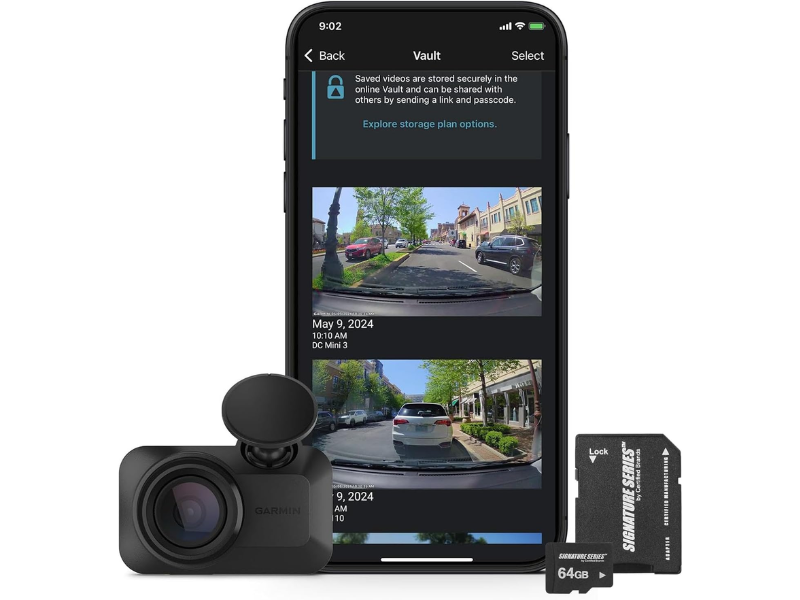
The device is extremely compact, small enough to be hidden behind the rearview mirror without affecting the driver’s field of vision. This design choice eliminates visual distraction and keeps the interior environment clean, which is often preferred by drivers who value minimalism or factory-like cabin appearance.
Despite its size, it maintains stable 1080p recording with a wide field of view that captures essential road activity without requiring manual adjustment. The absence of a screen is intentional, reducing physical interaction and simplifying the entire operation into a background function rather than an active device.
In practical use, voice control becomes the primary method of interaction. Drivers can save clips or control basic functions without touching the device, which is particularly useful in situations where attention must remain fully on the road. Incident detection works automatically, locking important footage during sudden braking or collisions.
The trade-off is clear: simplicity replaces direct control. All configuration and playback must be handled through a mobile application, which may not appeal to users who prefer on-device interaction.
5. REDTIGER F7NP 4K: Night Performance Focus
The REDTIGER F7NP is built around a specific challenge that many dash cams struggle with: low-light driving conditions. Nighttime roads introduce a different set of problems compared to daytime driving, including glare from headlights, inconsistent street lighting, and reduced contrast in surrounding environments.
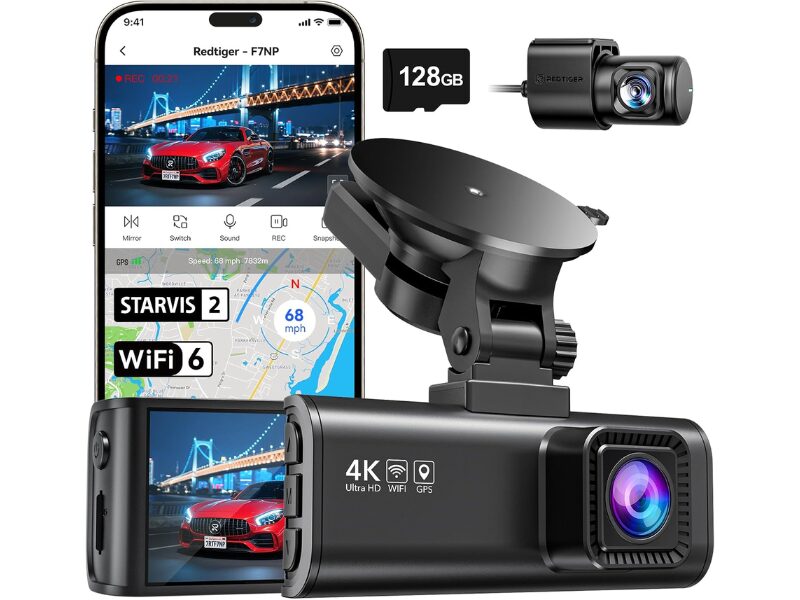
This system is tuned specifically to address those conditions rather than focusing purely on daytime sharpness. It records in 4K for the front camera while maintaining secondary rear coverage, but its real strength lies in how it processes light under low-visibility scenarios.
In practical driving, it manages bright light sources more effectively by reducing the harsh overexposure commonly caused by modern LED headlights. At the same time, it preserves enough ambient detail to keep surrounding road structure visible, which is often lost in lower-quality systems.
When paired with a hardwire kit, it extends functionality into parking surveillance mode. This is particularly useful in low-light environments such as underground parking structures or dimly lit residential areas where incidents are harder to document.
The system is often bundled with additional accessories, which improves initial usability. However, its performance still depends on correct installation and the use of reliable storage media to handle continuous recording loads.
Choosing Based on Real Driving Behavior
Selecting a dash cam is not a technical competition between resolution numbers or feature lists. It is a practical decision based on how, where, and when a vehicle is actually used.
Drivers who frequently travel on highways or require maximum clarity in legal situations will benefit most from high-resolution dual systems like the VIOFO A129 Pro Duo. Those who prioritize long-term stability and simplicity often find the A119 V3 more aligned with their needs. Balanced users who want full coverage with parking protection tend to prefer systems like ROVE or REDTIGER, while drivers who value minimal interior presence gravitate toward the compact design of the Garmin Mini 3.
There is no universal best choice. There is only the right match between driving behavior and system capability. And in real-world conditions, the most valuable feature a dash cam can offer is not complexity or resolution, but consistency under pressure.
Because when something happens on the road, clarity is not a specification. It is what decides the outcome.
FAQ
VIOFO A129 Pro Duo 4K
Can the VIOFO A129 Pro Duo handle large-capacity memory cards, and does constant 4K recording shorten card lifespan?
Yes, the A129 Pro Duo supports high-capacity microSD cards up to 256GB, which is highly recommended if you plan to record continuously in full 4K resolution. Because true 4K generates large data streams and writes to storage constantly, lower-quality cards can wear out much faster than expected. For long-term reliability, using a high-endurance UHS-I U3 card is essential. It is also good practice to format the card every few weeks through the camera itself, which helps maintain file integrity and reduces the chance of recording corruption during critical moments.
VIOFO A119 V3 2K
Is the A119 V3’s 2K resolution enough for clear evidence, or is 4K always the better option?
For most drivers, the A119 V3 provides more than enough clarity for everyday documentation and insurance protection. While 4K technically offers more pixels, real-world footage quality depends on far more than resolution alone. Lens quality, exposure tuning, reflection control, and bitrate optimization often matter just as much. The A119 V3 performs especially well because its HDR tuning and optional CPL filter reduce glare and maintain contrast in difficult lighting, which often produces clearer practical footage than poorly optimized 4K systems in the same price range.
ROVE R2-4K Dual Dash Cam
How does the ROVE hardwire kit protect the vehicle battery during overnight parking surveillance?
The included hardwire kit uses an integrated voltage-monitoring system that constantly tracks battery charge while the vehicle is parked. If the battery voltage drops below a preset safety threshold, usually around 11.8V to 12V depending on configuration, power to the camera is automatically cut off. This prevents the system from draining the battery to the point where the engine cannot start. It allows drivers to benefit from continuous parking protection while still maintaining enough battery reserve for reliable vehicle startup the next morning.
Garmin Dash Cam Mini 3
Without a built-in screen, how do you properly position and adjust the Garmin Mini 3 during installation?
Garmin handles this process through its smartphone integration. Once connected to the Garmin Drive app via Wi-Fi, the app provides a live real-time feed directly from the camera lens. This allows you to position the camera precisely before securing the adhesive mount permanently. You can adjust viewing angle, confirm road coverage, and verify horizon alignment directly from your phone. While some users initially prefer a physical display, the app-based setup quickly becomes intuitive and keeps the camera itself extremely compact and unobtrusive.
REDTIGER F7NP 4K
What happens when the REDTIGER F7NP’s memory card becomes full during continuous loop recording?
The REDTIGER F7NP uses intelligent loop recording to manage storage automatically. Video is divided into short segments, typically 1, 3, or 5-minute files depending on your selected settings. Once the memory card reaches full capacity, the system begins overwriting the oldest unlocked footage first. However, if the camera detects an impact, abrupt braking event, or collision through its internal sensor system, that clip is immediately moved into a protected folder where it cannot be overwritten. This ensures that critical evidence remains safely preserved even during long recording cycles.