2024 Chevrolet Colorado Review: What Changed?
A closer look at value, capability, and the trims worth your money.

The 2024 Chevrolet Colorado entered its second model year after the complete redesign introduced for 2023. Chevrolet had already replaced the previous-generation V6 and diesel options with a 2.7-liter turbocharged four-cylinder, moved to a new platform, and introduced a crew-cab-only lineup with a more aggressive design. We covered those major changes in detail in our 2023 Chevrolet Colorado review so there is no need to repeat the entire redesign here.
The 2024 Chevrolet Colorado is a different kind of story. Nothing about the body, the cab, or the platform changed. What did change is more interesting than it sounds on paper: Chevrolet quietly dropped one of its three engine tunes, renamed the strongest one TurboMax, and brought back the ZR2 Bison, an off-road variant developed with American Expedition Vehicles (AEV) that had been missing from the lineup entirely. None of that shows up in a walkaround video. All of it shows up on a build sheet.
So the question for this article isn’t “is the redesigned Colorado good.” That’s already been answered. The question is whether Chevrolet used its second year with this generation to fix real problems, or whether it just simplified the spreadsheet and called it a day. And separately: is the ZR2 Bison worth the money, or is it a $60,000 truck built mostly for people who will never see real trail damage on it?
Our Take
The 2024 Colorado is a better-organized truck than the 2023 model, not a fundamentally better one. The facts of the change are straightforward: 2023 offered three output levels of the same 2.7-liter engine, and 2024 narrows that to two, with the 310-hp/391-lb-ft middle tune removed entirely and the 310-hp/430-lb-ft version rebranded TurboMax. In our view, that simplification is a genuine improvement for anyone who’s ever tried to make sense of a Chevy order guide. Trail Boss and Z71 already came standard with a 310-hp engine in 2023, but that engine made only 391 lb-ft; for 2024, the standard 310-hp engine on those trims is the full 430-lb-ft TurboMax, which is a meaningful practical upgrade even though sticker prices ticked up slightly.
The ZR2 Bison is the more emotional story. It’s a legitimately serious piece of off-road engineering, built with American Expedition Vehicles and priced like it. But it doesn’t change the daily character of the Colorado, which remains a competent, slightly unremarkable truck to drive on pavement. If your priority is a comfortable daily driver with occasional towing duty, the 2024 changes matter to you mostly through the standardized 11-inch driver display and simpler ordering. If your priority is serious off-roading, the Bison is the biggest thing to happen to this truck since the redesign itself.
Is it meaningfully better than the 2023? For most buyers, yes, in a quiet, practical way. It is not a truck that leapfrogged its rivals in a single model year.
Pros and Cons
Pros
- Simplified two-tune engine lineup, with TurboMax available on WT and LT and standard on Trail Boss, Z71, and ZR2
- ZR2 Bison brings genuine AEV-developed off-road hardware, not just a styling package
- 7,700-pound maximum towing capacity when properly equipped
- Standard 11.3-inch touchscreen with Google built-in and a newly standardized 11-inch digital gauge cluster across every trim
- Good IIHS ratings on the small overlap front and updated side crash tests
Cons
- Base 237-horsepower engine feels genuinely underpowered once you’re loaded down or climbing a grade
- Marginal rating on IIHS’s updated moderate overlap front test keeps it out of Top Safety Pick contention
- Payload drops sharply on off-road trims, down to roughly 1,050 pounds on the ZR2 Bison
- Rear seat legroom, at 34.7 inches, trails several rivals
- ZR2 Bison pricing pushes past $60,000, which is real money for a four-cylinder midsize truck
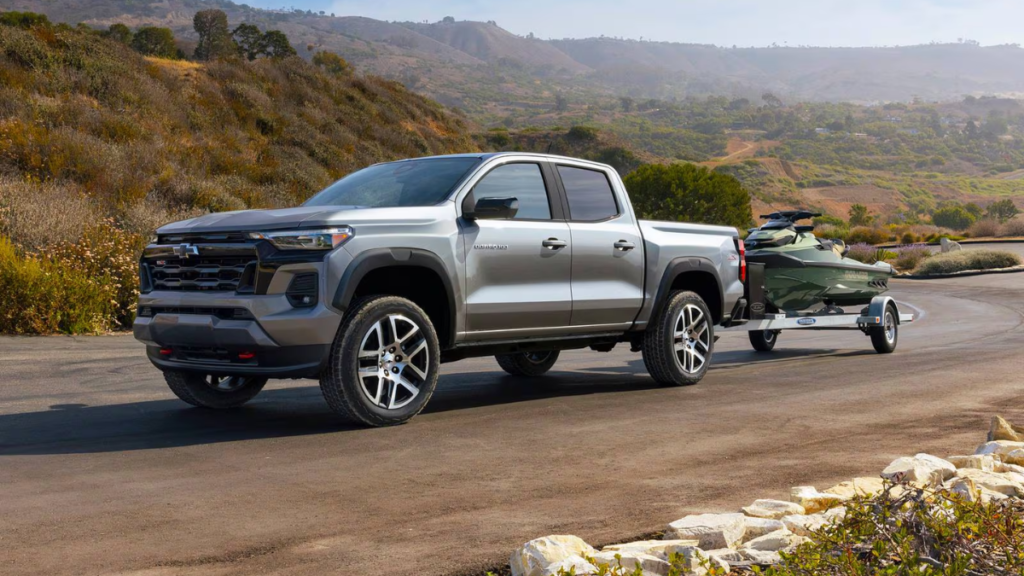
What’s New for 2024?
The headline change is under the hood. The 2023 Colorado launched with three distinct tunes of the same 2.7-liter turbocharged four-cylinder: a 237-horsepower base engine, a mid-level “Turbo Plus” making 310 horsepower and approximately 390 to 391 lb-ft of torque, and a “Turbo High-Output” version making the same 310 horsepower but with 430 lb-ft of torque. For 2024, Chevrolet removed that middle tune entirely. The lineup now runs on just two output levels: the 237-hp/260 lb-ft base engine, standard on WT and LT, and a 310-hp/430 lb-ft engine that Chevrolet has rebranded TurboMax, optional on WT and LT and standard on Trail Boss, Z71, and ZR2.
That’s a real change, not a cosmetic one. Under the old system, a buyer could option a Trail Boss with 310 hp and only around 390 lb-ft of torque. That combination no longer exists. Every 310-hp Colorado now gets the full 430 lb-ft. The additional torque is particularly useful when towing, hauling, or climbing grades.
The second big change is the return of the ZR2 Bison, a package developed jointly with American Expedition Vehicles that had skipped the redesigned third-generation Colorado’s launch year entirely. It debuted for 2024 as the range-topping off-road variant, built on the ZR2 but going considerably further in nearly every direction.
Beyond the powertrain and the Bison, Chevrolet made one meaningful equipment change: the 11-inch digital instrument cluster, previously reserved for the ZR2, is now standard across the entire lineup, replacing the smaller 8-inch display that lower trims had used. Destination freight also rose by $100 to $1,595, and most trims saw MSRP increase by around $400, with the ZR2 up a more modest $100. None of this is transformative on its own. Together, it reads like a manufacturer using year two to fix the parts of a new platform that didn’t quite work the first time, while adding one genuinely new product to the top of the range.
Who Is This Truck Really For?
The 2024 Colorado splits fairly cleanly into two audiences. The WT and LT trims target buyers who need a comfortable, reasonably efficient truck for commuting, light hauling, and occasional towing, and who will likely never option the TurboMax engine at all given how well the base 237-hp motor handles unloaded driving. The Trail Boss, Z71, ZR2, and ZR2 Bison target buyers who want either the visual toughness of an off-road-styled truck or, in the case of the two ZR2 variants, the actual hardware to back it up.
What the 2024 Colorado is not particularly well suited for is families who need generous rear-seat space, or work-truck buyers who need maximum payload alongside maximum towing. Those buyers have reasons to look elsewhere in the segment, which this article gets to later.
2024 Chevrolet Colorado Driving Experience
On pavement, the 2024 Colorado drives the way most modern midsize trucks do: composed, quiet enough, and not particularly memorable. The base 237-hp engine is adequate for an unloaded truck around town, but it runs out of enthusiasm quickly once you add a trailer, a full bed, or a grade. The TurboMax engine changes the personality noticeably. With 430 lb-ft of torque arriving at a relatively low 3,000 rpm, the Colorado is rated to pull away from stops with more urgency and less strain on highway passes than the base engine allows. Edmunds’ testing of the related powertrain has found the TurboMax tune the clear pick for anyone who tows or hauls with any regularity.
The eight-speed automatic, the only transmission offered, is designed to shift smoothly in normal driving and downshift promptly under throttle. Steering is light and easy to place in traffic, which suits the WT, LT, and Trail Boss trims well. The Z71 and ZR2 trade a bit of that low-speed ease for a taller stance and knobbier tires, which show up as more road noise and a slightly busier ride on the highway.
Off-road, the difference between trims widens considerably. The Trail Boss offers a mild lift and all-terrain tires that suit light trail use. The ZR2 is a genuine step up, with Multimatic spool-valve dampers, locking front and rear differentials, and 33-inch tires that let it handle terrain most midsize trucks would need to slow down for. The ZR2 Bison goes further still. Its 12.2 inches of ground clearance, 1.5 inches more than the standard ZR2, along with 35-inch Goodyear mud-terrain tires and Multimatic dampers fitted with jounce control for hard impacts, put it in territory that overlaps with purpose-built rock crawlers rather than lifted pickups. The tradeoff is exactly what you’d expect: those tires add road noise, the Bison’s approach angle is actually slightly worse than the regular ZR2’s despite the extra lift, and the truck is heavier and thirstier than anything else in the lineup.
2024 Chevrolet Colorado Interior and Comfort
Front-seat comfort is a strength across the lineup, with 45.2 inches of front legroom and seats that hold up well on longer drives, particularly in LT trim and above where leather-trimmed and heated options are available. The rear seat is the honest weak point. At 34.7 inches of rear legroom, adults will notice the squeeze on longer trips, and this is one area where the Colorado trails some rivals rather than leading them. Materials feel appropriate for the price tier: durable cloth and Evotex on lower trims, with leather-trimmed upholstery available higher up, none of it pretending to be more premium than a midsize truck needs to be.
Cabin noise is well controlled on WT, LT, and Trail Boss, with more road and tire noise creeping in on Z71, ZR2, and especially the Bison, a direct consequence of the more aggressive rubber those trims wear.
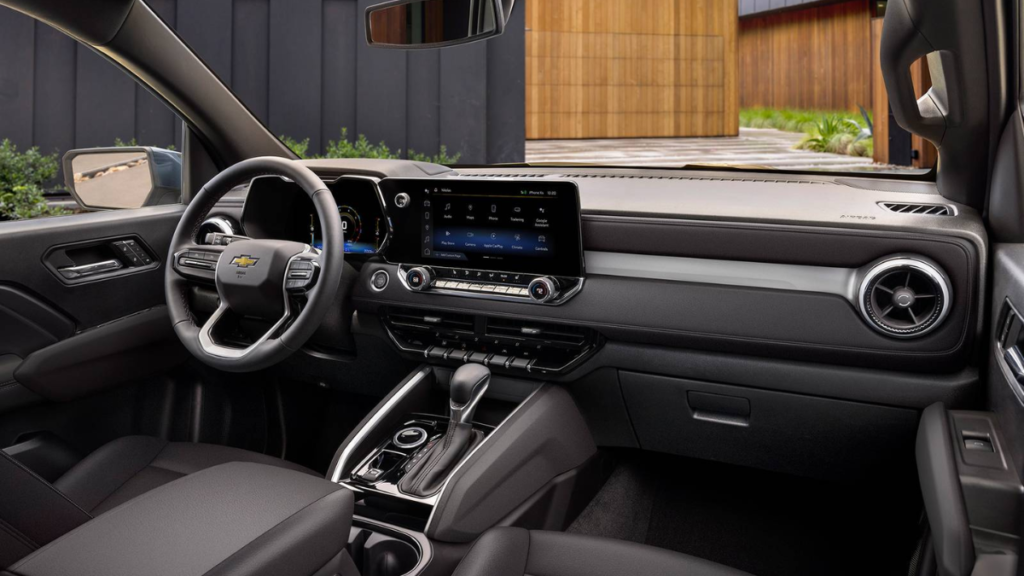
Technology and Infotainment
Every 2024 Colorado comes standard with an 11.3-inch touchscreen running Google built-in, giving owners native Google Maps and Google Assistant integration alongside wireless Apple CarPlay and Android Auto. This system has drawn consistent praise for its responsiveness and clean layout, a notable improvement over the infotainment setups Chevrolet offered in the previous-generation Colorado.
The newly standardized 11-inch digital instrument cluster, previously exclusive to ZR2, is available across the lineup in Balanced or Enhanced layouts with a few theme choices, letting owners customize how much information sits directly in their line of sight. Off-road trims add an Off-Road Performance Display that shows g-force, pitch, roll, and altitude directly on the center screen, genuinely useful information for anyone actually using the ZR2 or Bison off pavement rather than just admiring them in a parking lot. A seven-speaker Bose premium audio system is available as an upgrade, and wireless device charging, remote start, and a sliding rear window are optional depending on trim. Not every feature is standard on every trim, so buyers cross-shopping WT against ZR2 should expect a real gap in standard equipment, not just styling.
Fuel Economy and Real-World Efficiency
EPA figures vary meaningfully depending on engine, drivetrain, trim, and tire choice, and they don’t collapse into a single number for each engine. The base 2.7L Turbo is rated at 20 city/24 highway/22 combined in 2WD form, dropping to 18 city/23 highway/20 combined with 4WD added. TurboMax carries its own separate ratings: 19 city/24 highway/21 combined in 2WD, and 18 city/22 highway/20 combined in 4WD. Trim and tire choice push the numbers lower from there. Trail Boss, with its more aggressive all-terrain tires, is rated around 17 city/20 highway/18 combined. The ZR2 drops further to roughly 17 city/17 highway/17 combined, and the ZR2 Bison’s larger 35-inch mud-terrain tires bring it down to approximately 16 city/16 highway/16 combined. In practical terms, the meaningful choice for most buyers is between the two engine tunes and, separately, between on-road and off-road trims: anyone prioritizing efficiency is better served by the base engine on a WT or LT, while anyone who tows or hauls regularly may prefer TurboMax despite the efficiency tradeoff, and anyone considering an off-road trim should expect fuel economy to fall further as tire size and ground clearance increase.
Cargo, Space and Everyday Practicality
Every 2024 Colorado ships as a four-door crew cab with a bed of roughly five feet, a configuration choice that simplifies shopping but removes the longer-bed options some competitors still offer. The tailgate includes a lockable storage compartment, useful for smaller tools or gear that would otherwise disappear loose in the bed, and ZR2 models add a bed-mounted 120-volt outlet for job-site or campsite use, along with a standard spray-in bedliner.
Payload is where trim choice matters most for practical buyers, and it varies substantially by cab configuration, drivetrain, and equipment rather than sitting at one fixed number per trim. WT and LT models offer the strongest payload capacity in the lineup, with maximum payload varying by drivetrain and equipment, which makes them the more sensible choice for anyone regularly hauling heavy cargo rather than just looking tough. Payload drops on the off-road trims: the ZR2 is commonly rated around 1,280 pounds, and the ZR2 Bison further still, to approximately 1,050 pounds, a direct consequence of the extra off-road hardware, larger tires, and softer-tuned suspension those trims carry. Buyers cross-shopping a ZR2 Bison against a work-focused LT should understand they’re trading real hauling capacity for trail capability, and should confirm exact payload for their specific build against the window sticker rather than a general spec sheet.
Cabin storage is respectable rather than class-leading, with a usable center console, door pockets sized for large water bottles, and decent front-seat storage. Rear-seat storage is limited by the tighter rear legroom, which pushes family buyers toward using the bed for anything bulky.
Biggest Strength and Biggest Weakness
The Colorado’s biggest strength for 2024 is the simplified powertrain lineup combined with its 7,700-pound maximum towing capacity when properly equipped, which together make it easier to recommend without a confusing asterisk about which specific configuration actually delivers that number. Its biggest weakness remains the base engine’s real-world thinness once loaded, combined with a rear seat that will disappoint families cross-shopping this truck against roomier rivals.
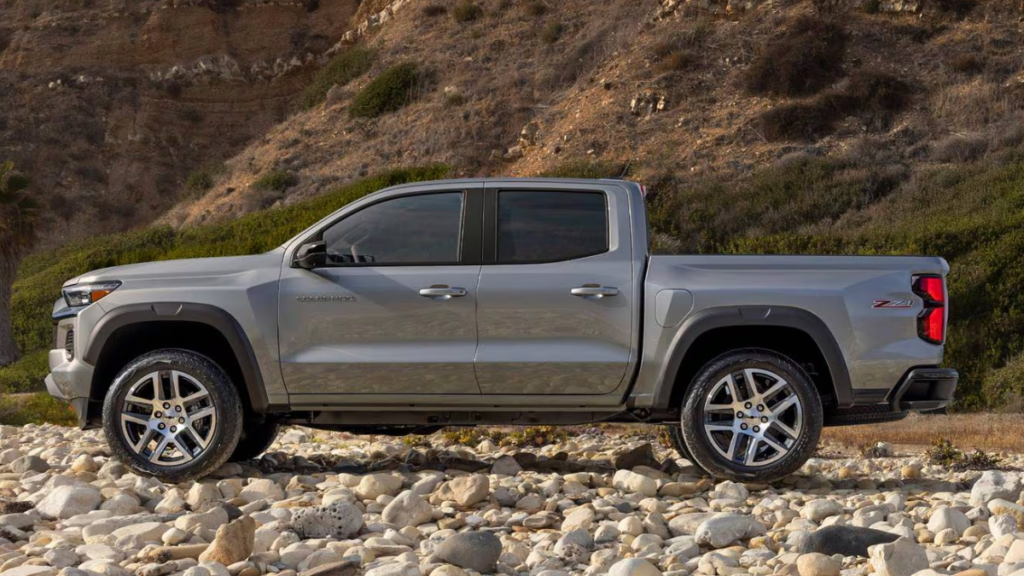
Competitors Worth Considering
The Toyota Tacoma, fully redesigned for 2024 alongside the Colorado’s second model year, starts at approximately $32,995 including destination, close to but slightly above the Colorado’s approximately $31,095 starting point, with a 228-hp base engine. Toyota also offers a non-hybrid 2.4-liter turbo four tuned to 278 hp and 317 lb-ft on SR5 and higher grades, a meaningful step up from the base engine without hybrid pricing. Buyers chasing the strongest available torque figure in the segment need the optional i-FORCE MAX hybrid, which starts around $46,300 and delivers 326 hp and 465 lb-ft, a genuine torque advantage over TurboMax at a real price premium. Buyers who want that torque without paying hybrid pricing should stick with the Colorado.
The Ford Ranger, also new for 2024, starts at approximately $34,160 including destination and delivery, with its 270-hp turbo four, and matches close to the Colorado’s towing at 7,500 pounds while offering a genuinely higher payload figure near 1,800 pounds on appropriate configurations. Ford also fields the Ranger Raptor, a 405-hp desert-runner that outguns the ZR2 Bison in horsepower, if not necessarily in rock-crawling hardware. Buyers who prioritize payload over off-road articulation may prefer the Ranger.
The Nissan Frontier sticks with a naturally aspirated 3.8-liter V6 making 310 hp and 281 lb-ft, less torque than TurboMax but a familiar, well-proven layout, and it tows up to 7,150 pounds. It’s a reasonable pick for buyers wary of turbocharged four-cylinders in a work truck.
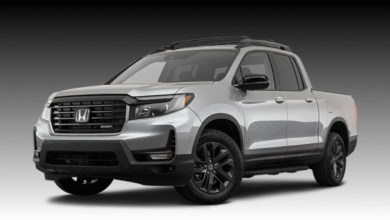
The Honda Ridgeline remains the outlier of the group: standard AWD, a car-like unibody ride, and a 280-hp V6, but a modest 5,000-pound tow rating that rules it out for serious trailer duty. It’s the right choice for buyers who want a pickup bed but drive mostly like they’d drive a crossover.
The Jeep Gladiator starts higher than the Colorado, typically in the high $30,000s to low $40,000s, and trades some efficiency, at 17 city/22 highway, for genuine open-air versatility no other truck here offers, plus off-road-focused Mojave and Mojave X variants that appeal to a similar buyer as the ZR2 lineup, though they lean toward desert running rather than the ZR2 Bison’s rock-crawling emphasis. Buyers who value the removable-roof novelty as much as capability gravitate here.
None of these trucks makes the Colorado a bad choice. They simply pull different buyers in different directions depending on whether the priority is price, payload, torque, on-road manners, or open-air fun.
2024 Chevrolet Colorado Trim Comparison
All prices below include Chevrolet’s $1,595 destination charge, so they represent what a buyer actually pays before taxes, options, or dealer fees. The WT starts at approximately $31,095, making it the value entry point with standard Chevy Safety Assist, the 237-hp engine, and 2WD as standard with 4WD optional. The LT, at approximately $33,495, adds interior refinement without changing the mechanical formula. The Trail Boss jumps to approximately $38,895 and switches to standard 4WD and the TurboMax engine, aimed at buyers who want light off-road capability without committing to ZR2 pricing. The Z71, at approximately $41,795, layers on comfort equipment like heated seats and dual-zone climate control rather than additional off-road hardware, making it a more comfort-oriented off-road trim than the harder-edged ZR2. The ZR2, starting at approximately $48,395, is where the real off-road engineering begins, with its 3-inch suspension lift, locking differentials, and Multimatic dampers. Finally, the ZR2 Bison, which requires the ZR2 as its base plus an $11,700 off-road package and a mandatory $445 safety package, lands at approximately $60,540.
For most buyers, the LT represents the strongest overall value. It keeps the sensible payload figures of the base engine trims while opening the door to the optional TurboMax if towing needs justify the upgrade, without paying for off-road hardware most owners will never use. Buyers who genuinely tow often should strongly consider adding TurboMax to an LT rather than jumping straight to Trail Boss for the engine alone.
ZR2 Bison: Is It Really Worth It?
The Bison is not a badge job. Built on the standard ZR2, it adds substantial off-road hardware on top of that truck’s existing capability rather than replacing its major systems: five boron-steel skid plates protecting the radiator, steering, transmission and transfer case, fuel tank, and differential; AEV-developed front and rear bumpers; steel rock rails; and Multimatic dampers upgraded with jounce control units designed specifically to absorb hard impacts at speed. The 35-inch Goodyear Wrangler Territory mud-terrain tires, mounted on AEV-designed 17-inch beadlock-capable wheels, push ground clearance to 12.2 inches, a real 1.5-inch gain over the standard ZR2’s 10.7 inches.
Why the Bison makes sense: for buyers who genuinely wheel their trucks on rocky, rutted terrain, the underbody protection and suspension articulation are not cosmetic. A bent oil pan or a torn skid plate on the standard ZR2 is exactly the kind of damage the Bison’s hardware is designed to prevent, and the jounce-control dampers are engineered specifically to absorb hard impacts from high-speed washboard and G-out sections that would otherwise transmit straight into the chassis.
Why the Bison may not make sense: the powertrain is identical to the regular ZR2, so buyers aren’t paying for more capability everywhere, only in the specific scenarios where the extra hardware gets used. Payload drops to roughly 1,050 pounds, towing falls to 5,500 pounds, and the approach angle is actually slightly worse than the standard ZR2’s despite the added ground clearance, a real tradeoff of the AEV bumper design. At over $60,000, the Bison also enters territory where buyers should cross-shop the Ford Ranger Raptor and Toyota Tacoma TRD Pro or Trailhunter rather than assuming the Colorado name makes it the default choice.
For most enthusiasts who occasionally trail-ride on weekends, a standard ZR2 delivers the large majority of the capability at a meaningfully lower price. The Bison is the right call specifically for buyers who plan extended off-grid trips or genuinely technical rock-crawling, not for buyers who mainly want the look.
Should You Buy It?
Buy the 2024 Colorado if you want a midsize truck with strong towing capacity, a genuinely improved infotainment system, and a simplified ordering process that makes it easier to get the powertrain you actually want without guessing. It’s a particularly strong pick for buyers who plan to option TurboMax on an LT for a comfortable daily driver that can still tow a boat or a trailer on weekends.
Skip it if rear-seat space is a priority, since the 34.7 inches of legroom will disappoint anyone regularly carrying adult passengers in back. Buyers chasing maximum payload for work use should look at the Ranger or a base Colorado WT rather than any off-road trim, and Buyers who want more torque should cross-shop the Tacoma’s i-FORCE MAX hybrid, which produces 465 lb-ft.
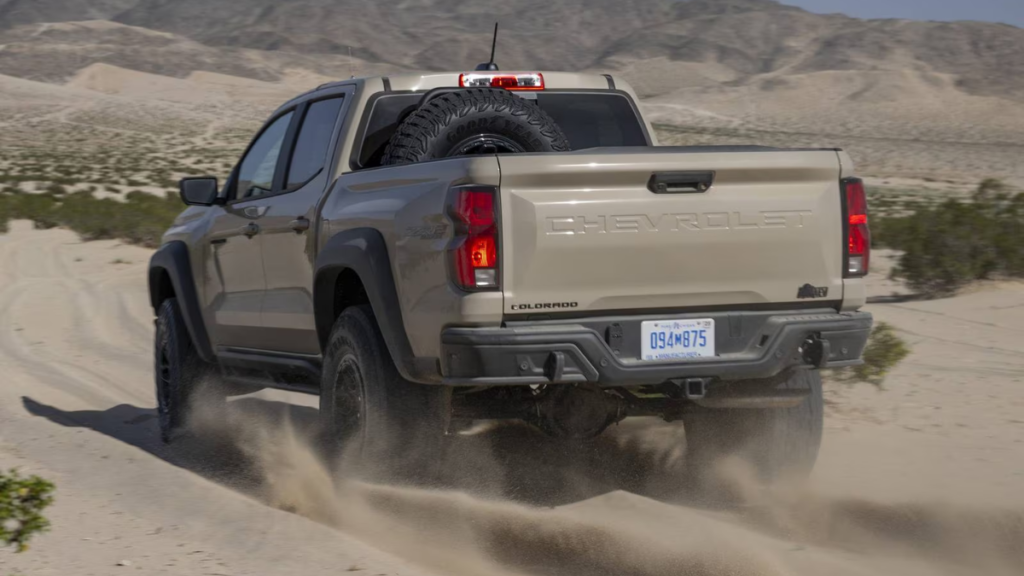
Final Verdict
The 2024 Chevrolet Colorado is worth buying for the right kind of shopper: someone who wants strong towing numbers, a genuinely good infotainment system, and either a comfortable daily-driver truck or a serious off-road machine, without much interest in what falls in between. It is not a dramatic leap over the 2023 model, and it shouldn’t be judged as one. What Chevrolet delivered in year two was a smarter, less confusing version of the same truck, plus one legitimately significant new product in the ZR2 Bison.
In our editorial view, the smartest buy for most shoppers is an LT with the TurboMax engine added, which delivers nearly all the capability most owners will ever need without paying for hardware they won’t use. Buyers who prioritize payload and value above all else should look to a base WT. Buyers who want genuine off-road engineering without the Bison’s price tag should look to the ZR2. And buyers set on maximum off-road capability, willing to pay for it, should look to the ZR2 Bison. None of these is a universal answer, but the 2024 Colorado gives you a clearer, better-organized path to whichever one fits than the 2023 model did.
FAQ
Is the 2024 Chevrolet Colorado reliable?
Long-term reliability data for this generation is still limited because it debuted for 2023. Chevrolet covers the 2024 Colorado with a 3-year/36,000-mile basic warranty and a 5-year/60,000-mile powertrain warranty, so buyers should avoid making strong reliability assumptions until more ownership data is available.
What engine does the 2024 Colorado have, and how much can it tow?
Every 2024 Colorado uses a 2.7-liter turbocharged four-cylinder. The base version makes 237 hp and 260 lb-ft, while TurboMax produces 310 hp and 430 lb-ft. Properly equipped TurboMax models can tow up to 7,700 pounds, while the ZR2 is rated for 6,000 pounds and the ZR2 Bison for 5,500 pounds.
Which 2024 Colorado trim is best?
For most buyers, the LT with the available TurboMax engine offers the best balance of price, comfort, payload, and towing capability. The WT makes more sense for buyers focused on value and payload, while the ZR2 is the better choice for serious off-road use. The ZR2 Bison is aimed at enthusiasts who need its additional off-road hardware.
What makes the Colorado ZR2 Bison different?
The ZR2 Bison is more than a styling package. Developed with American Expedition Vehicles, it adds 35-inch mud-terrain tires, AEV bumpers, boron-steel skid plates, beadlock-capable wheels, and Multimatic dampers with jounce control. Its 12.2 inches of ground clearance make it one of the most serious off-road trucks in the midsize segment, but it costs around $60,540 and sacrifices some payload and towing capacity.
Is the 2024 Chevrolet Colorado Good for Daily Driving and Off-Roading?
Yes, but the right trim matters. WT and LT models are better suited to everyday driving, commuting, and light-duty work, while the ZR2 and ZR2 Bison are built for serious trail use. The tradeoff is that the more capable off-road trims bring more tire and road noise, lower fuel economy, and less payload. Wireless Apple CarPlay, Android Auto, and the 11.3-inch Google built-in touchscreen are standard across the lineup.