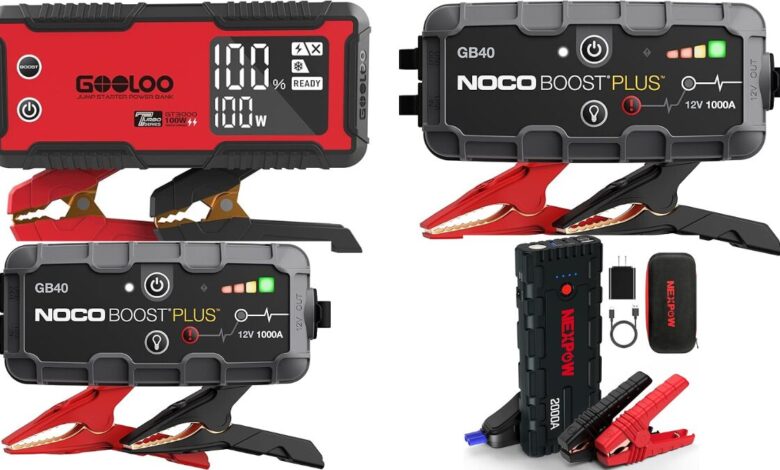
Car Jump Starters: From the invention of the electric self-starter to the close of the twentieth century, portable car jump starters were far from practical. They were massive, lead-acid battery packs used mainly by mechanics and tow-truck operators. Ordinary drivers had to rely on jumper cables which meant needing another vehicle and a bit of electrical know-how to avoid a dangerous short circuit. If your battery died while you were alone, your only options were to call for help or wave down a passing car to get moving again.
There are plenty of reasons a car battery might run out of juice. Even with perfect care, it’s a wear-and-tear component that usually lasts five to seven years, depending on climate and driving habits. Modern vehicles aren’t immune either: charging systems can malfunction, or slow electrical drains can quietly sap power while driving. And, of course, everyone at some point forgets the headlights or cabin light on, or leaves a gadget plugged into a 12-volt outlet that never switches off.
Thankfully, things have changed. Today’s best portable jump starters are compact, powerful, and reliable. You can charge one up, toss it in the trunk, and forget about it for half a year or more just remember to top it off occasionally, especially if you live somewhere extremely hot or cold. Nearly all models now include USB ports, and in our AutoGuide Garage, we often use one as a giant power bank to keep phones and devices charged. In short, it’s no longer just an emergency tool it’s a smart piece of gear every driver should carry.
Why You Can Trust Cardrav’s Product Reviews
At Cardrav.com, we don’t just test-drive the latest cars, trucks, and SUVs, we also take a deep dive into everyday automotive products such as tires, waxes, wiper blades, and pressure washers.
Before we recommend any product as a top pick, our editorial team runs it through a complete series of real-world tests. We explore every feature, verify the manufacturer’s claims, and share honest feedback based on genuine experience.
With years of expertise covering everything from practical family minivans to high-performance sports cars, and from portable jump starters to advanced ceramic coatings, our goal is simple: to help you choose products that truly perform, add value, and make every drive smoother and more enjoyable.
NOCO Boost Plus GB40
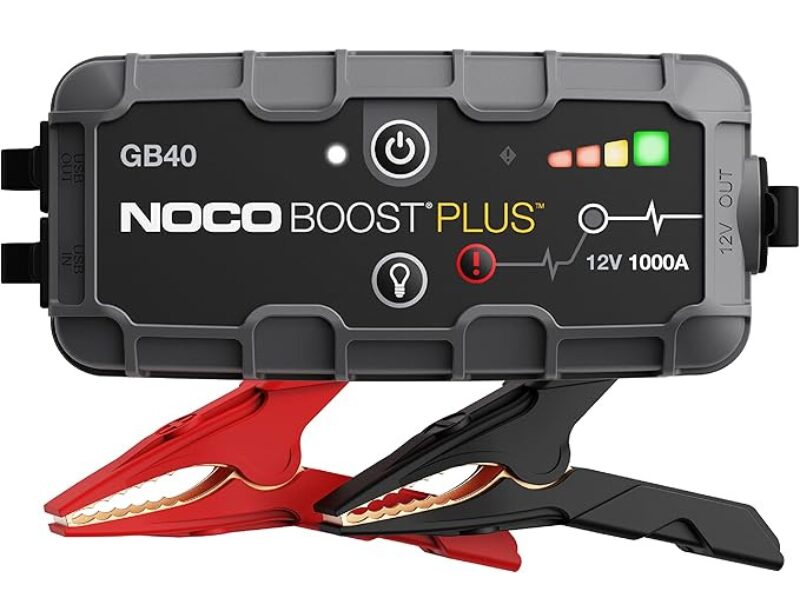
After using approximately a dozen jump starters in the AutoGuide Garage, we think the NOCO Boost Plus GB40 is the best jump starter for most people. It’s priced about the same as competing models, but is smaller and better constructed than any other jump starter of the size that we tested. The clamps, in particular, are great, even better than the GooLoo’s—weak clamps that don’t open wide enough can make it impossible to clamp onto a hard-to-reach battery terminal. They also use the same universal connector common across other NOCO products, so you could mix and match if you needed to, although using longer cables would result in a drop in amperage.
What Makes the NOCO Boost Plus Stand Out
We found other little details that make the NOCO easier to use than other jump starters. We loved that the unit turns on with a single short press to the power button, as does the flashlight, which cycles through multiple on and emergency flashing cycles. Other units we tested required an assortment of long and confusing sequences of presses, which might protect against turning them on accidentally, but is a hassle when you actually need to use it. Like every other lithium jump starter we’ve tested, it has reverse polarity detection, alerting you if you connect the clamps to the wrong battery terminals.
NOCO Boost Plus Specifications and Uses
NOCO says this 1,000A jump starter will give you 20 attempts, but they won’t be all at once, and that’s under ideal circumstances. The company also claims it’ll turn over gasoline engines up to six liters and diesel engines up to three liters, but we’d also say that’s optimistic. If you have a high-compression engine, or something larger than a 3.5-liter V6, we’d recommend going at least to the next 1,500 amp size up, if not the 2,000 amp model. The GB40 is IP65 water resistant, weighs just under 1.5 pounds, and is about seven inches long, three wide, and an inch-and-a-half thick.
While it is our top recommendation, there are a couple things we’d like to see improved. We really wish the NOCO Boost Plus GB40 used USB-C in/out, rather than 2.1 amp Micro-USB charging and a 2.1 and USB-A output, but it does come with a car 12V adaptor and USB cable, in case you threw yours away three years ago. Those really aren’t big drawbacks, and the size, price, convenience, and otherwise great design should put it in every car.
- Pros
- Best clamps in the business, comes with 12V adaptor and charging cable, extremely compact
- Cons
- Only 1,000A, USB-mini charging, no USB-C port.
——————————————————————————————————————–
NOCO Boost X GBX45
The NOCO Boost X GBX45 1250A 12V Portable Jump Starter is one of the most capable and dependable tools you can keep in your vehicle. Compact in size yet engineered for serious performance, it’s designed to bring dead batteries back to life with efficiency and power.
It stores easily in the trunk or glove box, always ready for use whenever needed. Delivering a peak current of 1250 amps, the GBX45 can handle everything from small cars to large vehicles, including 6.5-liter gasoline and 4.0-liter diesel engines. Its advanced safety system protects against overheating, overcharging, and reverse polarity, ensuring maximum protection for both your vehicle’s electrical system and the device itself.
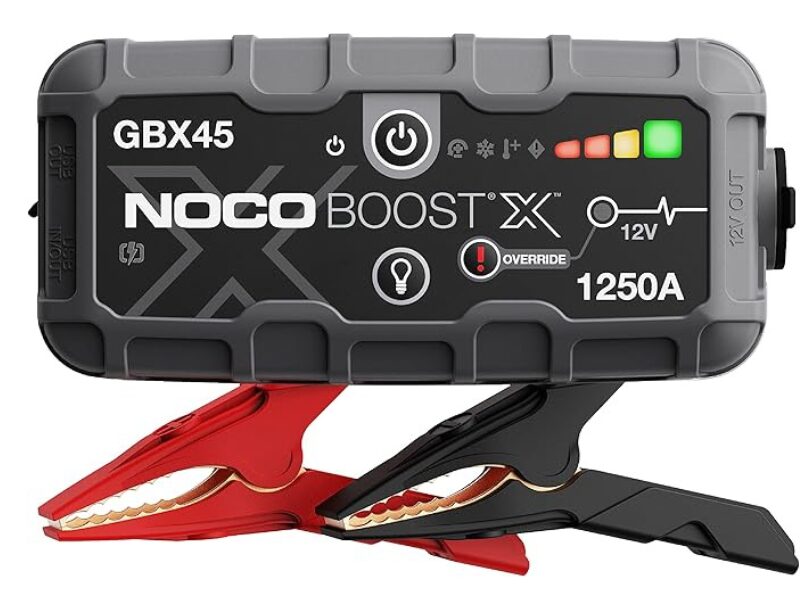
NOCO has upgraded this model with faster charging technology, capable of reaching a full charge in just forty-eight minutes, or providing enough power for a jump start in only five minutes. Additional features include a bright LED flashlight with multiple modes and a USB charging port that can power smartphones, tablets, or other electronic accessories. The heavy-duty clamps are rubber-coated for superior grip, color-coded for easy identification, and built to withstand repeated use in harsh environments.
Having the NOCO Boost X GBX45 in your car means you’re always prepared for unexpected emergencies. Whether it’s a dead battery on a cold morning, a night breakdown far from home, or simply a need to charge your devices on the road, this tool delivers peace of mind. Versatile, durable, and incredibly efficient, the GBX45 stands out as an essential addition to any modern driver’s emergency kit, offering both reliability and confidence wherever the road takes you.
——————————————————————————————————————–
Best NOCO Alternative: GooLoo GT3000
After testing several jump starters in the Cardrav Garage, the GooLoo GT3000 has proven to be our go-to choice whenever a dead battery strikes, which, unfortunately, happens more often than we would like. Measuring 9.06 by 3.94 by 2.12 inches and weighing just over four pounds, it is larger and heavier than most competitors, yet it compensates with impressive power. Delivering up to 3,000 peak amps and 600 starting amps, supported by an 84.36Wh battery, the GooLoo packs serious strength for its size.
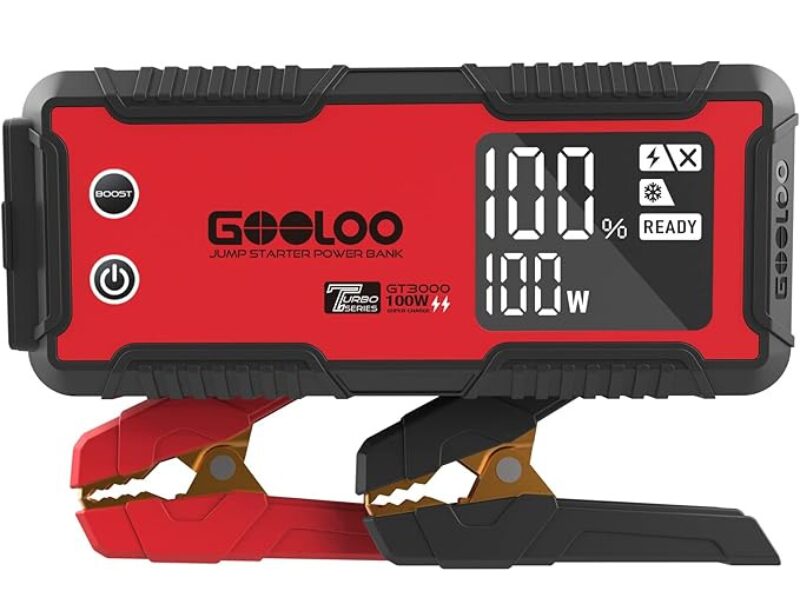
The battery clamps on the GT3000 are excellent and comparable to those found on NOCO devices. They are larger, open wider, and provide a stronger grip than many alternatives. During our tests, we noticed that several brands use identical small clamps that can be interchanged, but they often struggle to hold onto tightly positioned terminals. This detail may seem minor, but when you have jump-started as many engines as we have, you quickly realize that sturdy clamps make all the difference between an easy restart and a frustrating struggle.
We also appreciated the convenience of its multiple charging ports, including both USB and USB-C options, safely protected by a durable rubber cover. However, the flashlight feature left us slightly disappointed, as turning it off requires a long twelve-second press of the power button, which feels unnecessary. Another drawback is the small cloth carrying bag, which barely fits the device and often leaves the clamps protruding awkwardly.
Despite these minor inconveniences, the GooLoo GT3000 remains one of the most reliable and powerful jump starters we’ve used. Its robust build quality, high output capacity, and excellent clamps make it a trustworthy companion for long drives and emergency kits alike.
- Pros
- Excellent clamp design, 3,000 amp peak power, multiple USB ports including USB-C
- Cons
- Flashlight requires long press to deactivate, bulkier than competitors, carrying bag too small
——————————————————————————————————————–
NEXPOW G17 2000A Battery Starter
During our extensive testing of portable lithium-ion jump starters in the Cardrav Garage, we discovered that most units share a similar design and functionality. With a few exceptions, like the great clamps and awkward flashlight on the GooLoo, there isn’t much that sets them apart. The NEXPOW G17 2000A is a straightforward, minimalist device focused on essentials, including a few indicator lights, multiple USB ports, and a basic flashlight.

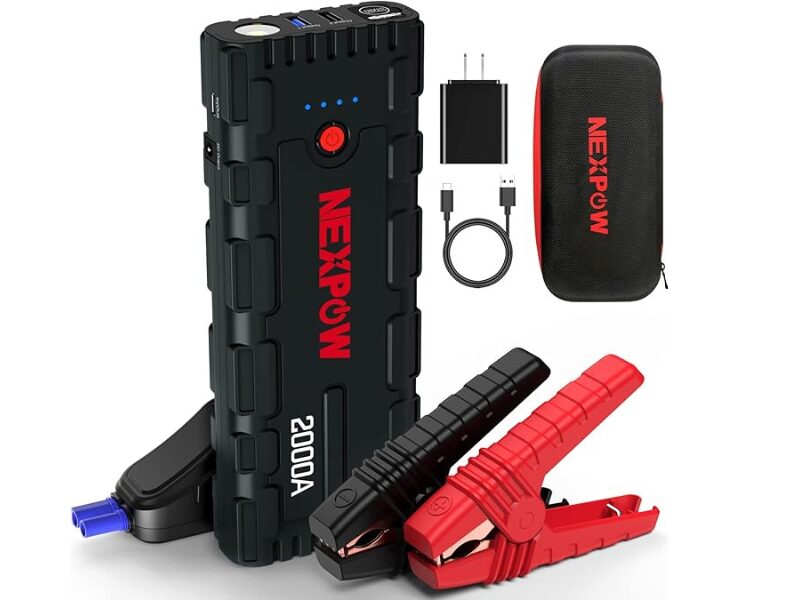
Fortunately, all of these core functions work well. However, the G17 uses the same interchangeable clamps and short cables found on budget brands such as Imazing, which suggests that many of these devices are produced by the same factories and rebranded for different sellers. The NEXPOW claims a 2,000 amp peak output, capable of starting engines up to 7.5 liters for gasoline and 6.5 liters for diesel. In real-world use, those numbers are a bit optimistic. In our testing, it successfully started a 3.0 liter gasoline engine with a weak battery, which is reasonable performance for its class.
The unit is powered by an 18,000 mAh battery that doubles as a portable power bank, supporting USB Type C input and output along with Quick Charge 3.0 technology. Charging through USB C is quick and convenient, and the claimed shelf life of up to two years adds to its practicality. The G17 also operates within a wide temperature range, from minus 4°F (minus 20°C) to 140°F (60°C), although its efficiency drops notably below 15°F. On the plus side, it is impressively lightweight and compact, measuring just 9 by 3.4 by 1.2 inches, though the included zippered case takes up more storage space than expected.
Despite its budget-friendly nature, the NEXPOW G17 stands out for delivering solid performance at a very competitive price. It is ideal for drivers who want a simple, compact jump starter without paying for unnecessary extras.
- Pros
- Very affordable, high power capacity in a compact size, USB Type C input and output, includes LED flashlight
- Cons
- Poorly written instructions, short cables, and low-quality clamps typical of budget models
——————————————————————————————————————–
Jump Starters vs. Jumper Cables
Portable jump starters have changed how we deal with dead batteries. They are safer, easier to use, and far more convenient than traditional jumper cables. With jumper cables, you always need another vehicle and a bit of luck. With a portable jump starter, you simply attach the clamps to your battery terminals, turn the unit on, wait a few seconds, and start the engine. Most models include built-in overheat protection, which pauses operation if the unit gets too warm, yet they usually hold enough power for multiple starts on a single charge. In addition, reverse polarity protection ensures nothing bad happens even if you accidentally connect the cables incorrectly.
Lithium Ion vs. Traditional Jump Starters
If you drive a large V8, a diesel truck, or operate heavy-duty equipment, you need more than a compact lithium jump starter. Modern lithium-ion models are lightweight and efficient, but they have their limits. Their power drops sharply in freezing temperatures, and they can only provide a few attempts before cooling down. Traditional lead-acid booster packs, on the other hand, are bulkier but far more resilient. They can crank repeatedly, maintain a strong output even in extreme cold, and come with long, heavy-duty cables that deliver consistent current. For drivers who live in areas with harsh winters or who deal with large engines, these old-style boosters remain the dependable choice.
How Many Amps Do You Need to Jump Start Your Car?
Choosing the right jump starter depends on understanding its power rating. These devices are usually measured in cold cranking amps (CCA) or peak amps (PA). CCA refers to the number of amps a fully charged battery can deliver for thirty seconds at zero degrees Fahrenheit. The higher the number, the stronger the unit.
Still, more power is not always better. Compact cars and small sedans often need as little as 150 CCA, while large trucks and SUVs may require around 450 CCA. Bigger engines and older vehicles usually need more current to turn over, as do high-compression diesel engines. This is why many heavy-duty jump starters are marketed as capable of starting engines up to eight liters in size. In most cases, a rating between 400 and 500 CCA is enough for the majority of vehicles. Keep in mind that colder temperatures always demand more power, since batteries lose efficiency in low heat.
Older carbureted vehicles, which are rare today, typically need longer cranking time and more amperage to generate a strong spark. But since carbureted cars disappeared from the market decades ago, that concern no longer applies to most drivers.
Lastly, it is worth considering that you might not only jump your own car but also help others. Most of the top-rated portable jump starters today can handle nearly any modern passenger vehicle, but choosing a slightly more powerful unit gives you extra flexibility, faster recovery, and peace of mind wherever you travel.
What Are the Different Types of Batteries?
Portable jump starters generally use one of two types of batteries: lithium-ion (Li-ion) or lead-acid. Each type offers unique advantages and drawbacks that affect performance, durability, and maintenance.
Lithium-ion batteries, the same kind found in smartphones and laptops, are highly energy-dense, meaning they can store a large amount of power in a small, lightweight package. They charge faster than lead-acid batteries and are ideal for compact, portable jump starters. However, they are more sensitive to extreme temperatures, particularly cold weather, which can significantly reduce their efficiency. Another quirk of lithium-ion technology is that these batteries last longest when maintained between roughly 25 and 85 percent charge. That is great for longevity but impractical for a jump starter, which you want fully charged at all times. They also prefer slow charging and discharging cycles, which again is not ideal for sudden high-power demands. The trade-off, however, is a much smaller, lighter, and easier-to-carry battery pack.
Lead-acid batteries, on the other hand, are the classic workhorses of automotive power. Similar to traditional car batteries, they are dependable, durable, and built to handle repeated use. They are much heavier because they contain lead plates, but they are also more stable and reliable in cold or harsh environments. Lead-acid batteries perform best when kept fully charged and should be topped up every month or after each use. To extend their lifespan, you can “train” or condition them by discharging them to about half capacity and recharging them again. After twenty to fifty cycles of this process, a lead-acid battery can actually increase its total capacity. You can even perform this process by powering small devices through the built-in USB or DC ports, which provides the perfect slow discharge rate for proper conditioning.
Ultimately, the choice comes down to your priorities. Lithium-ion jump starters are lightweight, fast to recharge, and convenient to store, but they may have a shorter lifespan. Lead-acid jump starters are heavier and bulkier, but they offer consistent performance, better cold-weather reliability, and exceptional longevity. Selecting between them depends on whether you value portability or long-term endurance more.
How to Use a Portable Jump Starter to Restart Your Car
Every driver eventually faces the silence of a dead battery, and few things feel more inconvenient. But with a portable jump starter in your glove box, that problem becomes nothing more than a quick pit stop instead of a crisis. Knowing how to use one is a simple life skill that saves time, money, and embarrassment. You will not need a tow truck, a second vehicle, or even a stranger’s help on a cold morning just your own preparation.
Modern portable jump starters are compact, easy to store, and incredibly powerful. They connect directly to your battery terminals, and within seconds, you can be back on the road. Keeping one charged and ready means you can also lend a hand to another driver when they are stranded.
If you do not own a jump starter, you can still revive a car the traditional way with jumper cables and another vehicle. However, that method requires patience, caution, and cooperation from someone else. A portable unit gives you independence and safety without the extra hassle. So, bookmark this guide and keep it handy you might need it sooner than you think.
How to Tell if Your Battery Is Really Dead
Before you grab the jump starter, make sure the battery is actually the issue. When you turn the ignition, listen closely. If the engine cranks or tries to start, the problem is likely somewhere else, not the battery. But if the car stays completely silent or you only hear a rapid clicking noise, the battery is most likely dead or too weak to power the starter.
A dead battery can happen for many reasons leaving the lights on overnight, an aging charging system, or simply the natural wear of time. Whatever the cause, identifying it quickly and safely using a portable jump starter can turn an emergency into a small inconvenience, and that is exactly the kind of control every driver deserves.
Final Thoughts
Modern portable jump starters have evolved far beyond the bulky, lead-acid battery boxes that once filled the trunks of roadside assistance trucks. Today’s devices are compact, efficient, and smart. They fit in the palm of your hand, yet deliver enough power to start engines that decades ago would have required professional help. They can revive your vehicle, charge your phone, and even light up your surroundings during an emergency. That versatility is what makes them one of the most valuable tools any driver can own.
Choosing the right model depends on your vehicle and your lifestyle. If you drive a small commuter car in mild weather, a compact lithium-ion unit like the NEXPOW G17 might be all you need. It is light, affordable, and quick to charge. But if you own a heavy-duty pickup, an SUV, or live in a region with freezing winters, a higher-capacity model such as the NOCO Boost X GBX45 or GooLoo GT3000 offers the extra security that can make all the difference. The key is to match your jump starter’s power output to your engine’s demands, ensuring that it can handle the job no matter the conditions.
However, even the best jump starter is only as good as its readiness. These devices require minimal maintenance, yet neglecting to recharge them for months can render them useless in a real emergency. Setting a reminder to top up your jump starter every few months ensures it will always be ready when you need it most. And while features like USB ports, flashlights, and fast charging are great bonuses, the most important thing is reliability. You need a unit that works every single time, even after sitting in your trunk through heat, cold, or rain.
Beyond practicality, there is something empowering about being able to fix a problem on your own. You are not waiting for help, not stranded on the side of a busy road, and not dependent on a stranger’s kindness. A good jump starter restores a sense of control that every driver should have. It is a small device that prevents big inconveniences.
So whether you are an experienced motorist, a new driver, or simply someone who values preparedness, a quality jump starter deserves a permanent place in your car. Think of it the way you think of your spare tire or first-aid kit, an essential tool that quietly waits for the day it becomes indispensable. As vehicles continue to evolve, self-sufficiency on the road remains one of the most important parts of safe driving. A reliable jump starter ensures that no matter where you are, your journey never truly stops.